
Nearshore outsourced bookkeeping is quietly replacing the two most common mistakes small business owners make with their finances: doing it themselves at midnight, or handing it to the cheapest offshore option and waiting three days for a reconciliation update. In 2026, you have a better path. Latin America–based virtual bookkeepers work your time zone, speak fluent English, and cost a fraction of a US hire — without the communication lag that kills offshore arrangements.
This guide breaks down how outsourced bookkeeping actually works for small businesses, what it costs, and how to choose the model that fits your operation. Whether you're running a five-person retail shop or a 50-unit real estate portfolio, the numbers here will help you make a smarter call.
What Is Outsourced Bookkeeping — and What Does It Actually Cover?
Outsourced bookkeeping means hiring an external person or firm to handle your day-to-day financial record-keeping instead of doing it in-house. A bookkeeper tracks income and expenses, reconciles bank and credit card accounts, manages accounts payable and receivable, generates monthly reports, and keeps your books clean for your CPA at tax time. They are not a CPA themselves — they prepare the records a CPA then interprets.
The term "virtual bookkeeper" refers to that same role delivered remotely, typically through cloud accounting software like QuickBooks Online, Xero, or FreshBooks. The bookkeeper logs in to your shared file, does the work, and communicates with you over Slack, email, or video — just like an employee sitting in your office would, minus the desk.
If you want a deeper look at how the online-only delivery model works in practice, our post on online bookkeeping services for small business walks through the software stack and daily workflow in detail.
How Much Do Outsourced Bookkeeping Services Cost in 2026?
Pricing varies dramatically based on who you hire, where they're based, and how many transactions you process each month. Here's a realistic breakdown of what the market looks like right now.
The $500 tier usually gets you a part-time offshore bookkeeper or an automated platform with minimal human review. That works fine if your books are simple. The moment you have payroll, inventory, multiple revenue streams, or project-based billing, you need a real human with judgment — and the automation platforms charge steeply for add-ons.
US-based bookkeeping firms charge $50–$100/hour on average, according to Bureau of Labor Statistics (BLS) occupational data (2024). At 40 hours/month (the minimum for a moderately active small business), that's $2,000–$4,000 per month before any CPA oversight fees.
For a full breakdown of what drives pricing up or down — including transaction volume tiers and what's negotiable — see our dedicated post on how much outsourced bookkeeping actually costs for a small business.

Nearshore vs. Offshore vs. Onshore: Which Model Wins for 2026?
This is the decision most small business owners get wrong. They compare sticker prices and miss the real cost: the time they personally spend managing delays, re-explaining context, and fixing errors that slipped through because their bookkeeper was 10 time zones away and couldn't ask a quick clarifying question.
"The biggest hidden cost in offshore outsourcing isn't the hourly rate — it's the decision latency. When your bookkeeper is asleep when you're working, every question takes 24 hours to answer. That compounds." — Nathan Hirsch, Founder of FreeeUp (acquired) and EcomBalance (2023)
| Factor | Onshore (US-based) | Nearshore (Latin America) | Offshore (Philippines/India) |
|---|---|---|---|
| Monthly cost (full-time) | $4,000–$8,000+ | $2,500 flat (Rose) | $800–$1,500 |
| Timezone overlap with US | Full overlap | Full overlap (same hours) | 0–4 hrs overlap (often none) |
| English proficiency | Native | Fluent (8/10+ screen) | Variable (4–8/10) |
| Cultural alignment with US | High | High | Moderate |
| Software training (QuickBooks, Xero) | Variable | Included AI copilot | Variable, no copilot |
| Turnaround on questions | Same day | Same day (real-time) | Next day (batched) |
| Replacement if not a fit | You rehire yourself | Free replacement (Rose) | Platform-dependent |
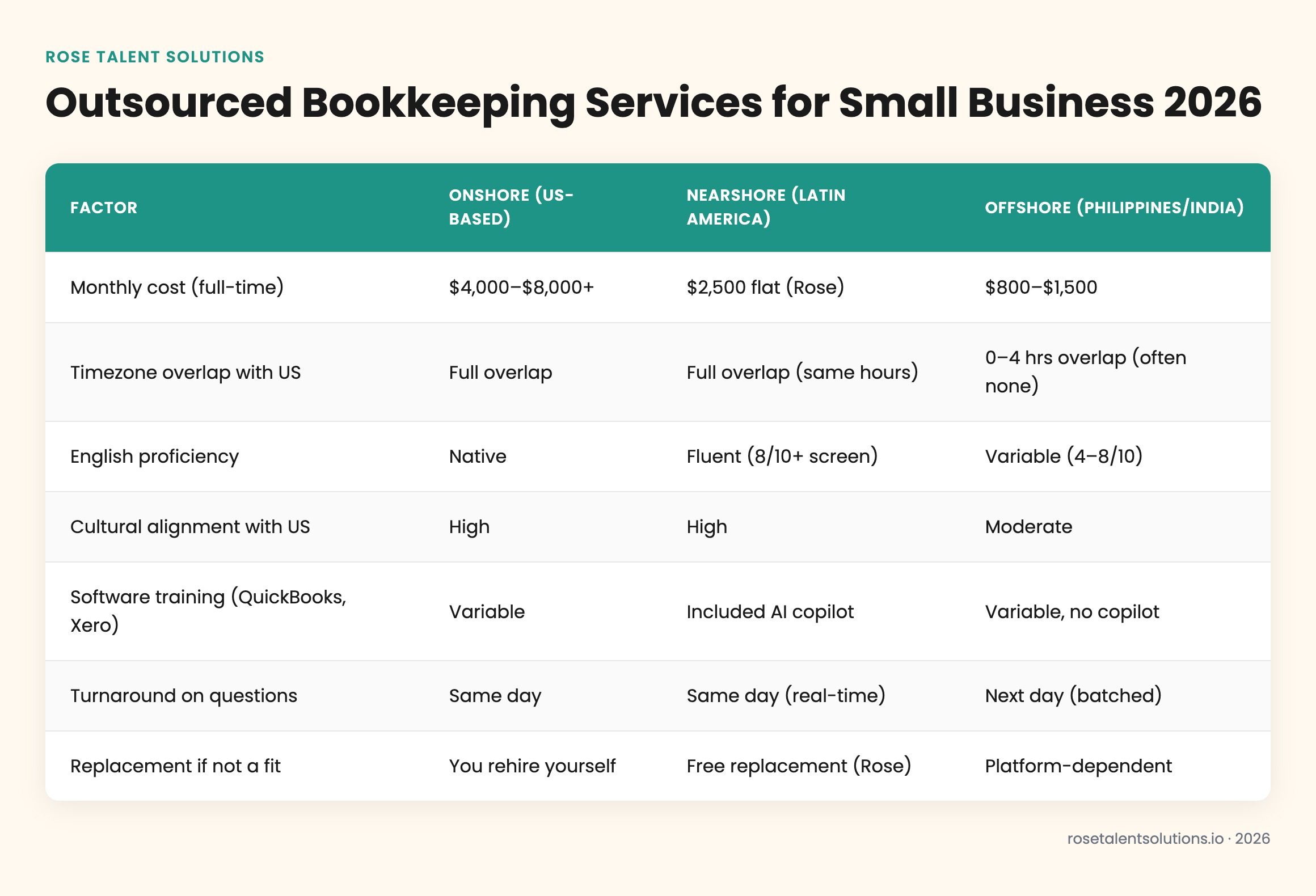
The nearshore model wins on the risk-adjusted math. You pay more than offshore, but you get real-time collaboration, cultural familiarity, and zero timezone debt accumulating in your week. Rose team members work US business hours — Eastern, Central, Mountain, Pacific — whichever your operation runs on.
How Rose's Nearshore Bookkeeping Model Works in 2026
Rose Talent Solutions places dedicated, full-time virtual bookkeepers based in Latin America with US small businesses. The model is simple: one flat monthly rate of $2,500 covers recruiting, vetting, payroll, HR, and ongoing management. You get a single person who shows up every day at your business hours, learns your chart of accounts, and owns your books.
Every bookkeeper Rose places ships with a role-specific AI copilot trained on their primary accounting software. If your bookkeeper works in QuickBooks Online, the copilot is tuned for QuickBooks workflows — bank feed rules, class tracking, recurring invoices, and month-end close checklists. If you use Xero, read our breakdown of what a Xero virtual bookkeeper handles day-to-day and how the AI layer accelerates their output.
The AI copilot isn't a chatbot your bookkeeper occasionally queries. It's a role-specific workflow assistant trained on the exact software your business runs — which means your bookkeeper ramps faster, makes fewer entry errors, and closes your books on a tighter schedule from week one.
There is no long-term contract. You pay month-to-month and cancel with 30 days written notice. If the team member isn't the right fit, Rose replaces them at no additional cost — that's the risk reversal built into the model. There are no setup fees and no per-task billing surprises at the end of the month.

What Tasks Can an Outsourced Bookkeeper Handle for Your Small Business?
Small business owners often underestimate how much a competent bookkeeper can own. The list below reflects what Rose-placed bookkeepers handle for clients across industries — retail, e-commerce, real estate, professional services, and healthcare practices.
- Bank and credit card reconciliation — monthly or weekly, depending on transaction volume
- Accounts payable — coding and scheduling vendor invoices for payment
- Accounts receivable — invoicing clients, tracking outstanding balances, sending payment reminders
- Payroll data entry — syncing payroll software outputs into your accounting file
- Expense categorization — applying correct chart-of-accounts codes so your P&L is accurate
- Month-end close — producing a clean P&L, balance sheet, and cash flow statement for your review
- 1099 prep support — tracking contractor payments throughout the year so January isn't a scramble
- Sales tax tracking — logging tax collected by state for your CPA or tax software to file
According to Intuit QuickBooks (2024), small business owners who maintain accurate monthly books are significantly more likely to secure financing and catch cash flow problems before they become crises. The bookkeeper doesn't just keep records — they give you real-time visibility into whether your business is actually profitable.
How to Get Started With Outsourced Bookkeeping in 5 Steps
The process is simpler than most owners expect. Here's how it works when you go through Rose — from inquiry to your bookkeeper's first day on the job.
Discovery call
You describe your business, your accounting software, your transaction volume, and any pain points. Rose scopes the role — bookkeeper, full-charge bookkeeper, or bookkeeper + AR/AP split.
Candidate matching
Rose surfaces 2–3 pre-vetted candidates from its Latin America talent pool. All have cleared English proficiency screens (8/10+ minimum), software assessments, and background checks.
You interview and select
You meet the candidates on video, ask your questions, and choose the person you want. No pressure to accept anyone you're not confident in.
Onboarding and software access
Rose handles HR setup, payroll, and compliance. You grant software access and walk your new bookkeeper through your chart of accounts — typically a 1-hour kickoff call.
Day one, live and working
Your bookkeeper logs in during your business hours, picks up the open items, and starts closing your backlog. The AI copilot is already loaded for your specific software environment.
Ready to move forward? You can start the matching process here — the intake form takes about four minutes and tells the team everything they need to find the right candidate for your books.
Is a Nearshore Bookkeeper Right for Your Business? Honest Pros and Cons
Nearshore outsourcing through Rose is not the right answer for every business. Here's the honest breakdown so you can make a clear-eyed call.
Pros
- Same-timezone availability — ask a question at 10am, get an answer by 11am
- Full-time dedication — your bookkeeper isn't splitting time across 20 other clients
- All-in flat pricing — no hourly overages, no per-transaction fees
- AI copilot included — faster ramp, fewer errors, consistent close cadence
- Free replacement if not a fit — zero risk on the hiring decision
- No long-term contract — exit with 30 days written notice
Cons
- $2,500/month is above the cheapest offshore options — it's a value argument, not a price argument
- Not a CPA — your bookkeeper prepares your records; a CPA still files your taxes
- Full-time model isn't cost-effective if you have fewer than ~100 transactions/month
- You manage the relationship day-to-day — Rose handles HR, but you're still the operator
If your transaction volume is low enough that part-time makes more sense, explore the range of best virtual bookkeeping services for small business in 2026 — including part-time and platform-based options — to find the right tier before committing to full-time.
For businesses running 200+ transactions per month, managing multiple bank accounts, or carrying inventory and payroll, the full-time dedicated model pays for itself quickly. The hidden cost of inaccurate or delayed books — missed deductions, overdraft surprises, late vendor payments — routinely exceeds the monthly rate of a competent bookkeeper.
According to SHRM research on cost-per-hire (2024), the average cost to recruit and onboard a single full-time employee is over $4,700 — not counting salary. Outsourcing sidesteps that entire burden: recruiting, vetting, and replacement are all included in the Rose monthly rate.
You can also explore the full scope of what a dedicated bookkeeping and accounting VA can own inside your operation — from daily transaction coding to quarterly close support — before deciding which tasks to hand off first.
The best outsourcing decisions start narrow — pick one recurring pain point (bank reconciliation, AR follow-up, month-end close) and let your bookkeeper own it completely before expanding scope. That approach builds trust, surfaces any workflow gaps early, and gives you a clear benchmark for ROI within the first 60 days.
According to Gallup's research on workforce engagement (2023), workers who have clear ownership of defined tasks report higher output and lower error rates than those with ambiguous responsibilities. The same principle applies to your outsourced bookkeeper: a defined scope on day one produces better results than an open-ended "help with finances" brief.