
Why Nearshore Virtual Bookkeepers Are the Smartest Hire of 2026
Nearshore virtual bookkeeping has quietly become the default choice for small business owners who need real accounting support without the overhead of a full in-house team. Unlike generic offshore outsourcing — which routes work through overnight batches in the Philippines or India — nearshore bookkeepers are based in Latin America, work your time zone, and speak fluent English. That difference alone changes how fast your books actually close each month.
Small businesses are under more financial pressure than ever. According to the Federal Reserve's 2024 Report on the Economic Well-Being of US Households, 43% of small businesses say managing cash flow is their top operational challenge — and most of them don't have a dedicated bookkeeper on staff. That gap is exactly what the best virtual bookkeeping services are designed to close.
This guide cuts through the noise. By the end, you'll know exactly what to look for, what to avoid, and how to find a virtual bookkeeper who operates like a full-time team member — without the full-time payroll cost.
What Is a Nearshore Virtual Bookkeeper? (And Why the Definition Matters)
A nearshore virtual bookkeeper is a remote accounting professional based in a geographically proximate country — in this context, Latin America — who works directly for a US, Canadian, or UK business during that business's local hours. They handle day-to-day accounting tasks: transaction categorization, bank reconciliations, accounts payable, payroll support, and financial reporting. The key distinction from a domestic freelancer is cost efficiency; from an offshore hire, it's time-zone alignment and communication quality.
The nearshore model is not a staffing agency dropping a warm body in front of a spreadsheet. Done right — as Rose Talent Solutions structures it — a nearshore bookkeeper arrives pre-vetted, software-trained, and paired with a role-specific AI copilot trained on the exact platform your business runs: QuickBooks, Xero, FreshBooks, or whatever stack you use. That combination — human judgment plus AI-assisted workflow — is what separates the best virtual bookkeeping services from a commoditized gig-worker marketplace.
If you're evaluating whether Xero is the right fit for your virtual hire, this deeper guide on working with a Xero virtual bookkeeper walks through exactly what to look for in platform-specific expertise.
How the Best Virtual Bookkeeping Services Compare in 2026
Not all virtual bookkeeping services are structured the same way. Some sell you a per-hour freelancer from a talent marketplace. Others charge a monthly subscription for access to a shared team that rotates through your account. And then there's the dedicated nearshore model — one person, fully yours, working your hours, learning your business. The differences compound fast when something actually goes wrong with your books.
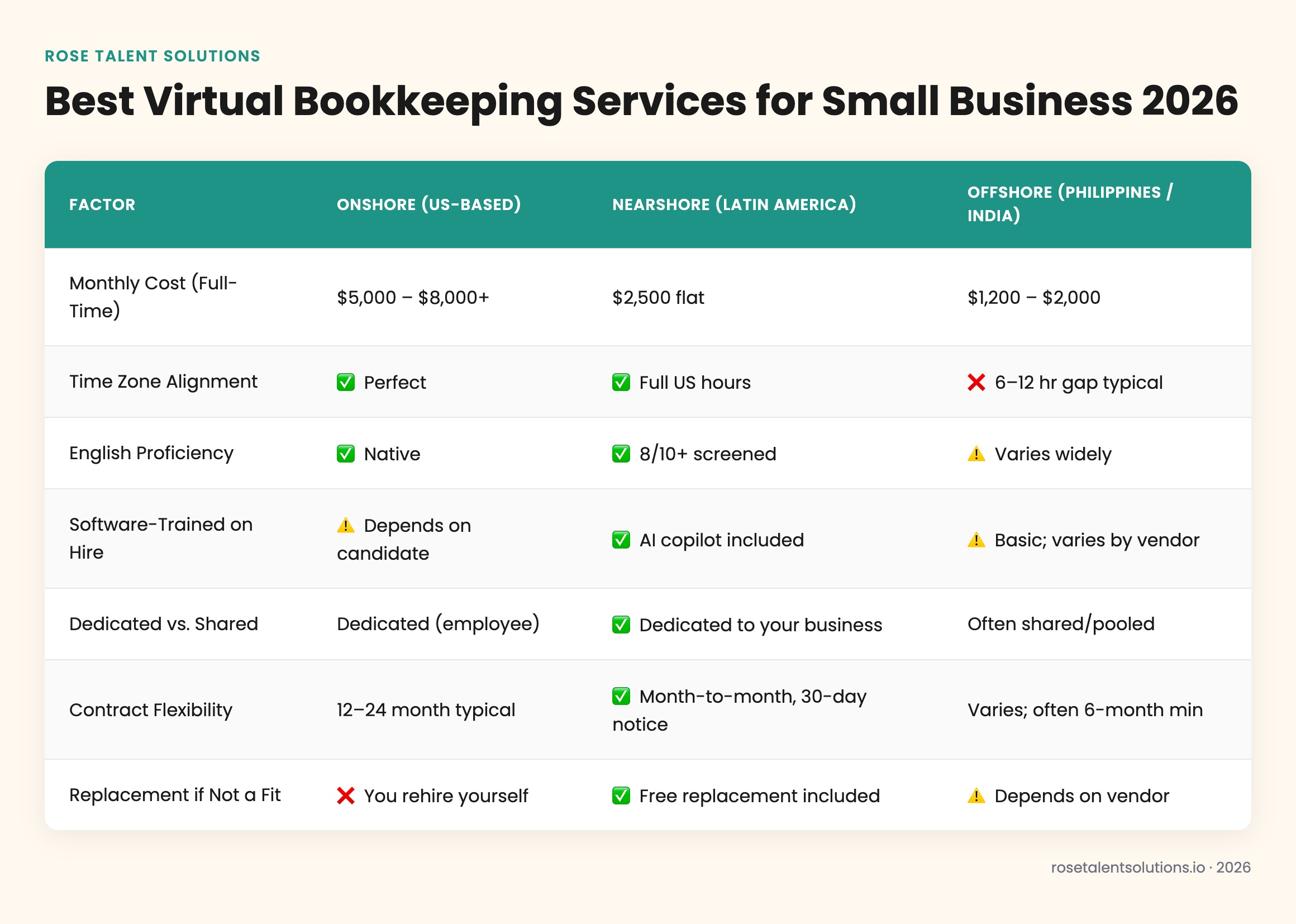
The table below compares the three main models head-to-head across the dimensions that actually matter for a small business owner.
| Factor | Onshore (US-Based) | Nearshore (Latin America) | Offshore (Philippines / India) |
|---|---|---|---|
| Monthly Cost (Full-Time) | $5,000 – $8,000+ | $2,500 flat | $1,200 – $2,000 |
| Time Zone Alignment | ✅ Perfect | ✅ Full US hours | ❌ 6–12 hr gap typical |
| English Proficiency | ✅ Native | ✅ 8/10+ screened | ⚠️ Varies widely |
| Software-Trained on Hire | ⚠️ Depends on candidate | ✅ AI copilot included | ⚠️ Basic; varies by vendor |
| Dedicated vs. Shared | Dedicated (employee) | ✅ Dedicated to your business | Often shared/pooled |
| Contract Flexibility | 12–24 month typical | ✅ Month-to-month, 30-day notice | Varies; often 6-month min |
| Replacement if Not a Fit | ❌ You rehire yourself | ✅ Free replacement included | ⚠️ Depends on vendor |
"The biggest mistake small business owners make when outsourcing bookkeeping is optimizing purely on hourly rate. Time-zone friction and communication gaps create rework that erases the savings within the first 90 days." — Joe Woodard, CEO at Woodard Events & Scaling New Heights (2024)
What Tasks Should a Virtual Bookkeeper Handle in 2026?
A well-scoped virtual bookkeeper is not a data-entry clerk. The best virtual bookkeeping services in 2026 place professionals who can own an entire accounting function — not just categorize transactions and wait for instructions. Here's the task stack a competent nearshore bookkeeper should be able to manage from day one:
- Daily transaction coding in QuickBooks Online, Xero, or FreshBooks
- Monthly bank and credit card reconciliations — flagging discrepancies proactively
- Accounts payable management — vendor invoice matching, approval workflows, and payment scheduling
- Accounts receivable follow-up — invoice generation, aging report monitoring, collections outreach
- Payroll data entry and reporting support coordinated with your payroll provider
- Monthly P&L and balance sheet preparation ready for your CPA or CFO review
- Expense report processing and employee reimbursement tracking
- 1099 prep support during tax season — gathering vendor W-9s, reconciling contractor payments
If accounts payable is a pain point specifically, this breakdown of the best accounts payable virtual assistant services goes deeper on vendor workflow automation and approval chain setup.
According to the U.S. Bureau of Labor Statistics (2024), the median annual salary for a US-based bookkeeping clerk is $47,440 — which translates to roughly $5,900/month when you factor in employer taxes and benefits. A full-time nearshore bookkeeper at $2,500/month all-in represents a 57% cost reduction with no sacrifice in output quality when the hire is properly vetted.
How Rose Talent Solutions Structures Nearshore Bookkeeping Support in 2026
Rose's bookkeeping and accounting virtual staffing service is built around one core promise: you get a dedicated team member, not a ticket queue. Every placement is full-time (40 hours/week), works your business hours, and is managed end-to-end — recruiting, vetting, payroll, HR, and ongoing performance management are all handled by Rose. You pay one flat rate of $2,500/month and focus on running your business.
The onboarding process is designed to get your bookkeeper productive within the first week, not the first quarter.
Discovery Call
Rose's team maps your accounting software, volume of transactions, and specific deliverables — P&L cadence, AP workflow, payroll support needs — before sourcing a single candidate.
Candidate Matching
Only candidates with verified software proficiency (QuickBooks, Xero, FreshBooks, etc.) and 8/10+ English scores are surfaced. You typically review 2–3 finalists, not a stack of 40 resumes.
AI Copilot Activation
Your bookkeeper ships with a role-specific AI copilot trained on your software stack — cutting ramp time dramatically and eliminating the "figuring it out" phase that kills momentum with most new hires.
Ongoing Management
Rose handles HR, payroll, and performance oversight. If the team member isn't the right fit for any reason, Rose replaces them at no additional cost — no re-sourcing fee, no gap in coverage.
For businesses that want to understand how this compares to other structured outsourcing options, this guide on the best nearshore bookkeeping services for US startups covers how the model scales as your transaction volume grows.
How to Evaluate Any Virtual Bookkeeping Service Before You Hire in 2026
The virtual bookkeeping market is crowded with vendors who all use the same language — "dedicated," "expert," "affordable." Here's how to cut through it with five questions that expose the reality of what you're actually buying.
Ask whether your bookkeeper is dedicated or shared. A shared bookkeeper is managing 8–15 clients simultaneously. Your month-end close competes with everyone else's deadline. A dedicated hire operates like an employee — your work is always the priority.
Ask how software proficiency is verified. A vendor saying their team "knows QuickBooks" is meaningless. What matters is whether they've run payroll runs, managed class tracking, and closed books in QBO specifically — not just entered receipts. According to Intuit's QuickBooks research (2024), businesses that use software-proficient bookkeepers close their monthly books an average of 4 days faster than those using generalist bookkeepers.
Ask about the replacement policy. Most marketplace-style services give you a credit or a discount if someone doesn't work out — but you do the rehiring yourself. The right answer is a free, no-hassle replacement handled entirely by the vendor, with no additional cost to you.
Ask about the contract terms. Month-to-month with 30 days written notice is the standard you should demand. Any vendor requiring a 6- or 12-month commitment upfront is protecting their revenue, not your flexibility.
Finally, ask where the team member is based and what their English proficiency floor is. Fluency isn't just about accent — it's about whether your bookkeeper can draft a professional email to a vendor, explain a discrepancy on a call with your CPA, or flag a cash flow concern clearly before it becomes a crisis. Rose's published bar of 8/10+ on English proficiency screens is a specific, measurable standard — not a marketing claim.
The hidden cost of an offshore bookkeeper isn't the rate — it's the 6–12 hour communication lag that means every question about a flagged transaction, a vendor dispute, or a reconciliation discrepancy adds a full business day of delay. Multiply that across a year and you've paid for the price difference in lost time alone.
According to a McKinsey Global Institute report (2024), businesses that pair human accounting staff with AI-assisted tools see a 30–40% improvement in task throughput on routine financial processes — which is precisely why Rose builds the AI copilot layer into every bookkeeping placement rather than treating it as an optional add-on.
Nearshore vs. Offshore Bookkeeping: The Real Pros and Cons in 2026
The price difference between nearshore and offshore bookkeeping is real — typically $500 to $1,000/month. Whether that gap is worth it depends on how much your time and peace of mind are worth. Here's the honest breakdown.
Nearshore Bookkeeping — Pros
- Works your exact business hours — no overnight batching of questions or deliverables
- English proficiency screened to a measurable standard (8/10+ at Rose)
- Cultural familiarity with US business norms, deadlines, and communication expectations
- AI copilot trained on your specific software stack from day one
- Month-to-month terms — no long-term contract required
- Free replacement if the fit isn't right — no re-sourcing cost to you
Offshore Bookkeeping — Cons
- 6–12 hour time zone gaps mean one-question delays become one-day delays
- English proficiency is inconsistent and rarely screened to a published standard
- Shared team models are common — your account isn't always the priority
- Software proficiency claims are harder to verify without a rigorous pre-screen
- Higher coordination overhead — more of your time managing the relationship
The Society for Human Resource Management (SHRM) (2024) consistently finds that real-time communication availability is among the top three factors driving employee and contractor performance in remote work arrangements — which is another way of saying: timezone alignment isn't a soft benefit, it's a productivity multiplier.
If you want a broader view of how full-cycle bookkeeping support is structured for growing businesses, this overview of bookkeeping and accounting support for small businesses covers how the service evolves as your team scales beyond one bookkeeper.
Ready to compare your current bookkeeping setup against what a dedicated nearshore hire could do? The fastest path to a placement starts with a 20-minute scoping call — Rose typically surfaces matched candidates within 7 days of that conversation.