
What Is Nearshore Accounting and Why Latin America?
Nearshore accounting means hiring full-time accounting staff based in Latin America — countries like Colombia, Mexico, Argentina, and Costa Rica — who work your US or Canadian business hours, communicate in fluent English, and operate under your direct supervision. It is not the same as offshore outsourcing to the Philippines or India, where an 8–12 hour time zone gap turns every question into an overnight ticket. With nearshore, your accountant is online when you are, responds in real time, and joins your Slack by 9 a.m. EST.
Latin America has quietly built one of the strongest accounting talent pipelines in the Western Hemisphere. According to the World Economic Forum's Future of Jobs Report (2023), Latin America is among the fastest-growing regions for finance and business-process talent, driven by university enrollment rates in accounting and economics that rival those of Western Europe. That supply has created a rare combination: university-educated, software-fluent accountants who cost a fraction of their US counterparts — and who work your hours.
What is a nearshore accounting VA? A nearshore accounting virtual assistant is a full-time remote employee based in Latin America who handles bookkeeping, accounts payable/receivable, reconciliations, payroll processing, financial reporting, or controller-level work — depending on their experience tier. They are hired, vetted, and managed by a staffing partner like Rose Talent Solutions, then dedicated exclusively to your business. Unlike a freelancer, they show up every day, 40 hours a week, and are accountable to you as their day-to-day supervisor.
If you want a deeper look at the full landscape of providers in this space, our breakdown of the top Latin America bookkeeping outsourcing companies walks through how the major players compare on vetting, pricing, and specialization.

How the 2026 Cost Math Actually Works for Outsourced Accounting
Let's run the numbers honestly. According to the U.S. Bureau of Labor Statistics (2024), the median annual wage for a US-based staff accountant is $79,880 — that's roughly $6,657 per month in base salary alone. Add employer payroll taxes (7.65% FICA), health insurance, paid time off, and recruiting costs, and you are realistically looking at $90,000–$105,000 per year fully loaded. That works out to $7,500–$8,750 per month before you account for software licenses or office overhead.
A full-time nearshore accounting specialist through Rose Talent Solutions runs $2,500 per month, flat. That rate includes recruiting, vetting, payroll administration, HR support, and ongoing management — not just the labor. You do not manage payroll in a foreign country. You do not navigate Latin American labor law. You get a dedicated accounting professional, ready to work, for one predictable monthly invoice.
The month-to-month arrangement matters too. Rose operates with no long-term contract — you can cancel with 30 days' written notice. For a growing business that is not sure exactly how much accounting bandwidth it will need six months from now, that flexibility alone is worth something. If the team member turns out not to be the right fit, Rose replaces them at no additional cost. That is the only risk reversal that matters: you are not locked in, and you are not starting over from scratch on your own dime.
For businesses specifically looking to bring on a dedicated remote bookkeeper rather than a full accounting generalist, our post on how to hire a remote bookkeeper in Latin America covers the vetting criteria and role scoping in more detail.
Nearshore vs. Offshore vs. Onshore Accounting in 2026: What the Data Shows
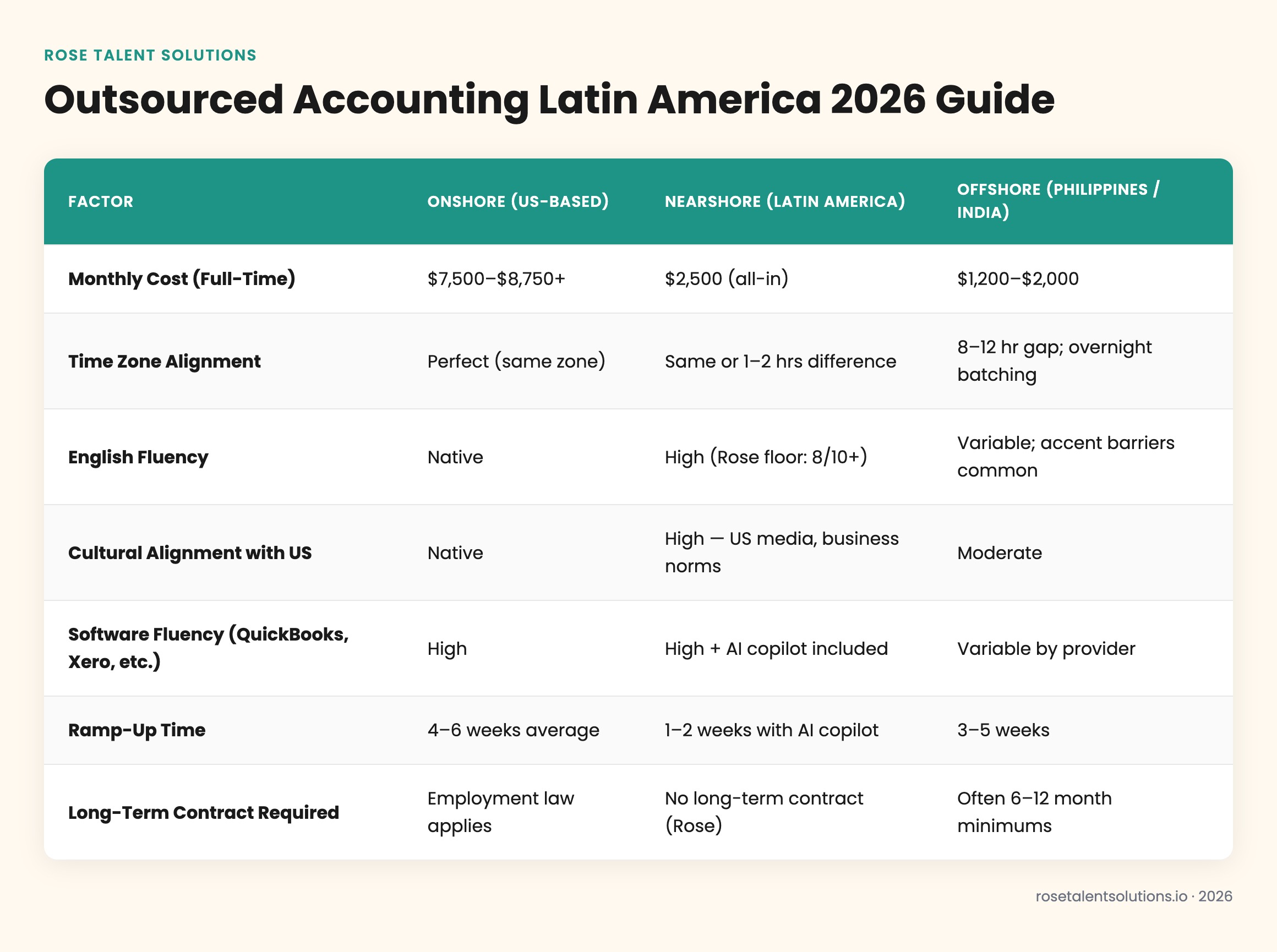
Not all outsourced accounting is the same. The table below compares the three main hiring models US businesses use in 2026. The differences in time zone alignment and English fluency alone explain why nearshore has grown faster than traditional offshore for finance roles specifically — accounting is a communication-heavy function where a 10-hour delay on a vendor dispute or a payroll discrepancy has real downstream consequences.
| Factor | Onshore (US-Based) | Nearshore (Latin America) | Offshore (Philippines / India) |
|---|---|---|---|
| Monthly Cost (Full-Time) | $7,500–$8,750+ | $2,500 (all-in) | $1,200–$2,000 |
| Time Zone Alignment | Perfect (same zone) | Same or 1–2 hrs difference | 8–12 hr gap; overnight batching |
| English Fluency | Native | High (Rose floor: 8/10+) | Variable; accent barriers common |
| Cultural Alignment with US | Native | High — US media, business norms | Moderate |
| Software Fluency (QuickBooks, Xero, etc.) | High | High + AI copilot included | Variable by provider |
| Ramp-Up Time | 4–6 weeks average | 1–2 weeks with AI copilot | 3–5 weeks |
| Long-Term Contract Required | Employment law applies | No long-term contract (Rose) | Often 6–12 month minimums |
"Nearshore models in Latin America have become the default choice for US SMBs that need real-time finance collaboration without the price tag of domestic hiring. The talent arbitrage is significant — and the time zone alignment means these teams actually integrate into daily operations rather than operating as an overnight batch queue." — Vinay Couto, Principal at PwC Finance Effectiveness Practice (2024)
What Tasks Can a Nearshore Accountant Actually Handle in 2026?
One of the most common misconceptions about outsourced accounting in Latin America is that you are getting data-entry support, not real accounting. That is outdated. The talent pool in Colombia, Argentina, Mexico, and Costa Rica includes CPAs, controllers, and CFO-level operators — not just bookkeepers. The role you hire depends on your business stage, not on a ceiling imposed by geography.
The accounting tasks most businesses outsource first — bank reconciliations, AP/AR, monthly closes, and payroll processing — are also the tasks that consume the most time from expensive US-based finance staff. Offloading them to a nearshore specialist frees your onshore controller or CFO to focus on strategy, not transaction processing.
Here is a non-exhaustive list of what Rose's nearshore accounting specialists handle for clients today:
- Daily and monthly bank reconciliations
- Accounts payable processing and vendor management
- Accounts receivable, invoicing, and collections follow-up
- Payroll processing (US payroll platforms)
- Month-end and year-end close support
- Financial statement preparation (P&L, balance sheet, cash flow)
- QuickBooks, Xero, NetSuite, and FreshBooks management
- Sales tax filing support and 1099 preparation
- Budget vs. actual variance reporting
- Property accounting for real estate operators (AppFolio, Buildium, Yardi)
Every Rose accounting team member ships with a role-specific AI copilot trained on the software they use — QuickBooks, Xero, or whichever platform you run. That means faster ramp-up and fewer errors on reconciliations, categorization, and report generation. You can read more about how that works on Rose's AI advantage page.
For teams running Xero specifically, our detailed guide on working with a Xero virtual bookkeeper covers platform-specific workflows, user permission setup, and what to delegate first.

Real estate businesses have a particularly strong use case here. Property management companies running AppFolio or Buildium need accounting staff who understand trust accounting, owner disbursements, CAM reconciliations, and security deposit ledgers — not just general bookkeeping. Rose's property management staffing practice places specialists trained specifically on these workflows. According to Buildium's State of the Property Management Industry Report (2024), 68% of property management companies cite administrative and accounting tasks as their single biggest operational bottleneck — making this one of the highest-ROI use cases for nearshore accounting support.
How Rose's 2026 Hiring Process Gets You an Accountant in Days, Not Months
The traditional hiring process for a US staff accountant takes 6–8 weeks from job post to start date, according to SHRM's Human Capital Benchmarking data (2023). Rose compresses that to roughly one week. Here is how the process works:
Intake Call (Day 1)
Rose's team scopes your accounting needs — software stack, volume, role level (bookkeeper vs. senior accountant), and preferred working hours. This call typically runs 30 minutes.
Candidate Matching (Days 2–4)
Rose surfaces 2–3 pre-vetted candidates from its Latin America talent network, each screened for English fluency (8/10+ floor), software proficiency, and accounting certifications. You review profiles and select who to interview.
Your Interview (Days 4–5)
You interview your top choice directly. Rose handles background screening and reference checks in parallel so there is no bottleneck after you decide.
Onboarding & AI Copilot Setup (Days 5–7)
Rose handles payroll enrollment, compliance, and equipment logistics. The AI copilot trained on your software stack is configured before Day 1 so your new accountant starts productive, not ramping.
You're Live
Your accountant is online at the start of your business day, working in your systems, reporting to you. Rose stays involved as the HR and management layer so you are never handling foreign payroll or compliance alone.
If you are ready to scope a role now, the fastest path is the Rose intake form — it takes about five minutes and triggers the matching process the same business day.
For businesses that want to go deeper on the LATAM accounting outsourcing market before committing — provider comparisons, pricing models, and what questions to ask during vetting — our post on LATAM outsourced accounting is the most thorough resource in this cluster.
Is Outsourced Accounting in Latin America Right for Your Business in 2026?
Nearshore accounting is not for every business at every stage. Here is an honest look at who benefits most — and where the model has real limits.
Best Fit
- US or Canadian SMBs with $1M–$50M in revenue needing full-time accounting support
- Companies running QuickBooks, Xero, NetSuite, or AppFolio/Buildium
- Businesses replacing a departing staff accountant without hiring at US rates
- Real estate operators, e-commerce companies, and professional services firms with high transaction volume
- Founders who want one flat invoice instead of payroll + benefits + recruiting overhead
Less Ideal
- Businesses needing a licensed CPA for audit sign-off (Latin America accountants can support, not sign)
- Companies with highly regulated industries requiring US-licensed CPAs by law (SEC registrants, etc.)
- Organizations that need accounting staff physically on-site
- Businesses with less than 20 hours/week of accounting work (a part-time contractor may be more efficient)
The honest answer is that if you are spending more than $4,000/month on accounting labor — whether that is a part-time US bookkeeper plus a fractional CFO, or a full-time staff accountant — nearshore is almost certainly cheaper and equally or more capable, especially with the AI copilot layer Rose includes. According to McKinsey's analysis of generative AI's economic potential (2023), finance and accounting functions are among the top three business areas where AI-augmented remote talent delivers the highest productivity lift — validating the direction the entire nearshore accounting industry is moving.
The Rose bookkeeping and accounting staffing page outlines the specific role tiers available — from junior bookkeepers handling AP/AR through senior accountants capable of running a full month-end close independently.