
Why Nearshore vs Offshore Is the Wrong Question — Until You See the Numbers
Nearshore property management staffing has quietly become the default for US operators who tried offshore, got burned by timezone lag, and decided they weren't going to lose another tenant over an unanswered maintenance call at 10am on a Tuesday. The difference between nearshore and offshore isn't philosophical — it shows up in response-time logs, owner retention rates, and your Yelp score. This article breaks down exactly where that gap lives across three variables that property managers say matter most: response time, English fluency, and all-in cost.
If you manage 50 or 500 units, the staffing math is the same. You need someone who picks up the leasing call before it goes to voicemail, reads a maintenance note without asking three clarifying questions, and updates AppFolio before your owner portal refreshes. A VA nine time zones away — with a 6am-2pm local shift to approximate your hours — does none of those things reliably. A nearshore coordinator in Medellín or Bogotá, on the other hand, is at their desk at 9am Eastern when you are.
That stat deserves a pause. Tenant churn is the single most expensive line item in property management — vacancy, turn costs, and re-leasing fees compound fast. If your VA's timezone is the root cause, the "savings" on an offshore rate disappear inside one vacant unit. According to Buildium's State of the Property Management Industry Report (2024), operators who cited communication delays as a staffing problem were also 2.3x more likely to report declining owner satisfaction scores year-over-year.
How Response Time Actually Breaks Down: Nearshore vs Offshore in 2026
Response time in property management isn't just a customer-service metric — it's a legal and contractual obligation in many states. Most lease agreements require a response to maintenance requests within 24-48 hours. If your VA is batching tickets overnight, you're already behind before the workday starts.
A nearshore VA in Latin America working 9am-6pm Eastern Standard Time has zero meaningful timezone offset from your US office. A phone call at 10:30am gets answered at 10:30am. An AppFolio work order submitted at 2pm gets triaged at 2pm. Compare that to a VA based in the Philippines or India, where a 9am EST task arrives at 10pm-12am their local time. Even with shifted schedules, the overlap window is narrow — typically 2-4 hours — and fatigue from overnight work degrades response quality.
According to the National Association of Realtors (NAR) (2024), tenant satisfaction scores drop measurably when maintenance response times exceed four hours during business hours. That window is nearly impossible to protect with a pure offshore team unless you're paying for two overlapping shifts — which blows up any cost advantage you thought you had.
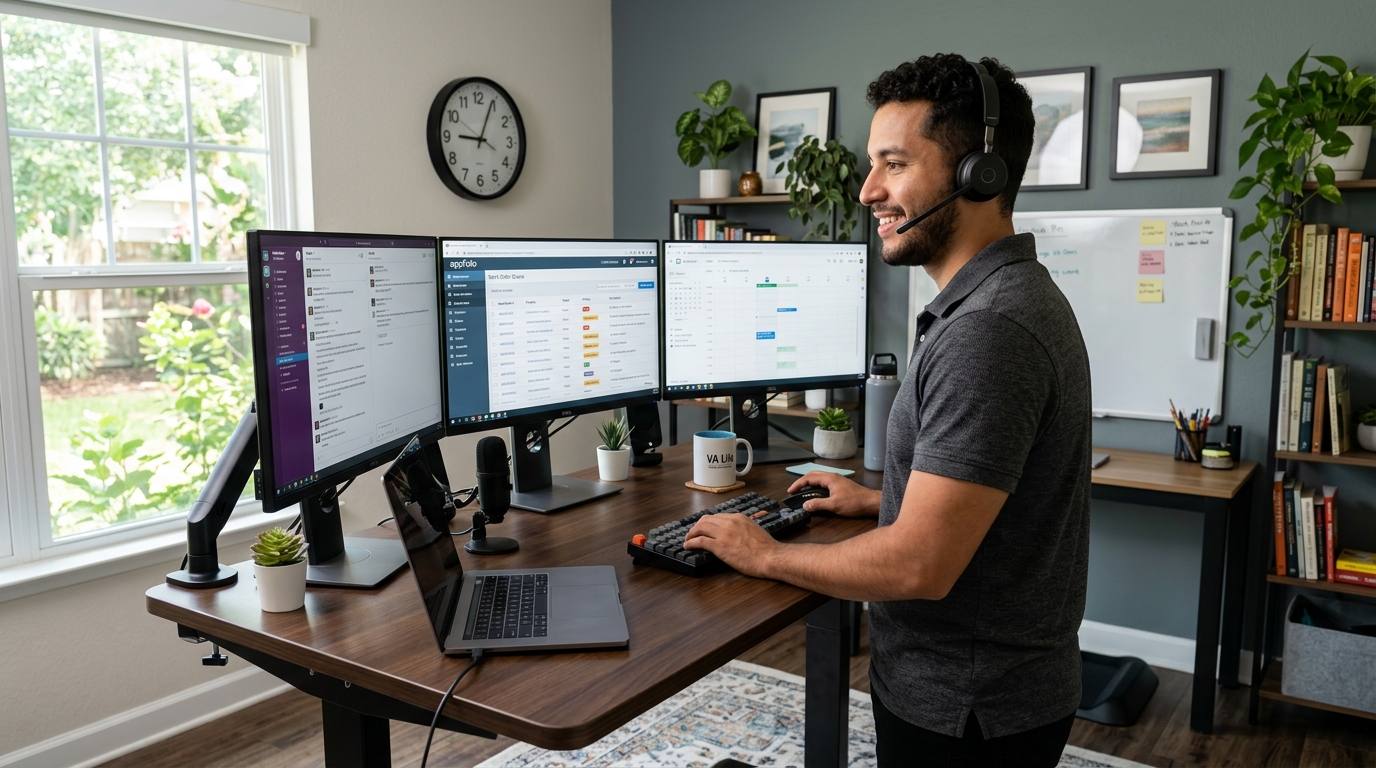
For a deeper look at how this plays out across real PM workflows, our nearshore virtual assistant property management comparison walks through task-by-task breakdowns for leasing, maintenance coordination, and owner reporting.
How English Fluency Shapes Every Owner and Tenant Interaction in 2026
English fluency is not a politically sensitive topic in property management staffing — it's an operational one. When a tenant calls about a water leak, they need to be understood the first time. When an owner reviews a monthly statement and calls to ask a question, they expect a clear, confident answer. Miscommunication at either moment costs you a renewal or a management contract.
"The number-one complaint we hear from property managers who've tried offshore VAs is not the price — it's that they spent more time fixing miscommunications than they saved on labor costs." — Jeremy Pound, Co-founder at RentScale (2023)
Rose screens every team member at 8/10 or higher on English proficiency before placement — that's the published, non-negotiable bar. Latin America produces a large pool of bilingual professionals who grew up consuming US media, studied in US-modeled university systems, and in many cases have prior experience supporting US clients directly. The Philippines also produces English speakers, but accent neutrality and idiom alignment for US real estate conversations tend to score higher among Latin American candidates in head-to-head blind call tests run by PM operators.
If you're running a boutique firm and every owner call reflects directly on your brand, fluency isn't a nice-to-have — it's table stakes. Our post on whether nearshore VAs work for boutique property management firms addresses this directly, including how small operators have used nearshore coordinators to punch above their weight on client communication.
The hidden cost of offshore VAs isn't the hourly rate — it's the rework loop. A miscommunicated maintenance request that requires two follow-up calls costs you 40+ minutes of principal time per incident. At 10 incidents a month, that's 400 minutes — nearly a full workday — spent fixing problems your VA was supposed to prevent.
The Full Cost Comparison: Nearshore vs Offshore vs Onshore in 2026
Sticker price is the first thing operators compare and the last thing that matters once you account for hidden costs. Here's how the three models stack up across every cost dimension that affects your bottom line.
| Factor | Nearshore VA (Latin America) | Offshore VA (Philippines / India) | Onshore US Employee |
|---|---|---|---|
| All-in monthly cost | ~$2,500 flat (Rose) | $800–$1,800 (platform + payroll) | $4,500–$7,000+ (salary + benefits) |
| Time zone overlap (EST) | Full 8-hr overlap | 2–4 hr overlap (forced shift) | Full 8-hr overlap |
| English proficiency | 8/10+ screened | Varies; 6–8/10 typical | Native |
| Software readiness (AppFolio, Buildium) | AI copilot included; trained pre-day-1 | Self-trained; varies widely | Depends on hire |
| Recruiting / HR overhead | Zero (included in flat rate) | Platform fee + your time | Full employer burden |
| Replacement if not a fit | Free replacement included | You re-post, re-interview | Rehire process; avg 6–8 weeks |
| Contract commitment | No long-term contract; 30-day notice | Varies; some platforms lock you in | At-will, but severance risk |
| Avg ramp time to full productivity | 5–10 days (AI copilot accelerates) | 3–6 weeks | 4–8 weeks |
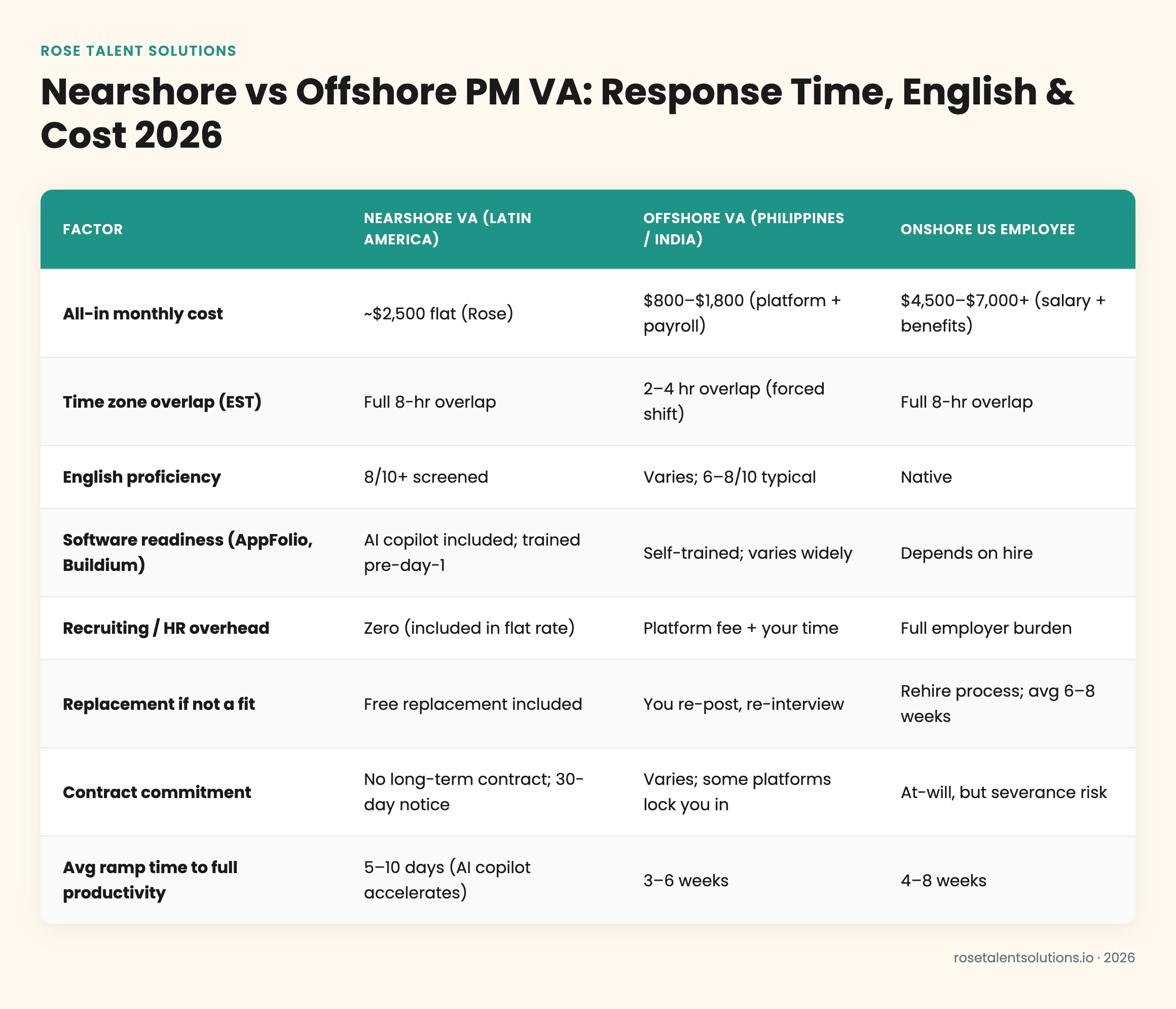
The offshore rate looks attractive in isolation. But add a platform markup, factor in the hours you spend re-communicating tasks, account for tenant dissatisfaction that costs you one renewal, and that "savings" typically evaporates within 60 days. According to SHRM (2024), the average cost of replacing a single employee — even a VA — is 50-200% of annual salary when you include lost productivity, retraining, and management time. Offshore churn rates among PM VAs run high precisely because forced overnight shifts drive burnout.
For a granular breakdown of what you should expect to pay across staffing models, our dedicated post on how much a property management VA costs per month covers every fee layer — platform cuts, payroll taxes, benefit equivalents, and what flat-rate all-in pricing actually includes.

How Rose's AI Copilot Changes the Software Readiness Equation
Software competency is the third leg of the stool that most VA comparisons ignore entirely. AppFolio, Buildium, Yardi, and Rent Manager each have steep learning curves — most onshore hires take four to six weeks to reach full productivity. Offshore VAs, self-trained via YouTube tutorials, often plateau at surface-level feature use and never learn the workflow-specific shortcuts that save your team hours each week.
Every Rose team member ships with a role-specific AI copilot trained on their assigned software — AppFolio, Buildium, QuickBooks, and others. That means on day one, your coordinator already knows how to generate owner statements, process work orders, and pull delinquency reports in your specific platform. They're not Googling how to do it while your tenant waits on hold.
According to AppFolio's 2024 Property Management Industry Pulse, 71% of property management companies say software proficiency is the hardest skill to find in new hires — beating out communication skills and time management. An AI-enabled nearshore VA flips that equation: you get software readiness pre-loaded, with the communication skills built in through English proficiency screening.
If you're specifically evaluating AppFolio support needs, our AppFolio virtual assistant hiring guide covers exactly which tasks nearshore VAs handle best inside the platform — from leasing workflows to owner portal management.
Submit your role brief
Tell Rose which software you run, how many units you manage, and what tasks you need covered. Takes under 10 minutes at rosetalentsolutions.io/start.
Rose recruits and vets
Rose sources from its Latin America talent network, screens for English fluency (8/10+ floor), software experience, and PM-specific knowledge — typically placing within 7 days.
AI copilot is configured
Before day one, your team member's AI copilot is trained on your specific platform — AppFolio, Buildium, or others — so they arrive productive, not in training mode.
They start. You stay on month-to-month terms.
No long-term contract. If the team member isn't the right fit, Rose replaces them at no additional cost. You pay $2,500/month flat — recruiting, payroll, HR, and ongoing management included.
Nearshore vs Offshore: Honest Pros and Cons for PM Operators
No staffing model is perfect for every operator. Here's an unvarnished breakdown — because the right decision depends on your unit count, communication standards, and risk tolerance.
Nearshore VA — Pros
- Full US business hours overlap — real-time response to tenants and owners
- 8/10+ English proficiency screened before placement
- AI copilot pre-loaded on your PM software from day one
- Flat $2,500/month — no recruiting, payroll, or HR overhead
- Free replacement if the team member isn't a fit
- No long-term contract; exit with 30 days written notice
Offshore VA — Cons
- 6–14 hour timezone lag creates overnight batching of urgent tasks
- English fluency variance — typically 6–8/10 unscreened
- Self-trained on PM software; ramp time 3–6 weeks
- Platform fees + hidden payroll costs erode the rate advantage
- High burnout/churn on forced overnight shifts — you re-hire frequently
- No replacement guarantee; re-posting costs you time and money
The Rose property management staffing page details which roles are the highest-ROI starting points for operators new to nearshore staffing — leasing coordinators and maintenance dispatchers typically pay back in the first 30 days through tenant retention alone.
According to the National Multifamily Housing Council (NMHC) (2024), the average cost of a single apartment turnover — including vacancy loss, cleaning, make-ready, and re-leasing — runs $3,500 to $6,000 per unit. If a nearshore VA's faster response time saves you even one unnecessary turnover per quarter, the staffing investment pays for itself multiple times over.
According to the U.S. Bureau of Labor Statistics (2024), median annual wages for US-based property management assistants now exceed $47,000 — over $3,900/month before benefits, payroll taxes, or PTO. The nearshore model at $2,500/month all-in represents a 36%+ direct cost savings against a comparable onshore hire, with no sacrifice on business-hours availability.