
What Are Nearshore React Developer Services in 2026?
Nearshore React developer services give US, Canadian, and UK companies access to senior frontend engineers based in Latin America — working your business hours, fluent in English, and embedded in your existing sprint workflow. Unlike offshore engagements routed through India or the Philippines, nearshore developers operate in the same or adjacent timezone, which eliminates the overnight delay cycle that kills sprint velocity. At Rose Talent Solutions, every React developer we place is vetted through a multi-stage technical screen and ships with a role-specific AI copilot trained on your stack.
What is a nearshore React developer? A nearshore React developer is a frontend engineer based in a geographically proximate country — typically Mexico, Colombia, Argentina, Brazil, or Costa Rica — hired to work full-time for a US or Canadian company. They build component libraries, manage state with Redux or Zustand, integrate REST and GraphQL APIs, and collaborate in real time with your product and design teams. The "nearshore" model specifically emphasizes timezone alignment and cultural compatibility, which are the two failure points most commonly cited in offshore engagements.
React remains the dominant frontend framework in 2026. According to the Stack Overflow Developer Survey 2023, React has held the top spot as the most-used web framework among professional developers for five consecutive years, with over 40% of respondents using it regularly. Demand for React talent has outpaced supply domestically, pushing US hiring timelines past 90 days and senior-level salaries above $160,000 annually in competitive markets, according to the U.S. Bureau of Labor Statistics. The nearshore model exists precisely to close that gap.

How Nearshore Compares to Offshore and Onshore React Hiring in 2026
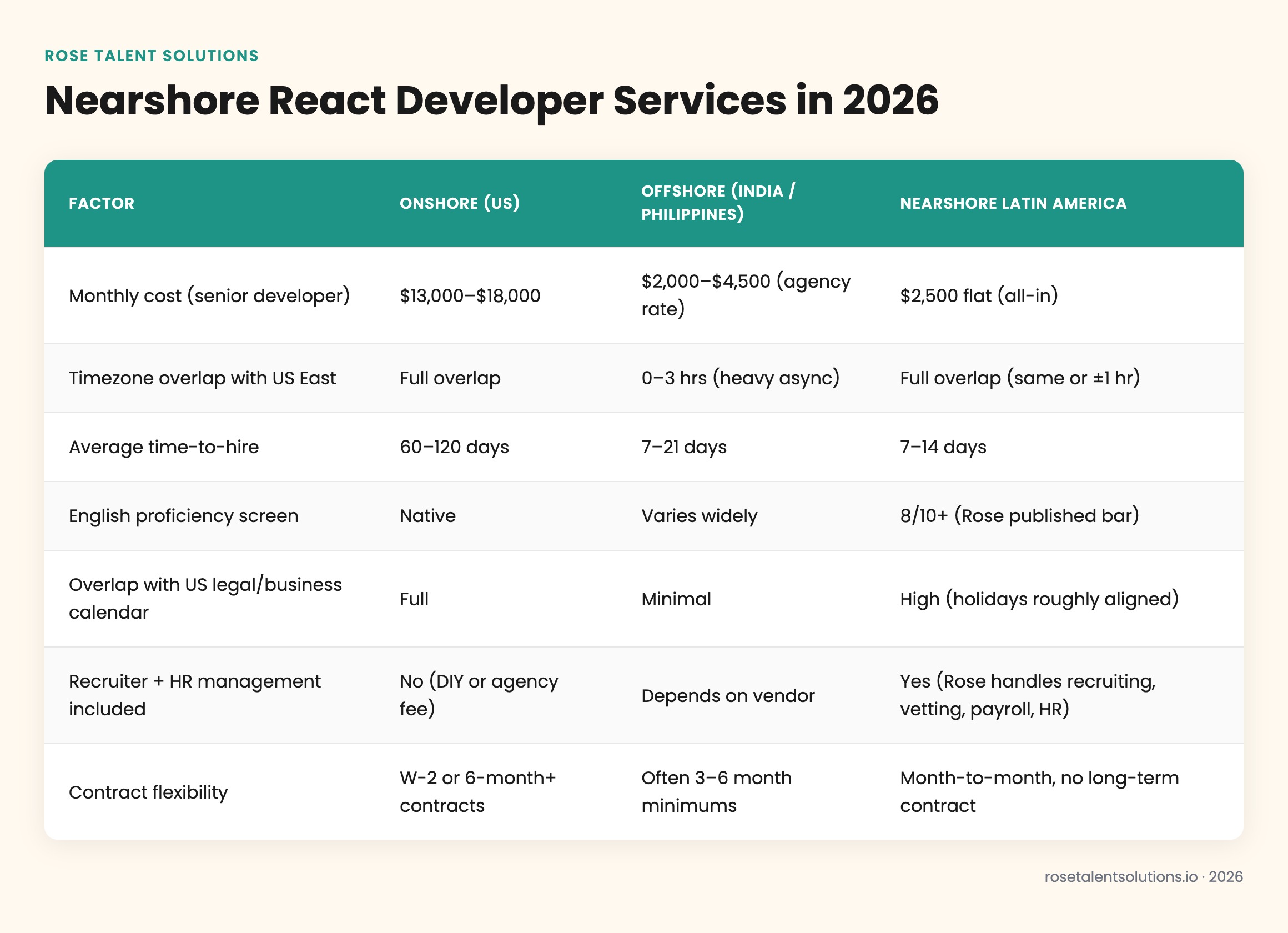
Before committing budget, most engineering leaders run a three-way comparison: hire domestically, engage an offshore firm, or build a nearshore team. Each model has a distinct cost and collaboration profile. The table below breaks down the decision across the dimensions that matter most for a React-heavy product team.
| Factor | Onshore (US) | Offshore (India / Philippines) | Nearshore Latin America |
|---|---|---|---|
| Monthly cost (senior developer) | $13,000–$18,000 | $2,000–$4,500 (agency rate) | $2,500 flat (all-in) |
| Timezone overlap with US East | Full overlap | 0–3 hrs (heavy async) | Full overlap (same or ±1 hr) |
| Average time-to-hire | 60–120 days | 7–21 days | 7–14 days |
| English proficiency screen | Native | Varies widely | 8/10+ (Rose published bar) |
| Overlap with US legal/business calendar | Full | Minimal | High (holidays roughly aligned) |
| Recruiter + HR management included | No (DIY or agency fee) | Depends on vendor | Yes (Rose handles recruiting, vetting, payroll, HR) |
| Contract flexibility | W-2 or 6-month+ contracts | Often 3–6 month minimums | Month-to-month, no long-term contract |
"The talent quality gap between nearshore Latin America and offshore Asia has closed dramatically — but the timezone gap hasn't. That single variable is what determines whether distributed engineering actually ships on schedule." — Matt Birnbaum, VP of Talent at Pendo (2023)
The offshore cost advantage looks compelling on a spreadsheet until you account for the hidden multipliers: async delay on PR reviews, compressed sprint retros, and the management overhead of a 9-hour timezone gap. A McKinsey Digital analysis found that distributed teams with fewer than 4 hours of daily overlap take 34% longer to complete feature cycles than co-located or timezone-aligned teams. For React product teams shipping weekly, that's a structural drag that compounds across every quarter.
The real cost of offshore React development isn't the hourly rate — it's the 6–9 hour timezone gap that converts every async PR comment into a 24-hour delay and turns a 2-week sprint into a 3-week one.
How Rose Places Nearshore React Developers: The 2026 Hiring Process
Speed matters in frontend hiring. A React role left open for 90 days doesn't just cost salary — it costs deferred features, overloaded senior engineers, and slipped release dates. Rose Talent Solutions compresses that timeline to under two weeks through a structured matching and vetting pipeline built specifically for technical roles. If you're also scaling your mobile product, the same pipeline covers nearshore iOS and Android mobile developers with equivalent depth of technical screening.
Role Brief & Stack Spec
You share your React version, state management library, CI/CD setup, and team structure. Rose uses this to filter candidates before you see a single resume — no generalist submissions.
Technical Screen & English Proficiency
Every candidate completes a live coding assessment in React plus a structured English proficiency interview scored to Rose's published 8/10+ floor. Below that threshold, they don't advance — period.
Curated Shortlist (3–5 candidates)
You receive a shortlist of 3 to 5 pre-vetted profiles with assessment scores, video intros, and GitHub portfolios. Most clients schedule final interviews within 48 hours of receiving the shortlist.
Placement & AI Copilot Onboarding
Once you select your developer, Rose handles payroll setup, HR documentation, and activates their role-specific AI copilot — pre-trained on your documented stack and internal tools.
Ongoing Management & Free Replacement
Rose manages ongoing HR, compliance, and performance. If the team member isn't a fit for any reason, we replace them at no additional cost — that's the only guarantee you need.
The AI copilot advantage is worth dwelling on. Every Rose developer joins with an AI assistant trained on their specific toolchain — whether that's GitHub Actions, Figma-to-code workflows, or your internal component library documentation. According to SHRM's Talent Acquisition research, new technical hires take an average of 8–12 months to reach full productivity without structured onboarding support. The AI copilot cuts that curve significantly by giving developers context-aware guidance from day one, not month eight.
What Nearshore React Developers Actually Build in 2026
The surface-level answer is "frontend." The real answer is more specific — and it's worth being precise because React seniority varies enormously. The developers Rose places are capable of owning entire frontend domains, not just implementing Figma handoffs. Senior nearshore React engineers in the Latin American talent pool regularly carry experience with Next.js App Router, server components, React Query, TypeScript-strict mode, and modern monorepo tooling like Turborepo and pnpm workspaces.
Common engagement patterns Rose sees from US tech companies include: greenfield SaaS product builds where a US-based founding team needs a dedicated frontend engineer without the $180K domestic price tag; scaling teams adding a second or third React developer to reduce bottlenecks on a senior engineer who's currently doing too much; and product redesigns where a company is migrating a legacy class-component codebase to modern functional React with hooks and concurrent features. If your team also needs backend infrastructure support, the same nearshore model scales to nearshore DevOps engineers and nearshore data engineers who integrate seamlessly with your frontend team.

According to the Statista Developer Ecosystem Report, React's ecosystem has grown to include over 1.3 million published npm packages with React as a peer dependency, making it the most interconnected frontend framework by dependency graph. That breadth means the hiring bar for "React developer" masks enormous variance in actual capability. Rose's technical screen tests not just React syntax but architecture decisions — how a candidate designs a component hierarchy, when they reach for context versus a state library, and how they handle performance optimization in a large component tree. That screen is what separates a genuine senior hire from a React-tutorial-level placement.
For teams building full-stack applications, it's also worth knowing that Rose's roster extends beyond pure frontend. If you need a developer who can own both the React layer and the Node/Express or Django backend, the nearshore full-stack developer track gives you that profile at the same flat rate and with the same vetting depth.
How Pricing Works for Nearshore React Developer Services in 2026
Rose Talent Solutions charges a single flat rate: $2,500 per month. That covers a full-time, dedicated React developer working 40 hours per week — plus recruiting, technical vetting, payroll processing, HR compliance, and ongoing management. There are no placement fees, no markup on hourly rates, no hidden costs when you need to replace a developer, and no long-term contract. You can cancel with 30 days' written notice.
Why the Flat-Rate Model Works
- Predictable monthly expense — no invoice surprises from overtime or agency markups
- Rose's incentive is retention, not churn — they manage the developer actively
- Replacement at no additional cost if the fit isn't right — zero re-engagement fee
- All-in pricing includes HR, payroll, and compliance — you don't manage the employment layer
What to Watch in Any Nearshore Engagement
- Vet the English proficiency screen — ask vendors for the exact methodology, not just "English fluent"
- Confirm timezone — "Latin America" can include UTC-5 to UTC-3; clarify overlap hours upfront
- Check technical assessment depth — a take-home project isn't the same as a live architectural review
- Understand the replacement policy in writing — "we'll find someone else" is not the same as "at no additional cost"
At $2,500 per month, a senior nearshore React developer costs roughly 15–18% of the fully-loaded annual cost of a comparable domestic hire when you factor in salary, benefits, payroll taxes, and recruiter fees. That delta is real capital — capital that most early-stage and growth-stage product teams redirect into design, infrastructure, or additional headcount. If your team also carries bookkeeping or financial operations needs alongside your tech build, Rose's bookkeeping and accounting virtual staff operate on the same model and the same flat rate, making cross-functional nearshore expansion straightforward to budget.
Month-to-month terms matter more than most companies realize at contract signing. According to a Gallup Workplace Report, 51% of currently employed workers say they are actively watching for or seeking a new job. Tech teams restructure. Roadmaps pivot. A no-long-term-contract model means your staffing structure can adjust with your business rather than locking you into a 12-month engagement you need to exit at a penalty. Ready to see matched candidates? Visit the Rose Talent start page to submit your role brief.