What Are Nearshore DevOps Engineer Services in 2026?
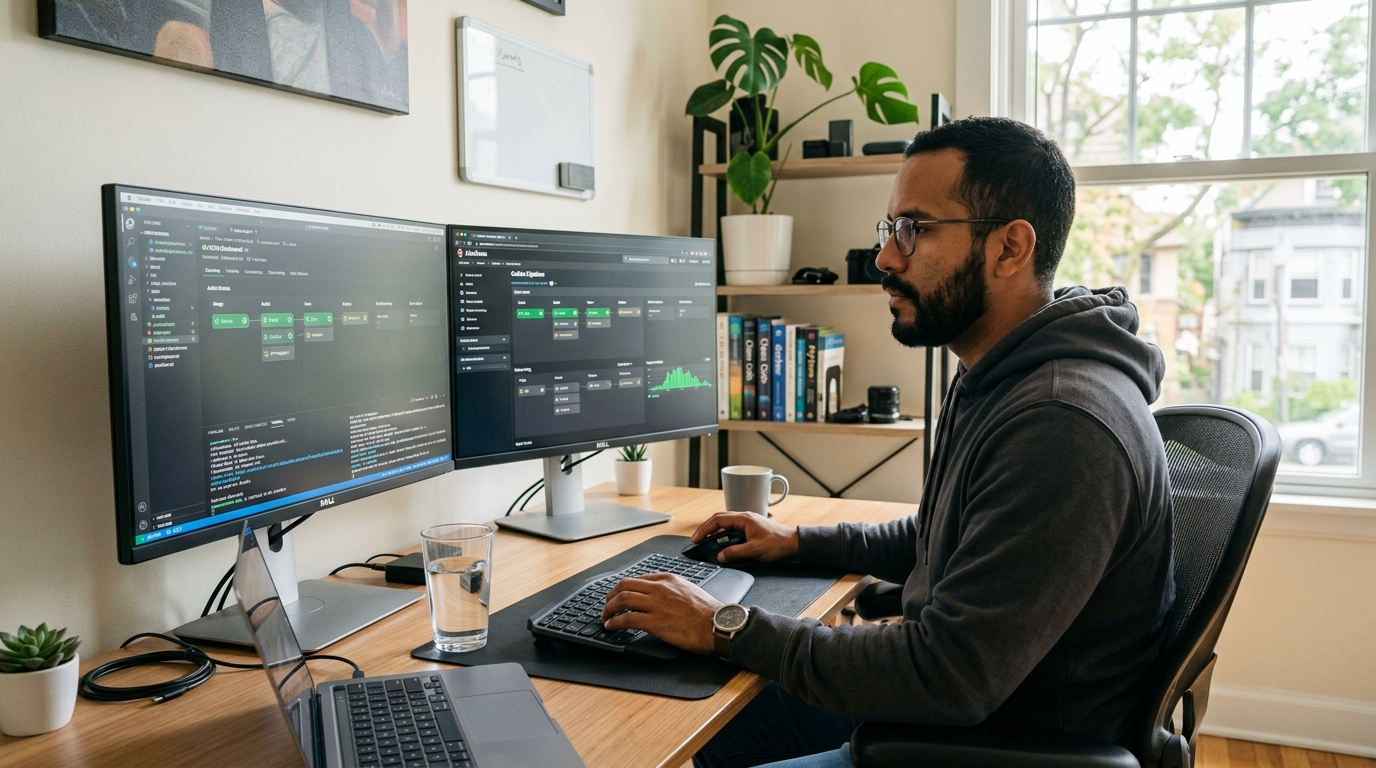
Nearshore DevOps engineer services place senior-level DevOps professionals — based in Latin America — directly inside your US, Canadian, or UK engineering workflows. Unlike generic offshore outsourcing routed through India or the Philippines, nearshore talent works your actual business hours, speaks fluent English, and sits within one to three time zones of your team. That distinction isn't cosmetic. It determines whether your standup happens in real time or becomes a Slack graveyard of overnight messages.
A nearshore DevOps engineer handles the full infrastructure stack: CI/CD pipeline management, containerization with Docker and Kubernetes, cloud cost optimization across AWS, Azure, or GCP, incident response, infrastructure-as-code with Terraform or Ansible, and security compliance automation. These are not entry-level support tasks — they are the same responsibilities you would hand a senior US hire at three to four times the cost.
The demand is undeniable. Software developer and DevOps roles remain among the most difficult and expensive positions for US companies to fill domestically, according to the U.S. Bureau of Labor Statistics (2024), which projects 26% employment growth for software quality assurance and DevOps-adjacent roles through 2032 — far outpacing most other occupations. That talent gap is exactly why the nearshore model has accelerated.
If you're already exploring adjacent technical hiring, our breakdown of nearshore data engineer services covers how the same Latin America–based model applies to data pipeline and analytics roles.
How Much Do Nearshore DevOps Engineers Cost in 2026?
Pricing is the first question every engineering leader asks, and it deserves a straight answer. Rose Talent Solutions charges a flat $2,500 per month for a full-time, dedicated nearshore DevOps engineer — 40 hours per week, fully managed. That rate covers recruiting, technical vetting, payroll, HR administration, and ongoing performance management. There are no hidden fees, no per-seat upsells, and no long-term contract. You can cancel with 30 days' written notice.
Compare that to what a US-based senior DevOps engineer actually costs. The median base salary for a senior DevOps engineer in the United States sits between $140,000 and $165,000 annually, according to SHRM's compensation benchmarking guidance (2024). Add employer payroll taxes, benefits, recruiting fees averaging 15–20% of first-year salary, and equipment — and the all-in annual cost often exceeds $200,000. That is roughly $16,700 per month for a single engineer.
Freelance platforms such as Toptal or Turing sit in a middle range — typically $5,000 to $10,000+ per month per engineer — but those models bill hourly, offer limited management support, and hand the entire HR and replacement burden back to you. We did a detailed side-by-side of this in our nearshore developer vs. Toptal comparison and our nearshore developer vs. Turing breakdown, both worth reading before you sign anything.

How Does Nearshore Compare to Offshore and Onshore DevOps Hiring in 2026?
The hiring model you choose dictates more than your monthly spend. It determines response latency during an outage at 2pm EST, how long code reviews take, and whether your sprint ceremonies run on time. The table below maps the four most common DevOps staffing paths across the dimensions that matter most to engineering leaders.
| Hiring Model | Typical Monthly Cost | Timezone Overlap (US ET) | English Fluency | Avg. Time to Fill | Management Overhead |
|---|---|---|---|---|---|
| Nearshore (Latin America) | $2,500/mo flat | Full overlap (0–3 hr gap) | 8/10+ screened | ~7 days | Low (fully managed) |
| Offshore (India/Philippines) | $1,000–$2,000/mo | Minimal (9–14 hr gap) | Varies widely | 2–4 weeks | High (self-managed) |
| US/Canada Onshore | $12,000–$18,000/mo | Full overlap | Native | 6–12 weeks | Medium (internal HR) |
| Freelance Platform (Toptal/Turing) | $5,000–$10,000+/mo | Varies | Screened | 1–2 weeks | High (you manage) |
The offshore cost advantage looks compelling until you model the real workflow tax. A 9-to-14-hour timezone gap means a single async back-and-forth on a deployment issue — the kind resolved in a 15-minute standup — can consume 48 hours of calendar time. According to McKinsey's technology talent research (2023), distributed engineering teams with more than a 5-hour timezone differential report 34% higher incident resolution times compared to co-timezone teams. That lost time is not free — it shows up in delayed releases, missed SLAs, and burned engineering hours on coordination rather than delivery.
How Rose Vets and Places Nearshore DevOps Engineers
Vetting is where most nearshore staffing firms cut corners and where placements fail. Rose Talent Solutions runs a multi-stage technical screen before any DevOps engineer reaches your team. Candidates complete role-specific assessments covering their primary cloud platform (AWS, Azure, or GCP), infrastructure tooling (Terraform, Ansible, Pulumi), container orchestration (Kubernetes, Docker Swarm), and CI/CD platforms (GitHub Actions, GitLab CI, Jenkins, CircleCI). English proficiency is screened separately — Rose's published bar is 8 out of 10 or higher on a standardized fluency assessment.
Every placed engineer also ships with a role-specific AI copilot trained on the exact tooling stack they will use with your team. If your infrastructure runs on AWS with Terraform and GitHub Actions, your engineer's AI copilot is pre-configured around that environment — not a generic ChatGPT wrapper. This is part of Rose's AI advantage model, and it materially reduces ramp time.
Discovery Call
Rose's team maps your stack, team size, sprint cadence, and must-have vs. nice-to-have skills in a 30-minute intake. This brief drives the sourcing spec — not a generic job description.
Technical Screening
Candidates complete cloud platform assessments, infrastructure-as-code challenges, and a live English fluency evaluation. Only engineers who clear every threshold advance.
Shortlist Presentation
You receive two to three vetted candidate profiles with assessment scores, tech stack depth ratings, and a short video introduction. You choose — or Rose refines the search.
Placement and Onboarding
Your engineer is placed and their AI copilot is configured to your environment. Rose handles payroll, HR, and ongoing performance management from day one.
Replacement Guarantee
If the engineer isn't a fit at any point, Rose replaces them at no additional cost. No penalties, no argument — just a fast rematch.
This process typically delivers a placed engineer within approximately seven days of the discovery call. For context, the average time-to-fill for a senior DevOps role in the US currently sits at 44 days, according to SHRM's 2024 talent acquisition benchmarking data. Getting a fully vetted, managed engineer in place in one week is a meaningful competitive advantage when your deployment pipeline is blocked or your team is underwater.

What DevOps Tasks Can a Nearshore Engineer Own in 2026?
One of the most common mistakes engineering managers make when evaluating nearshore DevOps talent is underscoping the role. They hire for one narrow function — say, maintaining Jenkins pipelines — and then discover the engineer is capable of owning their entire infrastructure roadmap. The Latin American DevOps talent pool in 2026 includes professionals with five to twelve years of experience in enterprise environments, many of whom have led platform engineering initiatives for US SaaS companies.
The strongest nearshore DevOps engineers in Latin America aren't pipeline maintainers — they are platform engineers capable of owning your full infrastructure strategy, cost optimization program, and security compliance posture. Scoping them narrowly leaves significant leverage on the table.
Here is a representative scope of what a senior nearshore DevOps engineer can own for your team:
- CI/CD pipeline architecture and maintenance — GitHub Actions, GitLab CI, CircleCI, Jenkins, or Buildkite
- Container orchestration — Kubernetes cluster management, Helm chart development, Docker image optimization
- Infrastructure as Code — Terraform module development, Ansible playbooks, Pulumi stacks
- Cloud cost engineering — Reserved instance management, right-sizing, FinOps dashboards on AWS Cost Explorer, Azure Cost Management, or GCP Billing
- Observability stack — Datadog, New Relic, Prometheus/Grafana setup, alerting runbooks
- Security and compliance automation — SOC 2 evidence collection, automated policy enforcement with Open Policy Agent, vulnerability scanning pipelines
- Incident management — On-call rotation participation, postmortem documentation, SLA tracking
The same talent depth applies across technical disciplines. If you're building out a broader technical team, our guide to building a dedicated nearshore developer team explains how to structure multi-role hiring across DevOps, backend, and frontend functions under one nearshore engagement model.
"Latin America's tech workforce has matured dramatically over the last five years — we're seeing engineers coming out of Colombia, Argentina, and Mexico with cloud certifications, enterprise DevOps experience, and English fluency that would be competitive in any US market." — Ariel Camus, CEO at Microverse (2023)
Demand for this profile is growing fast on both sides. Latin America's technology services export sector grew 22% year-over-year in 2023, driven largely by US companies nearshoring technical roles, according to Inter-American Development Bank research (2023). The talent density is there — the question is whether your hiring process is set up to reach it efficiently.
Is Nearshore DevOps the Right Model for Your Team in 2026?
Nearshore DevOps hiring is not the right answer for every company. It is the right answer for most US engineering teams that need senior DevOps talent quickly, want real-time collaboration, and cannot justify or compete for $160,000+ domestic salary candidates in the current market. The model works best when you have defined infrastructure tooling, a clear scope for the role, and a team lead who can run a weekly sync.
Nearshore DevOps — Best For
- US/Canada/UK startups and scale-ups with defined cloud infrastructure needs
- Engineering teams that require real-time standup and incident response participation
- Companies that want senior talent without the 44-day US recruiting cycle
- Teams needing full-time dedicated capacity rather than fractional freelance hours
- Leaders who want HR, payroll, and performance management handled externally
Consider Alternatives If
- Your role requires on-site data center access or hardware rack work
- Federal compliance mandates US-citizen-only access to classified infrastructure
- Your stack is so niche that only 2–3 people globally have the skill combination
- You need only 10–20 hours per week of DevOps support (fractional freelance may fit better)
If your team clears those filters, the next step is straightforward. Rose's intake process starts with a 30-minute discovery call. You describe your stack, your team structure, and the gap you're trying to close. Rose matches you with vetted candidates within days — not weeks. And if you want to see how the broader managed staffing model works beyond DevOps, the AI advantage page walks through how every Rose team member is equipped with a role-specific AI copilot on day one.
The talent shortage in domestic DevOps hiring is not a 2026 problem — it's a structural one. According to Gallup's workforce engagement research (2023), 51% of currently employed US workers are actively watching for or seeking new jobs — meaning even when you do hire domestically, retention is fragile and expensive to re-solve. The nearshore model, with its flat monthly pricing and built-in replacement guarantee, converts that variable cost and risk into a predictable, manageable operating line.