
What Nearshore QA Engineer Services Actually Mean in 2026
Nearshore QA engineers are software quality assurance professionals based in Latin America — countries like Colombia, Mexico, Argentina, and Peru — hired specifically to serve US, Canadian, or UK product teams. Unlike offshore arrangements routed through South Asia or Southeast Asia, nearshore talent operates in the same or adjacent time zones as your engineering org, participates in your standups live, and communicates in fluent English without the 6–12 hour lag that kills sprint velocity.
A nearshore QA engineer owns the full quality assurance function: writing and executing test cases, building automated regression suites, filing and triaging bugs, and coordinating release sign-off. In 2026, the best nearshore QA hires also arrive with working knowledge of modern QA toolchains — Selenium, Cypress, Playwright, JIRA, TestRail, Postman — so ramp time is measured in days, not months.
If you've been comparing this role to other technical nearshore hires, the QA function sits squarely in the same talent pool as nearshore DevOps engineers — Latin American professionals who've trained on US product stacks and can step into fast-moving teams without a learning curve.
The 2025–26 edition of the World Quality Report by Capgemini (2025) confirms that QA outsourcing adoption is accelerating — but teams that outsource to same-timezone talent outperform those routing work offshore by a measurable margin on defect escape rates and cycle time.
How Nearshore QA Engineers Outperform Offshore in 2026
The argument for offshore QA has always been cost. But the true cost calculation almost never includes the compounding friction of asynchronous defect loops. When your developer files a bug at 2pm EST and the offshore QA engineer's response comes back at 6am the next morning, you've lost a full working day on what might be a five-minute clarification. Multiply that by 20 tickets per sprint and you've added a week of unnecessary delay every cycle.
Nearshore QA engineers eliminate that loop entirely. A Latin American QA engineer in Bogotá, CDMX, or Buenos Aires is online while your dev team is online. They join your Slack, attend your retros, and push test results before your standup ends. Real-time collaboration isn't a feature — it's the default.
English fluency matters more in QA than almost any other technical role. Writing clear bug reports, articulating reproduction steps, and pushing back on ambiguous acceptance criteria all require precise written communication. Rose Talent Solutions screens every QA engineer to a minimum 8/10 English proficiency score before they ever reach a client team.

According to SHRM's Employee Job Satisfaction research (2024), communication quality is the top driver of cross-functional team satisfaction — more than compensation or role clarity. A QA engineer who communicates with precision and responds in real time doesn't just find bugs faster; they make your whole engineering org run better.
For teams already exploring Latin American technical talent, this dynamic mirrors what we see with nearshore full-stack developers — the timezone advantage compounds every day the team works together.
Nearshore vs. Offshore vs. Onshore QA Engineers: 2026 Comparison
Before committing to any QA staffing model, you need an apples-to-apples view of what each option actually delivers. The table below covers the five dimensions that matter most for software teams: fully-loaded cost, timezone fit, English fluency, tool ramp time, and communication quality.
| Factor | Nearshore QA (Latin America) | Offshore QA (India / Philippines) | Onshore QA (US / Canada) |
|---|---|---|---|
| Monthly cost (full-time) | ~$2,500 flat (all-in) | $1,200–$2,000 (hidden mgmt fees common) | $7,000–$12,000+ salary + overhead |
| Timezone alignment | Same or ±1–2 hrs of US EST/PST | 9–12 hrs behind EST — async by default | Perfect alignment |
| English fluency | High — screened to 8/10+ minimum | Variable — often 5–7/10 in practice | Native |
| Tool ramp time | 3–7 days (pre-screened on target stack) | 2–4 weeks (variable training levels) | 1–5 days (domestic market familiarity) |
| Bug report clarity | High — written in clear US-standard format | Mixed — formatting often needs rework | High |
| Defect loop turnaround | Same-day resolution | 24-hour minimum delay | Same-day resolution |
| Contract flexibility | Month-to-month, no long-term contract | Often 6–12 month minimums | At-will but severance risk |
| Replacement if not a fit | Yes — free replacement included | Rarely included | Full rehire cost (~$15K+) |
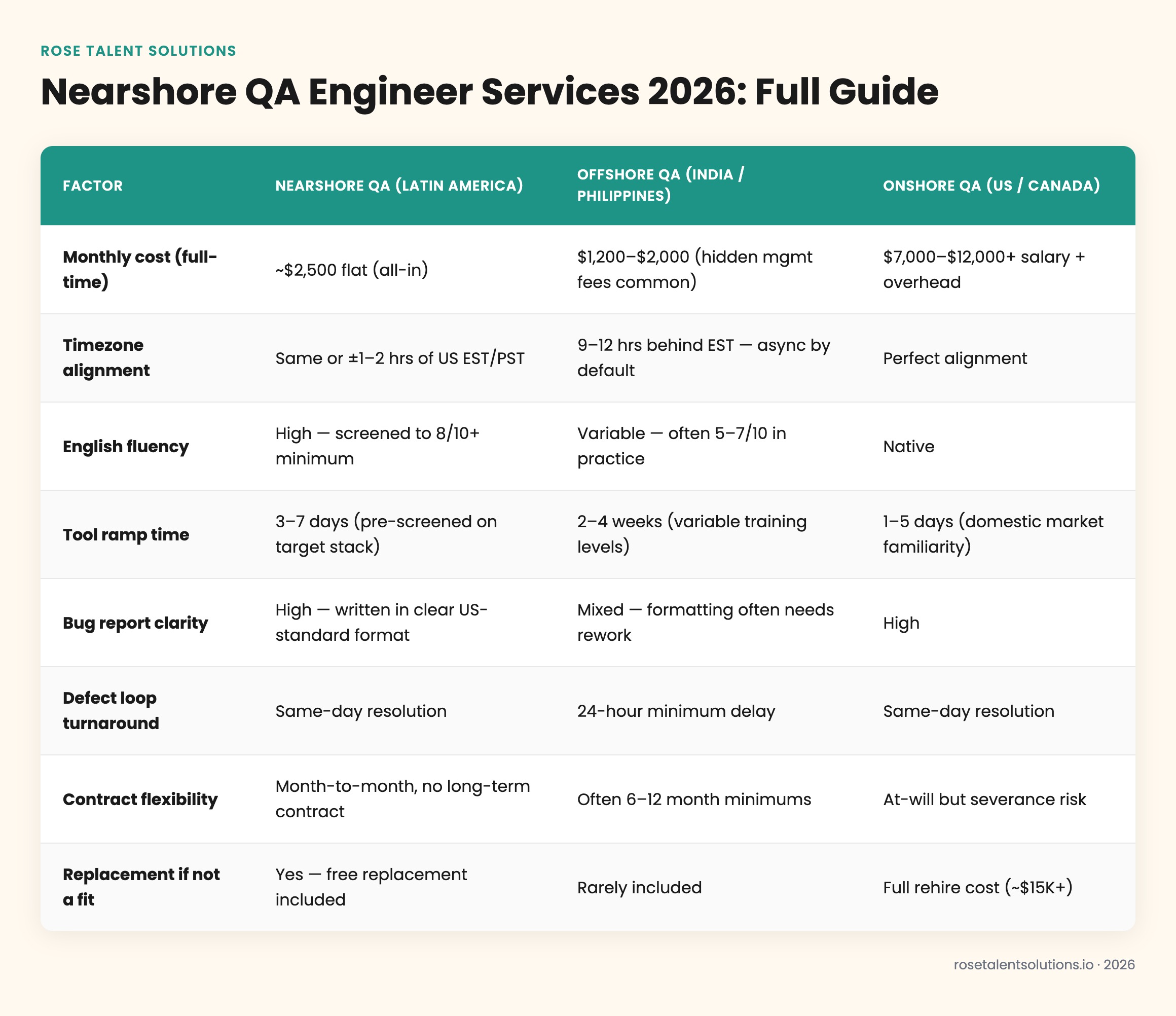
The cost gap between nearshore and onshore QA is significant. The U.S. Bureau of Labor Statistics (2024) puts the median annual salary for software quality assurance analysts in the US at $99,620 — roughly $8,300 per month before payroll taxes, benefits, or recruiting fees. A nearshore QA engineer at $2,500/month flat — with recruiting, vetting, HR, and ongoing management included — is a structural cost advantage, not a compromise.
What Does a Nearshore QA Engineer Actually Do Day-to-Day in 2026?
The scope of a nearshore QA engineer depends on your stack and release cadence, but most teams use them across four core workstreams. Understanding the day-to-day scope helps you staff the role correctly and set realistic expectations from week one.
The highest-leverage QA hire in 2026 isn't someone who only runs manual test cases — it's a hybrid engineer who writes automated regression suites in Cypress or Playwright while maintaining the manual coverage layer for edge cases and UX flows. That combination cuts your release cycle and your defect escape rate simultaneously.
Here's how a typical nearshore QA engineer structures their week on a product team running two-week sprints:
- Sprint planning (Day 1–2): Reviews acceptance criteria, flags testability gaps, and writes test cases before dev work starts — not after.
- Active development phase (Day 3–8): Runs exploratory testing on dev builds, files bug reports in JIRA or Linear with reproduction steps and screen recordings, and updates regression suites as new features land.
- Regression and sign-off (Day 9–10): Executes full regression against release candidate, coordinates go/no-go with the product lead, and documents test results for audit trail.
- Automation maintenance (ongoing): Adds new test cases to Cypress/Playwright suites, fixes flaky tests, and monitors CI/CD pipeline test results in GitHub Actions or CircleCI.
This work profile overlaps meaningfully with platform engineering — which is why teams that also invest in nearshore data engineering often find that pairing a QA engineer with a data engineer accelerates both data pipeline reliability and product quality simultaneously.

According to McKinsey's Developer Velocity Index (2023), companies that invest in dedicated QA functions — rather than expecting developers to self-test — ship features 4× faster with 60% fewer post-release defects. A dedicated nearshore QA engineer is the most cost-efficient way to build that function without a six-figure US hire.
How Rose Talent Solutions Places Nearshore QA Engineers in 2026
Rose's placement process is built around technical QA roles specifically — not a generic staffing intake retrofitted for engineers. Every QA candidate goes through a structured vetting sequence before a client ever sees their profile.
Role scoping call
Rose's team maps your stack, release cadence, and QA coverage gaps in a 30-minute call. This determines whether you need a manual-first, automation-first, or hybrid QA profile — before sourcing starts.
Candidate sourcing and technical screen
Rose sources from its Latin American talent network and runs a technical screen covering test case design, bug report quality, tool proficiency (Cypress, Playwright, Selenium, JIRA), and English communication — scored against your specific stack.
Client interview and selection
You interview your top 1–2 candidates. You make the call on fit — Rose doesn't make that decision for you. Most clients confirm a hire within 3–5 days of their first interview.
AI copilot onboarding
Your QA engineer is paired with a role-specific AI copilot trained on your toolchain — whether that's Cypress, TestRail, Postman, or your internal CI setup. This cuts ramp time from weeks to days.
Ongoing HR, payroll, and management
Rose handles payroll, compliance, HR escalations, and performance check-ins. You manage the work; Rose manages the employment relationship. The $2,500/month flat rate covers everything.
Every Rose placement includes a free replacement guarantee — if the QA engineer isn't a fit for your team for any reason, Rose replaces them at no additional cost. There's no long-term contract: the engagement runs month-to-month with 30 days written notice to cancel.
The AI copilot advantage is worth calling out specifically. Every Rose team member — whether a nearshore mobile developer or a dedicated QA engineer — arrives pre-configured with an AI assistant trained on their primary tools. For QA, that means a copilot that understands your test framework syntax, your bug-filing conventions, and your CI/CD environment from day one. Learn more about how Rose builds these assistants on the AI advantage page.
If you're ready to scope a QA role now, the fastest path is the Rose intake form — most clients get their first candidate profiles within five business days of completing it.
Nearshore QA in 2026: Pros and Cons vs. Building In-House
Nearshore QA isn't the right answer for every team in every situation. Here's an honest breakdown of where it wins and where you should think carefully before committing.
Pros of Nearshore QA
- Fully-loaded cost of $2,500/month vs. $8,000–$12,000/month for a US QA hire
- Same-timezone collaboration — joins standups, responds to Slack in real time
- Pre-vetted on your specific tool stack — Cypress, Playwright, Selenium, JIRA, TestRail
- Month-to-month engagement — scale up or down as sprint capacity shifts
- Free replacement if the engineer isn't the right fit for your team
- AI copilot pre-trained on your toolchain cuts ramp time to under a week
Cons / Considerations
- Not ideal if your codebase requires a US security clearance (government/defense contracts)
- Requires your team to invest 2–3 hours in onboarding to your internal processes in week one
- For highly specialized performance or security QA, senior US specialists may still be needed alongside
- If your product roadmap is highly confidential, ensure NDAs are in place before access is granted
For the vast majority of SaaS, fintech, proptech, e-commerce, and mobile product teams, the cons above are manageable procedural steps — not structural blockers. The cost and throughput case for nearshore QA is compelling enough that Deloitte's Tech Trends research (2024) identifies nearshore technical staffing as one of the fastest-growing engineering workforce strategies among mid-market US technology companies.
Teams that want to build out a broader Latin American technical bench — combining QA with infrastructure work — often find that pairing a QA engineer with a nearshore DevOps engineer covers both release quality and deployment reliability in a single staffing motion.
"Nearshore technical teams in Latin America have closed the skills gap with US talent markets faster than any other region in the past five years. For quality assurance specifically, the combination of strong CS education pipelines, English fluency, and US-aligned work culture makes Latin America the obvious first call for any North American product team." — Ariel Camus, CEO at Microverse (2024)
If your product ships code and you don't have dedicated QA coverage, you're shipping risk. Nearshore QA engineers in 2026 are the most cost-efficient, timezone-aligned way to close that gap — and the $2,500/month all-in flat rate makes the business case simple to present to any finance team. Visit the Rose start page to scope your QA role today.