
Nearshore development with time zone overlap is reshaping how US, Canadian, and UK businesses staff their operations in 2026. Instead of wrestling with an 8-to-12-hour gap that turns every simple question into a next-day email chain, nearshore teams in Latin America work shoulder-to-shoulder with you — same morning standup, same Slack channel, same business hours. The result is faster decisions, fewer dropped balls, and a working relationship that actually feels like a team rather than a vendor transaction.
This guide breaks down exactly what nearshore development with time zone overlap means, why the time zone factor is the most underrated variable in remote staffing, and how to evaluate whether a nearshore model is the right fit for your business right now.
What Is Nearshore Development With Time Zone Overlap — and Why Does It Matter in 2026?
Nearshore development refers to the practice of hiring technical or operational talent from a neighboring or geographically proximate country that shares a similar time zone with your own. For US companies, this means Latin America — countries like Colombia, Mexico, Argentina, Costa Rica, and Brazil. The defining characteristic is real-time collaboration: your nearshore team member is online when you are, available for a call when you need one, and closing tickets in the same business day rather than the next.
Time zone overlap isn't just a scheduling convenience. It is the core economic argument for nearshore over offshore. When a developer or coordinator is operating more than 10 hours away, a single round of review feedback takes 24 hours minimum. Multiply that across a sprint and you've quietly added two to three weeks of dead time to every quarter. Nearshore eliminates that drag entirely. According to McKinsey Digital (2023), distributed teams with fewer than 3 hours of time zone difference report 40% higher collaboration satisfaction scores than teams separated by more than 6 hours.
If you want a deeper look at how the three main staffing models compare on these dimensions, the nearshore vs. offshore vs. onshore virtual assistant complete comparison on the Rose blog lays out the full side-by-side breakdown.
How Time Zone Overlap Actually Changes Day-to-Day Workflows in 2026
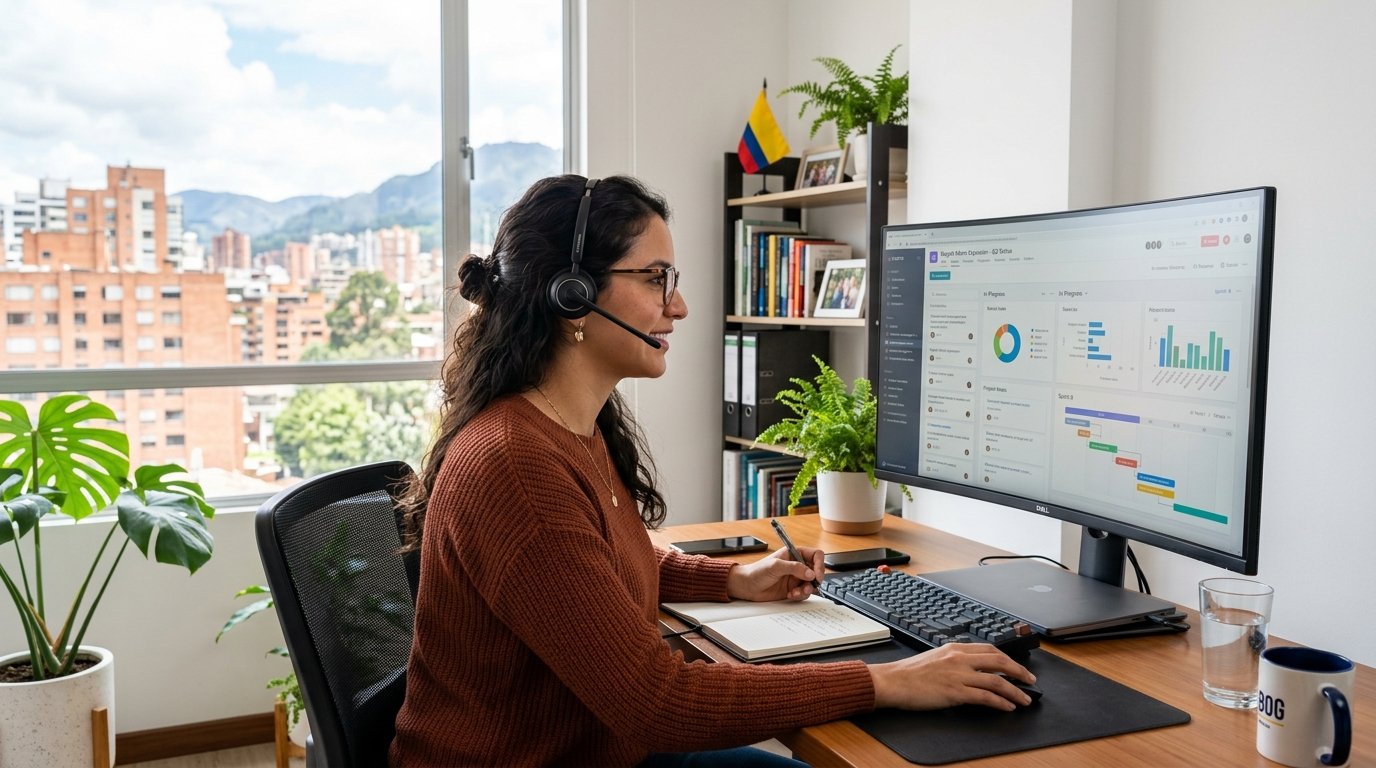
The difference between a 2-hour time zone gap and a 10-hour gap sounds administrative. In practice it determines whether your business moves at full speed or half speed. Consider a property management company fielding a maintenance emergency at 10 a.m. EST. A nearshore coordinator in Bogotá — operating on the same EST or EST-adjacent timezone — picks up the ticket, contacts the vendor, and updates the owner, all before lunch. A coordinator operating on the opposite side of the globe won't even log in until your afternoon is over.
This dynamic holds across every function: bookkeeping questions that need a same-day answer, leasing inquiries that go cold after 24 hours, and development sprints where a blocked ticket kills momentum for an entire team. The mechanics of how nearshore VAs handle time zone overlap are worth understanding in detail — especially the scheduling strategies that let nearshore staff cover 8 a.m. to 6 p.m. in any US time zone without overtime complexity.
"The single biggest productivity lever we see companies miss is time zone alignment. Teams that close the gap from 8 hours to 2 hours don't just communicate faster — they fundamentally change the quality of decisions being made." — Matt Mullenweg, CEO at Automattic (2023)
According to Gallup's State of the Global Workplace (2023), remote employees who report high levels of collaboration with their manager are 3.8 times more likely to be engaged. Time zone overlap is one of the primary structural factors that enables that collaboration to happen naturally rather than by heroic effort.
Nearshore vs. Offshore vs. Onshore: 2026 Comparison Table
Before committing to any staffing model, you need an honest look at the tradeoffs. The table below compares nearshore (Latin America), offshore (other distant regions), and onshore (US-based) virtual staffing across the seven variables that matter most to growing businesses.
| Factor | Nearshore (Latin America) | Offshore (Distant Time Zones) | Onshore (US-Based) |
|---|---|---|---|
| Time Zone Overlap with US | ✅ 0–3 hours difference | ❌ 8–13 hours difference | ✅ Exact match |
| English Proficiency | ✅ High (8/10+ screened) | ⚠️ Variable (fluency varies widely by region) | ✅ Native |
| Monthly Cost (Full-Time) | ✅ ~$2,500/mo all-in | ✅ ~$1,200–$1,800/mo (raw labor only) | ❌ $4,500–$7,500+/mo fully loaded |
| Cultural Alignment with US | ✅ Strong (shared business norms, US media fluency) | ⚠️ Moderate — varies by country | ✅ Exact match |
| Real-Time Availability | ✅ Full US business hours, no forced overnight shifts | ❌ Requires overnight shifts or async-only workflow | ✅ Full US business hours |
| Onboarding Speed | ✅ 7–14 days typical | ⚠️ 14–30 days (coordination friction) | ⚠️ 2–6 weeks (hiring pipeline) |
| Contract Flexibility | ✅ Month-to-month, 30-day notice | ⚠️ Varies by agency | ❌ Often 6–12 month commitments or W-2 obligations |
Sources: Rose Talent Solutions pricing data (2026); SHRM Talent Acquisition Benchmarking Report (2023); U.S. Bureau of Labor Statistics Occupational Employment Statistics (2024).
Distant-timezone offshore teams are cheaper on paper — but the 8-to-13-hour gap introduces invisible latency costs: slower decisions, longer feedback loops, and lower team engagement. For most US businesses, nearshore Latin America delivers better total ROI once you account for coordination overhead and the compounding drag of async-only communication.
How Rose Talent Solutions Structures Nearshore Teams for Maximum Time Zone Overlap in 2026
At Rose Talent Solutions, every team member is based in Latin America and works your standard US business hours — 9 a.m. to 5 p.m. in whatever time zone your company operates in. There is no shift negotiation, no asking someone to work through their night, and no 6 a.m. check-ins to manufacture overlap. The overlap is native to the model. Latin America's geography makes it structurally possible in a way that staffing from regions 10+ hours removed simply cannot replicate without forcing unnatural schedules on workers.
Beyond time zone alignment, every Rose team member ships with a role-specific AI copilot — trained on the software they'll actually use. Whether that's AppFolio for property management virtual staffing, QuickBooks for bookkeeping and accounting support, or a custom workflow stack. That AI layer means ramp time is shorter and output quality is higher from the first week. According to Buildium's State of the Property Management Industry Report (2024), 61% of property management companies that adopted AI-assisted workflows reported measurable reductions in administrative task completion time.
Pricing is flat at $2,500 per month — full-time, 40 hours per week, all-inclusive. Recruiting, vetting, payroll, HR, and ongoing management are all covered. There is no long-term contract. Cancel with 30 days written notice. And if a team member isn't the right fit, Rose replaces them at no additional cost. You can learn more about how it works at Rose's AI advantage page or go straight to get started here.

Understanding the average salary of a Latin America virtual assistant helps contextualize the $2,500 flat rate. Rose's all-in pricing includes the cost of employment, benefits, recruiting overhead, and management layer — which is why the comparison to a raw freelancer rate isn't apples-to-apples. You're not just buying labor; you're buying a managed, accountable team member.
How to Evaluate Whether Nearshore Development With Time Zone Overlap Is Right for Your Business
Not every company is equally ready to benefit from a nearshore model. The businesses that extract the most value share a few common characteristics: they have defined workflows (even imperfect ones), they communicate primarily over Slack, email, or video, and they have at least one internal person who can serve as a point of contact during onboarding. If you're still figuring out your internal processes, a nearshore hire will surface that gap quickly — which is actually useful information, though it can feel uncomfortable in the first two weeks.
Companies that struggle with nearshore engagements are typically those that expected zero onboarding investment. Every new hire — whether onshore, nearshore, or from any other model — requires some ramp time. The nearshore advantage is that the ramp is shorter because there's no timezone-induced async delay slowing down feedback loops. According to SHRM's Human Capital Benchmarking research (2023), the average US employer spends $4,700 per hire just in recruiting costs — before salary. That context makes the all-in nearshore model look structurally efficient by comparison.
For a detailed breakdown of where nearshore sits relative to the alternatives, the onshore vs. offshore virtual assistant comparison covers the cost and quality tradeoffs in depth — useful reading before you make a final decision on model fit.
Define the Role
Write a one-page description of the tasks, tools, and hours. Nearshore placements are faster and more accurate when the brief is specific rather than vague.
Get Matched in 48 Hours
Rose vets candidates against your role brief and presents a shortlisted match typically within 48 hours of intake. English proficiency is pre-screened at 8/10 minimum.
Interview and Confirm
You interview your matched candidate directly. If it's a fit, onboarding begins. If not, Rose re-matches at no additional cost — no pressure, no clock running.
Start in ~7 Days
Most placements are working within their first week. Rose handles all payroll, HR documentation, and tool access coordination on the back end.
Ongoing Support
Rose's management layer stays active post-placement — performance check-ins, issue escalation, and replacement coverage if anything isn't working.
Why Nearshore Wins
- Real-time collaboration during your exact business hours
- Strong English fluency — screened, not assumed
- Cultural alignment with US business norms
- All-in flat pricing at $2,500/month — no hidden costs
- No long-term contract — cancel with 30 days written notice
- Free replacement if the team member isn't a fit
What to Watch For
- You still need a defined onboarding process — nearshore isn't zero-effort
- Slightly higher monthly cost than the cheapest distant-timezone options (though total cost of ownership is competitive)
- Latin American talent pool varies by specialty — some niche technical roles require longer search windows
The bottom line: if real-time collaboration, English fluency, and cultural alignment matter to your business — and for most US businesses they do — nearshore development with time zone overlap is the structurally superior model in 2026. The cost premium over async-only offshore arrangements is modest. The productivity gain from eliminating that 8-to-13-hour communication lag is substantial. And the flexibility of a month-to-month arrangement means you can move forward without a long-term commitment weighing on you.