
What "Time Zone Overlap" Actually Means for a Remote Hire in 2026
Nearshore virtual assistants are remote professionals based in Latin America who work exclusively during US business hours. The question of how nearshore VAs handle time zone overlap with US teams comes down to one simple fact: Latin America sits 0–3 hours from every major US time zone, making full same-day collaboration structurally possible in a way that offshore hiring never achieves. Unlike hires based in the Philippines or India — who operate on a 10–14 hour time difference — nearshore VAs in countries like Colombia, Peru, and Mexico align almost exactly with Eastern, Central, and Mountain hours. That's the same offset you'd have with a contractor in Chicago dialing into a New York standup.
The distinction matters more than most hiring managers expect. When your VA is online the same hours you are, every Slack message gets a reply within minutes, not the next morning. Every urgent tenant call, client email, or bookkeeping question lands in a live inbox — not a queue that won't be touched until you're asleep. This is the core operational advantage of nearshore staffing, and it compounds every single workday.
According to Gallup's State of the American Workplace report (2023), remote workers who communicate synchronously with their teams report 21% higher engagement scores than those relying primarily on asynchronous handoffs. Time zone alignment isn't a soft benefit — it's a measurable productivity lever.
A nearshore VA is distinct from a domestic freelancer in one key way: they're a full-time, managed team member — not a contractor you find on a marketplace and manage solo. Rose Talent Solutions places VAs who are vetted, onboarded, and supported through ongoing HR and management, all included in a flat monthly rate. If you want a deeper look at how the model compares across providers, the best nearshore virtual assistant companies of 2026 roundup breaks it down by service tier and specialization.
How Latin America Time Zones Map to US Business Hours in 2026
Let's get specific about geography, because "Latin America" is a broad term and the time zone math matters. Understanding exactly how nearshore VAs handle time zone overlap with US teams requires knowing which countries Rose sources from and how each aligns with US working hours:
- Colombia, Peru, Ecuador — UTC-5 year-round (no DST). Perfectly synced with US Eastern Standard Time. One hour behind Eastern during Daylight Saving.
- Mexico City — UTC-6 (UTC-5 during CDT). Aligned with US Central Time almost perfectly.
- Argentina, Chile — UTC-3. Three hours ahead of Eastern, but still fully within a US workday. A 9am EST standup is noon in Buenos Aires.
- Costa Rica — UTC-6 year-round. Consistent Central Time alignment regardless of US DST changes.
Compare that to Manila (UTC+8) or Bangalore (UTC+5:30). A US Eastern business day of 9am–6pm corresponds to 10pm–7am in Manila. Effective real-time collaboration is structurally impossible without asking your offshore hire to work a night shift — which creates burnout, turnover, and communication lag all at once. This is precisely why the nearshore model solves what offshore cannot: it places your VA in the same working moment as your US team, not twelve time zones away from it.
The Bureau of Labor Statistics American Time Use Survey (2023) shows that the average US knowledge worker spends 2.3 hours per day in real-time communication — calls, video meetings, and instant messaging. If your VA cannot participate in that communication window, you're effectively managing a one-way information relay, not a collaborative team member.
For a detailed breakdown of why this overlap gap is the defining variable in the nearshore-vs-offshore decision — not the hourly rate — see Rose's nearshore vs. offshore virtual assistant comparison, which maps out communication latency, cultural alignment, and total cost of coordination across both models.
How Nearshore VA Time Zone Alignment Compares to Other Hiring Models in 2026
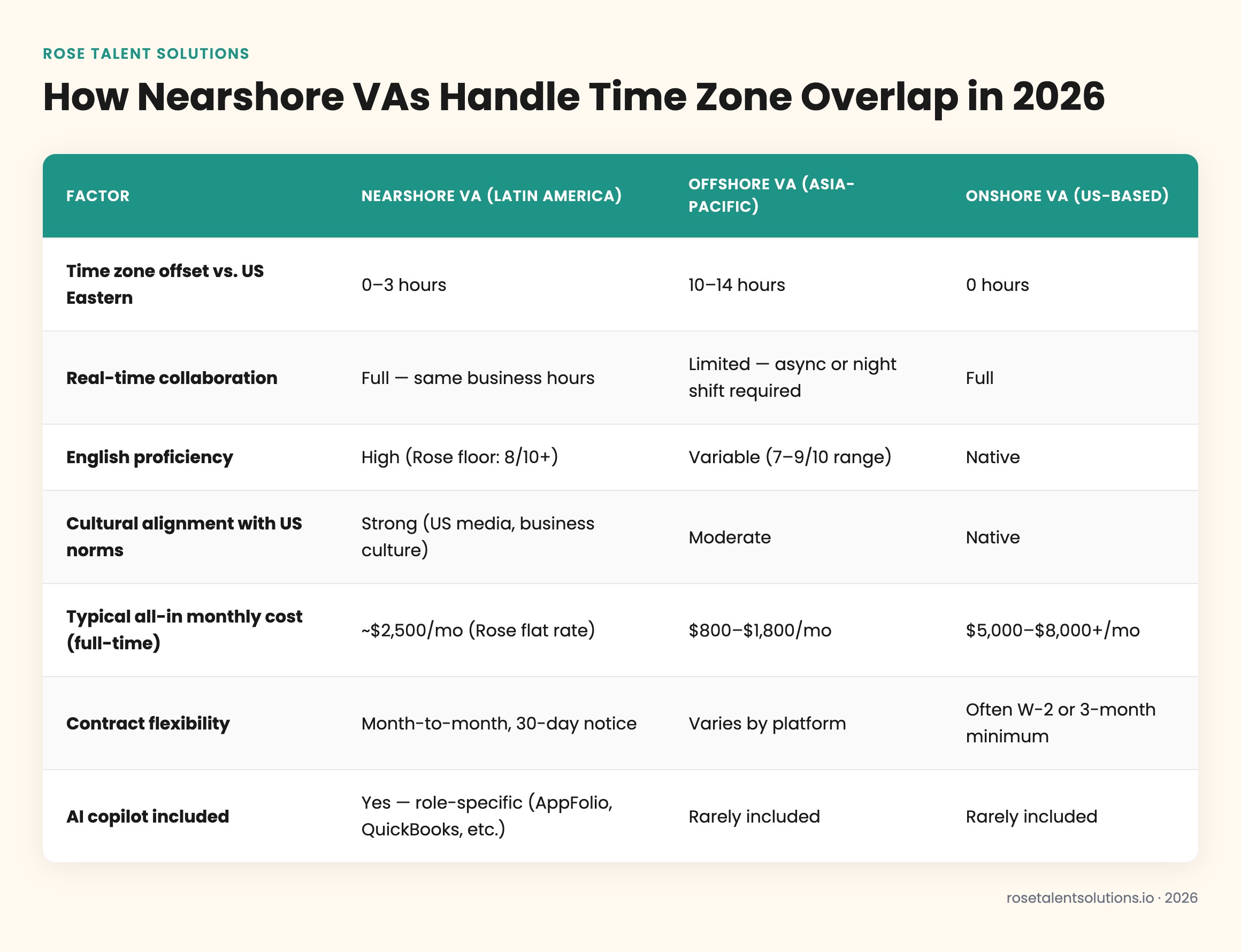
The table below puts the three most common remote staffing options side by side across the five dimensions that matter most to US business owners: overlap hours, communication speed, English fluency, cultural fit, and all-in monthly cost. When buyers ask how nearshore VAs handle time zone overlap with US teams versus other models, this comparison makes the answer concrete.
| Factor | Nearshore VA (Latin America) | Offshore VA (Asia-Pacific) | Onshore VA (US-based) |
|---|---|---|---|
| Time zone offset vs. US Eastern | 0–3 hours | 10–14 hours | 0 hours |
| Real-time collaboration | Full — same business hours | Limited — async or night shift required | Full |
| English proficiency | High (Rose floor: 8/10+) | Variable (7–9/10 range) | Native |
| Cultural alignment with US norms | Strong (US media, business culture) | Moderate | Native |
| Typical all-in monthly cost (full-time) | ~$2,500/mo (Rose flat rate) | $800–$1,800/mo | $5,000–$8,000+/mo |
| Contract flexibility | Month-to-month, 30-day notice | Varies by platform | Often W-2 or 3-month minimum |
| AI copilot included | Yes — role-specific (AppFolio, QuickBooks, etc.) | Rarely included | Rarely included |
"The single biggest mistake companies make with outsourcing is assuming that cheaper labor costs offset the communication overhead. They don't — time zone misalignment creates a coordination tax that compounds every day." — Matthew Mottola, Author of The Human Cloud and Future of Work Analyst (2023)
How Real-Time Overlap Changes Day-to-Day Operations in 2026
Time zone alignment isn't just about convenience — it changes the operational tempo of your business in concrete ways. Consider a property management company running 200 units. Maintenance requests come in throughout the day. Leasing inquiries need same-hour responses or prospects go cold. Owner reports need to be pulled before EOD calls. Every one of these tasks requires a VA who is online, responsive, and reachable when the work actually happens — not eight hours after the fact.
According to the National Association of Realtors (2023), 71% of buyers and renters expect a response to their inquiry within one hour. An offshore VA who receives your tenant's maintenance ticket at 2pm EST and processes it at 3am their time won't meet that window. A nearshore VA seated in Bogotá at 2pm EST is working the same live business day as your leasing manager — and can act immediately. This is the operational reality of how nearshore VAs handle time zone overlap with US teams: not by stretching schedules, but by being genuinely co-located in time.
The hidden cost of non-nearshore VAs isn't the lower hourly rate — it's the 10–14 hour timezone gap that converts every real-time decision into an overnight delay. For client-facing roles especially, that lag directly reduces response quality, customer satisfaction, and revenue conversion.
Rose VAs also arrive equipped with role-specific AI copilots trained on the software your business already uses — AppFolio, Buildium, QuickBooks, and more. This means the time-to-productivity curve is compressed significantly. You're not just getting someone in your time zone; you're getting someone who already understands your software's workflows from day one. Explore how that works in detail on Rose's AI advantage page.
The Society for Human Resource Management (2022) estimates that replacing a mid-level employee costs 50–200% of their annual salary. When time zone misalignment creates chronic communication friction — missed deadlines, rework, delayed handoffs — the downstream turnover risk on your core team rises, not just on the VA side.
How Rose Structures Nearshore Onboarding for Seamless Time Zone Integration in 2026
Knowing that time zone alignment is possible is one thing. Knowing how it's operationalized during onboarding is what turns the theory into a working team. Here's the standard sequence Rose uses to get a nearshore VA integrated into your US team's daily rhythm — typically within the first two weeks. This process is specifically engineered around how nearshore VAs handle time zone overlap with US teams from the very first day of engagement.
Role Scoping & Hours Confirmation
Before matching begins, Rose confirms your core business hours and communication tools (Slack, Teams, phone). Your VA's schedule is locked to match — not approximate — your working window.
Candidate Matching (Days 1–5)
Rose's recruiting team screens candidates on English proficiency (8/10+ floor), software fluency, and time zone availability. Only candidates already operating in your target hours are presented. For a benchmark of how long this stage takes across providers, see the nearshore VA hiring timeline benchmarks.
AI Copilot Configuration
Before day one, your VA's role-specific AI copilot is configured for your software stack — whether that's AppFolio for property management, QuickBooks for bookkeeping and accounting, or a custom stack. This cuts ramp time dramatically.
Live Team Integration (Week 1–2)
Your VA joins your standups, Slack channels, and task queues on day one — working the same hours as your team. Rose's ongoing management layer handles any early-stage friction so you don't have to troubleshoot solo.
Fit Review & Replacement Guarantee
If at any point the team member isn't the right fit, Rose replaces them at no additional cost. No penalty, no restart fee — just a new match initiated immediately. Ready to begin? Start the process here.
The all-in rate for this — recruiting, vetting, payroll, HR, ongoing management, and the AI copilot — is $2,500 per month, flat. Full-time, 40 hours per week. Month-to-month with no long-term contract; cancel with 30 days written notice. According to McKinsey & Company's Future of Work research (2021), businesses that standardize remote team onboarding with defined communication protocols see 35% faster time-to-full-productivity compared to ad hoc onboarding. Rose's structured approach to nearshore time zone integration is exactly that kind of protocol — systematized and repeatable.
Nearshore VA: Time Zone Pros
- 0–3 hour offset — full same-day collaboration
- Joins live calls, standups, and real-time Slack threads
- Same-hour turnaround on client-facing tasks
- No night shift premium or schedule compromise
- Cultural calendar alignment (US holidays, business norms)
Offshore VA: Time Zone Cons
- 10–14 hour offset forces async-only workflows
- Urgent tasks sit overnight before action
- Live calls require one party to work unsociable hours
- Cultural calendar misalignment adds coordination overhead
- Communication lag compounds rework and missed deadlines
If you're evaluating multiple providers before committing, the best nearshore staffing agencies for startups guide offers a side-by-side look at how agencies structure time zone guarantees, onboarding timelines, and pricing — useful context whether you're a 3-person startup or a 50-person operation scaling fast.