
What Is a Nearshore CPA — and Why Does It Matter in 2026?
Nearshore CPA work means hiring a credentialed or CPA-supervised accounting professional based in Latin America who operates entirely on your time zone. Unlike offshore teams in the Philippines or India — where a 10-to-12-hour gap turns every question into an overnight delay — nearshore staff in Colombia, Mexico, or Argentina log on when you do, answer Slack messages in real time, and close your books before your US colleagues head to lunch.
The term "nearshore" is geographic and operational: Latin America sits in the same or adjacent time zones as the continental United States, which is the structural advantage that separates it from every other outsourcing region. A nearshore CPA is not a freelancer on a gig platform. They are a full-time, vetted professional whose employment, payroll, and compliance are managed by a staffing partner — so you get the output of an experienced accountant without the overhead of a domestic W-2 hire.
The US accounting labor market makes this relevant fast. According to the U.S. Bureau of Labor Statistics (2024), the median annual wage for accountants and auditors in the United States is $79,880 — and that figure does not include benefits, payroll taxes, or recruiting costs that routinely add another 25–35% on top.
For small and mid-sized businesses, that number is prohibitive. A nearshore CPA model lets you staff a full-time, 40-hour-per-week accounting role for a predictable flat rate — without the six-figure salary, the benefits package, or the months-long domestic search. According to the AICPA's talent pipeline research (2023), accounting firms and finance departments across the US are facing a sustained shortfall of qualified domestic candidates, with the number of students sitting for the CPA exam declining for five consecutive years — a structural supply problem that makes nearshore staffing not just a cost play, but a practical necessity.
How Nearshore CPAs Compare to Offshore and Onshore Accounting Staff in 2026
The three staffing models — nearshore, offshore, and onshore — are not interchangeable. Each has a distinct cost profile, communication dynamic, and risk level. The table below lays them out side by side so you can make a direct comparison.
| Factor | Nearshore (Latin America) | Offshore (Philippines / India) | Onshore (US Domestic) |
|---|---|---|---|
| Monthly all-in cost (full-time) | ~$2,500 flat | $1,200–$1,800 | $6,500–$9,500+ |
| Timezone overlap with US | Full overlap (EST–PST) | 2–4 hours/day at best | Full overlap |
| English proficiency (avg. score) | 8/10+ (screened) | Varies widely | Native |
| Recruiting + HR burden on employer | Handled by staffing partner | Often handled by employer | Fully on employer |
| Typical ramp time to productive | 1–2 weeks | 3–6 weeks (timezone friction) | 2–4 weeks |
| Payroll / compliance risk | Staffing partner carries it | Mixed — depends on structure | Employer carries it |
| Replacement if not a fit | Included at no extra cost | Varies by provider | Full re-hire cost |
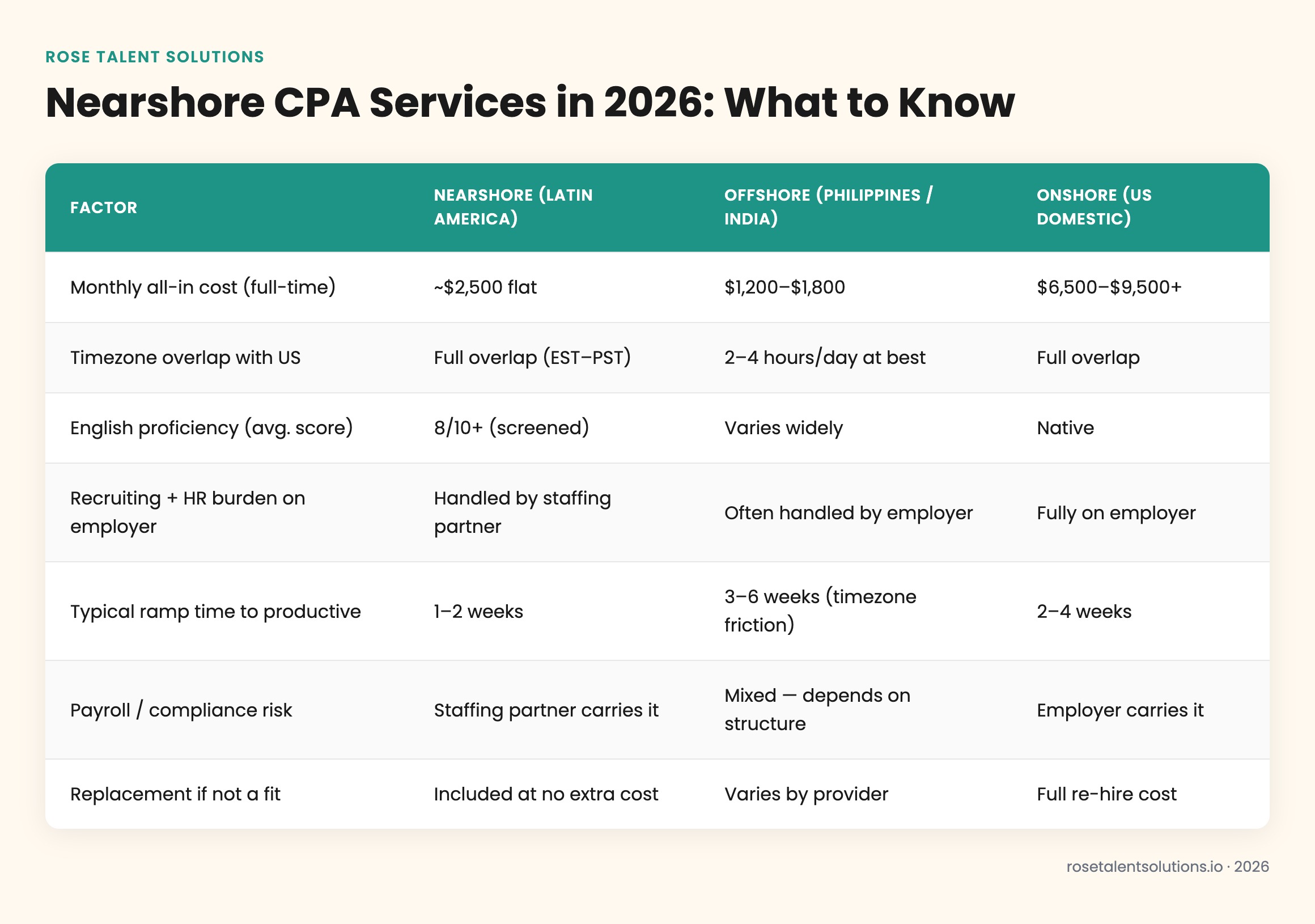
The cost gap between nearshore and offshore looks narrow until you factor in the hidden costs of the timezone lag: delayed closes, doubled review cycles, and the management overhead of batching questions for an overnight queue. When you account for those, nearshore accounting arrangements typically deliver faster turnaround at only a modest price premium over offshore alternatives.

What Tasks Can a Nearshore CPA or CPA-Supervised Accountant Actually Handle?
One of the most common misconceptions is that nearshore accounting hires are limited to data entry or invoice processing. In practice, a well-screened nearshore professional — especially one paired with AI-assisted workflows — can own substantial portions of the accounting function end to end.
Typical task scope for a nearshore CPA or senior bookkeeper includes:
- Full-cycle accounts payable and receivable
- Bank and credit card reconciliations
- Monthly close support and journal entries
- Payroll processing and benefits reconciliation
- Financial statement preparation and variance analysis
- Sales tax and use tax filing support
- 1099 preparation and vendor management
- Audit-ready workpaper organization
- Software management in QuickBooks, Xero, NetSuite, or Sage
If your business runs on QuickBooks, Rose's team members arrive pre-trained on the platform. You can explore the bookkeeping and accounting staffing page to see how roles are scoped. For context on what a QuickBooks-trained hire actually costs versus a domestic alternative, the QuickBooks virtual bookkeeper cost breakdown walks through the math in detail.
The AI copilot layer matters here. Every Rose team member is paired with a role-specific AI assistant pre-trained on the software stack they will use — whether that is QuickBooks, Xero, or a niche ERP. According to McKinsey's report on generative AI's economic potential (2023), accounting and finance functions stand to gain the highest productivity uplift from AI augmentation among all back-office categories. A nearshore hire with an AI copilot is not a cheaper version of a domestic accountant — in throughput terms, they can often exceed one. You can see exactly how Rose structures that layer on the AI advantage overview page.
How the Compliance Side of a Nearshore CPA Arrangement Works in 2026
Compliance is the question that stops most business owners from pulling the trigger on a nearshore hire. How does payroll work? Who handles taxes? What are the labor law obligations in Colombia or Mexico?
The short answer: when you engage through a staffing partner like Rose Talent Solutions, those questions are not yours to answer. Rose handles recruiting, vetting, payroll, local labor law compliance, and ongoing HR in Latin America. You issue one flat invoice per month. The team member works your hours, in your tools, on your accounts — and the employment infrastructure sits with Rose.
"The biggest compliance risk companies face with international remote staff isn't tax — it's misclassification. Treating a full-time remote worker as an independent contractor when local law says otherwise is the exposure most CFOs don't see coming." — Karin Borchert, CEO at Modern Hire (2023)
Structuring the engagement through a proper employer-of-record or managed staffing model eliminates that misclassification exposure entirely. For a deeper look at the specific compliance checkpoints involved in running a nearshore tax and accounting team, the nearshore tax accounting compliance checklist covers the exact documents, filings, and contractual structures you should verify before you start.
The compliance risk in nearshore accounting is not the work itself — it is the employment structure. A managed staffing model where the staffing partner carries payroll, HR, and local labor law obligations eliminates the misclassification risk that makes DIY international hiring genuinely dangerous for a small business.
According to SHRM's global HR research (2024), companies that use managed international staffing arrangements report 67% fewer compliance incidents than those that manage cross-border employment directly. That gap is not surprising — local labor law in countries like Colombia and Mexico changes frequently, and keeping up with it is a full-time function by itself. For additional framing on how international employment structures work, Deloitte's Global Employer Services practice publishes detailed guidance on employer-of-record obligations and cross-border payroll compliance that is worth reviewing before you structure any international staffing arrangement.

How Rose Talent Solutions Places a Nearshore CPA: The 2026 Process
Understanding the placement process removes the ambiguity that makes business owners hesitate. Rose's model is built around speed and fit — most clients have a screened, placed team member in under two weeks.
Intake Call and Role Definition
Rose's team walks you through the specific accounting tasks, software stack, and working hours you need covered. This call typically runs 30 minutes and produces a written role spec.
Recruiting and Vetting
Rose sources from its Latin America talent network and screens candidates against your spec — including English proficiency (8/10+ floor), software skills, and a live accounting assessment relevant to your industry.
Client Interview and Selection
You interview the top 1-2 candidates. You make the final selection — Rose does not place anyone without your explicit approval.
Onboarding and AI Copilot Setup
Your new team member is onboarded into your tools and paired with a role-specific AI copilot pre-trained on your accounting software. Most clients report full productivity within the first two weeks.
Ongoing Management and Replacement Guarantee
Rose handles HR, payroll, and performance issues. If the team member isn't the right fit, Rose replaces them at no additional cost — no penalties, no delays, no long-term contract holding you in place.
The pricing is $2,500 per month, flat, for a full-time 40-hour-per-week team member. That rate covers recruiting, vetting, payroll, HR, compliance, and ongoing management. You can learn more about getting started at the Rose Talent Solutions start page. The engagement is month-to-month with 30 days written notice to cancel — no long-term contract required.
Nearshore vs. Offshore CPA Staffing: Pros and Cons in 2026
If you are weighing a nearshore model against a lower-cost offshore alternative, the honest comparison looks like this:
Nearshore CPA — Pros
- Full US-hours overlap — real-time collaboration, same-day turnaround
- English proficiency screened to a defined floor (8/10+)
- Payroll, HR, and compliance managed by staffing partner
- Month-to-month terms — no long-term contract lock-in
- Free replacement if team member is not the right fit
- AI copilot included, pre-trained on your software stack
Offshore CPA — Cons
- 10–14 hour timezone gap creates overnight queues on every question
- English proficiency highly variable, often unscreened
- Monthly close cycles routinely extend due to delayed responses
- Employer often carries misclassification and compliance risk directly
- No structured replacement guarantee in most arrangements
The offshore model's lower sticker price is real — but it is also the floor. When you add the management hours your US team spends batching questions, re-reviewing work for accuracy, and compensating for async delays, the effective cost per productive output hour often closes the gap entirely. Timezone alignment is not a soft benefit — it is the operational mechanism that determines how fast your books close.
If your team already uses Xero rather than QuickBooks, the same nearshore logic applies. The guide to hiring a Xero virtual bookkeeper covers how to scope that role and what to look for in a screened nearshore candidate.
According to Gallup's research on distributed work (2023), the single greatest predictor of remote team performance is overlap in working hours — not location, not language, and not technology. Nearshore staffing is, at its core, a structural answer to that finding: it puts your accounting team in the same working day as the rest of your business. And according to IOFM's 2024 AP Automation Trends Report, finance teams that pair skilled human staff with AI-assisted workflows reduce invoice processing errors by up to 37% — exactly the combination a nearshore hire with an embedded AI copilot is designed to deliver.