
Nearshore virtual assistants are changing how property management companies scale — but the difference between a VA who transforms your operations and one who creates more work than they save almost always comes down to how you onboard a property management VA in your software stack. Get the access, SOPs, and communication structure right in the first week, and you'll have a self-sufficient team member in under 14 days. Get it wrong, and you'll spend three weeks untangling permission errors and explaining the same maintenance workflow four times. This guide walks you through the exact process, tool by tool, so you can onboard a property management VA in your software stack without the guesswork.
According to Buildium's State of the Property Management Industry report (2025), 63% of property managers cite inadequate software training as the primary reason new hires underperform in their first month. That number holds whether the hire is a salaried coordinator sitting in your office or a virtual assistant working from Bogotá. Software access is not a technicality — it is the foundation of every task your VA will touch.
What Is a Nearshore Property Management VA — and Why Does It Matter for Onboarding in 2026?
A nearshore virtual assistant is a full-time remote team member based in Latin America who works your US business hours, communicates in fluent English, and operates entirely within your existing software stack. Unlike offshore VAs based in the Philippines or India — who often work on 6-to-12-hour time-shifted schedules — a nearshore VA in Mexico City, Medellín, or Buenos Aires is online when your tenants are calling and your owners are emailing. That time alignment is not a comfort feature; it is an operational necessity for property management, where a maintenance emergency at 10am EST cannot wait until tomorrow morning for a response batch.
If you want a deeper breakdown of how these models compare on cost and coverage, our guide on nearshore virtual assistant property management covers the tradeoffs in full. For onboarding purposes, the critical distinction is this: a nearshore VA can participate in a live Zoom walkthrough of your AppFolio or Buildium workflow at 9am your time, ask questions in real-time, and start handling tickets by the afternoon of day one. That compressed ramp time is only possible because of timezone parity.

How to Set Up Software Access Before You Onboard a Property Management VA in Your Software Stack
The single biggest mistake property managers make when they onboard a property management VA in their software stack is waiting until the VA's first day to create logins. By the time you've submitted the user invite, waited for IT approval, and troubleshot the two-factor authentication setup, you've burned half a morning. Do this the week before they start — no exceptions.
Here is the exact access checklist to complete before your VA's first day:
- AppFolio or Buildium: Create a role-scoped user with the minimum permissions needed for their task set. For a leasing coordinator, that typically means read/write on units, applications, and tenant communications — but not owner financials. For more detail on scoping AppFolio roles specifically, see our AppFolio virtual assistant hiring guide.
- Communication tools: Add them to your Slack or Teams workspace with the correct channels. Create a dedicated #va-questions channel so they have a low-friction path to ask questions without interrupting your main ops threads.
- Email access: Set up a company email address (e.g., maintenance@yourcompany.com) with appropriate forwarding rules. Do not share a personal inbox — this creates audit trail problems.
- Task management: Add them to your project management tool (Asana, ClickUp, Monday.com) with a pre-built onboarding task list they can self-navigate.
- Document library: Share your SOP folder via Google Drive or Notion with view/comment access on all docs, edit access only on their role-specific templates.
According to the U.S. Bureau of Labor Statistics Job Openings and Labor Turnover Survey (2024), companies with structured onboarding processes retain new hires at a rate 50% higher than those with informal processes. A VA is no different — the structure you provide in the first five days directly predicts their 90-day performance.
Pre-staging software access before day one is not just about efficiency — it signals to your new VA that you are an organized operator worth working hard for. First impressions run both directions.
How Nearshore VAs Compare to Offshore and Onshore Options in 2026
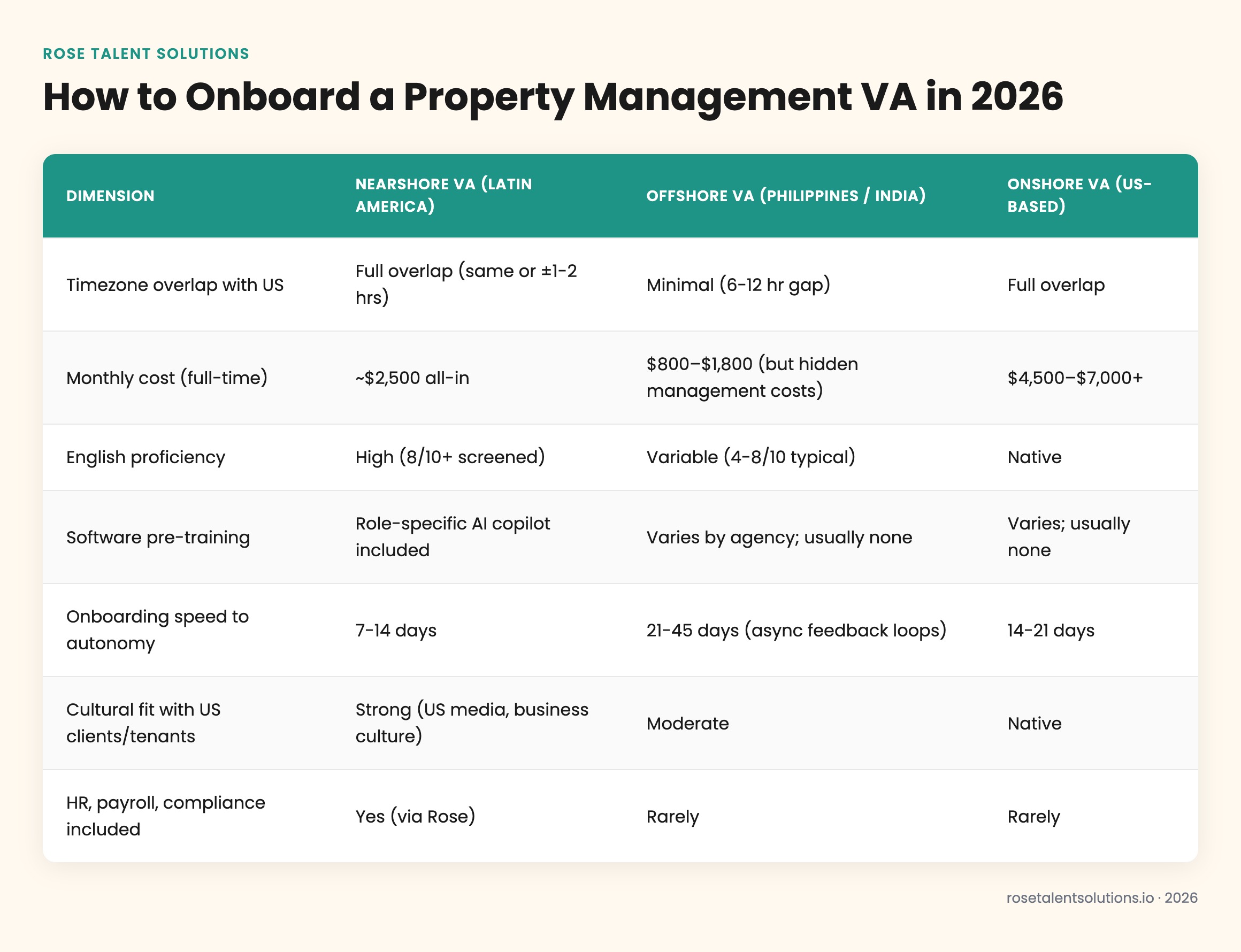
Before you finalize your plan to onboard a property management VA in your software stack, it helps to understand what you're working with relative to the alternatives. The table below compares the three main VA sourcing models on the dimensions that most affect how you'll onboard and manage them day-to-day.
| Dimension | Nearshore VA (Latin America) | Offshore VA (Philippines / India) | Onshore VA (US-based) |
|---|---|---|---|
| Timezone overlap with US | Full overlap (same or ±1-2 hrs) | Minimal (6-12 hr gap) | Full overlap |
| Monthly cost (full-time) | ~$2,500 all-in | $800–$1,800 (but hidden management costs) | $4,500–$7,000+ |
| English proficiency | High (8/10+ screened) | Variable (4-8/10 typical) | Native |
| Software pre-training | Role-specific AI copilot included | Varies by agency; usually none | Varies; usually none |
| Onboarding speed to autonomy | 7-14 days | 21-45 days (async feedback loops) | 14-21 days |
| Cultural fit with US clients/tenants | Strong (US media, business culture) | Moderate | Native |
| HR, payroll, compliance included | Yes (via Rose) | Rarely | Rarely |
"The fastest path to VA productivity isn't more training videos — it's giving them a live workflow to shadow on day one, in the same timezone, with someone they can ask questions to in real time." — Jordan Brown, Head of Operations at National Association of Residential Property Managers (NARPM), quoted in PM Grow Summit proceedings (2024)
How to Build the SOP Library That Makes Your Property Management VA Self-Sufficient
Your VA will only be as good as the documentation you give them. This is not a commentary on their capability — it is a systems truth that applies to every hire in every industry. According to SHRM's onboarding research (2024), employees who receive clear role documentation in their first week are 2.5× more likely to meet their 60-day performance benchmarks. Write the SOPs before they start, not after.
For a property management VA, the minimum SOP library should cover:
- Maintenance request workflow: How a tenant submits a ticket, how you categorize urgency (emergency vs. routine), which vendors to contact, and how to update the work order status in AppFolio or Buildium. If you're running Buildium specifically, our post on onboarding a Buildium virtual assistant has a workflow template you can adapt directly.
- Leasing inquiry response: Script for first-touch responses, qualification questions to ask prospective tenants, how to schedule showings inside your CRM, and the escalation path for edge cases.
- Owner reporting: Monthly statement distribution schedule, which owners get proactive calls versus email-only, and how to handle owner questions about line items without making financial commitments.
- Rent collection follow-up: Day-1, Day-5, and Day-10 late payment communication cadence, what language is compliant in your state, and when to escalate to management.
Keep each SOP to one page maximum. A VA who needs to scroll through a 12-page document to remember how to close a work order will revert to guessing. Loom videos work well as supplements — record yourself doing the task once in the software, link it in the SOP, and let them replay it as many times as needed.

The National Association of Realtors' 2024 Technology Survey found that property management firms using documented digital workflows reduced onboarding time for new staff by an average of 38%. That time saving compounds: a VA who reaches autonomy in 10 days instead of 21 gives you 11 additional productive days in their first month alone.
Rose team members arrive with a role-specific AI copilot pre-trained on the software they'll use — AppFolio, Buildium, QuickBooks, and others. That means they are not starting from zero on software knowledge when you onboard a property management VA in your software stack; they arrive knowing the interface. Your SOPs teach them your specific workflows, preferences, and escalation paths — the institutional knowledge that no AI can pre-load.
How to Run Your VA's First Two Weeks Without Micromanaging in 2026
The goal of a structured onboarding process is not to watch your VA constantly — it is to create enough clarity that they do not need you to. Here is the sequence that consistently produces autonomous VAs within 14 days when you onboard a property management VA in your software stack correctly:
Day 1: Live Shadow Session (2 hours)
Screen-share your AppFolio or Buildium account and walk through one real maintenance ticket and one leasing inquiry from start to close. Let them take notes. Do not rush. Answer every question on the spot.
Days 2-3: Supervised Practice
Assign them 5 real (low-stakes) tasks — work order updates, inquiry responses, scheduling. They complete them; you review within 2 hours and give written feedback in your shared task tool.
Days 4-7: Monitored Independence
They handle their full task queue independently. You run a 15-minute end-of-day Slack check-in to surface blockers. No hovering — just a structured window for questions.
Week 2: Async Operations with Weekly Sync
They run their full workflow without daily check-ins. You hold a 30-minute weekly video call to review KPIs: response time, work order close rate, leasing conversion steps. Adjust SOPs based on what surfaces.
Day 14: Autonomy Checkpoint
Review the previous two weeks' output against your baseline metrics. If they're meeting targets, shift to monthly performance reviews. If there are gaps, identify whether it's a training issue or a fit issue — and act on it immediately.
The autonomy checkpoint at day 14 is critical. If a property management VA is not performing at a functional level after two structured weeks inside your software stack, continuing the same approach will not fix the underlying issue. Rose's model includes a free replacement if a team member is not the right fit — so you are not locked into a placement that is not working. Month-to-month terms with no long-term contract mean you retain full flexibility as your needs evolve.
Understanding the full cost structure before you hire matters too. If you have not yet compared what an in-house coordinator versus a VA actually costs your business, our breakdown of how much does a property management VA cost per month puts real numbers on both sides of that equation.
What Good Onboarding Looks Like
- Software access staged before day one
- One-page SOPs for every core workflow
- Live shadow session on day one, not async video
- Daily check-ins in week one, weekly in week two
- Clear KPIs reviewed at the 14-day mark
What Kills Onboarding Success
- Waiting until day one to create software logins
- Sending a 20-page manual with no live walkthrough
- No dedicated communication channel for VA questions
- Vague task assignments without expected outputs defined
- No checkpoint — assuming it's working without measuring
According to Gallup's research on onboarding program failures (2024), only 12% of employees strongly agree that their employer did a great job onboarding them. The gap is almost always documentation and structure — not the hire's capability. The same dynamic applies when you onboard a property management VA in your software stack. The operators who get the most from their nearshore team members are the ones who invested three hours building their SOP library before the VA ever logged in. Ready to start building your nearshore property management team? The process begins with a single conversation.
The first two weeks of a VA's tenure with your business are the highest-leverage period of your entire working relationship. The structure you put in place — or fail to put in place — in those 14 days will determine whether you have a team member who adds 20 hours of capacity per week or a recurring source of friction. Choose structure. Choose specificity. And choose a nearshore VA who already knows your software stack before they start.