
Nearshore bookkeeping professionals who work inside QuickBooks every day will tell you the same thing: the software cost is only half the equation. Before we get into the full 2026 QuickBooks pricing breakdown, it's worth knowing that most US businesses underestimate what they'll actually spend — because Intuit's list prices don't include payroll, additional users, or the human labor required to make the numbers accurate. This guide covers every plan, every add-on, and shows you exactly where the real costs hide.
What Is QuickBooks Online and Who Is It For?
QuickBooks Online (QBO) is a cloud-based accounting platform built for small to mid-sized businesses. It handles invoicing, expense tracking, bank reconciliation, payroll (as an add-on), and financial reporting. As of 2026, it is the most widely used small business accounting software in the United States, with Intuit reporting over 7 million global subscribers across its QuickBooks Online products.
QuickBooks is not a bookkeeping service — it is a tool. Someone still has to categorize transactions, reconcile accounts, and generate accurate reports. That distinction matters enormously when you're calculating the true cost of "using QuickBooks."
How Much Does QuickBooks Online Cost in 2026?
Intuit has adjusted its pricing multiple times in recent years. The table below reflects published retail prices as of 2026. Promotional discounts (typically 50% off for the first three months) are often available but should not be counted on for budgeting purposes.
| Plan | Monthly Price (2026) | Users Included | Best For | Key Limitations |
|---|---|---|---|---|
| Simple Start | $35/mo | 1 | Freelancers, solo operators | No bill management, no time tracking |
| Essentials | $65/mo | 3 | Small teams, basic AP | No inventory, no project profitability |
| Plus | $99/mo | 5 | Growing businesses, inventory | No dedicated account manager |
| Advanced | $235/mo | 25 | Multi-entity, analytics, automation | High cost; still requires trained user |
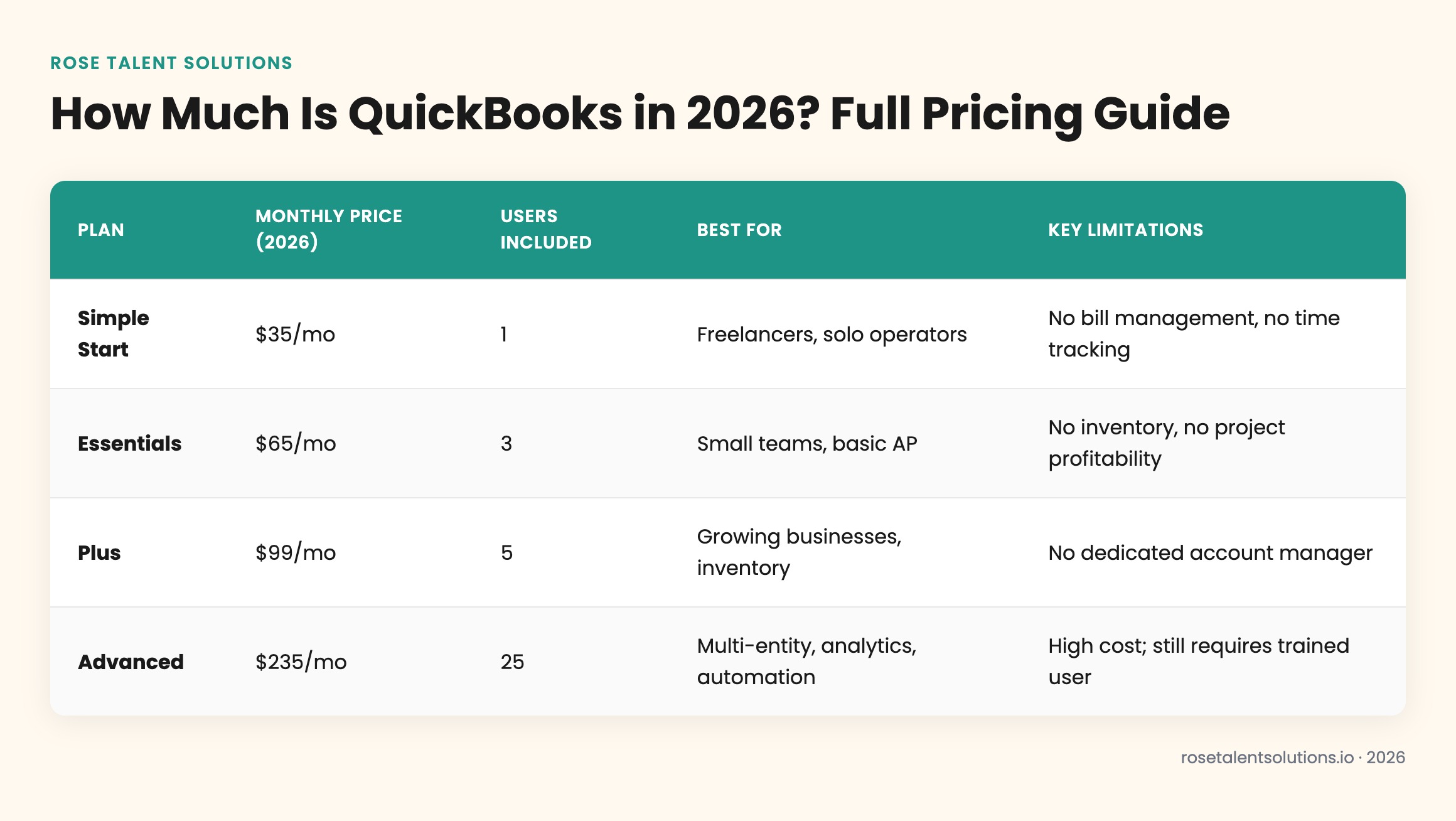
These are software-only prices. If you need payroll, Intuit charges an additional $45–$130/month base fee plus $6–$11 per employee per month, according to QuickBooks Payroll pricing pages (2025). A five-person company on QuickBooks Plus with payroll can easily cross $200/month before anyone has touched a journal entry.

What Does QuickBooks Live Bookkeeping Cost in 2026?
QuickBooks Live is Intuit's managed bookkeeping add-on. A certified bookkeeper (contracted through Intuit's network) connects to your account and handles cleanup, categorization, and monthly close. It sounds convenient — and for some businesses it is — but the pricing model deserves a close look.
QuickBooks Live Bookkeeping pricing is tiered by your business's monthly expenses. Lower-expense businesses pay around $200–$400/month; higher-volume businesses can pay $700/month or more, stacked on top of their existing QBO subscription. For a detailed breakdown of exactly what you get at each tier and how it compares to hiring your own bookkeeper, see our full post on how much QuickBooks Live Bookkeeping costs — including the tier thresholds Intuit doesn't advertise prominently.
"Small business owners often assume QuickBooks Live is a full-service accounting department. It's really a categorization and cleanup service — anything beyond monthly close requires a separate accountant or bookkeeper." — Joe Woodard, CEO at Woodard Events & Scaling New Heights Conference (2024)
The critical point: QuickBooks Live does not include tax filing, CFO-level analysis, accounts payable management, or payroll. Those gaps push many businesses toward hiring a dedicated bookkeeper — which is where the real cost calculation starts.
How Do QuickBooks Add-On Costs Stack Up in 2026?
Intuit's base pricing is designed to look approachable. The add-on ecosystem is where the monthly bill quietly doubles. Here are the most common additions businesses discover after signing up:
- QuickBooks Payroll Core: $45/mo + $6/employee
- QuickBooks Payroll Premium: $80/mo + $8/employee
- QuickBooks Time (time tracking): $20/mo + $8/user
- QuickBooks Payments (card processing): 2.4%–3.5% per transaction
- Additional user seats (above plan limits): Requires upgrading to next plan tier
A realistic mid-sized business on the Plus plan — with payroll for eight employees, time tracking for five, and card payments — could easily spend $350–$500/month on QuickBooks products alone, according to published Intuit pricing. That does not include the cost of whoever is operating the platform.
The software subscription is not the bookkeeping cost — it is the prerequisite. Every QuickBooks plan still requires a trained human to reconcile accounts, catch errors, and produce reports you can actually use. Businesses that forget this end up paying twice: once for the tool, and again to fix the mess.
How Does QuickBooks Pricing Compare to Hiring a Bookkeeper in 2026?
This is the question most business owners eventually land on. Software alone doesn't close your books. According to the U.S. Bureau of Labor Statistics (2024), the median annual wage for bookkeeping and accounting clerks in the United States is $47,440 — roughly $3,953/month before benefits, payroll taxes, and overhead. A full-time in-house bookkeeper in a major metro market often costs $55,000–$70,000/year fully loaded.
Freelance bookkeepers on platforms like Upwork or Bench typically charge $25–$75/hour, according to SHRM's workforce cost benchmarks (2024). At even 20 hours/month — a modest engagement — that's $500–$1,500/month with no guarantee of continuity, software familiarity, or availability during your peak periods.
If you're evaluating what a QuickBooks-trained virtual bookkeeper specifically costs compared to these options, our breakdown of QuickBooks virtual bookkeeper costs walks through hourly vs. flat-rate pricing models in detail — including what you should expect for full-time dedicated support.

The alternative gaining traction with lean US businesses is a nearshore virtual bookkeeper: a full-time, Latin America-based professional who works US business hours, is fluent in English, and comes already trained on QuickBooks. At Rose Talent Solutions' bookkeeping and accounting service, that's $2,500/month flat — all-in, covering recruiting, vetting, payroll, HR, and ongoing management. No long-term contract. If the team member isn't a fit, Rose replaces them at no additional cost.
Compare that to $3,953/month median for a US-based hire — plus benefits — and the math is straightforward. According to McKinsey & Company research on nearshore talent (2024), Latin America-based professionals working US hours show communication overhead comparable to domestic hires, with significantly lower total employment cost.
Nearshore QuickBooks Bookkeeper
- Full-time, 40 hrs/week dedicated to your books
- Works US business hours — available on Slack by 9am
- Flat $2,500/mo all-in (no payroll taxes, benefits, or overhead)
- Pre-vetted QuickBooks proficiency; role-specific AI copilot included
- No long-term contract; free replacement if not a fit
US In-House Bookkeeper
- $55,000–$70,000/year fully loaded (salary + benefits + taxes)
- Recruiting takes 4–10 weeks on average
- You manage HR, PTO, turnover, and software licensing separately
- Replacement costs average 50–200% of annual salary if they leave
- Software subscription still billed separately
What Is a Nearshore Virtual Bookkeeper? 2026 Definition
A nearshore virtual bookkeeper is a full-time, remote accounting professional based in Latin America — typically countries like Mexico, Colombia, Argentina, or Costa Rica — who works exclusively during US business hours. Unlike offshore bookkeepers based in the Philippines or India, nearshore professionals share overlapping time zones with US clients, eliminating the communication lag that slows down reconciliations and approvals. Rose's published English proficiency floor is 8/10 or higher on standardized screens.
Every Rose team member ships with a role-specific AI copilot trained on their primary software — in this case, QuickBooks Online. That means faster transaction categorization, smarter anomaly flagging, and report generation that doesn't require a CPA to interpret. It is a materially different product than a generic VA who "knows bookkeeping."
If you're also evaluating Xero as an alternative to QuickBooks, our guide on hiring a Xero virtual bookkeeper covers the platform-specific skills to look for and how pricing compares across both ecosystems.
How the Rose Talent Matching Process Works in 2026
Intake Call
Rose's team learns your business, your QuickBooks setup, your volume, and the specific tasks you need handled daily — AP, AR, reconciliation, reporting, or all of the above.
Candidate Matching
Rose sources from its vetted Latin America talent network, screening for QuickBooks proficiency, English fluency (8/10+ floor), and availability to match your business hours exactly.
Placement in ~7 Days
Your bookkeeper starts within approximately one week. Rose handles all onboarding logistics, payroll, and HR so you don't manage any of it.
AI Copilot Activation
Your team member's QuickBooks AI copilot is configured for your chart of accounts and workflow — accelerating ramp time from the first week.
Ongoing Management
Rose continues managing HR, performance oversight, and any replacement needs. If the fit isn't right, replacement is at no additional cost.
Ready to compare what this looks like for your specific situation? Visit Rose's start page to book a no-obligation intake call and get a placement estimate within 24 hours.
For businesses that want to understand the accountant-tier QuickBooks products — including QuickBooks Accountant and what it means when your CPA uses it — see our companion post on how much QuickBooks Accountant costs and whether you need it at all.
According to a Deloitte Global Outsourcing Survey (2024), 70% of companies cite cost reduction as a primary driver for outsourcing — but 40% say quality and access to skills now rank equally as motivators. The businesses winning with nearshore bookkeepers aren't just saving money — they're getting faster closes, cleaner books, and more time to focus on revenue-generating work.