
What Does Online Bookkeeping Actually Cost in 2026?
Nearshore virtual bookkeepers are reshaping what small and mid-sized businesses pay to keep their finances clean. For years, the choice was binary: hire a local accountant at a premium, or wrestle with the books yourself after midnight. In 2026, there is a third path that most business owners haven't fully priced out yet — and understanding the full landscape will save you real money.
Online bookkeeping costs in 2026 span a surprisingly wide range. At the low end, DIY software like QuickBooks Online starts at roughly $35/month. At the high end, an in-house bookkeeper in a major U.S. metro can cost $60,000–$75,000 per year in salary alone — before benefits, payroll taxes, and turnover risk. Everything in between is where most business owners get confused.
According to the U.S. Bureau of Labor Statistics (2024), the median annual wage for bookkeeping, accounting, and auditing clerks in the United States is $47,440 — roughly $22.80/hour — and that figure does not include employer-side payroll taxes, health insurance, or paid leave, which typically add another 20–30% to the true cost.
If you are researching how much a bookkeeper costs across all hiring models, it helps to map out every option before committing. The sections below do exactly that.
How the Four Main Online Bookkeeping Options Compare in 2026
Not all "online bookkeeping" is the same. There are four models most businesses are choosing between right now: DIY software, freelance bookkeepers, U.S.-based online bookkeeping firms, and nearshore virtual bookkeepers. Each has a different cost structure, capability ceiling, and risk profile.
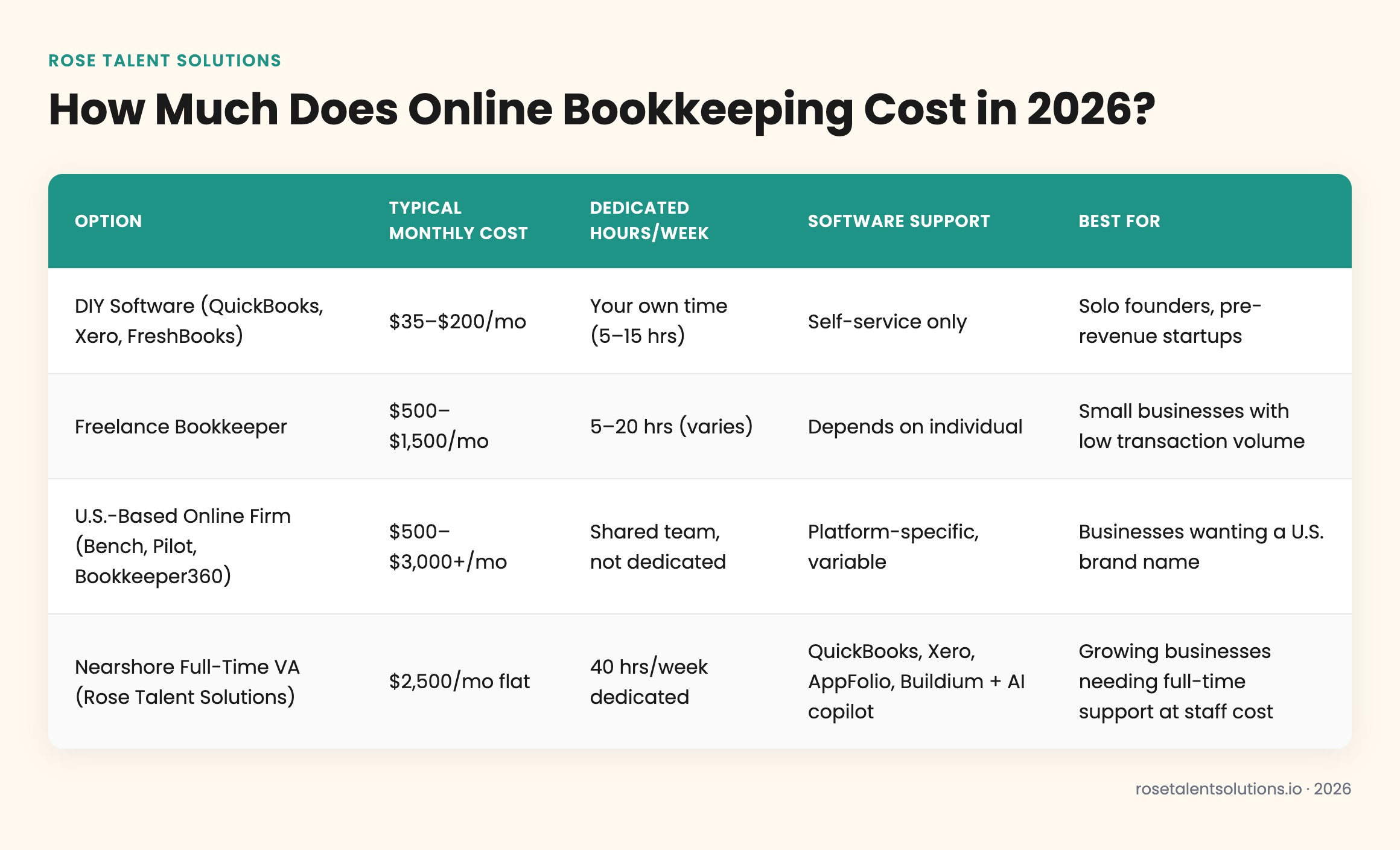
The table below breaks these options down by what you actually get for the money — hours, software fluency, and best-fit business type.
| Option | Typical Monthly Cost | Dedicated Hours/Week | Software Support | Best For |
|---|---|---|---|---|
| DIY Software (QuickBooks, Xero, FreshBooks) | $35–$200/mo | Your own time (5–15 hrs) | Self-service only | Solo founders, pre-revenue startups |
| Freelance Bookkeeper | $500–$1,500/mo | 5–20 hrs (varies) | Depends on individual | Small businesses with low transaction volume |
| U.S.-Based Online Firm (Bench, Pilot, Bookkeeper360) | $500–$3,000+/mo | Shared team, not dedicated | Platform-specific, variable | Businesses wanting a U.S. brand name |
| Nearshore Full-Time VA (Rose Talent Solutions) | $2,500/mo flat | 40 hrs/week dedicated | QuickBooks, Xero, AppFolio, Buildium + AI copilot | Growing businesses needing full-time support at staff cost |

What Drives Online Bookkeeping Costs Up (or Down) in 2026?
Price isn't random. Five variables determine where on the spectrum your business lands — and understanding them helps you avoid overpaying for things you don't need or under-buying support you do.
1. Transaction volume. A business processing 50 transactions per month is a fundamentally different engagement than one processing 500. Online firms and freelancers often tier pricing by transaction count. A nearshore full-time hire handles unlimited volume within their 40-hour week — no per-transaction surcharges.
2. Software complexity. Basic QuickBooks Online reconciliation is straightforward. Property management bookkeeping in AppFolio or Buildium — with owner distributions, trust accounting, and CAM reconciliations — requires specialized training. If you are curious how QuickBooks virtual bookkeeper costs stack up specifically, the pricing dynamics are worth comparing side by side.
3. Catch-up and cleanup work. If your books are behind by 3–12 months, every provider charges extra. Firms typically quote cleanup as a one-time project fee ($500–$5,000+). A full-time nearshore VA can absorb this workload without an add-on invoice because you are already paying for their full week.
4. Reporting depth. Basic P&L statements are table stakes. Cash flow forecasting, job costing, departmental P&Ls, and investor-ready reports require more senior skill. Make sure the tier you are buying actually includes the reports you will use.
5. Payroll integration. Many online bookkeeping subscriptions explicitly exclude payroll. When you add payroll processing, payroll tax filings, and year-end W-2/1099 prep, costs climb fast — often $100–$300/month extra on top of base bookkeeping fees.
The "low-cost" online bookkeeping plans that start at $299/month almost always exclude tax prep, payroll, cleanup work, and CFO-level reporting. When you add those line items back in, the actual monthly cost frequently exceeds $1,500 — and you still don't have a dedicated person who knows your business.
How Much Does Outsourced Bookkeeping Cost for a Small Business Specifically?
Small businesses — those under $5M in annual revenue — are the most price-sensitive buyers in this category, and also the most likely to under-invest and pay the penalty later. The SCORE Foundation (2023) reports that poor financial recordkeeping is among the top five reasons small businesses fail within the first five years.
For a small business with moderate complexity — say, a 10-person services company or a 20-unit property portfolio — here is a realistic cost breakdown by model:
- Freelance bookkeeper (part-time, 10 hrs/week): $800–$1,200/month. Availability gaps, vacation coverage not included, skill ceiling varies widely.
- U.S. online firm (shared team): $700–$2,000/month depending on add-ons. No single point of contact. Firms like Bench and Pilot have faced service continuity questions in recent years.
- Nearshore dedicated VA (full-time, 40 hrs/week): $2,500/month flat. Includes recruiting, vetting, payroll, HR, and ongoing management — plus a role-specific AI copilot trained on your software stack.
When you look at it on a per-hour basis, $2,500/month for 40 hours/week works out to roughly $15.60/hour fully loaded — including every HR cost Rose carries on your behalf. A freelancer charging $25–$40/hour for 10 hours per week runs $1,000–$1,600/month for a quarter of the coverage. If you are building out a broader picture of what outsourced bookkeeping costs for a small business, the per-hour math alone makes the case for full-time over part-time.
"Bookkeeping is not a cost center — it's a profit protection system. Every dollar you spend getting your books right saves you three dollars in tax penalties, missed deductions, and bad business decisions made from inaccurate data." — Gene Marks, Small Business Columnist at The Guardian and Forbes (2023)

According to QuickBooks / Intuit research (2023), 60% of small business owners feel they are not very knowledgeable about accounting and finance — which is exactly why delegating to a skilled, software-trained bookkeeper pays off faster than most owners expect.
What Is a Nearshore Virtual Bookkeeper — and Is One Right for You in 2026?
A nearshore virtual bookkeeper is a full-time, remote finance professional based in Latin America who works your U.S. business hours, communicates in fluent English, and operates inside your existing software stack. Nearshore specifically refers to Latin American countries — not India or the Philippines — which means minimal time-zone gap, strong cultural alignment with North American business norms, and real-time availability during your workday.
At Rose Talent Solutions, every nearshore bookkeeper ships with a role-specific AI copilot — pre-trained on the software they will use daily, whether that is QuickBooks, Xero, AppFolio, or Buildium. This cuts ramp time dramatically compared to a generic hire who arrives with no tool-specific context. You can learn more about how that works on the AI advantage page.
The all-in rate is $2,500/month flat — recruiting, vetting, payroll, HR, and ongoing management included. If the team member isn't a fit, Rose replaces them at no additional cost. The engagement is month-to-month with no long-term contract required, and 30 days written notice ends it. For a deeper look at how this compares to other virtual bookkeeper models, the guide on what a virtual bookkeeper costs walks through each option side by side.
Nearshore Full-Time VA — Pros
- Works your U.S. business hours in real time
- 8/10+ English proficiency — screened, not assumed
- 40 dedicated hours/week for one flat rate
- AI copilot trained on your specific software
- No long-term contract — month-to-month
- Free replacement if not a fit
Nearshore Full-Time VA — Cons
- $2,500/month is more than a part-time freelancer upfront
- Best ROI when you have enough volume to justify full-time hours
- Requires onboarding time — typically 1–2 weeks to full speed
How the Rose Onboarding Process Works in 2026
One of the most common objections to hiring a virtual bookkeeper is the fear that onboarding will eat up more time than it saves. Here is how Rose structures the process to get you to a productive working relationship fast — typically within one week of kickoff.
Intake & Role Scoping
Rose's team meets with you to map your exact bookkeeping workflow — software, volume, reporting cadence, and any catch-up work needed. This shapes the candidate profile before sourcing begins.
Candidate Matching
Rose sources from its vetted Latin America talent network, screens candidates on English proficiency (8/10+ floor), software certifications, and finance background. You review a shortlist — typically within 5–7 days.
AI Copilot Configuration
Your team member's role-specific AI copilot is configured for your software stack before day one — so they arrive context-aware, not starting from zero.
Week-One Ramp
Your bookkeeper shadows your existing process, asks calibrated questions, and begins handling live transactions under light supervision. Most clients report full independent operation by the end of week two.
Ongoing Management
Rose handles payroll, HR issues, performance check-ins, and any replacement coordination. You manage the work; Rose manages the relationship and compliance.
If you are ready to get started, the intake form at Rose's start page takes under three minutes to complete, and a team member follows up within one business day.
According to SHRM's research on talent acquisition costs (2023), the average cost to replace a single employee is 50–200% of their annual salary — which means a $50,000 bookkeeper who quits after 14 months costs you $25,000–$100,000 in recruiting, lost productivity, and training. A model with a built-in free replacement guarantee eliminates that risk entirely.
For businesses managing real estate portfolios specifically, the bookkeeping and accounting services page outlines how nearshore bookkeepers handle property-specific workflows — owner statements, security deposit accounting, CAM reconciliations, and trust account compliance — that generic bookkeepers frequently get wrong.
The IRS recordkeeping guidelines for small businesses require businesses to maintain accurate financial records for a minimum of three years — and in some cases seven. Sloppy books aren't just an operational problem; they are a compliance liability. According to the NFIB Small Business Tax Survey (2023), 40% of small business owners spend more than 80 hours per year on federal taxes alone — time that could be recaptured with a dedicated bookkeeper handling the groundwork year-round.