
Why Virtual Assistant Hiring ROI Statistics Matter in 2026
Nearshore virtual assistants have moved from "nice to have" to a core operating lever for lean US businesses. But most hiring guides bury the math. This article surfaces the actual virtual assistant hiring ROI statistics and cost savings benchmarks — along with the underlying productivity metrics and employment benchmarks — so you can make a defensible, numbers-backed decision instead of a gut-feel one.
The underlying demand is real. According to the US Bureau of Labor Statistics (2024), the median annual wage for a full-time administrative assistant is $46,760 — and that figure excludes payroll taxes, benefits, PTO, office space, and software seats, which typically add 25–35% on top of base salary. For a small or mid-size business, that overhead is not optional. It stacks whether the employee is productive or not.
Virtual assistants — especially nearshore professionals working in your time zone — eliminate most of that overhead while delivering comparable or superior output on high-volume, process-driven work. The sections below break down exactly where the virtual assistant cost savings and productivity gains come from, using real 2026 employment benchmarks.
How Virtual Assistant Cost Savings Benchmarks Stack Up in 2026
The single most useful way to evaluate virtual assistant hiring ROI statistics and cost savings benchmarks is a fully-loaded cost comparison. Most business owners compare hourly rates — that is the wrong unit. The right unit is total monthly cost to keep a seat filled and productive.
A full-time US-based administrative or marketing employee earning $45,000/year costs roughly $3,750/month in gross wages. Add employer FICA taxes (7.65%), health insurance contribution ($500–$700/month for a single employee per KFF Employer Health Benefits Survey (2023)), paid time off accrual, recruiting fees (typically 15–25% of first-year salary per SHRM), and onboarding time — and a $45K hire lands closer to $5,500–$6,200/month in true all-in cost.
A nearshore VA through Rose Talent Solutions is $2,500/month, flat. That rate is all-in: recruiting, vetting, payroll, HR administration, and ongoing management are included. No hidden fees, no long-term contract. The operating cost reduction from a single hire is $3,000–$3,700/month — before you account for a single hour of owner time reclaimed.

What Do the 2026 Employment Benchmarks Show About VA Productivity?
Cost savings get the headline, but productivity metrics are what actually justify the hire to a skeptical CFO or business partner. Here is what the data shows across several well-tracked employment benchmarks.
According to Gallup's workplace research (2023), engaged employees — including remote workers — deliver 18% higher productivity and 23% higher profitability than their disengaged counterparts. Nearshore VAs who work in your time zone, on your tools, and with your team tend to score higher on engagement metrics than offshore counterparts precisely because collaboration friction is lower.
A Global Workplace Analytics (2023) review of remote work studies found that remote workers are productive an average of 1.4 more days per month than their in-office equivalents — reducing unplanned absence and commute-driven tardiness. For a VA role that is inherently remote, that productivity baseline is built in from day one.
On task throughput specifically: a Stanford study covered by Harvard Business Review (2013, replicated in post-pandemic follow-ups) found a 13% performance increase among remote workers versus office counterparts on comparable tasks. For high-volume, process-driven work — inbox management, data entry, scheduling, bookkeeping, leasing coordination — that lift is consistent and measurable. These virtual assistant statistics translate directly into recoverable owner hours every single week.
Nearshore vs. Offshore vs. Onshore: How the 2026 Numbers Compare
Not all virtual assistants are created equal. The three common models — onshore (US-based), nearshore (Latin America), and offshore (Philippines, India) — have meaningfully different cost and performance profiles. The table below uses 2026 market benchmarks to illustrate the full picture across the categories that actually affect your operating cost reduction.
| Category | Onshore VA (US-based) | Nearshore VA (Latin America) | Offshore VA (Philippines / India) |
|---|---|---|---|
| Avg. Monthly Cost (full-time) | $4,000–$7,000+ | $2,000–$2,800 (Rose: $2,500 flat) | $800–$1,600 |
| Time Zone Alignment (US hours) | Full overlap | Full overlap (same or 1–2 hr offset) | 6–12 hour gap; async-only |
| English Proficiency | Native | Near-native (Rose floor: 8/10+) | Variable; accent friction common |
| Recruiting + HR Overhead | High (SHRM est. 15–25% of salary) | Included in flat rate | Moderate; often hidden platform fees |
| Avg. Ramp Time to Full Productivity | 4–8 weeks | 1–2 weeks (AI copilot trained on your stack) | 3–6 weeks |
| AI Copilot Included | No | Yes (role-specific, e.g., AppFolio, QuickBooks) | No |
| Replacement Guarantee | N/A | Yes — free replacement if not a fit | Varies; usually not included |
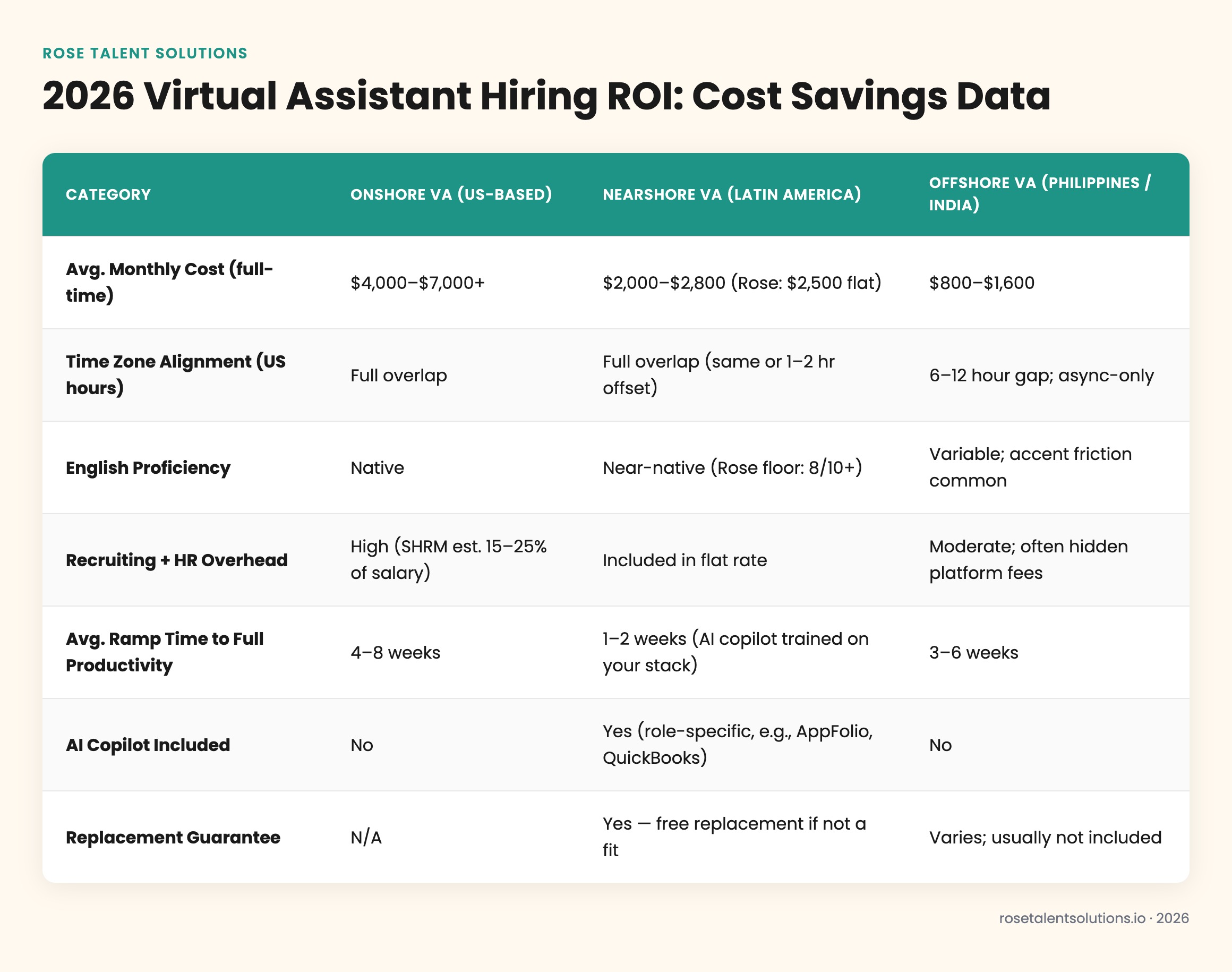
The offshore price point looks attractive in isolation. But the hidden cost of an offshore VA is not the hourly rate — it is the 6–12 hour timezone gap that turns every real-time question into an overnight ticket. For client-facing roles, that lag erodes the customer experience and ultimately costs more in churn than it saves in labor. Understanding this distinction is essential when evaluating any virtual assistant hiring ROI statistics and cost savings benchmarks.
Rose Talent's nearshore model is purpose-built to close that gap. Every team member is based in Latin America, works US business hours, and clears an 8/10+ English proficiency screen before a client ever speaks to them. Learn more about how the model works at Rose's AI Advantage page.
How Operating Cost Reduction Actually Works: The Real ROI Calculation
The ROI of a virtual assistant hire has two sides: cost avoided and value generated. Most analyses only model cost avoided. Here is the complete picture, grounded in verifiable employment benchmarks and productivity metrics.
Cost avoided: Based on BLS and SHRM data, replacing a $50,000/year US employee with a $2,500/month nearshore VA saves approximately $3,000–$3,700/month in fully-loaded labor cost. Over 12 months, that is $36,000–$44,400 in operating cost reduction — from a single hire.
Value generated: According to McKinsey's research on automation and AI-augmented work (2023), workers who offload routine tasks to AI-assisted support gain back 20–30% of their workweek. For a business owner or senior operator billing at $150–$300/hour in effective value, recovering 8–10 hours per week has an implied value of $1,200–$3,000/week — or $60,000–$150,000 annualized. These are the productivity metrics that make the business case undeniable.
The ROI of a virtual assistant hire is not just the salary you did not spend. It is the salary you did not spend plus the revenue-generating hours you got back. Modeled together, a single nearshore VA hire at $2,500/month can return $80,000–$180,000 in combined cost savings and owner time reclaimed — in year one alone. That is the real story behind the virtual assistant hiring ROI statistics that matter to operators in 2026.
That math is why property management companies and bookkeeping and accounting firms are among the fastest-growing VA adopters. Both sectors have high volumes of repeatable, process-driven tasks — work that is ideal for a well-trained VA with an AI copilot tuned to their specific software stack.

How Rose Talent Matches and Onboards a VA: The 5-Step Process
Understanding the process demystifies the ROI timeline. Most business owners worry that hiring a VA will take weeks of their own time. Here is how Rose Talent's placement model actually works — and why most clients have a placed VA within 7 days of starting.
Intake & Role Scoping
Rose's team maps your specific workflow, software stack, and communication style to a candidate profile — so matching is based on role fit, not just résumé keywords.
Candidate Vetting
Every candidate clears English proficiency screening (8/10+ floor), technical skills assessment for your specific software (AppFolio, QuickBooks, HubSpot, etc.), and a structured interview before you see their profile.
Client Interview & Selection
You interview your top match — typically 1 or 2 candidates — and make the call. Most clients select on the first interview.
AI Copilot Configuration
Before day one, your VA receives a role-specific AI copilot trained on your tools and workflows — cutting the ramp period from weeks to days and boosting the productivity metrics you will see immediately.
Ongoing HR & Management
Rose handles payroll, HR, compliance, and performance management. If the fit is not right, Rose replaces the team member at no additional cost — no paperwork, no recruiting fees.
Ready to see what a nearshore VA hire looks like for your specific role? The intake form at Rose's Start page takes under five minutes and kicks off the matching process immediately.
Generalist VA vs. Specialized VA: What the Productivity Data Says
One gap most competitor articles skip entirely: the productivity difference between a generalist virtual assistant and a role-specific one. It is significant enough to affect your ROI model and changes the virtual assistant hiring ROI statistics and cost savings benchmarks you should be targeting.
A generalist VA can handle a wide variety of administrative tasks — scheduling, email triage, basic research, light social media. Hourly rates are lower, but so is throughput on specialized work. A property management VA who does not know AppFolio from a spreadsheet will spend 2–4 weeks learning the software before contributing at full capacity. A property management-specialized VA from Rose arrives already trained on your platform.
According to SHRM's onboarding research (2022), new hires take an average of 8 months to reach full productivity in knowledge-work roles. For a specialized, software-trained VA with an AI copilot, that timeline compresses dramatically — Rose clients routinely report full-capacity output within 2–3 weeks of placement. That acceleration is one of the most underappreciated cost savings benchmarks in the industry.
Specialized Nearshore VA
- Pre-trained on your specific software (AppFolio, QuickBooks, HubSpot, Canva, Hootsuite)
- AI copilot reduces research and task time by 20–30%
- Works your exact business hours — no async lag
- Ramp time measured in days, not months
- Free replacement if not a fit — zero re-hiring cost
Generalist Offshore VA
- Broad but shallow skill set — needs significant software training
- 6–12 hour time zone gap creates async bottlenecks
- Variable English proficiency; accent friction on calls
- Platform fees often obscure true all-in cost
- No replacement guarantee in most arrangements
The productivity data consistently supports the same conclusion: specialization and time zone alignment together drive the largest operating cost reduction — not the lowest hourly rate. Cheap and slow is not actually cheap once you price in the hours your team spends compensating for the lag. When you stack the virtual assistant statistics across all the dimensions covered here — cost, ramp time, throughput, and owner time reclaimed — the nearshore specialized model wins on every metric that operators actually track in 2026.