
Why Hiring Timeline Benchmarking Matters in 2026
If you're a US or Canadian business owner trying to hire support staff right now, you've probably felt the friction — weeks of job posts, dozens of interviews, and a placement that still might not stick. Hiring timeline benchmarking for nearshore virtual assistants is the practice of measuring your actual time-to-hire against recruitment industry standards so you know whether your process is competitive or quietly bleeding money. And when the role you're filling is a nearshore virtual assistant, the benchmarks look very different from a traditional W-2 hire.
A nearshore virtual assistant is a full-time remote professional based in Latin America who works your US business hours, communicates in fluent English, and supports your operations at a fraction of domestic hiring cost. Unlike offshore outsourcing in the Philippines or India, nearshore staffing eliminates the timezone gap that makes real-time collaboration nearly impossible. For talent acquisition benchmarking purposes, that geographic and linguistic alignment changes every downstream metric — from time-to-productivity to quality-of-hire scores.
According to SHRM's Talent Acquisition research hub (2024), the average time-to-fill an open position across all industries is 36 days. For specialized or technical roles, that number climbs past 50 days. These figures form the baseline every HR benchmarking report uses — and they're the number you should be beating if you're sourcing nearshore.
How 2026 Recruitment Industry Standards Define "Fast" for Virtual Roles
The recruitment industry standards most HR teams reference come from a handful of authoritative sources: SHRM's benchmarking data, LinkedIn's annual Global Talent Trends report, and the Bureau of Labor Statistics job openings data. Each paints a consistent picture — the average hiring process for a professional-level role involves 3–5 interview rounds, background checks, and an offer-acceptance window that alone averages 7–10 days.
For virtual assistant roles specifically, LinkedIn's Global Talent Trends Report (2024) notes that remote roles receive 3x more applications than on-site equivalents — which sounds helpful until you realize that higher volume without a structured screening system actually lengthens average time-to-hire by 11 days due to review bottlenecks. Most hiring managers don't have a systematic way to filter 200 applicants for a $15/hour remote admin role. They end up doing it manually, and the process drags.
This is the core gap that structured nearshore staffing solves. Instead of posting, screening, and interviewing from scratch, a nearshore agency maintains a pre-vetted talent pipeline — candidates who've already cleared English proficiency screens (Rose's bar is 8/10+), skills assessments, and background checks. Your hiring timeline benchmarking for nearshore virtual assistants collapses from 36+ days to under a week because the sourcing and vetting work is already done.

2026 Hiring Timeline Data: Nearshore vs. Offshore vs. Onshore
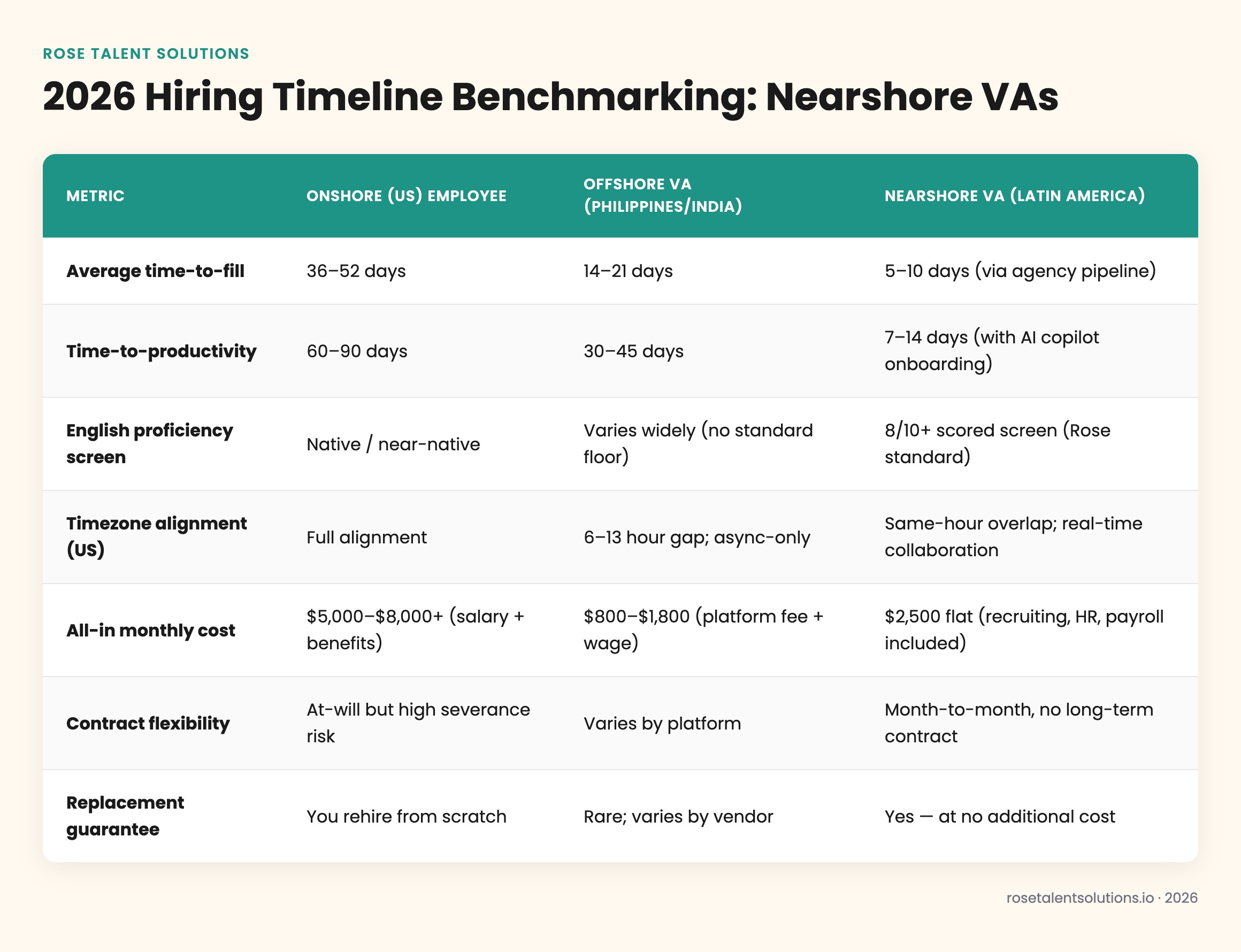
The table below compares the four most relevant dimensions of the hiring timeline across staffing models. These figures draw from SHRM's HR benchmarking report data, LinkedIn's talent trends research, and published agency placement windows. Use this as your baseline for talent acquisition benchmarking when evaluating which model fits your business.
| Metric | Onshore (US) Employee | Offshore VA (Philippines/India) | Nearshore VA (Latin America) |
|---|---|---|---|
| Average time-to-fill | 36–52 days | 14–21 days | 5–10 days (via agency pipeline) |
| Time-to-productivity | 60–90 days | 30–45 days | 7–14 days (with AI copilot onboarding) |
| English proficiency screen | Native / near-native | Varies widely (no standard floor) | 8/10+ scored screen (Rose standard) |
| Timezone alignment (US) | Full alignment | 6–13 hour gap; async-only | Same-hour overlap; real-time collaboration |
| All-in monthly cost | $5,000–$8,000+ (salary + benefits) | $800–$1,800 (platform fee + wage) | $2,500 flat (recruiting, HR, payroll included) |
| Contract flexibility | At-will but high severance risk | Varies by platform | Month-to-month, no long-term contract |
| Replacement guarantee | You rehire from scratch | Rare; varies by vendor | Yes — at no additional cost |
How to Measure Your Own Hiring Timeline Metrics Against Industry Benchmarks
Most small business owners have never formally tracked their hiring timeline metrics. They remember it "took a while" or "went pretty fast" — but without data, you can't benchmark against recruitment industry standards or make a defensible case to a business partner about switching staffing models.
The five metrics worth tracking for any role are: time-to-post (days from decision to hire to job posted), time-to-screen (post to first qualified candidate reviewed), time-to-interview (screen to first live interview), time-to-offer (interview to offer sent), and time-to-start (offer accepted to first day). According to SHRM's talent acquisition benchmarking research (2024), most companies lose the most time between screening and first interview — a stage that a pre-vetted nearshore pipeline eliminates almost entirely.
The hidden cost of a slow hiring timeline isn't just the recruiter's fee — it's the operational drag of running understaffed for 6+ weeks. For a property management firm managing 200 units, six weeks without a leasing coordinator can mean 15–20 missed or delayed lease conversions.
Quality-of-hire is the metric most HR benchmarking reports flag as the hardest to track but the most predictive of long-term cost savings. LinkedIn's Global Talent Trends research (2024) found that 88% of talent professionals consider quality-of-hire their most valuable recruiting metric, yet only 33% have a formal system to measure it. For nearshore VAs, a structured replacement guarantee functions as a built-in quality backstop — if the placement isn't performing, the agency replaces them at no additional cost rather than you absorbing a second full recruiting cycle.
If you're building a role in property management support or bookkeeping and accounting, the time-to-productivity benchmark shifts significantly when the VA arrives already trained on your software stack. Rose's AI copilot advantage means every team member ships with role-specific AI tools calibrated to AppFolio, Buildium, QuickBooks, and similar platforms — cutting the average ramp from 30+ days to under two weeks.
How the Rose Talent Solutions Placement Process Compresses Your 2026 Hiring Timeline
Understanding the mechanics of a fast nearshore placement helps you set internal expectations and compare it accurately against your current process. Here's what a 5–7 day hiring timeline benchmarking cycle looks like for a nearshore virtual assistant placement in practice:
Intake & Role Scoping (Day 1)
A brief 30-minute call covers the role's core responsibilities, software requirements, and working-hours expectations. This intake drives candidate matching — it's not a sales call.
Pipeline Match & Shortlist (Days 1–2)
Rose pulls from its pre-vetted Latin America talent pipeline. Candidates have already cleared English proficiency (8/10+ floor), skills assessments, and background screens. You receive a shortlist of 2–3 profiles, not 200 raw applications.
Client Interview (Day 3)
You interview the shortlisted candidates directly — typically 20–30 minutes each. Culture fit and soft-skill alignment are evaluated here, because remote-first success depends on communication style as much as technical ability.
Selection & Paperwork (Day 4)
You select your candidate. Rose handles all employment paperwork, compliance, and payroll setup — including the international labor law and contractor classification considerations that trip up DIY international hiring.
First Day & AI Copilot Activation (Days 5–7)
Your VA starts. Their role-specific AI copilot is activated and calibrated to your software stack. The first week is on us — so you can validate fit before the first invoice arrives.
2026 Compliance Benchmarks: What DIY International Hiring Gets Wrong
One gap almost every competitor guide ignores is the legal and compliance dimension of international hiring timelines. When US businesses hire directly from Latin America without a staffing intermediary, they face a set of decisions that can easily add 3–6 weeks to their timeline — and significant legal risk if skipped.
The core issue is worker classification. The IRS's worker classification guidance applies when you're directing a foreign contractor's work in ways that resemble an employment relationship. Misclassification penalties at the federal level start at $1,000 per worker per year for failure to file correct information returns, according to IRS Publication 15-A. Beyond US federal exposure, each Latin American country has its own labor law requirements around contracts, termination notice, and statutory benefits. Navigating Colombian, Mexican, or Brazilian labor compliance from scratch — correctly — takes legal counsel time you didn't budget for.
A nearshore staffing agency absorbs all of that compliance exposure. The VA is employed through Rose's local entities; you receive a simple, flat-rate service agreement. According to the Bureau of Labor Statistics Job Openings and Labor Turnover Survey (2024), the quit rate for professional and business services roles hovers around 2.8% monthly — meaning even after absorbing 6 weeks of hiring timeline, there's a non-trivial probability of having to restart. A replacement guarantee eliminates that restart cost entirely.
Nearshore vs. DIY Remote Hiring: Honest Pros and Cons in 2026
If you're weighing a structured nearshore agency against building your own international hiring process, here's a balanced view. Neither path is wrong — but the tradeoffs are real and the timeline implications are significant for any talent acquisition benchmarking exercise.
Structured Nearshore Agency (e.g., Rose)
- 5–7 day placement via pre-vetted pipeline — beats every HR benchmarking report standard
- Compliance, payroll, and HR fully managed — no legal exposure
- Replacement guarantee removes quality-of-hire risk from your balance sheet
- AI copilot onboarding cuts time-to-productivity to under 2 weeks
- Month-to-month terms, no long-term contract — easy to scale up or down
DIY International Recruiting
- 36–50+ day timeline to first placement, aligned with SHRM's all-industry average
- Worker classification, tax withholding, and local labor law risk fully on you
- No replacement safety net — a bad hire restarts the full recruiting cycle
- High-volume remote applicant pools require ATS infrastructure you may not have
- Compensation benchmarking across geographies requires dedicated HR research time
The compensation benchmarking dimension deserves a direct mention. Pay equity across distributed teams is increasingly scrutinized by both regulators and candidates. A flat-rate nearshore model ($2,500/month all-in) gives you cost predictability and eliminates the internal equity debates that arise when you're paying three different contractors in three different countries three different rates for similar work. According to Pew Research Center data on workforce compensation patterns (2023), pay transparency and consistency are increasingly tied to employee retention — even in contractor relationships.
For businesses managing multiple virtual team members across property management, bookkeeping, or administrative functions, a predictable per-seat pricing model simplifies budgeting in a way that hourly offshore rates never do. You know exactly what 3 full-time nearshore VAs costs: $7,500/month, all-in. No surprises from overtime, currency fluctuations, or platform fee increases.