
What Is the Brutos Framework and Why Is 2026 a Pivotal Year to Hire for It?
Nearshore developer sourcing has become the dominant strategy for US and Canadian companies needing specialized PHP talent — and Brutos Framework is one of the clearest examples of why that matters right now. Brutos Framework is an open-source PHP MVC framework designed for rapid application development, built around component-based architecture and convention-over-configuration principles. It's particularly popular in Brazilian and Latin American development ecosystems, which makes the nearshore talent pool a natural — and underutilized — fit for companies that need it.
If your team is maintaining a legacy Brutos-based application, migrating it, or building new modules on top of it, you need a developer who already understands the framework's conventions. Retraining a generalist PHP developer takes weeks. Hiring a Latin American developer who grew up in the same ecosystem the framework was built in is a fundamentally different proposition.
The global developer shortage isn't easing. According to the U.S. Bureau of Labor Statistics (2024), software developer employment is projected to grow 25% through 2032 — far outpacing the supply of qualified candidates entering the market. For niche frameworks like Brutos, the supply gap is even more pronounced at the onshore level.
This guide walks you through every meaningful option for hiring Brutos Framework developers in 2026 — from freelance platforms to managed nearshore staffing — so you can make the decision that matches your actual timeline, budget, and technical requirements.
How Do You Define What You Actually Need Before You Hire?
Before posting a job or contacting a staffing firm, you need to answer three questions that most hiring managers skip. First: is this a maintenance role, a migration role, or a greenfield development role? Each requires a different skill depth. A developer maintaining existing Brutos routes needs strong debugging instincts and familiarity with the framework's event lifecycle. A developer migrating Brutos to Laravel needs bilingual framework fluency. A greenfield developer needs architectural judgment on top of syntax knowledge.
Second: what is your timezone requirement? This is where most offshore hiring decisions quietly collapse. If your team does daily standups at 9am EST and your developer is 10-12 hours offset, you're not getting real-time collaboration — you're getting asynchronous handoffs with a full business day of lag. According to Gallup's workplace research (2023), poor collaboration and communication are among the top drivers of developer disengagement — and timezone misalignment is a structural cause, not a cultural one.
Third: do you need someone fully dedicated to your team, or is project-based engagement sufficient? A dedicated full-time developer embedded in your sprint cadence will produce fundamentally different output than a freelancer splitting attention across five clients. Dedicated nearshore developers consistently outperform part-time freelancers on long-horizon projects because they build context — and context is what makes a niche-framework specialist worth the hire.
If you're still weighing whether a virtual developer hire beats an in-house one, the cost and flexibility case for nearshore vs. in-house is worth a read before you finalize your decision.

How Do Nearshore, Offshore, and Onshore Models Compare for Brutos Framework Hiring in 2026?
The three dominant hiring models for specialized framework developers each carry distinct tradeoffs. The comparison below is designed to be honest — not a sales pitch. Your right answer depends on your timeline, your collaboration style, and your budget ceiling.
| Factor | Onshore (US/Canada) | Nearshore (Latin America) | Offshore (Asia/Eastern Europe) |
|---|---|---|---|
| Monthly cost (full-time) | $8,000–$14,000+ | $2,500 (managed, all-in) | $1,200–$2,800 (variable) |
| Timezone overlap with US | Full overlap | Full overlap (same hours) | 2–4 hrs overlap at best |
| English proficiency | Native | Fluent (8/10+ screened) | Highly variable |
| Brutos/PHP ecosystem fluency | Rare — niche framework | High — native ecosystem | Low-moderate |
| Ramp time to productivity | 2–4 weeks | 3–7 days (with AI copilot) | 4–8 weeks (timezone lag) |
| Contract flexibility | Often 6–12 month contracts | Month-to-month, 30-day exit | Varies widely |
| Recruiting/HR overhead | High (DIY or agency fee) | Zero (fully managed) | Moderate to high |
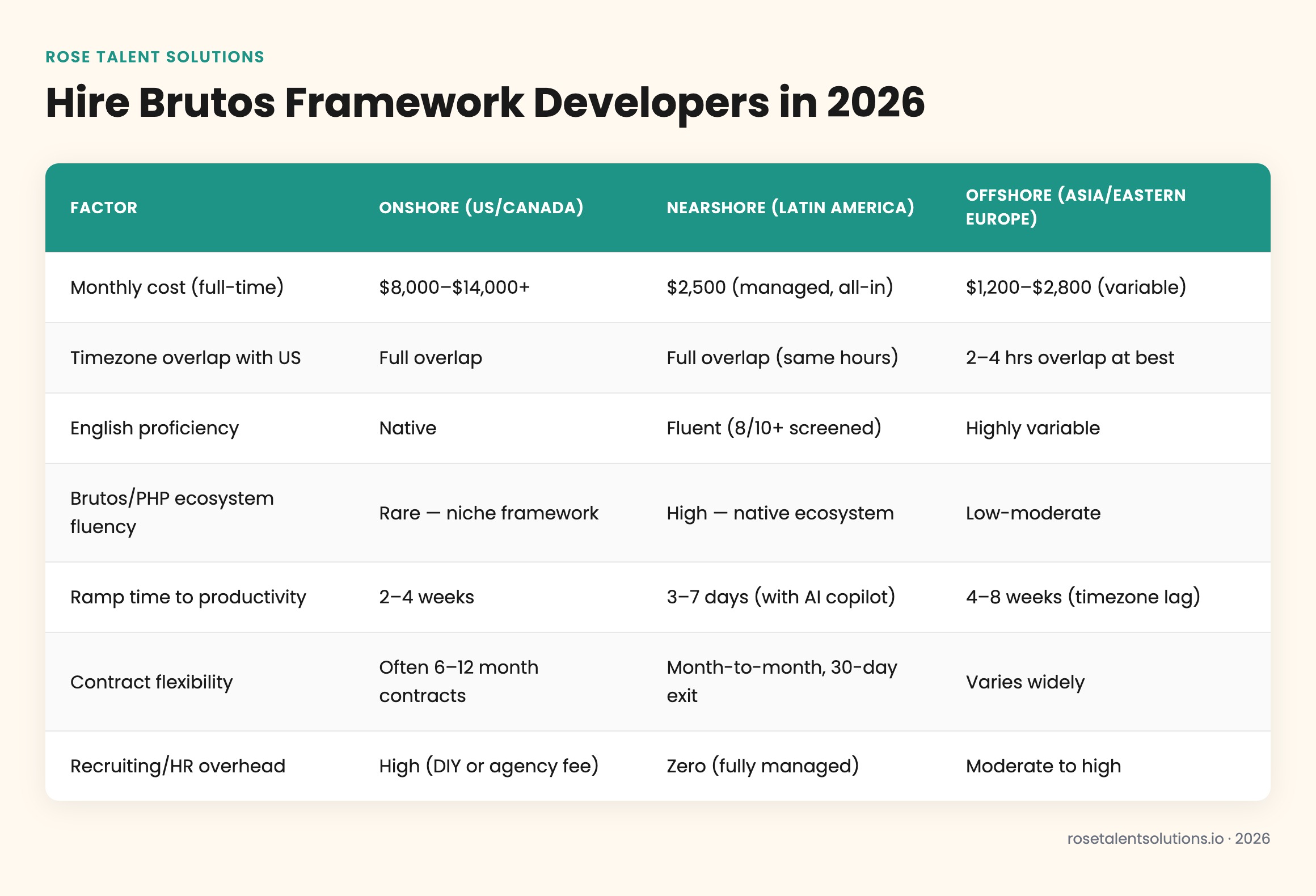
The hidden cost of offshore hiring isn't always visible on the invoice. When a developer is 8–10 time zones away, every pull request review, every bug escalation, every scope clarification costs you a full business day. That lag compounds across a sprint. For a niche framework like Brutos — where questions require nuanced answers — that compounding is especially damaging. For a deeper breakdown of how these models stack up structurally, the nearshore vs. offshore vs. onshore complete comparison covers the full picture beyond just tech roles.
Why Does Latin America Produce Strong Brutos Framework Talent in 2026?
Brutos Framework was created by a Brazilian developer and has historically had its strongest adoption in Brazil, Argentina, and Colombia — countries where PHP development culture runs deep and the framework appears in university curricula and open-source communities. This isn't a coincidence you should ignore when hiring. A developer from São Paulo or Medellín who learned PHP in an environment where Brutos was a reference framework has genuine hands-on context that a developer from outside that ecosystem simply won't have.
"Latin America has quietly become one of the world's strongest sources of PHP and framework-specific talent — the region's developer communities are sophisticated, collaborative, and deeply tied to open-source ecosystems." — Ariel Camus, CEO at Microverse (2023)
Beyond the framework-specific fit, Latin American developers working for US companies through a managed staffing model operate on US business hours — not a shifted schedule, not a partial overlap. They're in your Slack, on your standups, reviewing your PRs in real time. That's a collaboration model that offshore arrangements structurally cannot replicate.
According to McKinsey's Tech Talent Tectonics report (2022), Latin America is one of the fastest-growing regions for digital talent development, with governments and private institutions accelerating developer training programs at scale. The supply of qualified technical talent from the region is expanding — which means your hiring window for niche-framework developers is better right now than it was three years ago.
Understanding how Latin American developer compensation compares to other staffing models is also worth reviewing — the average salary breakdown for Latin America virtual staff gives you the market context to evaluate whether a flat-rate managed model is genuinely competitive.

The Brutos Framework was built within the Latin American PHP ecosystem. Hiring a nearshore developer from Brazil, Colombia, or Argentina isn't just a cost decision — it's a technical fit decision. Framework fluency that took years to develop in that ecosystem doesn't transfer easily to developers who encountered Brutos for the first time during your job interview.
How Does Rose Talent's Hiring Process Work for Technical Roles in 2026?
Rose Talent Solutions matches US, Canadian, and UK businesses with full-time nearshore technical staff from Latin America through a fully managed process. You don't post a job, screen 200 applicants, or negotiate salary ranges. You describe the role, and Rose handles recruiting, technical vetting, English proficiency screening (8/10+ floor), payroll, HR, and ongoing management — all at a flat $2,500/month.
Every placement also ships with a role-specific AI copilot. For developers, that means tooling trained on the relevant stack — whether that's Brutos Framework conventions, PHP 8.x patterns, or the specific SaaS tools your team uses. This isn't a generic AI assistant; it's configured around the role. According to SHRM's talent acquisition research (2024), AI-augmented onboarding cuts ramp time by up to 40% for technical roles — which aligns with the 3–7 day productivity window Rose's managed placements consistently hit.
Role Scoping Call
You describe the Brutos Framework work, your tech stack, team structure, and collaboration style. Rose maps that to a candidate profile — this takes 30 minutes, not 30 days.
Vetting and Matching
Rose recruits from its Latin America network, runs technical screening specific to PHP/Brutos, and applies the 8/10+ English proficiency floor before you see a single candidate.
Placement and AI Copilot Activation
Your developer starts within approximately 7 days. Their role-specific AI copilot is activated on day one — configured to your stack, your tools, and your team's conventions.
Ongoing Management
Rose handles payroll, HR compliance, and performance management. If the developer isn't a fit, you get a free replacement at no additional cost — no long-term contract required.
If you want to explore how the AI advantage integrates across technical and operational roles, the AI copilot feature overview breaks down exactly how it's configured per role. And if you're ready to scope a Brutos Framework developer placement directly, the getting started page is where that conversation begins.
What Are the Pros and Cons of Nearshore Managed Staffing vs. Freelance Platforms for Brutos Developers?
Freelance platforms like Toptal, Upwork, and Gun.io are legitimate sourcing channels — but they carry tradeoffs that managed nearshore staffing eliminates. The right choice depends on how much management overhead you want to own and how critical the role is to your core product.
According to Statista's freelance economy data (2023), over 64 million Americans performed freelance work — which means the freelance supply is large, but so is the variance in quality and availability. Niche framework developers on freelance platforms often juggle multiple clients, which creates the context-switching problem that kills deep technical work.
Nearshore Managed Staffing
- Fully dedicated 40hr/week developer — your team only
- Pre-vetted for PHP/Brutos fluency and English proficiency
- Flat $2,500/mo — recruiting, HR, payroll all included
- Free replacement if not a fit — zero additional cost
- AI copilot activated on day one for faster ramp
- No long-term contract — month-to-month with 30-day exit
Freelance Platforms (Upwork/Toptal)
- Developer typically splits time across 3–5 clients
- You own recruiting, screening, and vetting overhead
- Hourly billing — costs spike during crunch periods
- No replacement guarantee if the fit fails
- Platform fees (5–20%) add to effective cost
- No ongoing HR or management support
For companies where the Brutos Framework work is mission-critical — maintaining a production application or leading a migration — the dedicated model almost always wins on total cost of ownership, even if the nominal hourly rate on a freelance platform looks lower. The onshore vs. offshore staffing comparison digs into how hidden costs accumulate in non-managed models — the math applies equally to technical roles.
For teams that want to explore the full range of technical and operational roles available through a nearshore model, the Rose property management staffing page and the bookkeeping and accounting staffing page show how the same managed model scales across functions — useful context if you're building out a team beyond just development.