
Nearshore Latin America has become the default answer for US companies that are tired of overnight delays, broken English on support tickets, and offshore developers who disappear between your 5pm and their 9am. Argentina sits at the center of that shift. The country produces more STEM graduates per capita than almost any other nation in the region, and its developer talent pool is deep, English-fluent, and operating squarely inside US business hours. If you're trying to hire Argentinian developers in 2026, this guide covers everything — from what you'll actually pay, to how to vet candidates, to where a managed nearshore model outperforms a DIY hiring approach.
Why Argentina Leads Latin America's Developer Talent Pool in 2026
Argentina has consistently ranked among the top three countries in Latin America for software development talent. The reasons aren't accidental. The government has invested heavily in technology education for decades, and Buenos Aires in particular hosts a dense ecosystem of universities, bootcamps, and multinational tech offices. That infrastructure produces engineers who are comfortable with modern stacks — React, Node.js, Python, AWS, and increasingly AI tooling — at a rate few other regional markets match.
English proficiency is the other structural advantage. Argentina's exposure to American business culture through decades of international trade and media means professional developers typically speak conversational to fluent English. According to the EF English Proficiency Index (2023), Argentina ranks among the highest in Latin America for English proficiency — a critical factor when your dev team needs to interface directly with US product managers and stakeholders without a translation layer slowing every standup.
Time zone alignment seals the case. Argentina operates on ART (UTC-3), which puts it 1-2 hours ahead of US Eastern. Your Buenos Aires developer is logged in before your New York team's morning coffee is brewed. That's a fundamentally different working relationship than managing a team in India or the Philippines, where a real-time question asked at 3pm EST won't get answered until you're asleep. If you want to understand how this time-zone math plays out across hiring models, this complete comparison of nearshore vs. offshore vs. onshore staffing breaks it down in detail.
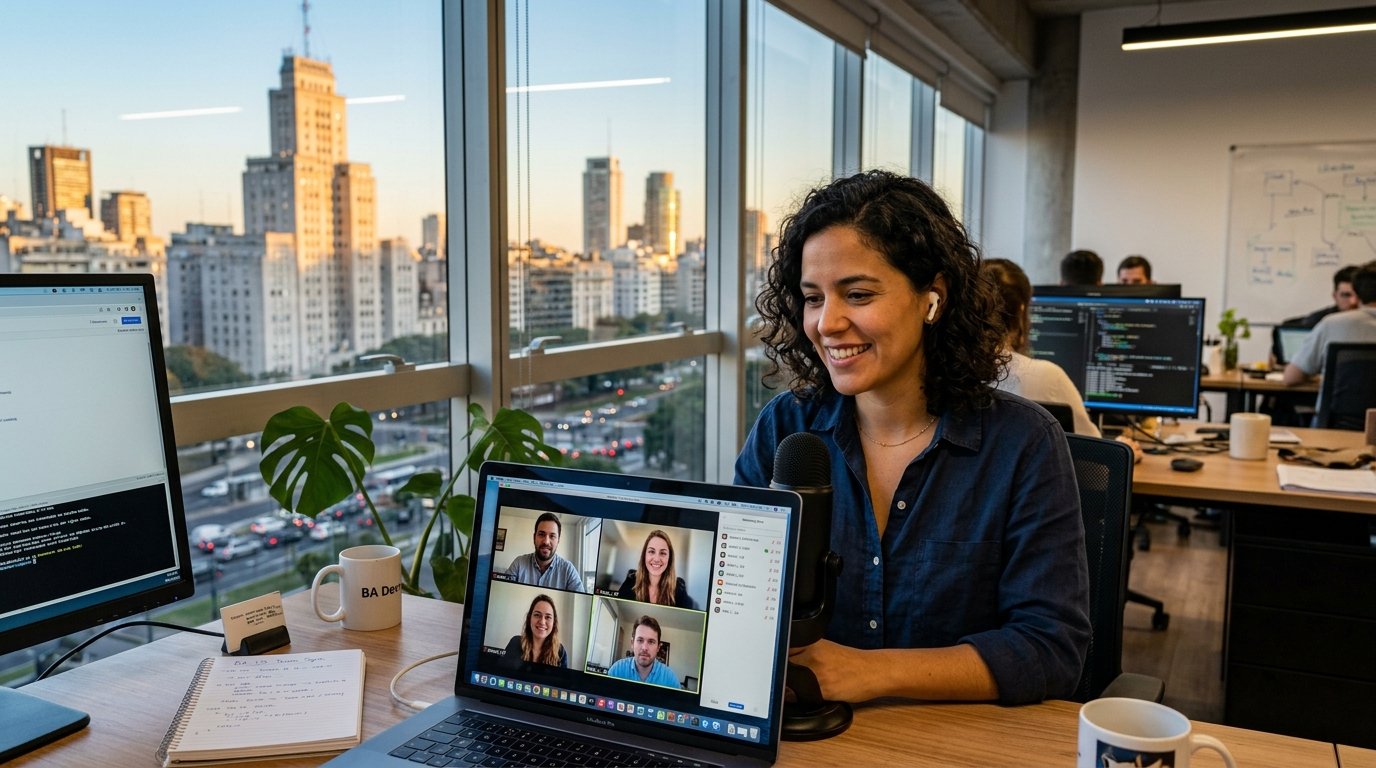
How Nearshore Argentinian Developers Compare to Offshore and Onshore in 2026
The talent-market decision for most US companies comes down to three options: hire locally (onshore), go fully offshore to Asia, or take the nearshore middle path through Latin America. Each option carries a different cost profile, collaboration style, and risk surface. The table below compresses the key variables so you can make an apples-to-apples comparison.
| Factor | Onshore US Developer | Nearshore Argentinian Developer | Offshore (India / Philippines) |
|---|---|---|---|
| Average Annual Cost | $110,000–$160,000+ | $30,000–$55,000 | $18,000–$35,000 |
| Time Zone vs. US Eastern | Same | +1 to +2 hrs | +9 to +13 hrs |
| English Proficiency | Native | High (8/10+ common) | Variable (4–8/10) |
| Real-Time Collaboration | Yes | Yes | Rarely — async-only |
| Cultural Alignment (US) | High | High | Low to moderate |
| Talent Depth (Tech) | Deep but expensive | Deep, strong STEM pipeline | Deep, highly commoditized |
| Managed Staffing Option | Recruiting agencies only | Yes — flat-fee managed (e.g., Rose) | Yes — platforms, agencies |
| Typical Ramp Time | 4–8 weeks | 1–2 weeks | 2–6 weeks |
"The Latin American developer market has matured to the point where US companies can access senior-level engineering talent with near-zero cultural or timezone friction — something that simply wasn't true of offshore markets a decade ago." — Andrés Franzetti, Managing Partner at BuenBit Ventures (2024)
What Does It Actually Cost to Hire Argentinian Developers in 2026?
Cost is where Argentina becomes genuinely compelling for US businesses. A mid-level software engineer in Buenos Aires earns roughly $28,000–$45,000 USD per year when hired directly, according to US Bureau of Labor Statistics comparisons (2024) — where the equivalent US role runs $110,000–$160,000 annually. That's not a rounding error. That's a structural cost advantage that lets you hire two senior engineers nearshore for the price of one junior engineer onshore.
But direct hiring carries its own overhead. You're handling payroll compliance in a foreign country, navigating Argentine labor law, managing HR yourself, and absorbing the full recruiting cost if the hire doesn't work out. Managed nearshore staffing solves all of that at a predictable flat rate. Rose Talent Solutions, for example, charges $2,500/month — flat, all-in — which covers recruiting, vetting, payroll, HR, and ongoing management. There's no long-term contract, and if the team member isn't a fit, Rose replaces them at no additional cost.
Understanding the full cost picture — including what Latin American virtual professionals actually earn after employer-side costs — is worth digging into. This breakdown of Latin America virtual assistant salary averages gives you a grounded view of market rates across the region so you're negotiating from data, not guesswork.
The hidden cost of direct offshore or self-managed nearshore hiring isn't the salary — it's the legal exposure. Argentine labor law includes mandatory severance, social security contributions, and regulated termination processes. A managed staffing partner absorbs all of that compliance risk inside the flat monthly fee.
How Rose Talent Solutions Matches You with Nearshore Argentinian Developers
Rose's placement process is built for speed without cutting corners on fit. Every candidate clears a multi-stage vetting process — English proficiency screens at 8/10 or above, technical role assessments, and background checks — before a name ever reaches your inbox. The average time from kickoff call to first placement is under seven business days.
Discovery Call
Rose's team maps your exact role requirements, software stack, working hours, and team culture in a 30-minute kickoff. This isn't a form — it's a conversation that determines fit criteria.
Candidate Sourcing & Vetting
Rose surfaces pre-screened candidates from its Latin America talent network, running English proficiency, technical, and behavioral screens before you see a single profile.
You Interview & Select
You meet 2-3 finalists and make the call. No pressure, no forced placements — you choose the person who feels right for your team.
Onboarding & AI Copilot Activation
Your new team member starts with a role-specific AI copilot trained on your software stack, so they hit the ground running — not spending week one reading documentation.
Ongoing Management
Rose handles payroll, HR, and performance oversight on an ongoing basis. You manage the work; Rose manages the employment relationship.
One feature that separates Rose from typical staffing agencies is the AI copilot advantage baked into every placement. Each team member ships with an AI assistant trained on their specific tools — whether that's QuickBooks, AppFolio, Buildium, or a custom CRM. According to McKinsey's 2023 report on generative AI, AI-assisted knowledge workers complete tasks 25-40% faster than unassisted peers — and that productivity gap compounds every week.

Is Hiring Nearshore Argentinian Developers Right for Your Business in 2026?
Nearshore Argentina is not the right answer for every situation. If your role requires someone physically present in your office, or if your compliance requirements prohibit any international employment, Argentina doesn't solve that. But if you're running a distributed or remote-first team — and most US companies are, post-2020 — the case is hard to argue against. You get real-time availability, strong technical skills, cultural alignment, and a cost structure that lets you scale without a board meeting every time you want to add headcount.
The clearest signal that you're ready to hire nearshore is when you're turning down work, dropping balls on existing clients, or watching your internal team burn out doing tasks that a skilled remote professional could handle from day one. The case for nearshore over in-house is worth reading if you're still weighing whether to hire locally or go remote — it runs the math on true all-in costs for a US employee versus a managed nearshore placement.
Argentina's economic environment has also created a talent-hungry workforce. Highly educated professionals there are motivated to work with US companies, maintain US-aligned hours, and build long-term working relationships. That motivation shows up in retention rates. According to Gallup's State of the Global Workplace report (2023), engaged remote workers show 23% lower turnover than disengaged counterparts — and nearshore Latin American professionals consistently score high on engagement metrics when paired with US teams that treat them as genuine team members, not transactional vendors.
For businesses exploring the full spectrum of remote staffing options — not just developers — this comparison of onshore vs. offshore virtual assistant models provides a clear breakdown of when each model makes sense, with cost and collaboration variables laid out plainly.
Why Hire Nearshore Argentinian Developers
- 1-2 hour time zone gap from US Eastern — real-time collaboration without scheduling gymnastics
- Strong English proficiency — no translation layer between your PM and your dev
- Deep STEM pipeline — Buenos Aires alone has 30+ universities producing tech graduates annually
- Cultural alignment with US business norms — Western media, international trade exposure, direct communication style
- Significant cost savings vs. onshore — 60-75% lower all-in cost for equivalent skill level
Limitations to Know Before You Hire
- Argentine labor law is complex — direct hiring without a local entity or EOR adds legal risk
- Currency volatility can affect independent contractor pay structures — managed partners absorb this
- Not the cheapest option in Latin America — Colombia and Mexico are slightly lower cost, though Argentina's tech talent depth often justifies the difference
- On-site roles are not possible — nearshore is remote-only by definition
The bottom line: if you want developers who work your hours, write in fluent English, and ship code without a 12-hour async delay on every pull request, Argentina is where you should be looking in 2026. And if you want to skip the compliance headaches of direct hiring, a managed nearshore partner like Rose gets you there in under two weeks. Start the process here — the first conversation takes 30 minutes and costs nothing.
According to SHRM's workforce planning research (2024), companies that use structured staffing partners for remote roles reduce average time-to-productivity by 34% compared to self-managed international hires — a meaningful advantage when your growth depends on getting capable people into seats fast.