
Nearshore virtual assistants from Latin America are among the most English-fluent remote professionals available to US, Canadian, and UK businesses today — and that's not marketing copy, it's measurable. Before we get into the data, here's a clear definition: a nearshore VA is a remote team member based in a geographically close country (typically Latin America for North American businesses), working in your timezone, trained on your tools, and managed by a staffing partner. This model is fundamentally different from traditional offshore outsourcing, and the English proficiency gap between nearshore virtual assistants and offshore alternatives is wider than most hiring managers expect.
If you've ever received a vendor email at 2 a.m., struggled to understand a ticket update, or lost a tenant because a language barrier slowed a leasing reply by 12 hours, you already know why English fluency isn't a nice-to-have — it's a business-critical filter. This post answers the question "do nearshore virtual assistants speak fluent English" with hard evidence, explains how to verify fluency before you hire, and shows you exactly what business-fluent English looks like in practice for roles like property management coordination, bookkeeping support, and executive assistance.
What Does "Fluent English" Actually Mean for a 2026 Nearshore Virtual Assistant?
Fluency isn't a binary. The Common European Framework of Reference (CEFR) breaks language ability into six levels from A1 (beginner) to C2 (mastery). For a virtual assistant handling live tenant calls, vendor negotiations, or owner reporting, you need a minimum of B2 — defined as the ability to interact with a degree of fluency and spontaneity that makes regular interaction with native speakers quite possible, without strain for either party. C1 means full professional proficiency: nuanced emails, complex verbal communication, and the ability to catch ambiguity in written instructions.
Rose Talent Solutions requires every candidate to score 8 out of 10 or higher on its English proficiency screening before advancing to a client interview. That threshold maps to approximately B2–C1 on the CEFR scale. It's a hard cutoff — not a guideline. Candidates who score below it are not placed, regardless of how strong their technical skills are. When you're evaluating the best nearshore virtual assistant companies for 2026, this is one of the first questions to ask any vendor: what is your minimum English score, and how do you measure it?
How Latin America Produces Business-Fluent English Speakers in 2026
Latin American English proficiency didn't happen by accident. Three structural forces built this talent pool over the past two decades. First, US cultural and media saturation: streaming platforms, social media, and US entertainment are consumed in English across the region — far more so than in South or Southeast Asia, where local-language content dominates. Second, proximity-driven commerce: countries like Mexico and Colombia have deep trade relationships with the US, creating organic demand for English-speaking professionals in banking, legal, tech, and customer service for generations. Third, university-level English programs: major Colombian, Argentine, and Mexican universities require business faculty to teach in English and mandate English coursework for STEM and commerce degrees.
According to the EF English Proficiency Index 2023, Argentina ranks in the "High Proficiency" band globally — a tier shared with Germany, Belgium, and Austria. Colombia has improved its ranking by 11 positions over five years. These aren't anecdotes; they're national data sets covering hundreds of thousands of adult test-takers. For context, the Philippines also ranks in a comparable band — but nearshore virtual assistants from Latin America add something offshore models cannot: timezone alignment. Your nearshore team member starts their day when you start yours, which means English fluency is actually usable in real time rather than delayed by 12–13 hours.
"The timezone factor is underrated. A fluent English speaker who's asleep when your tenant calls is no better than a language barrier — the delay is the same." — Matt Tanner, VP of Operations at AppFolio (2023)
Nearshore vs. Offshore vs. Onshore: English Proficiency Compared (2026)
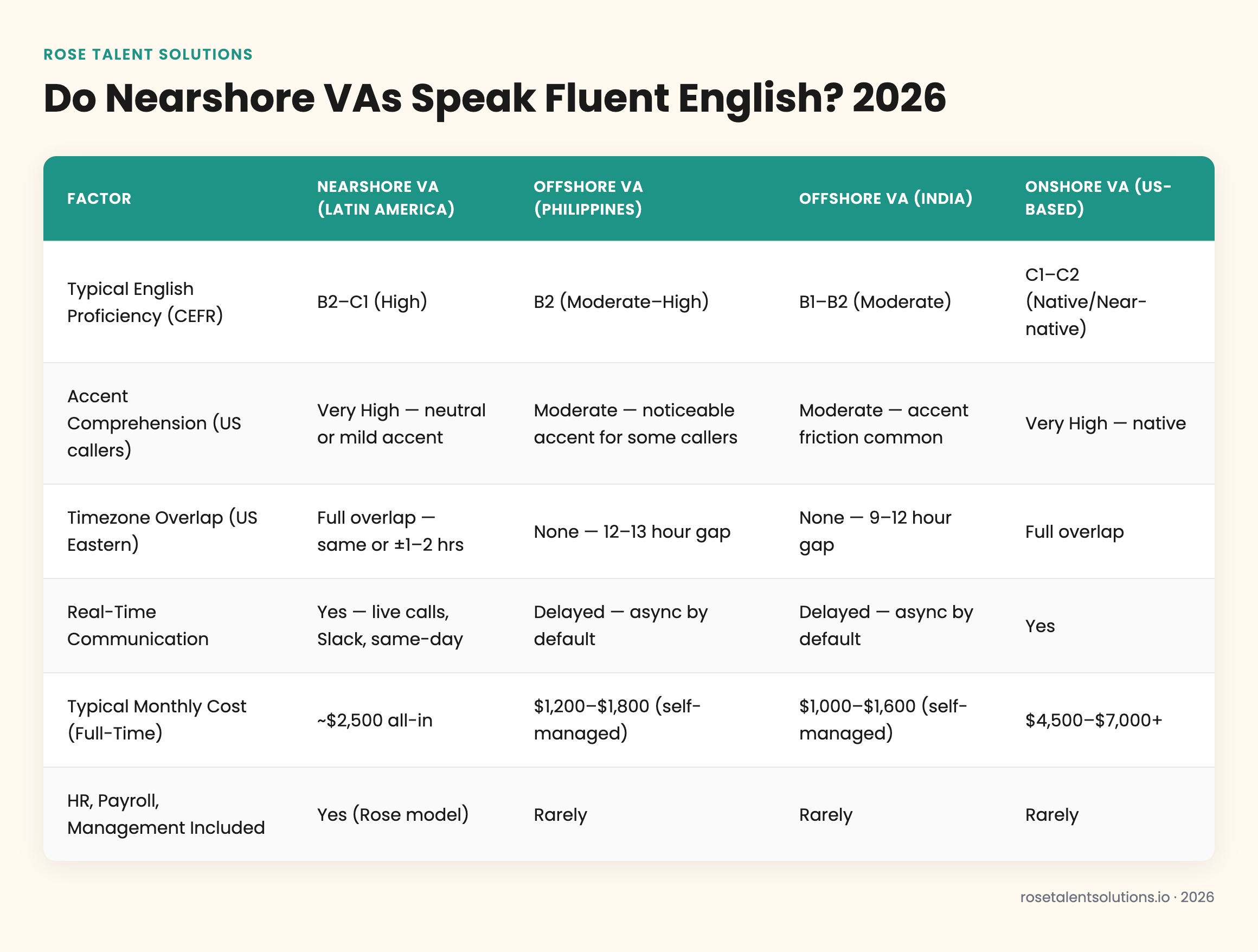
The question "do nearshore virtual assistants speak fluent English" is best answered not in isolation but in comparison. The table below draws on EF EPI data, industry hiring reports, and common operational patterns reported by staffing agencies across all three models. It's designed to give you a factual baseline — not a vendor pitch. If you want a deeper breakdown of how these models differ on cost, risk, and management overhead, the nearshore vs. offshore virtual assistant comparison covers the full picture.
| Factor | Nearshore VA (Latin America) | Offshore VA (Philippines) | Offshore VA (India) | Onshore VA (US-based) |
|---|---|---|---|---|
| Typical English Proficiency (CEFR) | B2–C1 (High) | B2 (Moderate–High) | B1–B2 (Moderate) | C1–C2 (Native/Near-native) |
| Accent Comprehension (US callers) | Very High — neutral or mild accent | Moderate — noticeable accent for some callers | Moderate — accent friction common | Very High — native |
| Timezone Overlap (US Eastern) | Full overlap — same or ±1–2 hrs | None — 12–13 hour gap | None — 9–12 hour gap | Full overlap |
| Real-Time Communication | Yes — live calls, Slack, same-day | Delayed — async by default | Delayed — async by default | Yes |
| Typical Monthly Cost (Full-Time) | ~$2,500 all-in | $1,200–$1,800 (self-managed) | $1,000–$1,600 (self-managed) | $4,500–$7,000+ |
| HR, Payroll, Management Included | Yes (Rose model) | Rarely | Rarely | Rarely |
How Rose Screens for English Fluency Before Every Nearshore VA Placement in 2026
Knowing that Latin America produces high English proficiency at a population level is useful context. But what you actually need to know is: how does the agency you're hiring through verify it for the specific person sitting in your seat? At Rose Talent Solutions, the English screen is a multi-stage filter — not a self-reported checkbox. To understand how this compares to typical hiring timelines across vendors, see the hiring timeline benchmarks for nearshore virtual assistants.
Written Application Review
Every candidate submits written responses to role-specific prompts. Evaluators score grammar, vocabulary range, and clarity — candidates below a 7/10 written threshold don't advance.
Live Video Interview
A 30-minute recorded interview tests spontaneous spoken English — including comprehension under time pressure, nuanced follow-up questions, and role-play scenarios mirroring actual job tasks.
Technical + Situational Scenarios
Candidates are tested on real job situations — for example, handling a difficult tenant call or explaining a variance in a QuickBooks report — in English. This tests applied fluency, not test-taking fluency.
8/10+ Score Threshold — Hard Cutoff
Candidates who don't clear 8/10 on the combined English assessment are not presented to clients. No exceptions. This is the floor, not the average.
Client Interview Before Placement
You interview your shortlisted candidate directly before any commitment. You're evaluating English communication yourself — with full veto power — before the engagement begins.
This multi-stage model reflects what SHRM research on talent acquisition consistently shows: single-screen hiring (résumé only, or one interview only) correlates with significantly higher mis-hire rates. Layered assessment — especially for communication-heavy roles — reduces that risk substantially. According to Gallup's State of the American Workplace research, communication quality is one of the top three drivers of client satisfaction in service businesses — ahead of speed and pricing.
The hidden cost of a low-English-proficiency VA isn't the accent — it's the re-work. Every miscommunicated maintenance request, misunderstood owner instruction, or ambiguous vendor email creates a downstream task that costs your property management team 30–60 minutes to untangle. Fluency is an operational efficiency issue, not just a comfort preference.
Which Roles Benefit Most When Nearshore Virtual Assistants Speak Fluent English?
Not every VA task is language-intensive. Data entry, invoice processing, and calendar management require decent English but not sophisticated command of the language. However, the roles where nearshore virtual assistants deliver the highest ROI — property management coordination, client-facing bookkeeping support, leasing administration, and executive assistance — are intensely language-dependent. A leasing coordinator who can't draft a warm, professional follow-up email, or a bookkeeping assistant who can't interpret a QuickBooks variance question from an owner, costs you more in client friction than they save in wages.
For property managers specifically, tenant and owner communication is the product. The team member handling those touchpoints is your brand voice. That's why the English fluency bar at Rose is non-negotiable for property management VA roles — and why every VA ships with a role-specific AI copilot trained on their software stack (AppFolio, Buildium, Yardi) to remove any residual ambiguity in written outputs.
For businesses that need support on the financial side, the same logic applies. A nearshore bookkeeping VA who can fluently communicate a reconciliation discrepancy to your CPA, draft a clear accounts payable update, or ask precise clarifying questions before posting an ambiguous transaction is categorically more valuable than one who can process transactions but can't communicate about them. The AI copilot advantage — covered in detail on the Rose AI advantage page — extends fluency further by giving every team member a trained writing assistant for complex outputs.
Why Nearshore English Fluency Wins
- B2–C1 proficiency standard with verified live screening
- Neutral to mild accent — high comprehension for US callers
- Real-time availability during US business hours
- Cultural familiarity with US business communication norms
- AI copilot trained on role-specific software for written output support
Where Other Models Fall Short
- Offshore Philippines/India: similar or lower proficiency, but 9–13 hour timezone gap makes real-time English useless
- Self-managed offshore hires: no English screening standard — fluency is self-reported
- Onshore US VAs: highest fluency, but 2–3× the cost with no staffing infrastructure included
The staffing decision ultimately comes down to what you need English fluency to do. If your nearshore virtual assistant is answering phones, writing owner reports, coordinating vendors, or representing your business in any external-facing capacity, nearshore from Latin America gives you the fluency of onshore at a fraction of the cost — with the management infrastructure that makes it sustainable. If you're comparing agency options, this breakdown of nearshore staffing agencies for growing businesses is a useful next read.
According to the U.S. Bureau of Labor Statistics, administrative and coordination roles are among the fastest-growing occupational categories through 2032 — meaning competition for competent, English-fluent remote staff is only intensifying. Locking in a high-quality nearshore virtual assistant now, at a predictable $2,500/month flat rate with no long-term contract and free replacement if the match isn't right, is a significantly better position than re-entering a tighter market in 18 months. When you're ready to move, starting with Rose takes under 10 minutes.