
What Is Digital Leasing Agent Software in 2026?
Nearshore property management teams are adopting digital leasing agent software faster than any other real estate technology category right now — and for good reason. Digital leasing agent software is a category of property management platforms that replaces or augments the manual work of a traditional leasing agent: capturing inbound rental leads, scheduling self-guided or virtual tours, processing rental applications, running background and credit checks, generating leases, and collecting digital signatures — all from a single dashboard. It is not just a listing syndication tool; it is an end-to-end leasing workflow engine.
The category has exploded because renters expect instant responses. According to the National Multifamily Housing Council (NMHC) (2024), more than 65% of renters expect a response to a leasing inquiry within one hour. No in-house leasing agent working a standard 9-to-5 shift can realistically meet that bar across a portfolio of 200+ units without automation and dedicated support staff.
The software solves the automation layer. But software alone does not follow up on a stalled application, negotiate a lease start date, or notice that a prospect's income documentation looks off. That judgment layer is where a trained human — specifically, a nearshore virtual assistant who specializes in property management — closes the gap between what the platform can do and what actually gets a unit leased.
How Digital Leasing Platforms Work in 2026: Core Features
Understanding what these platforms actually do helps you evaluate them side by side. Every major digital leasing agent software product in 2026 covers some version of the following workflow stages:
- Lead capture and syndication — Pulls inquiries from Zillow, Apartments.com, Facebook Marketplace, and your own website into one inbox.
- Automated follow-up sequences — Texts or emails prospects on a preset cadence so no lead goes cold.
- Self-showing or virtual tour scheduling — Lockbox integrations (Rently, Igloo) let prospects tour without a live agent present.
- Online applications and screening — TransUnion or Experian integrations run background and credit checks inside the platform.
- Lease generation and e-signature — Pulls lease terms from your templates and routes to DocuSign or a native signing module.
- Move-in coordination — Triggers utility setup reminders, deposits, and welcome packets automatically.
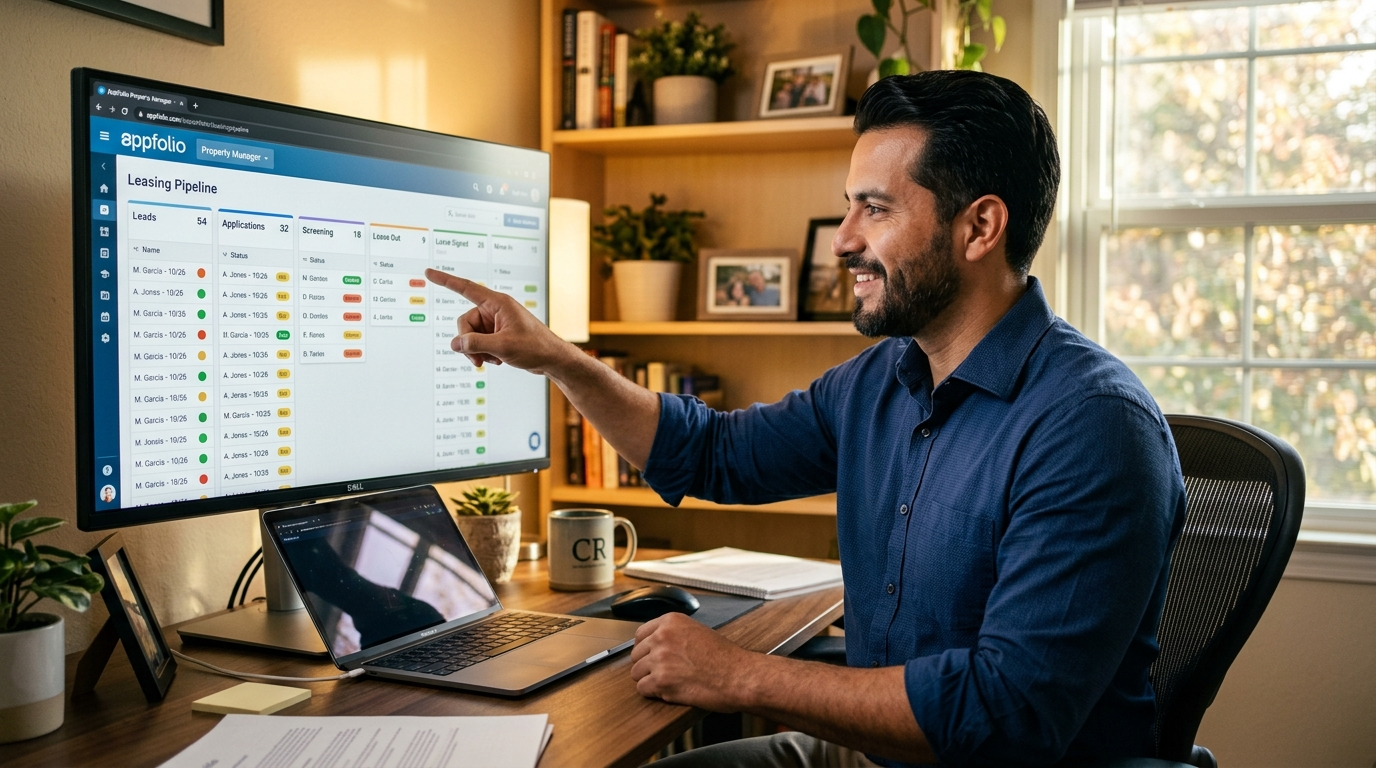
AppFolio and Buildium are the two dominant all-in-one property management platforms that include robust leasing modules. Knock CRM and Entrata are more leasing-specialist tools popular at larger multifamily operators. Each has different strengths, pricing models, and levels of VA-readiness — meaning how easily a remote team member can be trained to work inside the platform without on-site access. If you want a deeper breakdown of which platform pairs best with a remote team, the Rose blog has a full guide on which property management software offers the best VA support.
2026 Platform Comparison: Which Digital Leasing Agent Software Fits Your Portfolio?
Not every platform is right for every operator. A 20-unit single-family portfolio has very different needs from a 500-unit multifamily community. The table below compares the four platforms property managers ask about most frequently in 2026.
| Platform | Best For | Pricing Model | Key Leasing Features | VA-Readiness |
|---|---|---|---|---|
| AppFolio | SFR & small-mid multifamily (50–2,000 units) | Per-unit/month (~$1.40+) | AI leasing assistant (Lisa), self-showing, online apps, e-lease | Excellent — role-based permissions, full remote access |
| Buildium | Residential PMs, HOA (small–mid portfolios) | Tiered flat monthly ($58–$375+) | Listing syndication, online apps, tenant screening, e-sign | Very good — clean UI, easy to train remote staff on |
| Knock CRM | Mid–large multifamily (200+ units) | Custom enterprise pricing | Leasing CRM, pipeline management, performance analytics | Good — built for leasing teams, supports remote agents |
| Entrata | Large multifamily communities (500+ units) | Custom enterprise pricing | Full leasing suite, marketing, resident portal, analytics | Moderate — complex platform, steeper VA onboarding curve |
AppFolio's built-in AI leasing assistant — named Lisa — handles initial lead responses and basic FAQ conversations automatically, according to AppFolio's product blog (2024). That automation layer is valuable, but Lisa does not replace the human follow-through needed to convert a warm lead into a signed lease. A trained leasing VA picks up where Lisa leaves off: qualifying prospects, answering nuanced questions about the property, and shepherding applications through screening. Rose's guide on hiring an AppFolio virtual assistant walks through exactly how to structure that hand-off.
"Technology can automate the first touch, but conversion still lives in the conversation. The operators winning on occupancy right now are the ones who combine automated lead capture with a dedicated human who actually knows the property." — Alex Osenenko, CEO at Fourandhalf Property Management Marketing (2023)
How a Nearshore VA Makes Digital Leasing Software Work Harder in 2026
Digital leasing agent software eliminates paperwork. A nearshore virtual assistant eliminates the thinking gaps the software cannot fill. Here is what that looks like in practice: your AppFolio or Buildium platform sends an automated text when a prospect submits an inquiry. The prospect replies with a question the bot cannot answer — "Is the backyard fully fenced?" or "Can I move in two weeks early?" Without a human in the loop, that conversation stalls and the prospect tours your competitor's unit. With a nearshore leasing coordinator monitoring the inbox during US business hours, that reply goes out in minutes.
The timezone alignment is the underrated variable. Offshore VAs based in the Philippines or India operate on a 10-14 hour lag relative to a US business day. A prospect who submits an application at 2 PM Eastern may not get a human response until the following morning — by which time they have already signed elsewhere. Nearshore team members based in Latin America work your actual business hours, in real time, with no overnight delay. For a full breakdown of why that matters for property management specifically, see Rose's comparison of nearshore versus offshore VAs for property management.
The hidden cost of offshore leasing support is not the hourly rate — it is the 10-14 hour timezone gap that turns a same-day leasing decision into a next-day conversation, after the prospect has already signed with a competitor. Nearshore eliminates that gap entirely.
Beyond response time, a Rose nearshore leasing coordinator ships with a role-specific AI copilot trained on their assigned platform — AppFolio, Buildium, Knock, or Entrata. That means they are not spending their first three weeks learning where the screening report button is. They arrive platform-ready. According to Buildium's State of the Property Management Industry Report (2024), property managers who use dedicated trained staff inside their software report a 2x faster ramp-up compared to generalist hires who learn on the job. Software fluency on day one is not a nice-to-have — it is a direct driver of days-to-lease.
Rose's platform also covers the full HR and management layer: recruiting, vetting, payroll, and ongoing supervision. The flat rate is $2,500/month for a full-time 40-hour-per-week team member. No long-term contract — just 30 days written notice to cancel. If the placement is not the right fit, Rose replaces them at no additional cost. You can explore the full property management staffing service to see role types and coverage areas.
How to Onboard a Leasing VA into Your Digital Leasing Stack: 2026 Playbook
Getting a nearshore leasing coordinator fully operational inside your digital leasing agent software does not have to take weeks. Rose's standard onboarding framework compresses it into a repeatable five-step process. For the complete technical checklist, the Rose blog has a dedicated guide on how to onboard a property management VA into your software stack — but here is the high-level sequence:
Platform Access & Permissions
Create a role-based login in AppFolio, Buildium, or your platform of choice with permissions scoped to leasing tasks only — no access to financial reports or owner statements during the first 30 days. This limits risk while the team member ramps.
Property Fact Sheets
Provide a one-page brief for each property covering pet policy, parking, utilities included, preferred move-in windows, and any common prospect questions. Your VA loads these into their AI copilot for instant reference during live conversations.
Response Templates & Escalation Rules
Define which inquiry types the VA handles independently (tour scheduling, application status, standard FAQs) versus which escalate to you immediately (legal questions, eviction-related inquiries, major maintenance disclosures).
Live Shadow Period (Days 1–3)
The VA monitors your inbox in read-only mode for the first one to three days, drafting responses for your approval before sending. This calibrates tone and decision-making without risk to your prospect relationships.
Full Handoff & KPI Baseline
Transfer inbox ownership by day five. Track three metrics from day one: average first-response time, application-to-approval cycle time, and days-on-market per unit. These baselines let you measure the VA's direct impact on leasing velocity.
The entire onboarding sequence above assumes your VA already knows the software — which is the Rose standard. According to the U.S. Bureau of Labor Statistics (2024), property management is one of the fastest-growing occupations in the services sector, with demand for leasing coordinators outpacing the available local labor supply in most US metros. Hiring nearshore is not a cost-cutting compromise — it is a talent acquisition strategy for a market where qualified local candidates are genuinely scarce.
Nearshore vs. Offshore vs. In-House: Which Is Right for Your Leasing Operation?
Every property manager weighs the same three options when building out their leasing support layer. The right answer depends on portfolio size, timezone requirements, and how much management overhead you want to carry. Here is an honest comparison of all three:
Nearshore VA (Rose) — Pros
- Works US business hours in real time — no overnight delay on prospect replies
- Arrives platform-trained on AppFolio, Buildium, Knock, or Entrata
- Flat $2,500/month all-in — no recruiting, payroll, or HR overhead
- No long-term contract; free replacement if not a fit
- English proficiency screened at 8/10+ before placement
Offshore VA — Cons
- 10–14 hour timezone gap means overnight batching of prospect inquiries
- English proficiency varies widely — often unscreened
- Platform training typically not included — ramp time 3–6 weeks
- Savings erode when you factor in management time and vacancy days lost
In-house leasing agents carry their own trade-offs: office space, benefits, workers' comp, PTO coverage, and the reality that a single agent calling in sick leaves your leasing inbox dark for a day. A nearshore leasing coordinator has none of that overhead. According to SHRM's benchmarking data (2024), the average cost to hire a single full-time employee in the US is $4,700 — before you count the first month of salary. At $2,500/month all-in, a nearshore placement is less expensive than the hiring process alone.
You can see the full AI copilot advantage Rose builds into every placement, or go straight to the get started page to describe your leasing support needs and receive a matched candidate profile.
Digital leasing agent software in 2026 is powerful, but the platform is only as effective as the person operating it daily. The operators with the lowest vacancy rates are not the ones with the most sophisticated software — they are the ones who have a trained, responsive human inside that software every hour of the business day. That is the combination that actually moves units.