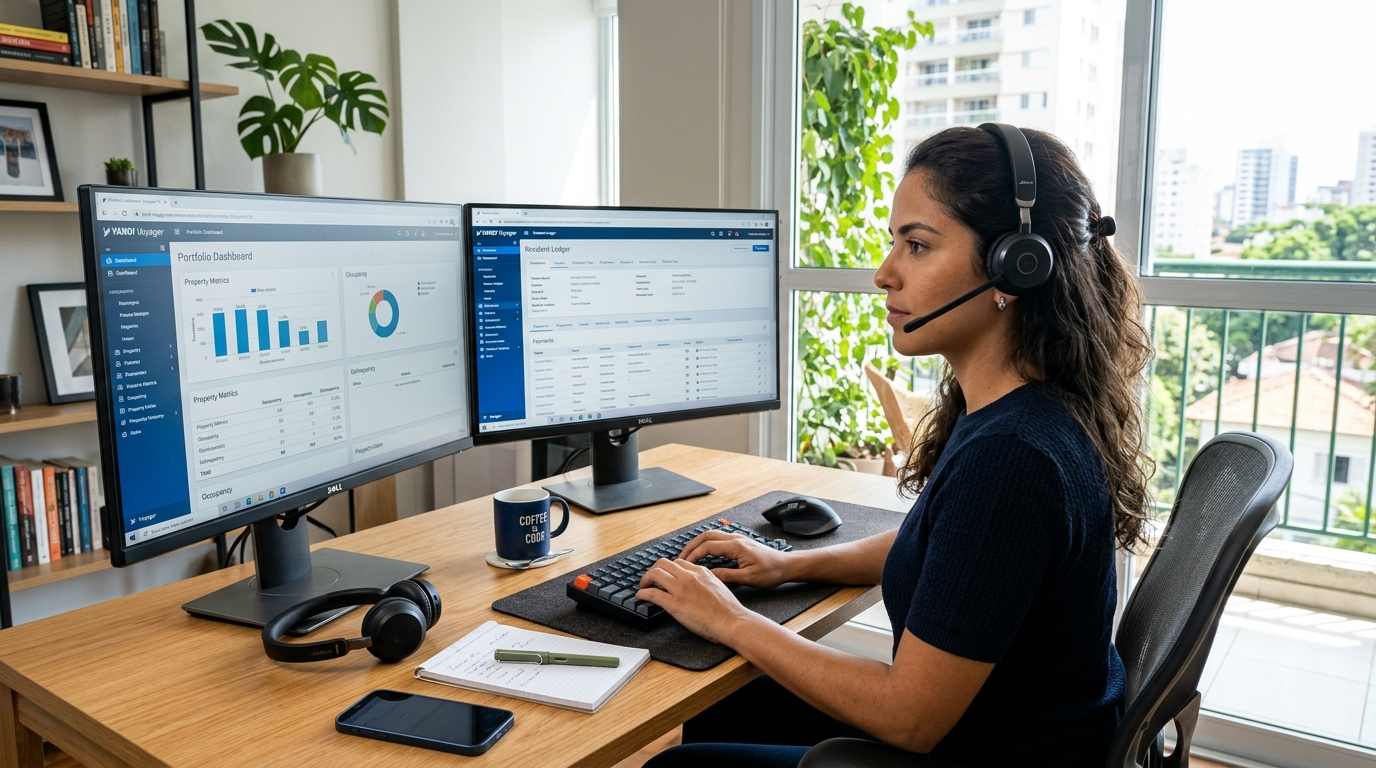
Why Yardi Help Desk Support Has Become a 2026 Priority
Nearshore virtual assistants trained on Yardi are now the fastest-growing support tier for US property management companies — and it's not hard to see why. Yardi Voyager, Yardi Breeze, and Yardi Breeze Premier are powerful platforms, but they're not simple. Work orders break. Ledger entries go sideways. CAM reconciliations stall. When something goes wrong inside Yardi at 10am on a Tuesday, you need a human who knows exactly where to click — not a 48-hour ticket queue.
The property management software market continues to grow at a rapid clip. According to Grand View Research (2024), the global property management software market is projected to reach $4.47 billion by 2030, compounding at 6.4% annually. That growth means more operators running Yardi — and more operators needing reliable, day-to-day support that goes beyond vendor documentation.
This guide breaks down every legitimate Yardi help desk support option available in 2026, what each one actually costs in time and money, and how to choose the right fit for your portfolio size and team structure. If you manage 50 doors or 5,000, there's a support model built for you.
What Is Yardi Help Desk Support — and What Does It Actually Cover?
Yardi help desk support is any resource — human or automated — that helps your team resolve errors, navigate workflows, configure settings, or recover data inside a Yardi platform. This includes Yardi Voyager, Yardi Breeze, Yardi Breeze Premier, Yardi RENTCafé, and connected modules like Yardi Payments and Yardi Maintenance.
Support needs typically fall into three buckets: break/fix issues (something is erroring out), workflow guidance (how do I run this CAM rec or set up this lease charge?), and configuration requests (we need a new report template or a custom workflow rule). Different support options handle these buckets with very different speed and cost profiles — which is exactly why choosing the wrong one is so expensive.
The scale of property management software adoption makes this a high-stakes decision. The US Bureau of Labor Statistics reports that property, real estate, and community association managers number over 374,000 in the United States alone — a workforce almost entirely dependent on platforms like Yardi for daily operations, according to the Bureau of Labor Statistics (2024).
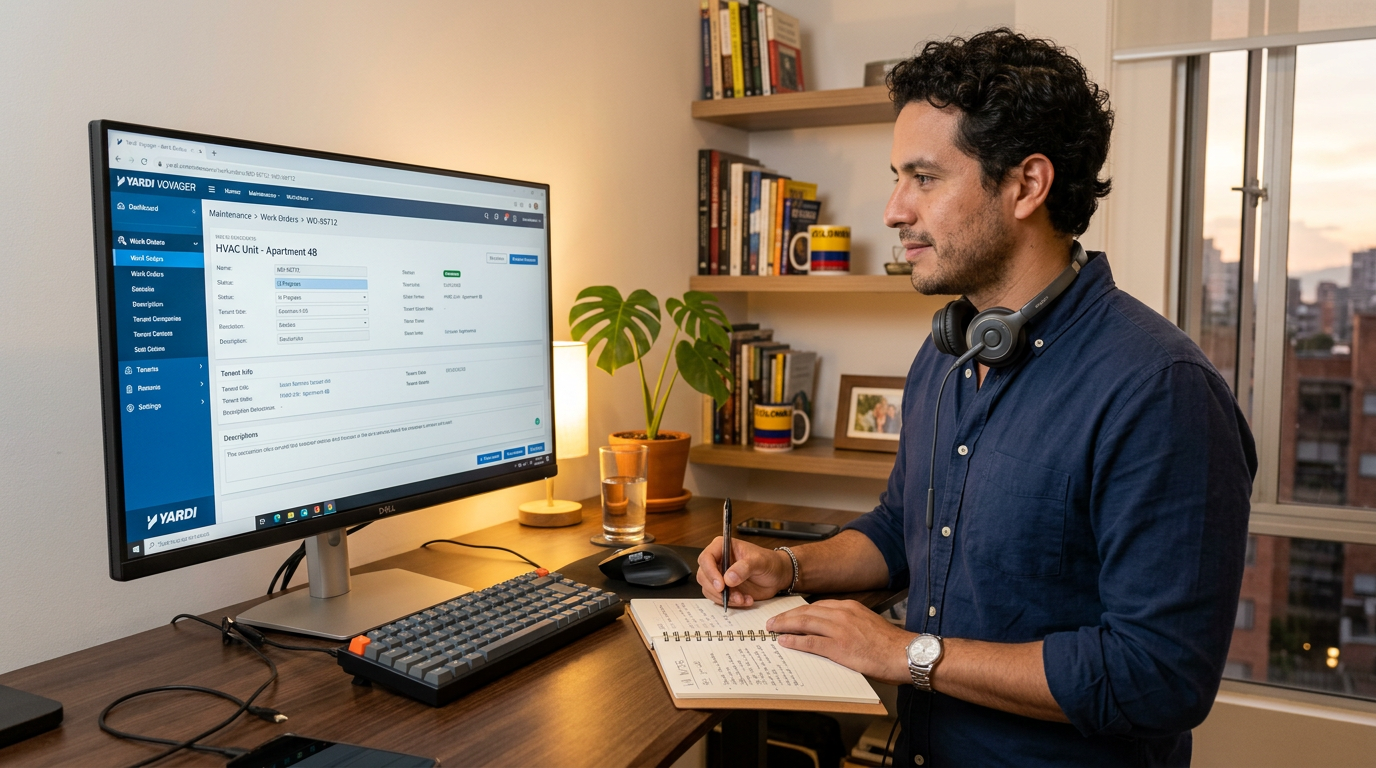
How the 4 Main Yardi Help Desk Support Options Compare in 2026
Not all support options are created equal. Here's an honest comparison of the four options property managers actually use in the real world — mapped across the dimensions that matter most when a Yardi issue is costing you time or money right now.
| Support Option | Avg. Monthly Cost | Response Time | Yardi Expertise Level | US Timezone Alignment | Best For |
|---|---|---|---|---|---|
| Yardi Client Central (Official) | Included in license | 24–72 hrs (tickets) | High (vendor-native) | Partial (US support team) | Complex bugs, feature requests |
| Yardi Certified Consulting Firm | $3,000–$12,000+ | 1–5 business days | Very High (certified) | Yes (US-based firms) | Large portfolios, enterprise config |
| Nearshore Yardi-Trained VA | $2,500 flat | Real-time (same shift) | High (role-specific training) | Yes (US business hours) | Daily ops, work orders, leasing, AR |
| Offshore VA (Philippines/India) | $800–$1,500 | Overnight batch (6–10 hr lag) | Low–Medium (self-trained) | No (significant timezone gap) | Async data entry only |
The table above reveals a critical pattern: official Yardi support is best for genuine software bugs, while day-to-day operational support — the stuff your team handles dozens of times per week — is far better served by a dedicated human who works your hours and knows your specific Yardi configuration. That's the gap nearshore VAs fill most cost-effectively.
If you're evaluating which property management platform provides the best environment for VA-assisted support overall, our deep dive on property management software with the best VA support benchmarks Yardi against AppFolio, Buildium, and Rent Manager across trainability, API openness, and ticket resolution speed.
How Nearshore Yardi VAs Outperform Offshore Alternatives in 2026
The word "nearshore" gets used loosely, so here's a precise definition: a nearshore virtual assistant is a remote staff member based in Latin America who works US business hours, communicates in fluent English, and operates within 0–3 hours of Eastern Time. That timezone alignment is not a minor convenience — it is the entire operational model.
When a tenant calls about a lease discrepancy in Yardi at 2pm EST, a nearshore coordinator picks it up in real time. An offshore VA in Manila or Hyderabad is asleep. The tenant calls your personal cell instead. That's the hidden cost of going cheap on timezone fit, and it compounds across every single day of operation.
The hidden cost of offshore Yardi support isn't the hourly rate — it's the 6–10 hour timezone gap that turns a 15-minute fix into a next-morning batch, stacking unresolved tickets, irritated tenants, and owner callbacks on your plate every single day.
Labor productivity data backs this up at scale. According to SHRM (2023), employees working in overlapping time zones with their managers report 31% higher task completion rates than those operating on asynchronous schedules. For Yardi help desk tasks — which are inherently reactive and time-sensitive — that gap is even more pronounced.
The National Apartment Association's research reinforces the operational stakes. According to the National Apartment Association (2024), maintenance request resolution speed is now the top driver of resident satisfaction scores — ahead of rent price — meaning every delayed Yardi work order has a measurable impact on renewals and vacancy.
Rose Talent Solutions places full-time nearshore coordinators trained specifically on Yardi workflows. Each team member ships with a role-specific AI copilot calibrated to their software environment — meaning your Yardi coordinator isn't just trained on the platform, they're assisted by AI that surfaces the right answer faster than any manual lookup. For a broader look at how nearshore staffing stacks up against offshore models for property management, see our detailed nearshore vs. offshore VA comparison for property management.

What Tasks Does a Yardi Help Desk VA Handle Day-to-Day?
A well-trained Yardi VA isn't just a ticket-logger. They function as an embedded help desk coordinator who owns specific Yardi workflows end-to-end. The scope of what they handle depends on your Yardi module stack, but most Rose placements cover the following task categories from day one.
- Work order management — creating, assigning, and closing maintenance requests inside Yardi Maintenance or Voyager
- Accounts receivable support — posting payments, flagging delinquencies, running aging reports, issuing late fee charges
- Lease administration — entering new leases, processing renewals, updating tenant records, generating move-in/move-out checklists
- CAM reconciliation assistance — pulling expense data, organizing actuals vs. estimates, flagging discrepancies for your PM or CPA
- Reporting — running standard Yardi reports on schedule (vacancy, delinquency, cash flow) and formatting them for owner distribution
- Vendor coordination — communicating with vendors through Yardi's vendor portal, tracking invoices, uploading W-9s
- Resident communication — responding to portal messages, escalating maintenance complaints, logging communication records in Yardi
Gallup's workplace research adds important context here. According to Gallup (2023), workers who have clearly defined daily tasks and consistent software tools show 21% higher productivity than those with ambiguous responsibilities — which is exactly why scoping a Yardi VA role precisely at intake makes such a measurable difference in output from week one.
This operational scope is what separates a Yardi-trained VA from generic administrative support. If you're running AppFolio alongside or instead of Yardi, our AppFolio virtual assistant hiring guide covers parallel task frameworks for that platform. And if your accounting team runs Buildium, the Buildium virtual assistant workflow guide maps out the same approach for that system.
"The property management companies scaling past 500 doors in 2024 and 2025 aren't doing it by hiring more US-based coordinators at $55,000 a year — they're building lean teams augmented by trained remote staff who own the software layer."
— Andrew Propst, CPM, Past President at NARPM (2024)
How Rose's Nearshore Yardi VA Placement Process Works in 2026
Getting a Yardi-trained team member placed doesn't have to mean weeks of recruiting, resume screening, and onboarding from scratch. Rose handles the full pipeline so you spend time managing outcomes, not hiring logistics.
Intake & Role Scoping
You tell Rose which Yardi modules you use, your portfolio size, and the specific task types you need covered. This shapes the candidate profile before the first resume is pulled.
Vetting & English Screening
Candidates are screened for Yardi experience, English proficiency (8/10+ floor), and US timezone availability. Only candidates who pass all three gates reach your interview stage.
Interview & Selection
You interview your shortlist and choose the team member you want. Rose doesn't place without your approval — you have full final say on who joins your operation.
AI Copilot Activation
Your new team member's role-specific AI copilot is configured for your Yardi environment — module-specific prompts, your SOPs, your reporting cadence — before their first day.
Ongoing HR & Management
Payroll, HR, compliance, and performance management are handled by Rose. If the placement isn't a fit, Rose replaces them at no additional cost — no long-term contract required.
The all-in pricing is $2,500/month flat — recruiting, vetting, payroll, HR, and ongoing management included. Month-to-month terms with 30 days written notice. If you're ready to scope a role, start the placement process here.
Nearshore Yardi VA vs. Offshore VA: Honest Pros and Cons
The offshore vs. nearshore debate comes down to what you're actually optimizing for. If pure sticker price is the only variable, offshore wins on paper. If you're optimizing for resolved Yardi tickets, satisfied tenants, and reduced owner callbacks, the math shifts quickly. Here's an honest look at both sides.
Nearshore Yardi VA
- Works US business hours — real-time response to Yardi issues
- English fluency at a consistent, screened standard (8/10+)
- 0–3 hour timezone offset means same-day resolution on almost every ticket
- Ships with AI copilot trained on your Yardi modules and SOPs
- Easier culture fit with US-based owners and tenants
- No long-term contract — month-to-month with free replacement guarantee
Offshore Yardi VA
- Lower sticker price ($800–$1,500/mo) but hidden costs in rework and delays
- 6–10 hour timezone gap creates overnight batching on time-sensitive tasks
- Inconsistent English proficiency — no industry-standard screening benchmark
- Self-trained on Yardi through YouTube and documentation, not live platform experience
- No embedded AI tooling — requires you to build and maintain your own stack
- Coordination overhead falls back on your internal team to manage
According to McKinsey & Company (2023), the total cost of a mis-hire — including ramp time, error correction, and re-recruiting — averages 1.5–2× the annual salary equivalent of the role. For property management operations running on Yardi, where a single misconfigured lease or unprocessed payment can trigger cascading errors across your ledger, that figure is conservative.
For property managers who want to understand the full staffing picture — not just Yardi help desk support but the broader role of VAs across leasing, maintenance, and accounting — the Rose property management staffing page maps out every function where nearshore VAs are actively replacing in-house hires at a fraction of the cost.
If your books run through QuickBooks alongside Yardi, it's worth noting that Rose's nearshore team members can be scoped for bookkeeping and accounting support as well — handling AP/AR, bank reconciliation, and owner distributions inside the same flat monthly rate.
The bottom line on Yardi help desk support in 2026: the best option is the one that resolves issues in the same timezone your business operates in. Official Yardi support handles genuine software bugs. Certified consultants handle enterprise-level configuration. And a nearshore Yardi-trained VA handles everything in between — the daily operational layer that keeps your portfolio running without touching your team's capacity.