
Why Nearshore VAs From Colombia and Mexico Are Dominating 2026
Nearshore virtual assistants based in Colombia and Mexico have become the go-to staffing solution for US and Canadian businesses that are done losing hours to timezone gaps and miscommunication. Unlike traditional offshore outsourcing with 8–12 hour time differences, nearshore talent operates in the same time zones as your team — EST, CST, MST, or PST — which means your inbox gets answered at 9am, not 9pm. That single difference changes everything about how remote staffing actually works in practice.
The numbers back this up. Latin America's remote workforce has grown by over 300% since 2019, driven largely by US companies discovering that geographic proximity matters more than rate-per-hour when you factor in communication overhead, according to McKinsey Global Institute (2021). When a tenant needs a maintenance callback or a client needs an invoice corrected, waiting 8 hours for an overnight response isn't neutral — it costs you deals and client trust.
Colombia and Mexico specifically have emerged as the two deepest talent pools in the region. Bogotá, Medellín, Mexico City, and Guadalajara each have large, university-educated workforces with strong English proficiency pipelines. These aren't entry-level gig workers — they are career-focused professionals who chose virtual assistance as a long-term vocation.
If you want a deeper look at how the three major sourcing models compare before going further, the complete nearshore vs. offshore vs. onshore VA comparison breaks down every dimension from cost to communication latency to legal risk.
What Is a Nearshore Virtual Assistant? (And Why the Definition Matters in 2026)
A nearshore virtual assistant is a remote professional hired from a country in a similar or overlapping time zone to the client — typically within one to three hours of US business hours. The term distinguishes this model from offshore outsourcing (6–12 hour gaps across the Pacific or South Asia) and from onshore hiring (same country, significantly higher cost). For US businesses, nearshore almost always means Latin America.
The definition matters because the word "virtual assistant" has been watered down to include everything from $5/hour task-runners on Fiverr to trained executive assistants earning professional wages. When you're evaluating the best virtual assistant services from Colombia and Mexico, you're looking at a specific tier: full-time (40 hrs/week), English-fluent (Rose's published bar is 8/10+ on proficiency screens), software-literate professionals who work your hours and report into your workflows — not a freelancer you message when you remember they exist.

Rose Talent Solutions places nearshore VAs at a flat $2,500/month — that's recruiting, vetting, payroll, HR, and ongoing management included, on a month-to-month basis with no long-term contract. If the team member isn't a fit, they're replaced at no additional cost. To see how that stacks up against the broader market, the guide to the best affordable virtual assistant services in 2026 puts flat-rate nearshore pricing in full context against hourly and retainer models.
How Colombia and Mexico Compare to Other VA Sources in 2026
Not all virtual assistant markets are created equal. Colombia and Mexico punch above their weight for US businesses for a specific set of structural reasons — time zone alignment, education system output, and the sheer volume of English-track graduates entering the workforce each year. But you should see the comparison in full before committing to any model.
| Criteria | Nearshore (Colombia / Mexico) | Offshore (SE Asia / South Asia) | Onshore (US-based VA) |
|---|---|---|---|
| Timezone vs. US Eastern | Same to +1 hr | +11 to +13 hrs | Same |
| Avg. Monthly Cost (Full-Time) | ~$2,500 flat | $800–$1,500 | $4,000–$7,000+ |
| English Fluency (avg. EF score) | High (B2–C1) | Moderate–High (B1–B2) | Native |
| Real-Time Availability | Yes — full US hours | Rarely (shift work required) | Yes |
| Cultural Alignment with US | Strong | Moderate | Highest |
| Software Training (AppFolio, QBO, etc.) | Included (AI copilot) | Varies by vendor | Varies |
| Contract Flexibility | Month-to-month | Often 6–12 month minimum | Varies widely |
| Payroll / HR Overhead | Managed by agency | Often self-managed | Self-managed or EOR |
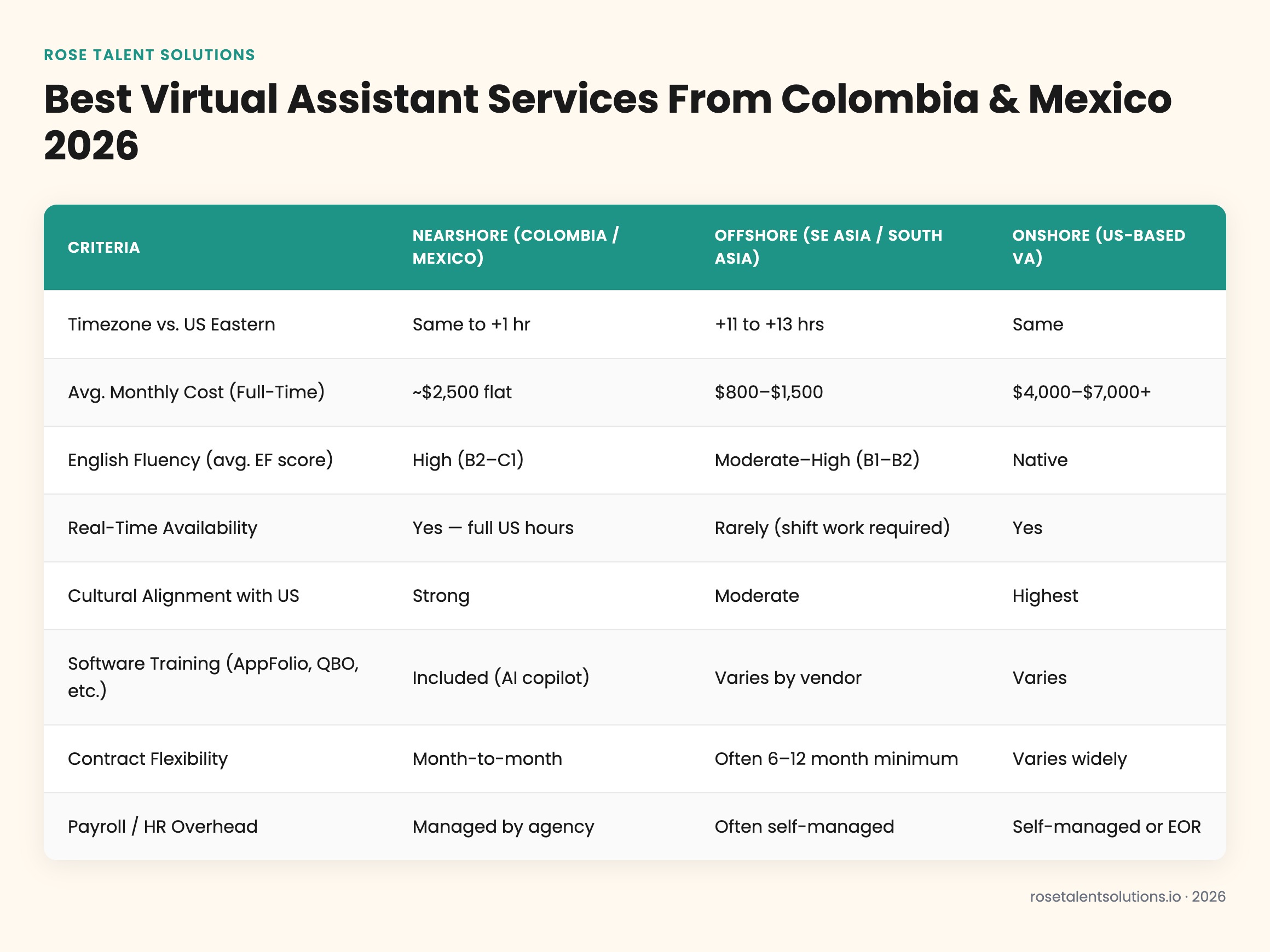
The cost gap between nearshore and offshore is real, but it narrows dramatically once you price in the management overhead of an 11-hour timezone difference. According to SHRM (2022), replacing a failed remote hire costs an average of 50–200% of that role's annual salary. A $900/month distant-timezone VA who churns in four months — after weeks of miscommunication and delayed deliverables — is far more expensive in practice than a flat $2,500/month nearshore placement backed by a no-cost replacement guarantee. For a direct breakdown of what separates these models structurally, the onshore vs. offshore virtual assistant breakdown covers the tradeoffs in plain terms.
How Rose's AI Copilot Advantage Changes What a VA Can Do in 2026
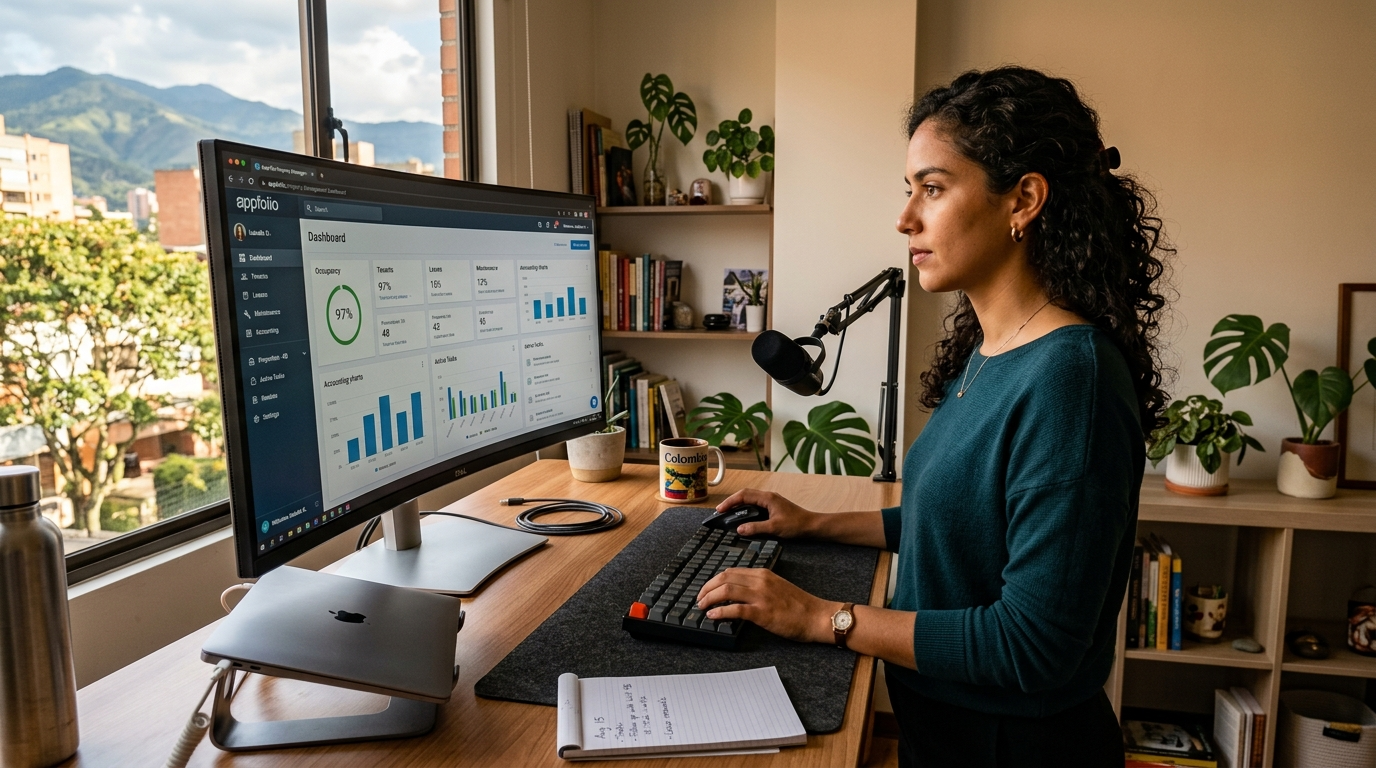
One of the most significant shifts in virtual assistant services since 2024 has been the integration of role-specific AI tools directly into VA workflows. At Rose, every team member ships with an AI copilot trained on their specific software stack — whether that's AppFolio, Buildium, QuickBooks Online, or another platform. This isn't a chatbot bolted on after the fact. It's purpose-built tooling that makes each VA measurably faster and more accurate from day one.
"AI-assisted workers complete tasks up to 66% faster than those without AI support, with the largest gains seen in structured knowledge work like data entry, scheduling, and correspondence drafting." — Erik Brynjolfsson, Professor at Stanford Digital Economy Lab, Stanford University (2023)
For property management businesses, this means a nearshore VA who is already trained on AppFolio can handle property management tasks — work orders, lease renewals, tenant communications — without a three-month ramp-up. For accounting teams, the same logic applies: a bookkeeping VA arrives knowing QuickBooks, ready to reconcile, categorize, and report from week one. See how that translates directly to bookkeeping and accounting support your team can actually delegate without holding hands.
The hidden cost of distant-timezone VAs isn't the hourly rate — it's the 6–12 hour gap that turns a 5-minute Slack question into a 24-hour email chain. Nearshore VAs from Colombia and Mexico eliminate that overhead entirely because they're online when you are.
According to the U.S. Bureau of Labor Statistics (2023), labor productivity growth is consistently highest in sectors that adopt AI-assisted workflows ahead of competitors. Virtual staffing agencies that embed AI training into their placement model — rather than leaving it to the client — deliver a measurable productivity premium from the first week of engagement. A Deloitte AI survey (2023) found that organizations embedding AI tools into employee onboarding workflows reduced time-to-productivity by an average of 40% compared to those relying on traditional training alone.
How Rose Talent Solutions Places Your VA in as Few as 7 Days
Speed to placement is one of the most common concerns businesses raise before hiring a nearshore VA. The assumption is that vetting talent across an international border takes months. In practice, Rose's process compresses that timeline to a single week for most roles because the recruiting infrastructure is already built — candidate pipelines in Colombia and Mexico are active year-round, not assembled on demand.
Intake Call (Day 1)
You describe the role, the software stack, and the hours. Rose maps this to the right candidate profile within 24 hours of the call.
Candidate Matching (Days 2–4)
Rose pulls pre-vetted candidates from the Colombia and Mexico talent pool — English-screened at 8/10+, software-tested, background-checked. You receive 1–3 profiles, not a 40-person shortlist.
Interview and Selection (Day 5)
You interview your top match. Most clients select on the first interview. Rose handles the offer, contract, and onboarding logistics.
AI Copilot Activation (Day 6)
Your VA's role-specific AI copilot is configured for your software stack before their first day — AppFolio, Buildium, QuickBooks, or whatever tools your team uses.
Day One, Live (Day 7)
Your VA logs in during your business hours, ready to work. Payroll, HR, and ongoing management are handled by Rose from this point forward.
The month-to-month structure means you are never locked in. If the placement isn't right, Rose replaces them at no additional cost — no fee, no restart charge, no delay. To start the intake process now, visit the Rose Talent Solutions start page and book your intake call. If you want to evaluate Rose alongside other providers before making a decision, the independent roundup of the best nearshore virtual assistant companies in 2026 benchmarks the top agencies across pricing, vetting depth, software specialization, and replacement policies.
Nearshore VA Services From Colombia and Mexico: Pros, Cons, and Who They're Best For in 2026
Nearshore isn't the right model for every business — but for most US and Canadian SMBs with 5–200 employees, it hits the optimal intersection of cost, quality, and communication. Here's an honest look at both sides before you decide.
Pros of Nearshore VAs (Colombia / Mexico)
- Same or near-identical US business hours — no shift scheduling required
- English fluency high enough for client-facing communication
- Flat monthly pricing eliminates hourly billing surprises
- Cultural alignment with US business norms and communication styles
- AI copilot training included — faster ramp, fewer errors
- Month-to-month terms with free replacement if not a fit
- Payroll, HR, and management handled by the agency
Cons / Limitations to Know
- Higher monthly cost than pure distant-timezone outsourcing at face value
- Not a fit if you need native-level Spanish for US-domestic markets only
- Requires a clear role definition — a vague brief produces a slower match
- Not suited for roles requiring physical presence or US licensure
The businesses that get the most out of nearshore VAs from Colombia and Mexico are those with defined, repeatable workflows that currently live in someone's inbox or head — property managers drowning in maintenance tickets, bookkeepers manually chasing receipts, operations leads answering the same 12 questions daily. If you can document the process, a nearshore VA can own it. According to Gallup's State of the American Workplace report (2023), employees who offload repetitive administrative tasks to support staff report 34% higher engagement scores — a reliable proxy for the productivity gains owners feel when delegation actually works.