
Why Nearshore VAs Are Winning for US Small Businesses in 2026
Nearshore virtual assistants — staffed from Latin America and working on US business hours — have quietly become the default choice for small business owners who tried offshore and got burned by timezone gaps, language friction, and slow ramp times. The market has shifted. Where offshore was once "good enough," small businesses today are running leaner operations, using more software, and moving faster than a 12-hour turnaround will allow.
Small businesses account for 99.9% of all US employer firms, according to the US Small Business Administration (2023). That's a massive base of operators who need support staff but can't justify the overhead of a full in-house hire. Virtual assistants fill that gap — and in 2026, the question isn't whether to hire a VA, it's which model actually delivers.
This guide breaks down every major VA service category, compares the models honestly, and tells you exactly what to look for so you hire once and hire right. If you want to see how nearshore staffing specifically benchmarks against other sourcing models, our detailed nearshore vs. offshore virtual assistant breakdown is worth reading alongside this post.
That time savings is real — but only when the VA is actually available during your business day, speaks your language, and already knows the software your team runs on. Those three criteria eliminate most offshore options and put nearshore providers at the top of the list for most US small business owners.
What Is a Nearshore Virtual Assistant? (2026 Definition)
A nearshore virtual assistant is a remote support professional based in a geographically proximate region — in the US context, that means Latin America. Unlike offshore VAs (typically based in the Philippines or India), nearshore VAs work in the same or adjacent time zones as their US clients, usually Eastern through Pacific Standard Time, depending on the country of placement.
The practical difference is immediate: a nearshore VA can join your 9am standup, respond to a client email at 10:30am, and close a task loop before lunch — all in real time. An offshore VA in Southeast Asia is answering those same messages at 3am their time, batching responses overnight, and handing back a thread that's already 14 hours old.
Rose Talent Solutions sources exclusively from Latin America, where English proficiency scores hit 8/10 or higher on all candidate screens. The result is a team member who communicates like a domestic hire and costs a fraction of one.
How the Top VA Service Models Compare in 2026
Not all virtual assistant services are structured the same way. Some are hourly marketplaces where you're hunting for a reliable contractor. Others are managed staffing models where the agency handles recruiting, vetting, payroll, HR, and ongoing performance management. The difference in outcome between those two models is dramatic, especially for small businesses that don't have an HR department to absorb the friction.
Before committing to any provider, it's worth understanding exactly what you're buying. The table below compares the three dominant VA sourcing models on the dimensions that matter most to US small business owners.
| Criteria | Nearshore Managed (Rose) | Offshore Marketplace | Domestic Freelance |
|---|---|---|---|
| Time Zone Overlap | Full US hours (EST–PST) | Partial or overnight | Full US hours |
| English Proficiency | 8/10+ screened | Varies widely (2–8/10) | Native |
| Monthly Cost (Full-Time) | $2,500 flat | $800–$1,600 | $4,500–$8,000+ |
| Recruiting & Vetting | Fully managed | Self-managed | Self-managed |
| Payroll & HR Included | Yes | No | No |
| Software-Trained VA | Yes — role-specific AI copilot | Rare | Varies |
| Contract Flexibility | Month-to-month, 30-day notice | Varies by platform | Varies by freelancer |
| Replacement if Not a Fit | Free replacement included | Restart search yourself | Restart search yourself |
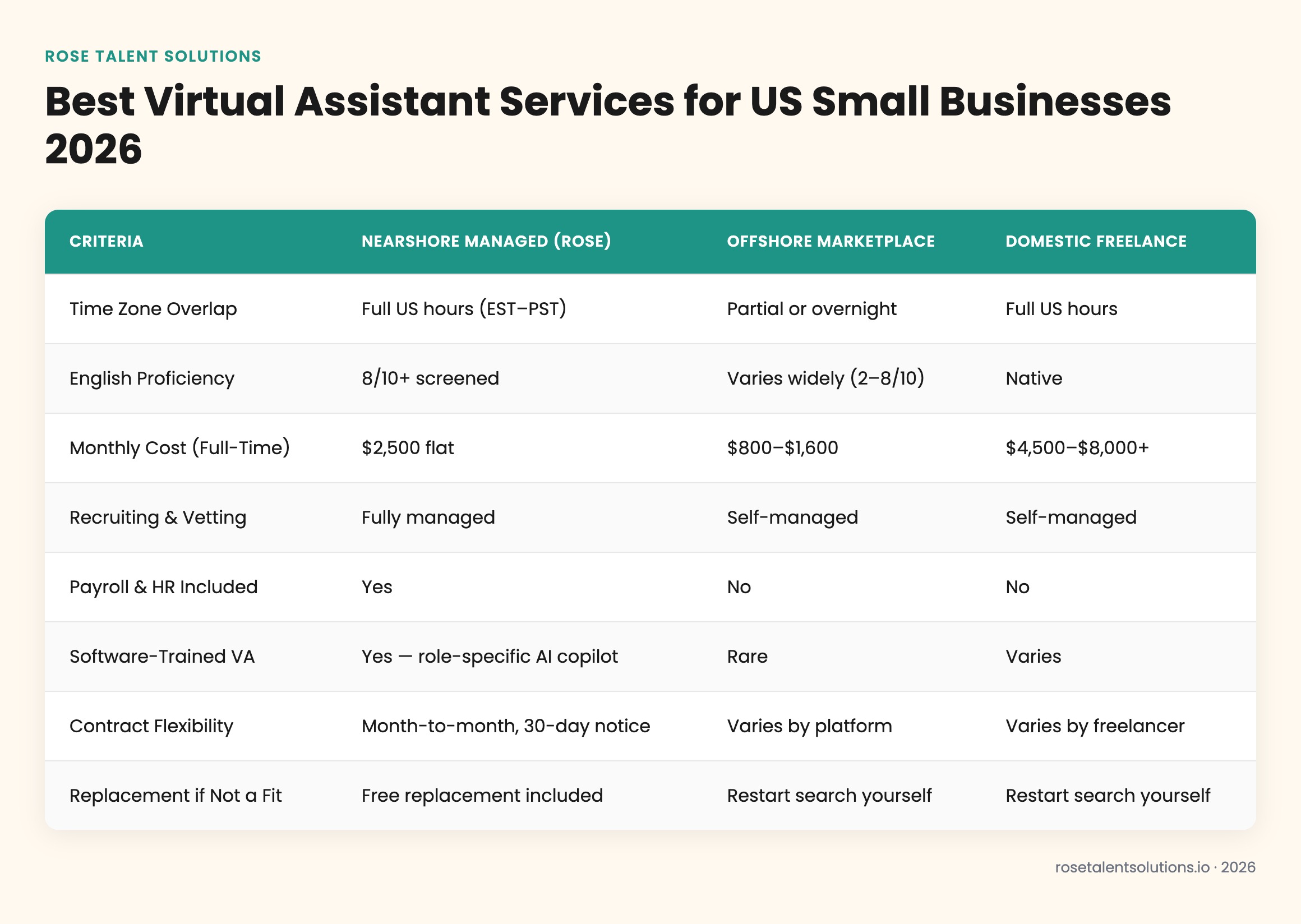
The offshore marketplace looks cheap on paper. But when you factor in the hours you spend sourcing, vetting, onboarding, managing payroll compliance, and re-hiring after a bad placement, that $800/month quickly becomes more expensive than a fully managed $2,500/month engagement where all of that is handled for you. For a deeper look at how nearshore agencies stack up specifically, see our 2026 roundup of the best nearshore virtual assistant companies.
How AI-Trained VAs Give Small Businesses an Edge in 2026
The standard VA hire in 2026 isn't just a person who handles tasks — it's a person paired with a role-specific AI copilot trained on the exact software your business runs. This is the single biggest differentiator separating premium nearshore services from commodity offshore marketplaces right now.
At Rose Talent Solutions, every team member ships with an AI advantage layer built around their assigned software stack — whether that's QuickBooks for bookkeeping VAs, AppFolio or Buildium for property management coordinators, or a custom CRM for sales support roles. The AI copilot accelerates onboarding, reduces errors, and keeps the VA current as software updates roll out.
"AI-augmented workers aren't replacing jobs — they're compressing the ramp time to full productivity from months to days. The small businesses that win are the ones pairing skilled humans with targeted AI tools, not choosing one over the other." — Josh Bersin, Global Industry Analyst and Founder at The Josh Bersin Company (2024)
The practical result: a bookkeeping VA trained on QuickBooks Online can categorize transactions, reconcile accounts, and flag anomalies from day one instead of spending weeks just learning the interface. According to Intuit QuickBooks (2024), 64% of small business owners say keeping up with bookkeeping and accounting is a top operational pain point. A software-fluent VA eliminates that pain faster than any other hiring approach.
For businesses running property management operations specifically, the property management VA services at Rose include coordinators pre-trained on AppFolio and Buildium workflows — maintenance dispatch, lease renewals, tenant communication, and owner reporting. The AI copilot layer means those VAs arrive knowing the tool, not learning it on your dime.
The hidden cost of an untrained VA isn't their hourly rate — it's the 3–6 weeks of productive time you lose while they learn software your business depends on daily. AI-copilot-equipped VAs close that ramp gap before they start.
How Rose's Hiring Process Works: From Brief to First Day in 7 Steps
Speed to placement matters for small businesses. You're usually hiring because you're already overwhelmed, not because you have a leisurely runway to evaluate candidates for three months. Rose's placement process is engineered for that reality — most clients receive their first matched candidate within 7 days of submitting a role brief.
If you want to benchmark that timeline against industry norms, our hiring timeline benchmarking guide for nearshore virtual assistants shows exactly how Rose's 7-day average compares to the 30–45 day typical offshore marketplace search.
Submit Your Role Brief
You tell us the role, the software stack, the hours, and the key outcomes you need. Takes about 10 minutes at /start.
Rose Sources & Screens
Our recruiting team pulls from an active Latin American talent pipeline, screens for English proficiency (8/10+ floor), software fluency, and culture fit.
You Meet Your Match
You receive a shortlist of pre-vetted candidates — typically 2–3 profiles — and conduct a 30-minute intro call with your top choice.
AI Copilot Configuration
Rose configures the role-specific AI copilot to your software stack before day one so your VA arrives ready to execute, not explore.
Onboarding & First Week
Rose manages payroll, HR compliance, and onboarding logistics. You focus on giving context and priorities — not paperwork.
Ongoing Performance Management
Rose stays in the loop on performance. If anything is off-track, we address it before it becomes your problem to manage.
Free Replacement If Not a Fit
If the placement isn't right for any reason, Rose replaces at no additional cost — no restarting a search, no re-paying a placement fee.
What Small Businesses Are Actually Delegating to VAs in 2026
The most common mistake small business owners make when hiring a VA is being too vague about scope. "General admin" is not a job description — it's a recipe for underutilization. The best VA engagements start with a specific set of recurring tasks that have clear outputs and measurable outcomes.
According to Gallup's workplace research (2023), employees who clearly understand their roles and expectations are 2.5× more likely to be highly engaged — and that principle applies directly to virtual assistants. Role clarity on day one is the strongest predictor of VA retention and output quality.
Here are the highest-leverage delegation categories for US small businesses right now:
- Bookkeeping & Accounts Payable — transaction categorization, invoice processing, bank reconciliation, vendor payments. Rose's bookkeeping and accounting VA services pair team members with QuickBooks and Xero copilots for same-day accuracy.
- Customer & Tenant Communication — email inbox management, live chat support, inbound call handling, CRM updates.
- Calendar & Scheduling — appointment booking, meeting prep, follow-up sequencing, travel coordination.
- Social Media & Content Scheduling — post drafting, scheduling in tools like Buffer or Hootsuite, basic engagement monitoring.
- Data Entry & Reporting — CRM hygiene, spreadsheet maintenance, KPI dashboards, weekly summary reports.
- Property Management Coordination — maintenance ticket routing, lease renewal tracking, owner reporting, showing coordination in AppFolio or Buildium.
The average US small business owner works 52 hours per week, according to a Small Business Trends survey (2022). Delegating even 10–12 of those hours to a skilled VA in the right role is the equivalent of a 20% productivity gain without adding a domestic employee to payroll.
Nearshore vs. Offshore VA: The Honest Pros and Cons for 2026
If you're weighing nearshore against offshore purely on sticker price, offshore wins. If you're weighing them on total cost of ownership — including your time, ramp lag, communication friction, and the cost of a bad placement — nearshore wins by a wide margin for most US small businesses. The comparison below is honest about both sides.
For startups specifically, cost sensitivity makes this decision even more acute. Our guide to the best nearshore staffing agencies for startups walks through how to evaluate this trade-off when runway is tight and every hour counts.
Nearshore VA — Pros
- Full US-hours availability (EST–PST overlap)
- English proficiency screened to 8/10+ floor
- Same-day response loops — no overnight batching
- Cultural alignment with US business norms
- AI copilot training on your specific software stack
- Managed service covers payroll, HR, and replacements
Offshore VA — Cons
- 6–12 hour timezone gap creates overnight response lag
- Variable English proficiency — inconsistent communication quality
- Self-managed hiring means you absorb recruiting and vetting costs
- Software ramp time longer without AI copilot layer
- Bad placement requires restarting an unmanaged search process
- Lower sticker price often offsets by hidden coordination overhead
According to McKinsey & Company (2023), the cost of a bad hire can reach 30% of the employee's first-year earnings — even for contract and freelance workers when you account for lost productivity, re-hiring, and ramp time. For a $1,200/month offshore VA, that's a $4,300+ mistake if the placement fails at the six-month mark. A managed nearshore model with a free replacement guarantee eliminates that risk entirely.
The month-to-month structure and no long-term contract policy at Rose means you're never locked in — but the replacement guarantee means you also never have to start over from scratch if a placement isn't right.