
Why Nearshore Virtual Assistant Agencies Dominate in 2026
Nearshore virtual assistant agencies — firms that staff talent from Latin America to serve US, Canadian, and UK businesses — have moved from a niche workaround to the default choice for operators who need real coverage, not just cheap labor. The shift happened because timezone gaps finally broke enough teams that owners stopped tolerating them. A VA who responds at 11 PM your time isn't a support system; it's a delayed inbox. Nearshore closes that gap completely, with team members working live during your business hours.
The global virtual assistant market is projected to reach $19.6 billion by 2025, according to Grand View Research (2024). That growth isn't driven by the same models that dominated the 2010s — it's driven by demand for VAs who can operate inside complex software stacks, communicate fluently in English, and function as genuine team members rather than ticket-closers.
If you want the full breakdown of how the nearshore model stacks up against every alternative, our nearshore vs. offshore vs. onshore complete comparison walks through every dimension — cost, quality, risk, and ramp time.
What Is a Nearshore Virtual Assistant Agency?
A nearshore virtual assistant agency recruits, vets, and places remote workers from nearby countries — typically Mexico, Colombia, Argentina, Costa Rica, and similar Latin American markets — to serve businesses in the United States, Canada, or the UK. The model prioritizes timezone overlap, English fluency, and cultural alignment with North American business norms. Team members work your hours, in your language, inside your tools.
The model matters because timezone alignment is the single biggest predictor of whether a VA actually improves your throughput or just adds administrative overhead. A VA who works your hours, speaks your language naturally, and understands your customer's expectations operates like a local hire — at a fraction of the fully-loaded cost.
What separates a staffing agency from a freelance platform? A full-service VA agency handles recruiting, skills vetting, payroll, HR compliance, and ongoing performance management. You get a dedicated team member without becoming an international employer. Freelance platforms like Upwork put all of that burden on you.

How Do the Best Virtual Assistant Agencies in 2026 Differ From Each Other?
Not all VA agencies are built the same, and the differences matter more than most buyers realize until they're six weeks in and frustrated. The core dimensions to evaluate are: staffing model (nearshore vs. offshore), pricing structure (flat vs. hourly vs. markup on labor), what's included in the fee, English proficiency standards, software training depth, and replacement policy.
Agencies that charge hourly sound cheaper until you do the math. A "dedicated" VA at $18–$22/hour adds up to $3,000–$3,500/month for 40 hours per week — before you account for management overhead, platform fees, or the cost of replacing a bad placement yourself. Flat-rate models with built-in HR and replacement guarantees consistently come out ahead on total cost of ownership.
According to SHRM (2023), the average cost to replace an employee is six to nine months of their salary. For a VA role, even a conservative estimate puts a single bad placement — factoring in your time — at $4,000–$8,000 in lost productivity. This is why the replacement guarantee offered by agencies like Rose matters: it isn't a marketing line, it's real risk elimination.
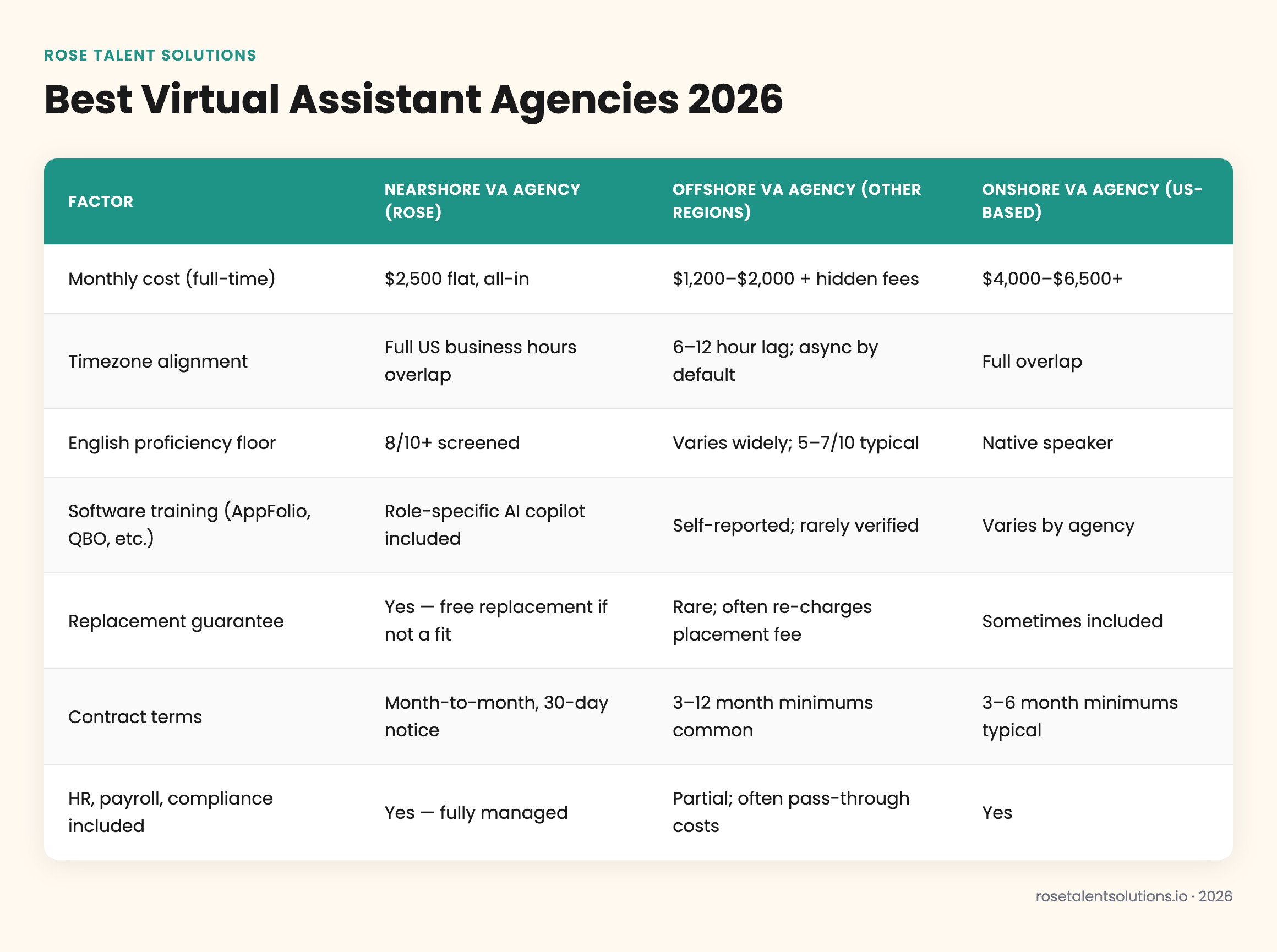
| Factor | Nearshore VA Agency (Rose) | Offshore VA Agency (other regions) | Onshore VA Agency (US-based) |
|---|---|---|---|
| Monthly cost (full-time) | $2,500 flat, all-in | $1,200–$2,000 + hidden fees | $4,000–$6,500+ |
| Timezone alignment | Full US business hours overlap | 6–12 hour lag; async by default | Full overlap |
| English proficiency floor | 8/10+ screened | Varies widely; 5–7/10 typical | Native speaker |
| Software training (AppFolio, QBO, etc.) | Role-specific AI copilot included | Self-reported; rarely verified | Varies by agency |
| Replacement guarantee | Yes — free replacement if not a fit | Rare; often re-charges placement fee | Sometimes included |
| Contract terms | Month-to-month, 30-day notice | 3–12 month minimums common | 3–6 month minimums typical |
| HR, payroll, compliance included | Yes — fully managed | Partial; often pass-through costs | Yes |
How AI Copilots Make 2026's Best VA Agencies Faster Than Ever
The agencies that separated themselves in 2025 and into 2026 aren't just placing warm bodies — they're placing software-trained talent augmented by AI tools trained on the specific platforms their clients run. Rose Talent Solutions built what it calls the AI Advantage: every team member ships with a role-specific AI copilot pre-trained on their software environment — whether that's AppFolio, Buildium, QuickBooks Online, or another platform.
This matters because the ramp time problem — the 4–8 weeks it typically takes a new VA to become genuinely productive — is cut in half when the VA already has a trained copilot surfacing the right workflows, templates, and data on demand. Faster ramp means faster ROI for you.
"AI won't replace virtual assistants — it will replace the virtual assistants who don't use AI." — Liam Martin, Co-founder at Time Doctor (2024)
According to McKinsey Global Institute (2023), generative AI tools have the potential to automate 60–70% of time spent on routine business tasks. For a VA handling lease processing, tenant communications, or bookkeeping reconciliation, that translates directly into more tasks completed per shift — without increasing headcount or cost.
The best VA agencies in 2026 aren't competing on labor cost alone — they're competing on how fast their team members become productive contributors inside your specific tech stack. AI copilots trained on your software are now table stakes for top-tier agencies.

How to Evaluate a Virtual Assistant Agency Before You Sign
The wrong agency costs you more than the right one saves you. Here's how to filter fast. Before you request a demo or fill out any intake form, ask these five questions directly:
- Where are your VAs located? The answer determines timezone, English proficiency baseline, and cultural fit. Latin America for US clients — avoid agencies that are vague about geography.
- What's included in the monthly fee? Recruiting, vetting, payroll, HR, ongoing management, and replacement should all be covered. If any of those are add-ons, the stated price is misleading.
- What is your English proficiency screen? Get a number. Rose's published floor is 8/10. Agencies without a specific score are telling you they don't screen consistently.
- What happens if the placement isn't a fit? Free replacement at no additional cost is the right answer. Re-charging a placement fee is a red flag.
- What are the contract terms? Month-to-month with 30 days written notice is standard for reputable agencies. Long minimum commitments before you've seen performance are a warning sign.
For a deeper look at pricing models across the market, our rundown of the most affordable virtual assistant services in 2026 breaks down exactly what each price tier actually buys you.
The U.S. Bureau of Labor Statistics (2024) puts the median annual wage for a US-based administrative assistant at $44,080 — roughly $3,675/month before benefits, taxes, equipment, and management overhead. A fully managed nearshore VA at $2,500/month all-in isn't just more affordable; it's a structurally different cost model with less employer risk.
Why Nearshore Wins in 2026
- Full US business hours — live collaboration, not async catch-up
- English proficiency screened to a published standard (8/10+)
- Flat all-in pricing with no hidden HR or payroll fees
- AI copilots trained on your specific software stack
- Month-to-month terms — no long-term contract required
- Free replacement if the team member isn't a fit
Where Other Models Fall Short
- Far-offshore: 6–12 hour timezone lag kills real-time workflows
- Far-offshore: English proficiency often unscreened or inconsistent
- Onshore: 2–3× the cost for equivalent role types
- Freelance platforms: No replacement guarantee, no HR support
- Hourly billing: Cost unpredictability as workload scales
- Long-term contracts: Locked in before performance is proven
Which Roles Are Best Suited to a 2026 Virtual Assistant Agency?
The highest ROI use cases for VA agencies in 2026 are roles where software proficiency, communication quality, and real-time responsiveness all matter simultaneously. Generic data entry or basic scheduling can be handled by almost any model. But the roles that actually move the needle for growing businesses require more.
Property management is one of the clearest examples. Lease coordination, maintenance dispatch, tenant communication, and AppFolio or Buildium administration all require someone who works your hours, responds to tenants in real time, and knows the software inside out. Rose's property management VA service was built specifically for operators running 50–500+ units who need that coverage without hiring locally.
Bookkeeping and accounting support is another high-value category. According to QuickBooks / Intuit (2023), over 40% of small business owners spend more than 80 hours per year on bookkeeping tasks they could delegate. A QuickBooks-trained VA handling reconciliation, AP/AR tracking, and financial reporting frees that time immediately. See how Rose structures that support at the bookkeeping and accounting VA page.
Other strong fits: executive assistance, customer service, marketing operations, and CRM management. The common thread is software complexity — roles where training time and tool fluency determine output quality, not just effort.
How Rose Talent Solutions Onboards a New Team Member
Role Scoping Call
Rose's team meets with you to define the exact role, software stack, working hours, and must-have skills. This call takes 30–45 minutes and produces the hiring brief.
Recruiting & Vetting
Rose sources from its Latin America talent network, screens for English proficiency (8/10+ floor), software competency, and cultural fit. You review 2–3 pre-vetted finalists only.
AI Copilot Configuration
Before day one, the team member's role-specific AI copilot is configured for your software environment — AppFolio, Buildium, QuickBooks, or your specific stack.
Placement & First Week
Your team member starts within approximately 7 days of the scoping call. Rose handles payroll, HR, and compliance — you focus on onboarding them to your processes.
Ongoing Management & Replacement Guarantee
Rose monitors performance and handles HR issues. If the placement isn't a fit, Rose replaces them at no additional cost — no re-placement fee, no disruption to your billing cycle.
If you're ready to scope a role now, the fastest path is the start page — it walks through the role intake in under 10 minutes.
For a broader view of which companies are leading the nearshore staffing market right now, our analysis of the best nearshore virtual assistant companies in 2026 ranks the top providers across pricing, specialization, and placement speed. And if you're still deciding between models, the detailed onshore vs. offshore VA comparison is worth reading before you commit.
According to Gallup (2023), teams with high engagement — driven in part by clear communication and cultural alignment — show 23% higher profitability than disengaged teams. Nearshore VAs who share your timezone and work norms are structurally more likely to become engaged contributors than counterparts operating in async isolation.
The agencies worth your attention in 2026 are the ones that can prove their model with specifics: a published English proficiency score, a named replacement policy, a transparent all-in price, and a clear answer about where their talent actually sits. Vague answers to any of those four questions are a signal to keep looking.