
Nearshore content marketing virtual assistants are quietly becoming the competitive edge for B2B companies that need consistent pipeline-driving content — blog posts, LinkedIn copy, email sequences, case studies — without the overhead of a full-time hire. If your marketing output has stalled because your team is stretched thin, or if you've burned budget on offshore VAs who batch-deliver work while you sleep, this guide breaks down exactly what separates a great B2B content marketing VA from a mediocre one, and what to look for in 2026.
Content is not a "nice to have" for B2B companies in 2026. According to the Content Marketing Institute (2024), 82% of B2B marketers say content marketing is a core part of their overall marketing strategy — yet most teams still publish inconsistently because execution bandwidth is the bottleneck. A dedicated content marketing VA solves that bottleneck at a cost that makes sense.
What Is a B2B Content Marketing VA — and What Should One Actually Do?
A B2B content marketing virtual assistant is a remote specialist who handles the production and distribution layer of your content strategy. They are not a strategist — you set the direction. They execute it: drafting blog posts, reformatting long-form content into LinkedIn carousels, scheduling email newsletters, updating editorial calendars, repurposing webinar recordings into written assets, and pulling together monthly performance reports from Google Analytics or HubSpot.
The best VAs in this role have hands-on familiarity with the tools your team already uses: HubSpot, WordPress, Notion, Canva, SEMrush, Mailchimp, and similar platforms. If you're also looking to delegate inbox and scheduling alongside content tasks, a virtual marketing assistant with a broader scope may be the better fit — but a pure content VA goes deeper on production quality.
What separates a B2B content VA from a general VA: B2B content requires understanding buyer personas, longer sales cycles, and how to write for technical or professional audiences. A good B2B content VA knows the difference between a top-of-funnel awareness post and a bottom-of-funnel comparison page — and executes accordingly.

How Nearshore VAs Outperform Offshore for B2B Content in 2026
Timezone alignment is not a soft benefit — it is a hard output multiplier. When your content VA is online during your business hours, you can send a brief at 9 a.m. and have a draft ready for review before lunch. When your VA is 10–12 hours ahead, that same brief waits overnight. For B2B content teams running on editorial deadlines, that gap compounds weekly.
Nearshore VAs based in Latin America work US business hours by default. They're in CST, EST, or within one to two hours of your timezone, which means real-time Slack conversations, live edits on Google Docs, and same-day turnarounds on revision cycles. That's the functional difference that makes content velocity possible.
"Timezone overlap is the single most underrated factor in content production speed. Teams that close that gap — even partially — see measurable improvements in publishing consistency within 30 days." — Ann Handley, Chief Content Officer at MarketingProfs (2023)
English fluency compounds the timezone advantage. Rose's published screening floor is 8/10+ on English proficiency. That matters specifically for B2B content, where the writing has to sound credible to a procurement manager, a CFO, or a technical buyer — not just grammatically correct. According to Gallup (2023), teams with high communication alignment report 23% higher productivity — and clear written communication between you and your VA is the foundation of that alignment.
UK-based B2B teams are increasingly arriving at the same conclusion. If you want the data behind that shift, the UK virtual assistant hiring statistics and adoption trends for marketing teams break down exactly why nearshore is gaining ground over traditional offshore models.
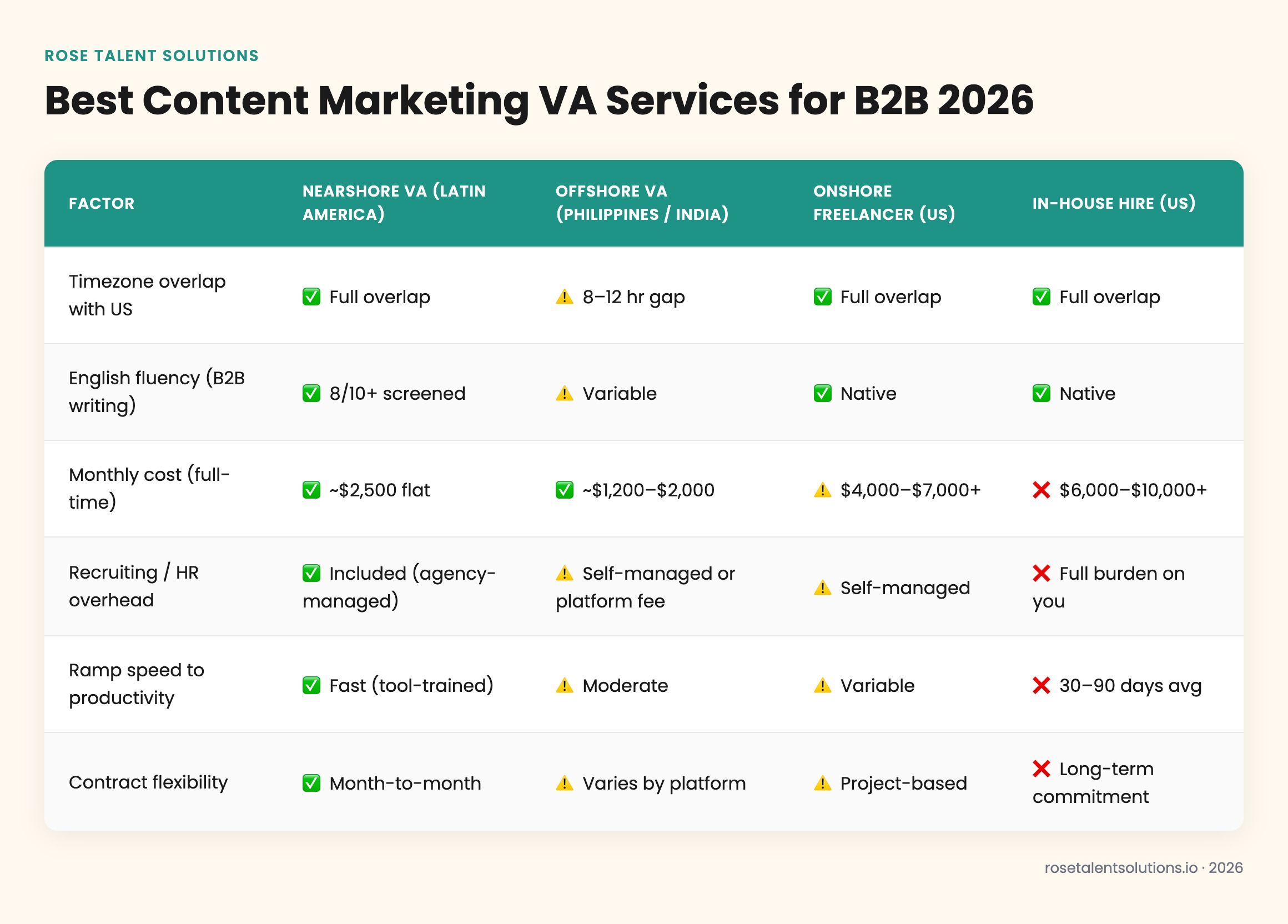
| Factor | Nearshore VA (Latin America) | Offshore VA (Philippines / India) | Onshore Freelancer (US) | In-House Hire (US) |
|---|---|---|---|---|
| Timezone overlap with US | ✅ Full overlap | ⚠️ 8–12 hr gap | ✅ Full overlap | ✅ Full overlap |
| English fluency (B2B writing) | ✅ 8/10+ screened | ⚠️ Variable | ✅ Native | ✅ Native |
| Monthly cost (full-time) | ✅ ~$2,500 flat | ✅ ~$1,200–$2,000 | ⚠️ $4,000–$7,000+ | ❌ $6,000–$10,000+ |
| Recruiting / HR overhead | ✅ Included (agency-managed) | ⚠️ Self-managed or platform fee | ⚠️ Self-managed | ❌ Full burden on you |
| Ramp speed to productivity | ✅ Fast (tool-trained) | ⚠️ Moderate | ⚠️ Variable | ❌ 30–90 days avg |
| Contract flexibility | ✅ Month-to-month | ⚠️ Varies by platform | ⚠️ Project-based | ❌ Long-term commitment |
What Does the Best B2B Content Marketing VA Service Look Like in 2026?
The best services in 2026 are not generic staffing platforms where you post a job and hope. They are managed placement models — where the agency recruits, vets, matches, and continues to support the VA after placement. That matters for content roles specifically because writing quality is subjective, and a bad match costs you weeks of reruns before you realize the fit isn't working.
Rose Talent Solutions places full-time, dedicated content marketing VAs at $2,500/month flat. That price includes recruiting, vetting, payroll, HR, and ongoing management. There is no long-term contract — just a month-to-month arrangement with 30 days written notice to cancel. If the placement isn't working, Rose replaces the team member at no additional cost. That is the only risk reversal in play — and it's a meaningful one for B2B teams who can't afford a quarter of mediocre content output.
Every Rose team member also ships with a role-specific AI copilot trained on their tools — including content platforms like HubSpot, SEMrush workflows, and CMS environments. This isn't a generic ChatGPT wrapper. It's a trained assistant that knows your VA's specific stack, which is why ramp time compresses significantly compared to a raw hire.
The hidden cost of a bad content VA isn't the salary — it's the 8–12 weeks of substandard output before you cut the engagement, plus the time your team spent reviewing, editing, and re-briefing work that still missed the mark. A managed placement with a free replacement guarantee eliminates that tail risk.
According to SHRM (2024), the average cost to replace an employee is 50–200% of their annual salary. Even for a mid-market content manager earning $70,000/year, that's $35,000–$140,000 in replacement costs. A managed VA model with built-in replacement protection sidesteps that entirely.

How to Evaluate and Vet B2B Content Marketing VA Services in 2026
Not every VA service that claims "content marketing" specialization delivers B2B-grade output. Here is what to pressure-test before you commit to any provider.
1. Ask for writing samples in your industry. A VA who writes great lifestyle blog posts may struggle with a 1,200-word B2B SaaS comparison piece. Request samples that match your buyer's reading level and vocabulary.
2. Confirm platform proficiency — not just awareness. There is a difference between a VA who has "used HubSpot" and one who can build a nurture workflow, pull contact list segments, and schedule a campaign sequence without training wheels. Ask for a task-based screen.
3. Verify timezone and availability windows. This is non-negotiable for B2B content teams running editorial calendars. Confirm your VA will be online during your core working hours — not just "available async."
4. Understand the replacement policy before you sign. If the agency doesn't offer a free replacement if the placement isn't a fit, your downside is fully exposed. Rose's replacement guarantee is built into the flat rate.
If your content needs extend into email marketing specifically — sequences, newsletters, drip campaigns — pairing your content VA with support from the best email marketing virtual assistant services in your stack is a logical next step. The two roles overlap significantly and many Rose VAs cover both.
According to McKinsey (2023), companies that personalize their marketing content see 40% more revenue than slower-moving competitors. A dedicated content VA is the operational engine that makes that personalization sustainable at scale — without burning out your in-house team.
Submit Your Brief
Tell Rose what content role you need to fill — platform experience, industry background, output expectations. Takes about 10 minutes.
Review Matched Candidates
Rose pre-vets and shortlists candidates to your specs. You review profiles and writing samples within days — no cold sourcing on your end.
Meet Your VA
You interview your top match. If the fit feels right, you move forward. If not, Rose iterates — no pressure, no extra cost.
Onboard and Launch
Your VA starts with a role-specific AI copilot already loaded. Most placements are publishing their first pieces of content within the first week.
How Much Do the Best B2B Content Marketing VA Services Cost in 2026?
Pricing in the VA market is fragmented, which makes honest comparisons difficult. Freelance platforms like Upwork and Fiverr list content VAs from $8/hour to $40/hour — but those rates don't include vetting, management, replacement, or any continuity guarantee. You're self-managing everything, which adds invisible time costs to every engagement.
Managed nearshore VA services typically price between $2,000–$3,500/month for a full-time dedicated placement. Rose Talent Solutions sits at $2,500/month flat — full-time (40 hours/week), all-in. Recruiting, payroll, HR, and ongoing management are bundled. No long-term contract. No surprise fees.
For B2B marketing leaders who also need executive-level support layered above the content production role — scheduling, stakeholder communications, board prep — a nearshore executive assistant running in parallel is a natural complement. Many Rose clients stack both roles once they see the output a dedicated VA generates.
According to the U.S. Bureau of Labor Statistics (2024), the median annual salary for a marketing coordinator in the United States is over $58,000 — that's salary alone, before benefits, payroll taxes, and overhead. A nearshore content VA at $2,500/month ($30,000/year, all-in) represents a material cost reduction without sacrificing US-hours availability or English writing quality.
Why Nearshore Content VAs Win for B2B
- Real-time collaboration during US business hours
- English fluency screened to 8/10+ — B2B-grade writing from day one
- Flat, predictable pricing with no recruiting overhead
- Month-to-month flexibility — scale or pause without penalty
- AI copilot pre-loaded for your content stack
Where to Be Careful
- Unmanaged freelance platforms put all vetting and replacement risk on you
- Offshore VAs in high-gap timezones slow editorial cycles materially
- Generic VA agencies don't screen for B2B content writing specifically
- Low hourly rates often mean split attention across multiple clients
Ready to see who Rose would match you with? Start the matching process — it takes about 10 minutes and there's no obligation until you've met your candidate.