
What Is a Virtual Marketing Assistant in 2026?
A virtual marketing assistant is a dedicated remote professional — and in 2026, the strongest version of that hire is a nearshore specialist based in Latin America, working your US business hours in real time. They handle the day-to-day execution of your marketing operations: content creation, social scheduling, email campaigns, SEO tasks, paid ad support, and analytics reporting. They work inside your tools, follow your brand guidelines, and free your core team to focus on strategy instead of production.
The definition matters because "virtual assistant" has become a catch-all term. A virtual marketing assistant is a specialist, not a generalist. They should walk in knowing HubSpot, Canva, Buffer, Google Analytics 4, and at least one paid ads platform. If the candidate you're evaluating has never touched a campaign dashboard, you're looking at a general VA, not a marketing VA.
Nearshore means Latin America — not the Philippines, not India. It means the same time zone as your team, real-time collaboration, and cultural alignment with North American business norms. That distinction shapes every part of the working relationship, from revision cycles to standup calls.
According to SCORE's Small Business Owner Survey (2024), 63% of small business owners identify marketing execution as one of the top time drains on their week. Delegating that execution to a trained specialist isn't a luxury — it's a leverage decision.
What Does a Virtual Marketing Assistant Actually Do in 2026?
The job description for a virtual marketing assistant covers a wide range of tasks, but the best hires cluster around four core functions: content production, distribution, analytics, and campaign support. Here's what that looks like in practice across a standard 40-hour week.
Content production includes writing blog drafts, creating social graphics in Canva, editing short-form video clips, and drafting email sequences in platforms like Mailchimp or Klaviyo. Distribution means scheduling posts in Buffer or Hootsuite, uploading blogs to WordPress, and managing your content calendar. Analytics covers weekly GA4 reporting, social performance summaries, and campaign ROI tracking in HubSpot or a spreadsheet dashboard. Campaign support involves pulling ad reports from Meta Ads Manager, running A/B test variants, and coordinating with designers or copywriters.
A strong virtual marketing assistant job description should list required platform proficiencies, not just soft skills. If your business runs on HubSpot, say so. If you need someone who can pull GA4 reports and interpret them, say that too. Vague job descriptions attract generalists. Specific ones attract specialists.

How the Real Cost of a Virtual Marketing Assistant Compares to an In-House Hire in 2026
This is the gap almost every competitor article skips, and it's the number that actually moves decisions. Let's build the comparison honestly.
An in-house junior marketing coordinator in the US earned a median salary of $52,000–$62,000 in 2024, according to the U.S. Bureau of Labor Statistics (2024). Add employer payroll taxes (7.65%), health insurance ($6,000–$8,000/year), paid time off, equipment, software seats, and recruiting costs — and your true annual cost lands between $75,000 and $90,000. That's $6,250–$7,500 per month for a single mid-level hire.
A full-time nearshore virtual marketing assistant through Rose Talent Solutions costs $2,500/month flat. That includes recruiting, vetting, payroll, HR, and ongoing management. No benefits overhead. No equipment budget. No long-term contract.
| Hiring Model | Monthly Cost | Time Zone | English Proficiency | Ramp Time | Contract Required |
|---|---|---|---|---|---|
| Nearshore VA (Latin America) | ~$2,500/mo all-in | US hours (real-time) | 8/10+ screened | 3–7 days | No long-term contract |
| Offshore VA (Philippines/India) | $800–$1,800/mo | 6–12 hr gap | Varies widely | 1–3 weeks | Varies by agency |
| US Freelancer (contract) | $3,500–$6,000/mo | US hours | Native | 1–2 weeks | Project-based |
| In-House Junior Hire (US) | $6,250–$7,500/mo | US hours | Native | 4–8 weeks | Employment at-will |
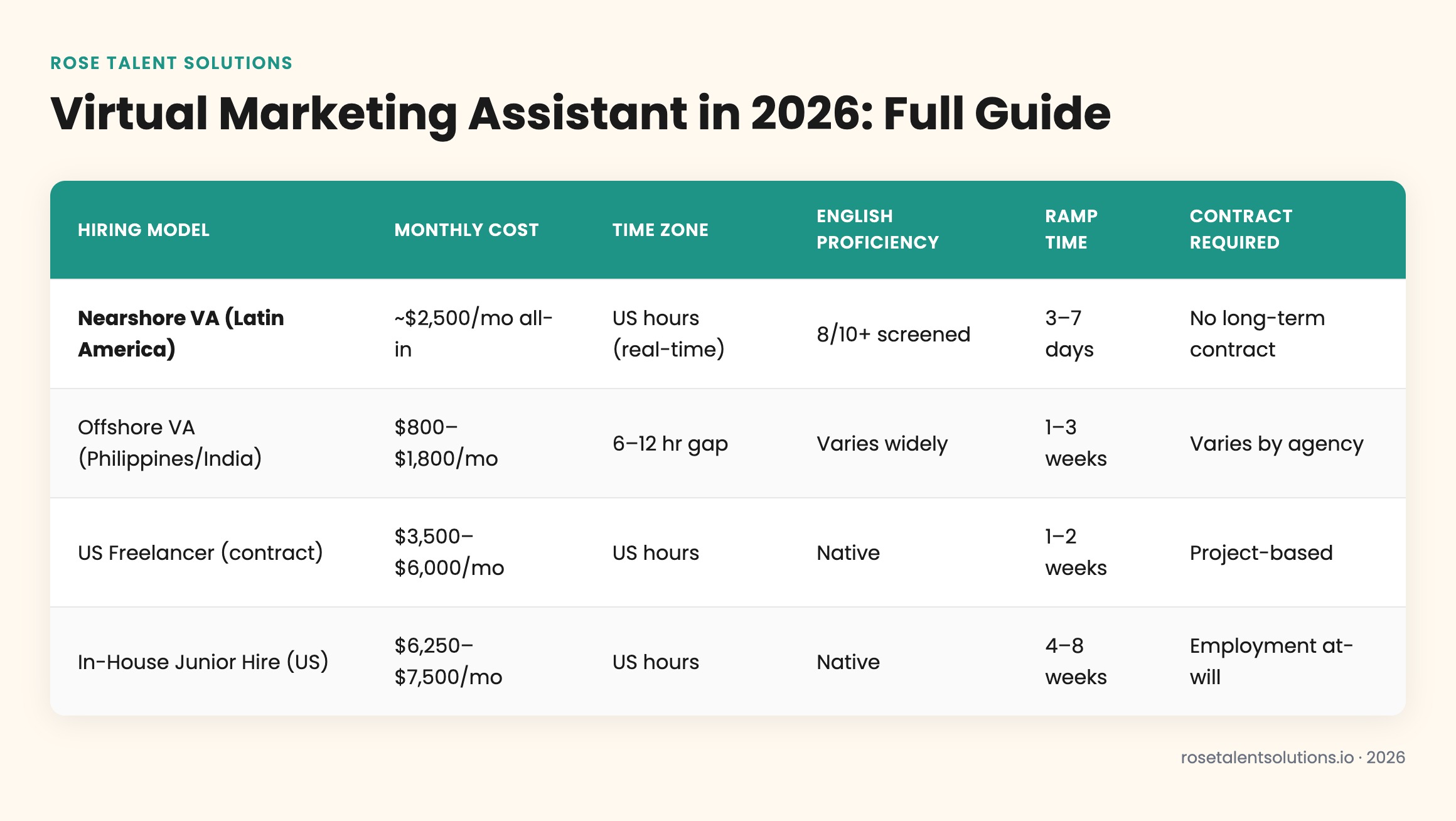
The offshore option looks cheaper on paper, but factor in the 6–12 hour time zone gap and you lose real-time collaboration entirely. Every revision cycle, every campaign question, every urgent content edit gets batched overnight. For marketing work — where speed to publish matters — that lag is a hidden tax on every deliverable.
How to Vet a Virtual Marketing Assistant: Red Flags and Green Flags in 2026
Most businesses get burned on VA hires not because the candidate lied, but because the vetting process tested the wrong things. Here's how to separate real marketing specialists from generalists who checked a box.
Red flag #1: No live platform access during the interview. Ask the candidate to screenshare and pull a GA4 acquisition report in real time. If they can't navigate the interface confidently, they've overstated their experience. Red flag #2: Vague answers about campaign results. A strong candidate says "I managed a 3-email welcome sequence in Klaviyo that improved open rates from 22% to 31%." A weak one says "I helped with email marketing." Specificity is the signal.
Red flag #3: No portfolio or samples. Even a junior marketing VA should have Canva graphics, sample blog posts, or social calendars they can share. If there's nothing, the experience is probably thinner than the resume suggests. Green flag: Unprompted questions about your brand voice, target audience, and current tools. A specialist who asks "What's your primary CTA on the welcome email?" before you've onboarded them is already thinking like a team member.
The single best vetting test for a virtual marketing assistant is a paid skills task — give them a real brief, a 2-hour window, and a $50 honorarium. What they produce in that window tells you more than five interviews ever could.
Rose Talent Solutions handles this vetting layer before a candidate ever reaches you. Every AI-equipped team member is screened on platform proficiency, English fluency (8/10+ required), and a role-specific skills assessment. You see a shortlist of pre-vetted finalists, not a pile of unfiltered applications. If the placement isn't a fit after onboarding, Rose replaces them at no additional cost — that's the risk reversal built into every engagement.

How to Onboard and Measure a Virtual Marketing Assistant With KPIs That Work in 2026
Hiring the right person is step one. Onboarding them effectively is step two — and it's where most businesses lose momentum. A marketing VA who isn't given clear systems, access, and metrics in week one will spend weeks two through four guessing at priorities.
According to SHRM (2023), organizations with a structured onboarding process improve new hire retention by 82% and productivity by over 70%. The same principle applies to remote VAs — structure isn't micromanagement, it's acceleration.
Access and Tools Setup (Day 1)
Grant platform access to HubSpot, GA4, Buffer, Canva, and your CMS on day one. A VA who can't log in can't produce. Create a shared password manager entry and walk through each tool's login on a screenshare call.
Brand and Voice Brief (Days 1–2)
Share a written brand guide — tone, colors, target audience, top-performing past content, and competitors to avoid sounding like. This single document cuts revision cycles in half in the first 30 days.
First-Week Deliverable (Days 3–5)
Assign one contained, real deliverable: a content calendar draft, a social graphics batch, or a GA4 weekly report template. Reviewing real output gives you calibration data and builds the VA's confidence simultaneously.
KPI Baseline (Week 2)
Set three to five measurable KPIs: posts published per week, email open rate, organic traffic change, ad report turnaround time, or content calendar fill rate. Review them weekly in a 15-minute async Loom or live standup.
30-Day Review (End of Month 1)
Compare KPI actuals against targets, identify one skill gap to close, and expand the VA's scope by 10–20%. This progressive ramp model consistently produces full productivity by month two.
Strong KPIs for a virtual marketing assistant include: content pieces published per week, social engagement rate month-over-month, email campaign open and click-through rates, ad report delivery time, and keyword ranking movement for SEO-focused roles. Tie every KPI to a tool output — not to effort or hours logged. Output is measurable. Effort is not.
For businesses that need specialized support beyond marketing — from bookkeeping and accounting to property management operations — Rose places dedicated nearshore specialists across every back-office function, not just marketing.
Industry-Specific Use Cases: How Different Businesses Deploy a Virtual Marketing Assistant
The tasks a marketing VA owns look different depending on your business model. Here's how three common business types deploy them most effectively.
E-commerce brands lean heavily on product description writing, email flow management in Klaviyo, and social ad creative support in Canva. A marketing VA for an e-commerce store might spend 60% of their week producing and scheduling content and 40% pulling Shopify and Meta Ads performance reports. The volume of creative assets required makes a dedicated specialist more cost-effective than a freelancer billed per deliverable.
Real estate and property management companies use marketing VAs to manage listing syndication, write neighborhood content for SEO, and run email nurture campaigns for leads. According to the National Association of Realtors (2023), 96% of home buyers use the internet during their search — which means content and digital presence are non-negotiable for real estate businesses. A nearshore marketing VA who understands US real estate platforms is a direct growth lever. Rose's property management VA service is specifically built for this vertical.
Marketing agencies use VAs as execution bandwidth — handling client social scheduling, monthly reporting, and creative asset production so senior strategists can focus on client relationships and campaign architecture. Agencies that staff one nearshore VA per two or three client accounts consistently report faster delivery times and lower contractor spend.
Why Nearshore Marketing VAs Win
- Real-time availability during US business hours — no overnight lag on revisions
- Flat $2,500/month all-in — no benefits, payroll tax, or equipment overhead
- Pre-vetted on HubSpot, Canva, GA4, Buffer, and other standard marketing tools
- AI copilot trained on your specific platforms ships with every placement
- Free replacement if the match isn't right — zero additional cost
Limitations to Plan Around
- Not a strategic marketing director — they execute plans, not build them from scratch
- Requires a clear onboarding brief and tool access to ramp efficiently
- Best results come after a 30-day calibration period with defined KPIs
Virtual Marketing Assistant Salary and Rate Benchmarks for 2026
Virtual marketing assistant salary ranges vary sharply by model. US-based freelance marketing VAs charge $25–$55/hour, putting a full-time equivalent at $4,000–$8,800/month. According to ZipRecruiter (2025), the average annual salary for a virtual marketing assistant in the US is approximately $57,000 — around $4,750/month before benefits and overhead.
Nearshore marketing VAs through Rose Talent Solutions cost $2,500/month flat, all-in. That's the rate for a full-time, 40-hour-per-week dedicated specialist with recruiting, vetting, payroll, HR, and management included. No long-term contract and no hidden fees — just month-to-month with 30 days written notice to cancel.
The Bureau of Labor Statistics (2024) projects marketing roles to grow 6% through 2032 — faster than average. Demand for marketing execution talent is rising, and the cost of US-based hires is rising with it. Locking in a nearshore specialist at a flat monthly rate now is a hedge against that inflation.
Every Rose placement also ships with a role-specific AI copilot — trained on the exact platforms your marketing VA uses. That means faster ramp, fewer errors, and a team member who leverages AI to produce more, not one who competes with it.