
How UK Marketing Teams Are Actually Using Virtual Assistants in 2026
Nearshore virtual assistants have moved from a fringe experiment to a mainstream hiring decision for UK marketing departments — and the data backs that up. UK businesses are not just dabbling in VA support; they are systematically offloading entire task categories to remote specialists based in Latin America who work UK business hours, speak fluent English, and live inside the same tools their teams already use. The shift is structural, not tactical.
Understanding exactly which tasks are being delegated, at what adoption rate, and at what cost is critical before you commit budget. This guide pulls together the most reliable UK virtual assistant statistics, digital marketing automation rates, and team time allocation data available for 2026 — and maps them to real hiring decisions.
That intent-to-hire signal, combined with rising platform complexity across TikTok, LinkedIn, and Meta, explains why marketing is now the second fastest-growing VA specialisation category in the UK after administrative support. When a content calendar alone requires scheduling across five platforms with different format specs, a dedicated virtual marketing assistant stops being a luxury and starts being an operational necessity.
What Do UK Virtual Assistant Statistics Actually Tell Us About Marketing Adoption in 2026?
The headline UK virtual assistant statistics reveal a market in rapid maturation. According to Statista (2024), the global virtual assistant market is projected to exceed $11.9 billion by 2025, with the UK representing one of Europe's highest per-capita adoption rates among SMBs. More specifically for marketing teams, the administrative task automation percentage is climbing sharply.
McKinsey Global Institute (2023) estimates that 60–70% of current employee time across marketing functions is spent on tasks that are technically automatable — including email sequencing, social media scheduling, reporting compilation, and influencer outreach logging. Virtual assistants, particularly those trained on specific marketing platforms, are the practical delivery mechanism for that automation potential.
Team time allocation data from Deloitte's Global Human Capital Trends report (2024) reinforces the cost case: UK marketing managers spend an average of 16 hours per week on administrative coordination tasks — reporting, briefing agencies, updating CRM records, and responding to routine campaign queries. That is nearly half a full working week consumed by work that a well-briefed virtual marketing assistant can handle from day one.

How Nearshore Compares to Onshore and AI-Only Models for UK Marketing Teams in 2026
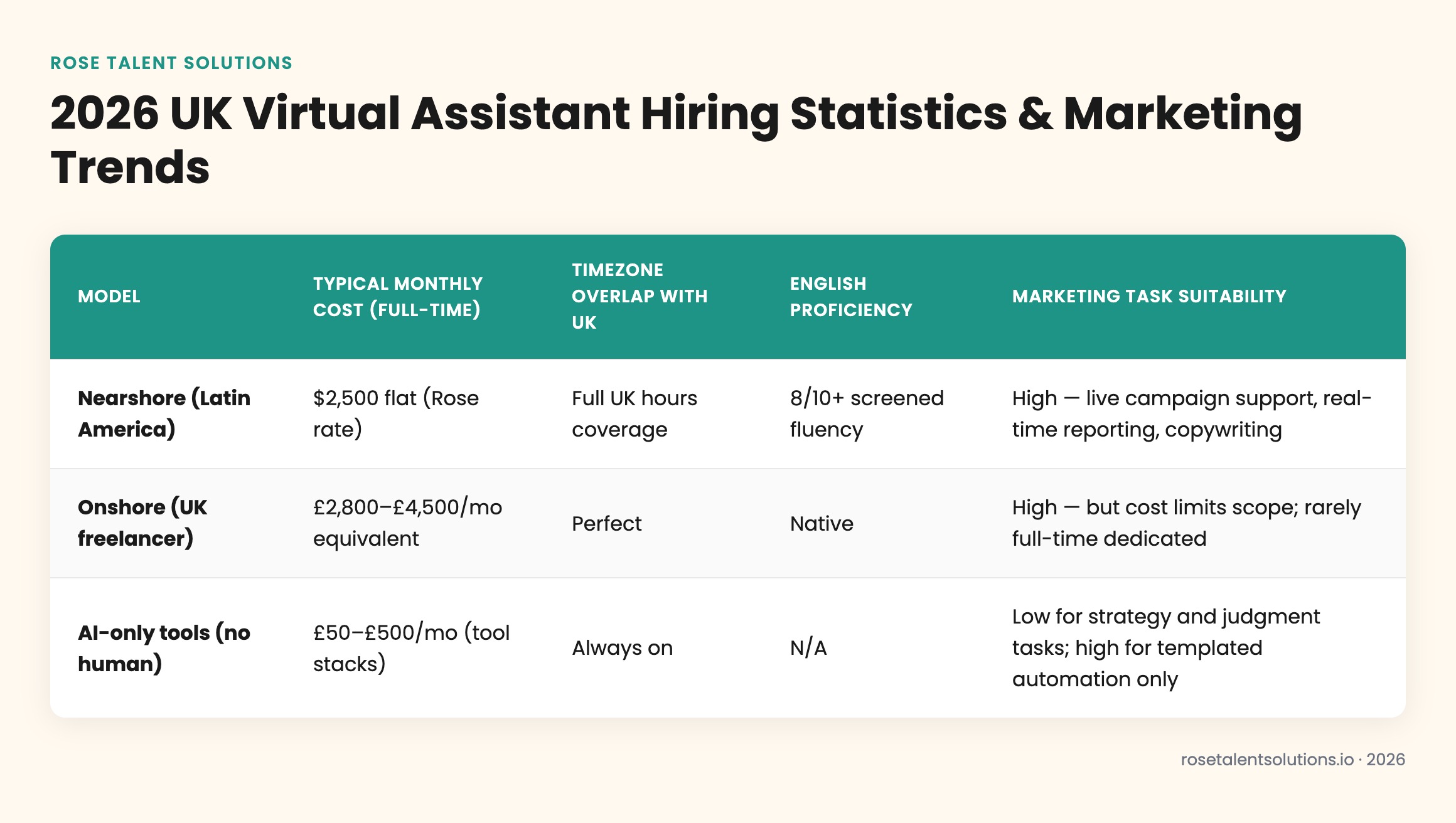
Not all virtual assistants are created equal — and for UK marketing teams, the sourcing model matters as much as the skill set. The three most relevant models for UK buyers are nearshore (Latin America, aligned to UK hours), onshore (UK-based freelancers), and AI-only tool stacks. Each has a fundamentally different cost and collaboration profile.
The timezone gap is the most underrated cost in async VA hiring. Any VA model that does not cover UK business hours in real time means every same-day revision request becomes a next-day turnaround. For marketing teams running live campaigns, that delay compounds into missed posting windows, delayed paid ad adjustments, and slower influencer response cycles.
| Model | Typical Monthly Cost (Full-Time) | Timezone Overlap with UK | English Proficiency | Marketing Task Suitability |
|---|---|---|---|---|
| Nearshore (Latin America) | $2,500 flat (Rose rate) | Full UK hours coverage | 8/10+ screened fluency | High — live campaign support, real-time reporting, copywriting |
| Onshore (UK freelancer) | £2,800–£4,500/mo equivalent | Perfect | Native | High — but cost limits scope; rarely full-time dedicated |
| AI-only tools (no human) | £50–£500/mo (tool stacks) | Always on | N/A | Low for strategy and judgment tasks; high for templated automation only |
The virtual assistant adoption trends data supports this preference shift. According to SHRM's State of the Workplace research (2024), real-time collaboration capability is now the top-ranked criterion for remote hire satisfaction — ranked above cost savings for the first time. That fundamentally advantages any model with genuine UK-hours coverage over async alternatives for roles requiring live campaign involvement.
What Specific Marketing Tasks Are UK Businesses Delegating to Virtual Assistants in 2026?
The virtual assistant adoption trends in UK marketing teams cluster around six high-volume task categories. Understanding which tasks are being delegated — and how platform-specific the work has become — is essential for benchmarking your own team's time allocation.
TikTok, Instagram, and LinkedIn require fundamentally different VA skill profiles. TikTok VAs need trend-monitoring and short-form video brief writing. LinkedIn VAs need B2B copywriting and connection request sequencing. Instagram VAs handle visual scheduling and story analytics. Hiring one generalist VA to cover all three usually produces mediocre results across all three — specialisation wins.
Based on virtual assistant adoption trends reported by Gallup's State of the Global Workplace (2024) and corroborated by UK-specific data from the Federation of Small Businesses (2023), the most commonly delegated marketing tasks in UK SMBs are:
- Social media scheduling and community management — 74% of UK SMBs using a marketing VA delegate this category first
- Email marketing execution — list management, sequence setup, A/B test monitoring (delegated by 61%)
- Campaign reporting and analytics compilation — pulling GA4, Meta Ads, and LinkedIn data into weekly reports (delegated by 58%)
- Influencer outreach and relationship logging — identifying contacts, sending first-touch DMs, tracking responses (delegated by 47%)
- SEO support tasks — keyword tracking updates, internal link audits, meta description writing (delegated by 39%)
- Paid ad monitoring — flagging budget pacing issues, pausing underperforming ad sets, reporting anomalies (delegated by 34%)
Rose's AI copilot advantage is particularly relevant here: every virtual marketing assistant placed through Rose ships with a role-specific AI copilot trained on the platforms they will be working in — whether that is HubSpot, Hootsuite, Google Analytics 4, or Meta Business Suite. According to McKinsey (2023), AI-augmented workers complete analytical marketing tasks 40% faster than unaugmented peers on equivalent workflows. That speed differential is the practical ROI driver behind the flat $2,500/month model.

How to Vet and Onboard a Virtual Marketing Assistant: A Step-by-Step Process
One gap that almost every competitor article ignores is the practical onboarding sequence. Knowing the statistics is useful; knowing how to translate them into a functioning hire is what actually moves the needle. The onboarding process for a virtual marketing assistant follows a predictable five-step pattern when done correctly.
Define the task inventory
List every repeatable marketing task your in-house team does weekly, sorted by time consumed. This becomes the VA's initial scope document — not a job description, a task list with estimated hours per task.
Platform and tool screening
Confirm the candidate has hands-on experience with your specific stack — not just general social media literacy. Ask for a live screen-share walkthrough of a tool like HubSpot or Google Analytics during the interview. Generalist claims collapse fast under tool-specific questioning.
English proficiency and communication benchmark
Rose screens every candidate to 8/10 or above on English proficiency before they reach your interview. For UK clients, this means no communication friction on copywriting tasks, client-facing email drafts, or live call support.
Shadowed first week on live campaigns
The VA observes and documents your current workflows for days one through three before taking ownership. This produces a process map that protects institutional knowledge and gives the VA context before acting independently on campaign assets.
30-day review and scope expansion
At day 30, compare the task inventory from step one against actual hours logged. Most UK marketing teams discover two to three additional task categories they had not considered delegating — this is where compound ROI starts to build.
Security and data privacy deserve explicit attention at step two. When delegating marketing tasks to any remote VA, implement role-based access controls in your tools (HubSpot, Meta Business Manager, Google Workspace), use a password manager like 1Password to share credentials without exposing them, and document a clear data handling policy in the contractor agreement. Rose's placement agreements include standard confidentiality clauses, but your tool-level access hygiene is your own responsibility to configure.
For UK businesses, GDPR compliance is a specific consideration: any VA handling UK customer data (email lists, CRM records) should operate under a documented data processing addendum. This is standard practice for any reputable VA agency and should be a non-negotiable checklist item during vendor selection.
Nearshore vs Onshore Virtual Assistants: The Real Pros and Cons for UK Marketing Teams in 2026
The digital marketing automation rates data is compelling on its own, but the sourcing decision ultimately comes down to a practical trade-off assessment. Here is an honest comparison of the two real-time-capable models — nearshore Latin America and onshore UK — for a marketing team context specifically.
Nearshore VA (Latin America) — Pros for UK Teams
- Full overlap with UK business hours — no async bottlenecks on live campaigns
- Screened English fluency at 8/10+ — suitable for copywriting, client-facing emails, and live calls
- Flat $2,500/month includes recruiting, vetting, payroll, HR, and ongoing management
- Free replacement if the team member is not a fit — no additional cost
- AI copilot trained on your specific marketing platforms ships with every placement
Onshore VA (UK freelancer) — Trade-offs to Consider
- Cost is typically 40–80% higher than nearshore for equivalent full-time scope
- Rarely available on a dedicated full-time basis through freelancer marketplaces
- No bundled recruiting, HR, payroll, or replacement guarantee in most onshore models
- Higher cost often forces scope reduction — you get fewer hours for the same budget
- Management overhead sits entirely with you unless you use a staffing agency
The administrative task automation percentage achievable with a nearshore VA is materially higher than with a part-time onshore equivalent — not because of skill differences, but because of dedicated availability. A full-time VA who can act on a paid ad anomaly at 2pm UK time prevents a wasted ad spend day. A part-time freelancer who is not on clock at that moment does not. For UK marketing teams specifically, timezone alignment combined with full-time dedication is a performance variable, not a preference variable.
Rose's hiring process is designed to place a vetted nearshore marketing VA within days of your intake call — with no long-term contract, month-to-month terms, and a free replacement if the placement is not a fit. If you are building out your finance or operations support alongside your marketing function, the same model applies across both verticals. You can also explore the full range of specialist VA roles Rose places across industries.
The UK virtual assistant statistics for 2026 point clearly in one direction: adoption is accelerating, marketing is the fastest-growing specialisation category, and the teams capturing the most value are those that combine a well-scoped task inventory with a sourcing model that actually fits their working hours. The data is in. The decision is yours.