
What Is a Nearshore Executive Assistant — and Why Does "Near" Matter in 2026?
A nearshore executive assistant is a dedicated, full-time administrative professional based in Latin America who supports US, Canadian, or UK executives during normal business hours. Unlike offshore alternatives in the Philippines or India — where a 10-to-13-hour time gap turns every urgent request into an overnight ticket — nearshore EAs operate in the same or adjacent time zones, which means real-time communication, not batch replies.
The "near" in nearshore refers to both geography and culture. Latin American professionals share North American business norms, holidays, and communication styles in a way that genuinely shortens the ramp-up curve. According to the U.S. Bureau of Labor Statistics (2024), the median annual wage for executive secretaries and executive administrative assistants in the United States is approximately $68,900 — and senior EAs in major metros routinely hit $85,000–$95,000 when you add benefits, payroll taxes, and PTO.
That salary gap is the starting point for the business case. But as you'll see below, the real leverage in 2026 isn't just labor arbitrage — it's what you can build on top of it.
Nearshore EA Salary Benchmarks: What Does an EA Actually Cost in 2026?
One of the biggest gaps in the existing conversation around nearshore executive assistants is the absence of real numbers. Let's fix that.
A full-time in-house EA in the United States — factoring in base salary, employer-side payroll taxes (roughly 7.65% for FICA), health insurance, paid time off, and equipment — realistically costs a US business $80,000 to $110,000 per year in total compensation expense. That figure comes from standard HR benchmarks tracked by SHRM (2024), which consistently finds that benefits add 30–40% on top of base wages for salaried employees.
A nearshore executive assistant through a staffing agency like Rose Talent Solutions runs $2,500/month flat — that's $30,000/year, all-in, covering recruiting, vetting, payroll, HR compliance, and ongoing management. No hidden markups. No separate HR overhead.
The $50,000–$80,000 annual delta is the number your CFO will ask about. It's also why the nearshore model has become the default for growth-stage companies and small-to-mid-size businesses that need executive-level support without the overhead of a full-time US employee.

Nearshore vs. Offshore vs. Onshore: 2026 Comparison
Choosing between an onshore, nearshore, or offshore EA isn't just a cost decision — it's an operational one. Timezone alignment affects how fast decisions get made. Language fluency affects how your executive is represented on calls, in emails, and with clients. Cultural fit affects how quickly the relationship becomes self-directed rather than hand-held.
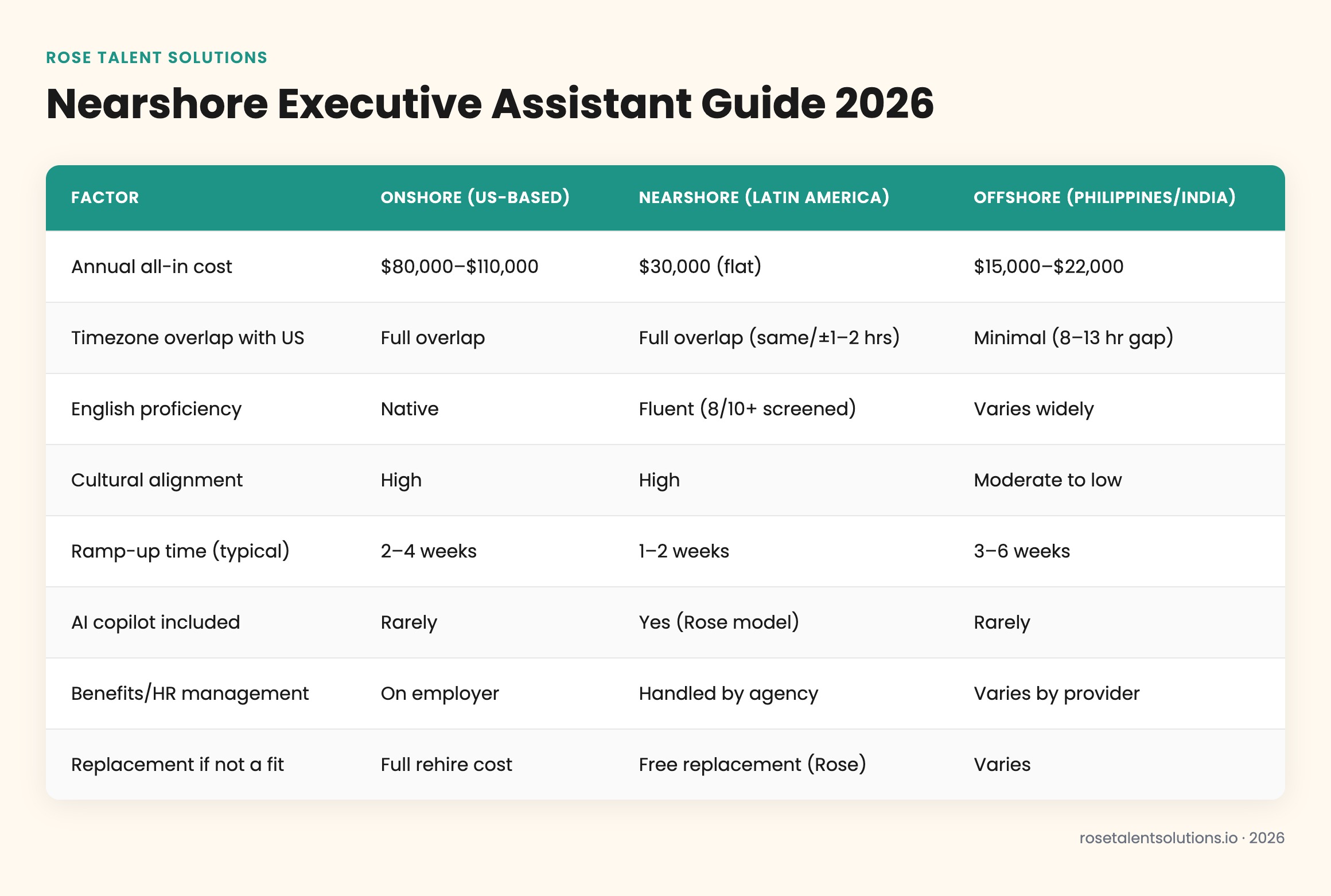
The table below breaks down the three models across the dimensions that matter most to operators who've actually managed remote EAs at scale.
| Factor | Onshore (US-based) | Nearshore (Latin America) | Offshore (Philippines/India) |
|---|---|---|---|
| Annual all-in cost | $80,000–$110,000 | $30,000 (flat) | $15,000–$22,000 |
| Timezone overlap with US | Full overlap | Full overlap (same/±1–2 hrs) | Minimal (8–13 hr gap) |
| English proficiency | Native | Fluent (8/10+ screened) | Varies widely |
| Cultural alignment | High | High | Moderate to low |
| Ramp-up time (typical) | 2–4 weeks | 1–2 weeks | 3–6 weeks |
| AI copilot included | Rarely | Yes (Rose model) | Rarely |
| Benefits/HR management | On employer | Handled by agency | Varies by provider |
| Replacement if not a fit | Full rehire cost | Free replacement (Rose) | Varies |
How to Onboard a Nearshore Executive Assistant Without Losing Two Weeks
Most onboarding failures aren't about the EA's skills — they're about the executive's process. If your systems, access credentials, communication preferences, and priorities aren't documented before day one, you'll spend the first two weeks training instead of delegating. Here's the sequence that actually works.
Pre-Access Audit (Before Day 1)
List every tool your EA will touch — email, calendar, project management, CRM, travel platforms. Prepare role-specific logins, set permissions, and establish whether access will be individual credentials or shared. Document the answer to: "What does a perfect Monday morning look like?"
Day 1–3: Shadowing and SOPs
Have the EA shadow your current workflow — reading your sent emails, reviewing your calendar patterns, and absorbing your communication style. Deliver a one-page SOP for the top 5 recurring tasks. Rose EAs arrive pre-loaded with a role-specific AI copilot trained on your software stack, so tool ramp-up is compressed significantly.
Week 2: Live Delegation with Check-Ins
Transfer ownership of two or three real tasks — scheduling, inbox triage, vendor follow-ups — with a daily 10-minute sync to catch questions before they become mistakes. This is where timezone alignment pays its first dividend: you can course-correct in real time.
Week 3+: KPI Baseline and Full Handoff
Set measurable expectations — response time targets, task completion rates, error rates on recurring deliverables. A well-onboarded nearshore EA should be running independently on core tasks by week three. Document what "fully ramped" looks like so you're not evaluating on feel alone.
If you're operating in property management and need an EA integrated into AppFolio or Buildium from day one, Rose's property management staffing track includes software-specific pre-training so the first week isn't remedial.
How to Measure a Nearshore EA's Performance: KPIs That Actually Work
The biggest operational mistake executives make after hiring a virtual EA is evaluating performance on feeling instead of data. "She seems on top of things" is not a KPI. Here are the metrics that separate high-performing nearshore EAs from mediocre ones — and give you a defensible basis for feedback, development, or replacement decisions.
The single most predictive KPI for EA performance isn't task completion rate — it's proactive flag rate: how often your EA surfaces a problem or conflict before you notice it yourself. High proactive flag rate = high situational awareness = an EA who's genuinely managing your executive function, not just executing tasks.
Track these five metrics monthly:
- Calendar accuracy rate: Percentage of scheduled events that require no correction after booking. Target: 98%+.
- Inbox response time: Average time from email receipt to drafted reply or triage action. Target depends on your SLA, but sub-2-hour is the nearshore advantage over offshore.
- Task completion rate: Percentage of delegated tasks completed by agreed deadline. Target: 95%+.
- Proactive flag rate: Number of issues surfaced by EA before executive noticed. Track this qualitatively; even 2–3 per week is meaningful signal.
- Rework rate: Percentage of deliverables that need significant revision. Target: under 10% after the first 30 days.
According to Gallup's State of the Global Workplace (2023), employees who receive regular, structured feedback are 3.6x more likely to be engaged and perform at a high level. Your nearshore EA is no different — monthly structured reviews against these KPIs are the single highest-leverage management habit you can build.

Security, NDAs, and Confidentiality: What You Must Get Right in 2026
Executive assistants handle some of the most sensitive data in your organization — board communications, financial projections, legal correspondence, personnel issues. When your EA is a remote international contractor, the question of data security and confidentiality compliance deserves a direct, specific answer — not a hand-wave.
Every Rose Talent Solutions team member signs a mutual NDA as part of the engagement agreement. Beyond the contractual layer, the operational security framework matters just as much. Require your EA to access sensitive systems only through company-provisioned credentials, use a password manager (1Password or similar) for credential hygiene, and enable two-factor authentication on every platform that supports it.
For US-based businesses handling consumer data, CCPA compliance applies to how personal data is processed regardless of where your staff sits. The practical implication: your nearshore EA should never store personal customer data in personal accounts, personal email, or unapproved cloud storage. Document this explicitly in your onboarding SOP. If your business operates in finance or healthcare, your EA must be briefed on your relevant compliance framework — SOX, HIPAA, or otherwise — before handling any sensitive workflow.
Latin America-based staff are not subject to GDPR as data processors in the same way EU-based workers are, but if your business has EU customers, your data-handling obligations extend to every vendor and contractor in your workflow. A well-structured bookkeeping and accounting EA engagement, for example, will document data handling protocols in the role SOP from day one.
Red Flags When Vetting a Nearshore Executive Assistant (And How Rose Screens Them Out)
Not every "nearshore EA" offering delivers what the label promises. Here are the hiring mistakes operators make — and what Rose's vetting process is designed to prevent.
Green Flags in a Strong Nearshore EA
- Communicates proactively about blockers before they become missed deadlines
- Demonstrates English at 8/10 or above in written and spoken screening — fluency under pressure, not just in prepared answers
- Has documented experience with your software stack or passes a practical skills assessment before placement
- Provides specific examples of how they've managed confidential executive information in past roles
- Asks clarifying questions about your working style during intake — this signals EQ, not insecurity
Red Flags to Screen Out Immediately
- Vague employment history with unexplained gaps and no references available
- English that reads polished in writing but breaks down on live calls — a sign of AI-assisted applications
- Resistance to structured onboarding, KPI setting, or tool access requirements
- No familiarity with your industry's core platforms (and unwillingness to be assessed on them)
- Provider can't tell you where specifically in Latin America your EA is based, or how they're managed
Rose's matching process includes a multi-stage screening: skills assessment, live English proficiency evaluation, role-specific software testing, and background verification. The result is a matched candidate, not a roster browse. And if the match isn't right, we replace them at no additional cost — the replacement guarantee is the risk buffer that makes month-to-month terms viable without a long-term contract.
Learn more about how the AI copilot advantage pre-loads your EA with software-specific training before their first day, reducing your onboarding burden and accelerating time-to-value.
Is Hiring a Nearshore Executive Assistant Right for Your Business in 2026?
The nearshore EA model is purpose-built for a specific type of operator: you're growing fast enough to need senior-level administrative support, but not yet at the scale where a $90,000 US-based EA makes financial sense. You need someone in your timezone, in your tools, and on your priorities — not a task-ticket VA who batches replies at 2am your time.
According to Statista (2024), the global virtual assistant services market is projected to exceed $19.6 billion by 2025, driven largely by SMB adoption of dedicated remote support staff. The shift from "outsourcing tasks" to "hiring full-time remote team members" is the defining operational trend for growth-stage businesses in 2026.
The companies winning with nearshore EAs aren't treating them as contractors-at-arm's-length — they're treating them as the first member of a remote executive team. That framing changes how you onboard, how you manage, and how much value you extract from the relationship.
If you're ready to explore what a dedicated nearshore EA looks like for your specific role and workflow, Rose Talent Solutions matches and manages the full engagement at $2,500/month — no long-term contract required, with a free replacement if the first match isn't right.