
What Is a Backend Engineer Recruiting Agency in 2026?
Nearshore backend engineer recruiting agencies handle the full hiring lifecycle for server-side developers — sourcing, technical screening, culture vetting, payroll, and ongoing HR — so your team gets a productive engineer without spending four to six months running a DIY search. That definition matters because "recruiting agency" covers a wide spectrum in 2026, from contingency headhunters who charge 20–25% of first-year salary to flat-rate staffing firms that bundle everything into a single monthly fee.
A backend engineer is a software developer who builds and maintains the server-side logic, databases, APIs, and infrastructure that power applications — the code users never see but always depend on. Backend roles include Node.js and Python developers, database architects, DevOps-adjacent engineers, and API integration specialists. Because their work sits at the core of every digital product, a bad hire or a long vacancy is expensive fast.
According to SHRM (2024), the average cost-per-hire across all roles is $4,700 — and for specialized technical roles like backend engineers, that number routinely climbs past $28,000 when you factor in recruiter fees, internal HR time, and the productivity gap during the vacancy window. A flat-rate nearshore agency collapses that cost significantly.
If you are weighing the full landscape of virtual and remote staffing models, the complete comparison of nearshore, offshore, and onshore hiring breaks down the trade-offs in detail — including hidden costs that standard pricing comparisons miss.
How Nearshore vs. Offshore Backend Recruiting Compares in 2026
The biggest mistake growing companies make is treating "offshore" and "nearshore" as interchangeable. They are not. Offshore typically means South or Southeast Asia — a 10-to-13-hour timezone gap from US East Coast. Nearshore means Latin America — a 0-to-3-hour gap. For a backend engineer who needs to join daily standups, unblock a frontend team, or respond to a production incident at 2 PM EST, that timezone difference is not a minor inconvenience. It is a structural bottleneck baked into every single workday.
English proficiency compounds the difference. The EF English Proficiency Index (2024) consistently ranks several Latin American countries — including Argentina, Costa Rica, and Colombia — above the global average for English fluency, while many Southeast Asian markets score in the "moderate" band. Rose Talent Solutions screens every candidate to an 8/10 or higher on English proficiency before they reach your inbox.

| Hiring Model | Typical Monthly Cost | Timezone Overlap (US) | English Fluency | Time to Hire |
|---|---|---|---|---|
| Onshore (US-based) | $10,000–$18,000+ | Full overlap | Native | 60–120 days |
| Nearshore (Latin America) | $2,500 flat | 0–3 hours difference | High (8/10+ screened) | 7–14 days |
| Offshore (South/SE Asia) | $1,200–$2,000 | 10–13 hours difference | Moderate | 14–30 days |
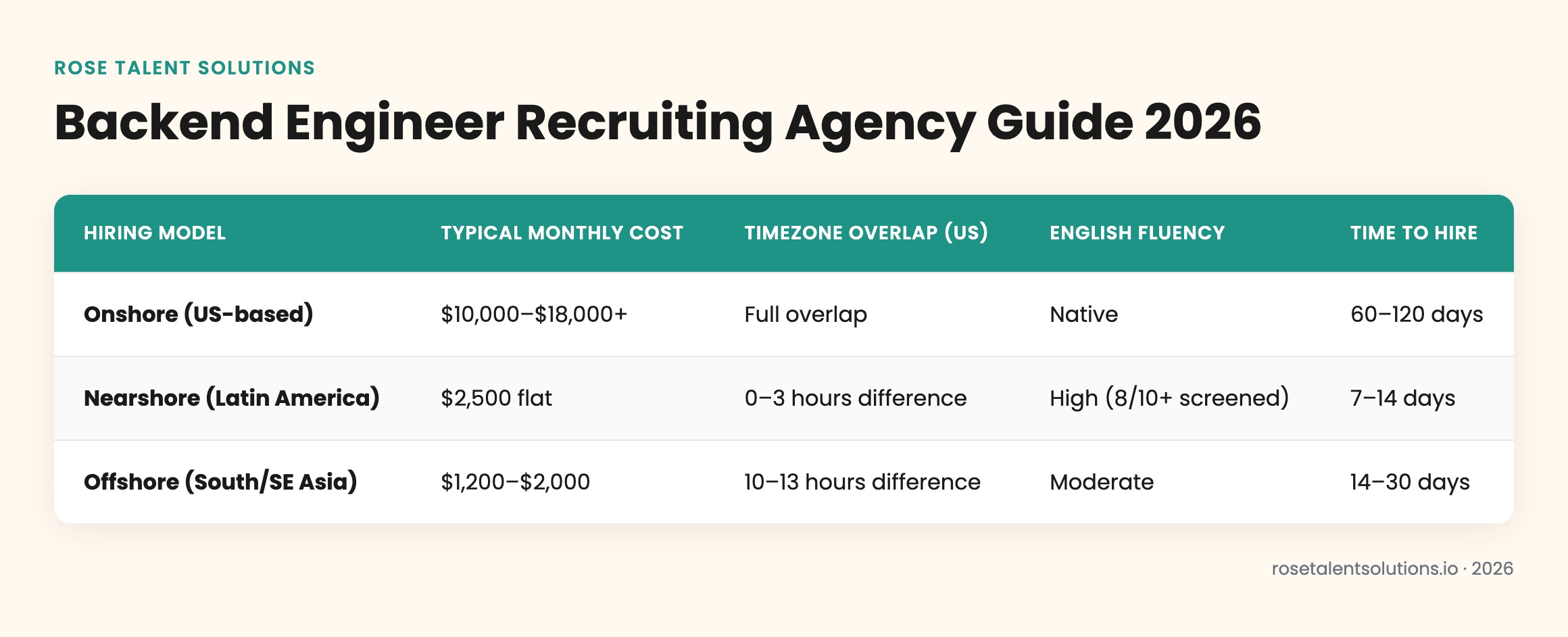
For a deeper look at how these models stack up day-to-day, the onshore vs. offshore breakdown covers the operational realities that pricing tables alone cannot capture.
How a Backend Engineer Recruiting Agency Vets Technical Talent in 2026
Not all technical vetting is equal. A generalist staffing firm might run a resume screen and a single behavioral interview. A specialized backend engineer recruiting agency runs a layered process: skills assessment, live coding screen, system design review, communication evaluation, and reference checks — before the candidate ever reaches you. That depth is what separates a placement that sticks from one that churns in 90 days.
"The best technical recruiters function less like headhunters and more like engineering leads — they know the difference between a developer who can pass a LeetCode screen and one who can actually architect a production-grade API." — Gergely Orosz, Author & Engineering Career Analyst at The Pragmatic Engineer (2024)
According to McKinsey Digital (2024), companies that invest in structured technical assessment during hiring see a 40% reduction in early attrition among engineering hires compared to those relying on unstructured interviews alone. Structured vetting is not bureaucracy — it is downstream cost savings.
Rose Talent Solutions layers an AI copilot advantage on top of the human vetting process. Every engineer placed ships with a role-specific AI copilot trained on the tools your stack already uses — whether that's AWS, PostgreSQL, Docker, or a specific SaaS platform. Learn more about how that works on the AI advantage page. The result is a backend engineer who is productive in days, not weeks.
The hidden cost of a slow technical vetting process is not the recruiter fee — it is the 60-to-90-day vacancy window where your senior engineers are context-switching to cover backend gaps instead of shipping product. A specialist backend engineer recruiting agency with a structured screen compresses that window to under two weeks.

How Rose Talent Solutions Places Backend Engineers: 2026 Process
Rose operates as a nearshore staffing agency purpose-built for US, Canadian, and UK businesses that need Latin American technical talent. The process is designed to remove every step that wastes your time — no job board management, no 40-tab applicant tracking, no payroll setup in a foreign country.
Role Scoping Call
A Rose team member maps your backend stack, timezone requirements, communication style, and must-have technical skills. This call takes 30 minutes and drives every downstream decision.
Candidate Matching
Rose pulls from its vetted Latin American talent network and runs the full technical and English proficiency screen. You receive a shortlist — typically 2 to 3 candidates — within 7 days.
Your Interview
You interview your shortlist and select your engineer. Rose handles the offer, contracting, and payroll setup on the backend so there is nothing for you to administer.
Onboarding + AI Copilot Activation
Your engineer starts on a Monday with their role-specific AI copilot already configured. Rose stays on as the ongoing HR layer — performance check-ins, escalation support, and replacement logistics if needed.
Month-to-Month Flexibility
All engagements run month-to-month. If the engineer isn't a fit, Rose replaces them at no additional cost. Cancel with 30 days written notice — no long-term contract required.
You can get started with Rose Talent Solutions directly — the intake process takes under five minutes and triggers the role scoping call within one business day.
What to Look for in a Backend Engineer Recruiting Agency in 2026
The market for technical recruiting agencies expanded rapidly between 2022 and 2025. That growth produced a lot of generalist firms calling themselves "tech specialists." Here is how to separate the signal from the noise when evaluating a backend engineer recruiting agency.
Specialization depth matters more than agency size. A 500-person generalist firm with a "tech division" will almost always underperform a focused nearshore agency that has placed 50 backend engineers in the last 12 months. Ask for placement data by role type — not aggregate headcount.
According to the U.S. Bureau of Labor Statistics (2024), software developer employment is projected to grow 25% through 2032 — far faster than average across all occupations. That demand trajectory means the talent market for backend engineers will stay competitive for the foreseeable future. Agencies that have already built Latin American talent pipelines will have a structural advantage over those scrambling to build them reactively.
Pricing transparency is a second filter. Flat-rate all-in pricing (recruiting, payroll, HR, management) is the cleaner model for most growing businesses. Contingency fees — typically 18 to 25% of first-year salary for a $90,000 backend engineer — mean you pay $16,000 to $22,500 upfront with no ongoing HR support. For context, that is six to nine months of Rose's $2,500/month flat rate, with zero replacement guarantee included.
If you are also evaluating agencies for broader staffing needs — finance, operations, or executive support — the Latin America recruiting agency overview and the Latin America staffing agency guide cover how nearshore talent pipelines work across functional roles beyond engineering.
Nearshore Backend Recruiting Agency — Pros
- US-timezone alignment (0–3 hour offset) enables real-time collaboration
- Flat all-in pricing eliminates surprise recruiter fees
- Free replacement guarantee reduces your hiring risk
- Latin American engineers increasingly trained in modern stacks (Node, Python, AWS, Kubernetes)
- No long-term contract — month-to-month flexibility
Nearshore Backend Recruiting Agency — Cons
- Smaller total talent pool than offshore markets at scale
- Not the right fit if you need on-site presence
- Some niche deep-specializations (e.g., embedded systems, proprietary chip firmware) have thinner pipelines in LATAM
For businesses that need backend engineering support connected to financial systems, Rose's bookkeeping and accounting staffing can complement a backend hire — particularly for teams building internal fintech tools or automating reporting pipelines. And if your use case is broader product and operations support, the property management staffing page shows how Rose applies the same placement model across technical-adjacent roles.
According to Gallup (2024), engaged employees — those who feel supported by their managers and connected to their team — are 21% more productive than disengaged peers. Nearshore engineers who work in real-time with your team, in your tools, with an AI copilot that shortens their ramp curve, consistently score higher on engagement surveys than async offshore counterparts, according to operator feedback Rose collects at 90-day check-ins.