
Nearshore recruiting from Latin America has quietly become one of the highest-leverage hiring decisions a US or Canadian business owner can make in 2026. Instead of paying $55,000–$75,000 a year for a domestic administrative hire — or gambling on an overnight offshore team eight time zones away — hundreds of operators are now building full-time remote teams in Colombia, Mexico, Argentina, and Costa Rica for a fraction of that cost, with zero timezone lag.
This guide breaks down exactly what a Latin America recruiting agency does, how to evaluate one, what you should pay, and what separates a genuinely great placement from a mediocre one. If you've been searching for a smarter way to staff your business, you're in the right place.
What Is a Latin America Recruiting Agency in 2026?
A Latin America recruiting agency is a staffing firm that specializes in identifying, screening, and placing remote workers based in Latin American countries with businesses in the US, Canada, or the UK. The best agencies handle everything end-to-end: job scoping, candidate sourcing, skills testing, English proficiency screening, background checks, payroll, HR compliance, and ongoing performance management.
This is fundamentally different from a freelance marketplace like Upwork, where you post a job, sift through hundreds of unvetted applicants, and manage payments yourself. A proper recruiting agency owns the talent pipeline and stands behind every placement. If a placement isn't a fit, a reputable agency replaces them at no additional cost — that's the risk reversal that matters.
The term "nearshore" is key here. Nearshore staffing specifically refers to hiring remote talent in geographic proximity to your home country — in this case, Latin America for North American businesses. That proximity delivers something offshore markets in the Philippines or India structurally cannot: same-day working hours with your team. For a deeper look at how the models stack up, the complete nearshore vs offshore vs onshore virtual assistant comparison is worth reading before you make any hiring decision.

How Nearshore LatAm Compares to Other Staffing Options in 2026
The honest answer to "is a Latin America recruiting agency worth it?" depends heavily on what you're comparing it to. Below is a direct head-to-head across the three most common staffing models. The differences on timezone and English proficiency alone explain why nearshore has grown so rapidly among US SMBs.
| Factor | Nearshore LatAm | Offshore Asia-Pacific | Onshore US |
|---|---|---|---|
| Typical all-in monthly cost | $2,000–$3,000 | $1,000–$2,000 | $4,500–$7,000 |
| Timezone overlap with US | Full overlap (EST/CST/PST) | Little to none (8–13 hr gap) | Full overlap |
| English proficiency | High (8/10+ screened) | Variable (4–7/10 typical) | Native |
| Cultural alignment with US | Strong | Moderate | Native |
| Ramp time to productivity | 7–14 days | 21–45 days | 14–30 days |
| Contract flexibility | Month-to-month typical | Often 6–12 month minimums | At-will, but high turnover cost |
| Replacement guarantee | Yes (reputable agencies) | Rare | No |
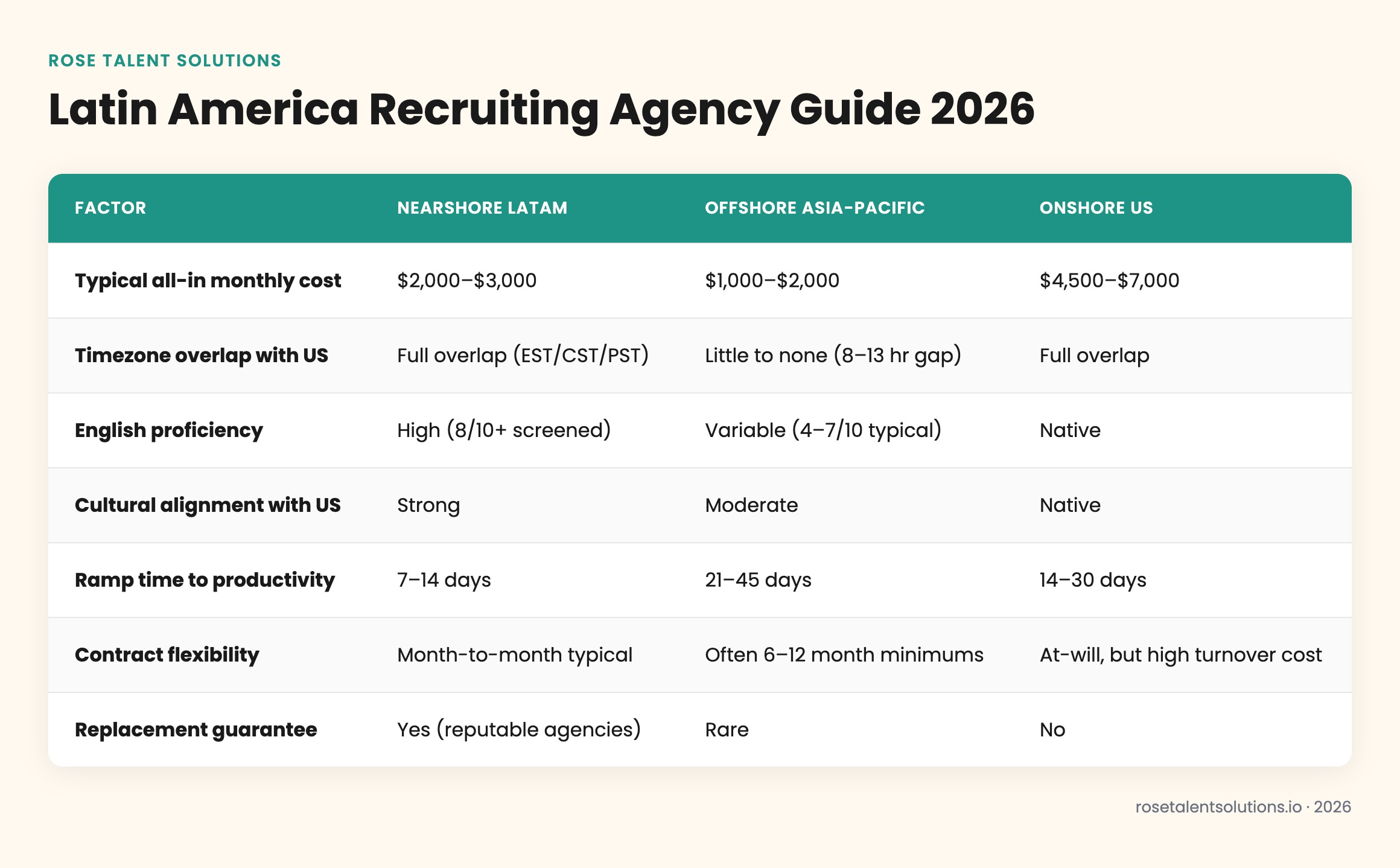
According to SHRM's Benchmarking Report (2023), the average cost to replace a single US employee is $4,700 in direct costs alone — not counting lost productivity during the ramp period. That figure alone makes the replacement guarantee offered by quality LatAm recruiting agencies one of the most financially meaningful terms in any staffing agreement.
What Does a Latin America Recruiting Agency Actually Charge?
Pricing models vary widely across agencies, and the structure matters as much as the number on the invoice. Some agencies charge a one-time placement fee (often 15–25% of annual salary) and hand the worker off to you entirely. Others — including Rose Talent Solutions — charge a flat monthly rate that covers recruiting, vetting, payroll, HR, and ongoing management.
Rose's model is $2,500/month per full-time team member — 40 hours a week, all-in. No hidden payroll fees, no annual contracts, no long-term contract required. You can cancel with 30 days written notice. If the placement isn't the right fit, the team member is replaced at no additional cost.
For a full breakdown of what drives the price difference between LatAm staffing options, the Latin America virtual assistant cost guide breaks down every cost component — placement fees, payroll overhead, benefits, and what "all-in" actually means across different provider models.
One thing worth watching: some agencies advertise a low headline rate but charge separately for onboarding, software licensing, or HR compliance. Always ask for a total cost of engagement, not just the base placement figure. According to Pew Research Center (2023), remote workers in professional roles earn a median wage roughly 23% higher than their non-remote counterparts — a gap that illustrates exactly why international remote staffing has become so attractive to cost-conscious US operators.
The cheapest LatAm staffing option on paper is rarely the cheapest in practice. A $1,800/month placement that requires 20 hours of your own recruiting, compliance, and payroll management may cost more in real terms than a $2,500/month fully managed placement where you do nothing but onboard the team member.
How Rose Talent Solutions Vets and Places LatAm Team Members
Not all Latin America recruiting agencies vet candidates the same way. The quality of the screening process is what separates a placement that ramps in 10 days from one that disappoints in 60. Here's exactly how the Rose process works:
Role Scoping Call
Rose's team works with you to define the exact responsibilities, software stack, and communication style needed — before sourcing begins. This cuts mismatched placements significantly.
Talent Sourcing Across LatAm
Candidates are drawn from Rose's proprietary network across Colombia, Mexico, Argentina, Costa Rica, and other LatAm markets — not from public job boards only.
Multi-Stage Vetting
Every candidate passes English proficiency screening (minimum 8/10), skills assessments for their specific role, background checks, and a structured interview with Rose's talent team.
AI Copilot Assignment
Each placed team member is paired with a role-specific AI copilot trained on the software they'll use — AppFolio, Buildium, QuickBooks, and others — so they're productive from day one. Learn more at Rose's AI Advantage page.
Placement and Ongoing Management
Once placed, Rose handles payroll, HR compliance, and performance monitoring. If the team member isn't a fit, Rose replaces them at no additional cost.
The AI copilot element deserves special attention. According to McKinsey's report on the economic potential of generative AI (2023), AI tools can reduce the time workers spend on repetitive knowledge tasks by up to 60–70%. When a virtual assistant arrives already trained on the client's specific software stack, that ramp curve compresses dramatically.

Which Roles Does a Latin America Recruiting Agency Fill Best in 2026?
LatAm nearshore staffing agencies aren't a single-role solution. The range of functions that translate well to full-time remote LatAm placements has expanded considerably as software tools have matured. Here are the highest-ROI role categories:
- Property management operations: Leasing coordination, maintenance dispatch, tenant communication, and full-service property management virtual assistant support for AppFolio and Buildium users.
- Bookkeeping and accounting: Accounts payable/receivable, bank reconciliation, monthly close support, and QuickBooks-trained bookkeeping and accounting VA placements for small business owners.
- Executive and administrative support: Calendar management, inbox triage, CRM data entry, travel coordination, and project tracking.
- Customer success and client communications: Responding to inbound inquiries, following up on open tickets, managing review responses, and maintaining client relationships.
- Marketing operations: Social media scheduling, content calendar management, email campaign execution, and basic graphic asset coordination.
According to the US Bureau of Labor Statistics (2024), the median annual wage for a US-based administrative assistant is $44,080 — before payroll taxes, benefits, office overhead, or turnover costs. A full-time, fully managed LatAm placement at $2,500/month represents a potential annual saving of over $14,000 against that baseline, with no benefits administration required.
How to Evaluate a Latin America Recruiting Agency Before You Sign
The LatAm staffing market has grown fast, and not every agency operates at the same standard. Before committing to a provider, ask these specific questions:
- What is your English proficiency screening methodology? Ask for the specific test used and the minimum score required. Rose's published floor is 8/10. Agencies that can't answer this question specifically are likely not screening rigorously.
- What countries do your candidates work from? Colombia, Mexico, Argentina, and Costa Rica have strong talent pools and good infrastructure. Be cautious of agencies that are vague about geography.
- What happens if the placement isn't a fit? The answer should be a clear replacement policy at no additional cost. If the agency hedges here, that's a red flag.
- Who handles payroll and HR compliance? In-country payroll compliance varies by country. A good agency owns this entirely so you never face local labor law exposure.
- What is the contract structure? Look for month-to-month or no long-term contract arrangements. Any provider requiring 12-month commitments upfront is transferring their pipeline risk onto you.
"The number one mistake companies make when hiring remote international staff is prioritizing cost over communication quality. A $200/month savings evaporates the first time a miscommunication costs you a client." — Liam Martin, Co-founder at Time Doctor (2023)
Also consider the agency's specialization depth. A generalist staffing firm placing everyone from graphic designers to nurses is structurally different from a firm focused on business operations roles for US SMBs. Specialization drives better candidate matching, faster ramps, and lower churn. For more context on how different staffing models are structured, the overview of what a Latin America staffing agency actually does is a useful complement to this guide.
Employee engagement is another underappreciated variable. According to Gallup's State of the Global Workplace report (2023), remote workers who report high engagement are 21% more productive than their disengaged counterparts — a statistic that underscores why placement quality and cultural fit matter far beyond the hourly rate. Agencies that actively manage performance post-placement produce measurably better outcomes than those that simply hand over a CV and disappear.
Strengths of LatAm Nearshore Staffing
- Full US timezone overlap — real-time collaboration with your team
- High English fluency when properly screened (8/10+ standard)
- Strong cultural alignment with North American business norms
- Significant cost savings versus domestic hiring
- Month-to-month flexibility with reputable agencies
- Role-specific AI copilots accelerate ramp time
Limitations to Understand
- Quality varies widely — vetting rigor differs by agency
- Not suited for roles requiring physical presence or US licensure
- Time investment required for effective onboarding, like any hire
- Infrastructure reliability varies by candidate location and setup
How to Get Started With Rose Talent Solutions in 2026
The fastest path to a qualified LatAm team member is a scoped intake process — not a generic job board post. Rose's onboarding starts with a brief role scoping conversation, moves through the multi-stage vetting process described above, and typically results in a first placement within about seven days.
The all-in rate is $2,500/month per full-time team member. No long-term contract. Cancel with 30 days written notice. If the placement isn't a fit, Rose replaces them at no additional cost — that's the only guarantee that matters, and it's the one Rose stands behind unconditionally.
If you're ready to scope your first role, the Rose Talent Solutions intake process starts here — it takes about 10 minutes and gives the team enough context to begin sourcing immediately.
For businesses still weighing the full model comparison — including the specific differences between nearshore and traditional offshore hiring — the onshore vs offshore virtual assistant breakdown covers every variable in depth, including real cost modeling and communication lag data. The scale of the remote workforce opportunity in Latin America continues to grow: according to OECD Education at a Glance data (2023), tertiary education enrollment across Latin America has risen sharply over the past decade, expanding the pool of degree-qualified candidates available to US employers through nearshore staffing channels.