
Why Non-Technical Founders Struggle to Staff Tech Roles in 2026
Nearshore staffing has quietly become the most practical solution to one of the biggest bottlenecks non-technical founders face: building a capable, affordable tech team without a CTO, an HR department, or a six-figure recruiting budget. If you're running a SaaS tool, a service business with heavy software operations, or a growing startup that relies on platforms like QuickBooks, HubSpot, or Shopify, you already know the problem. You need skilled, tech-fluent support — yesterday. But hiring domestically is expensive, generic offshore options introduce timezone and communication gaps, and sorting through freelancer platforms takes weeks you don't have.
The cost pressure is real. According to the U.S. Bureau of Labor Statistics (2024), the median annual wage for computer and information technology occupations in the United States exceeds $104,000 — a number that puts full-time in-house tech hires completely out of reach for most early-stage founders. And that figure doesn't include benefits, payroll taxes, or onboarding costs.
Non-technical founders aren't looking to hire engineers. They need tech-fluent operators — people who can run the software stack, manage integrations, handle data entry and reporting, and keep the digital side of the business moving. That's a very different hire, and nearshore virtual staffing is built precisely for it.
What Are Affordable Tech Staffing Services for Non-Technical Founders?
Affordable tech staffing services for non-technical founders are managed staffing solutions that place skilled, software-trained virtual team members with small businesses and startups at a predictable flat monthly rate. Unlike traditional recruiting agencies that charge placement fees or staffing firms that bill hourly, these services bundle recruiting, vetting, payroll, HR, and ongoing management into a single all-in price. The result is a full-time remote team member who works your hours, speaks fluent English, and hits the ground running on the tools your business already uses.
A nearshore VA, specifically, is a virtual assistant or remote team member based in Latin America — countries like Colombia, Mexico, Argentina, Costa Rica, and Peru — who works in U.S. time zones and communicates in English at a professional level. This is distinct from offshore staffing, which typically involves a 6–12 hour time difference and variable English proficiency. For a deeper breakdown of how these models compare structurally, this complete comparison of nearshore vs. offshore vs. onshore virtual assistants walks through every relevant dimension.
For non-technical founders specifically, the defining feature of a good affordable tech staffing service isn't just the price — it's the role-specific software training that comes baked in. A VA who already knows how to navigate your CRM, run reports in QuickBooks, or manage your project management tool doesn't require you to teach them. That's the gap most founder-led businesses fall into: they hire someone affordable, then spend 40 hours onboarding them on tools the founder barely understands themselves.

How Nearshore Compares to Every Other Tech Staffing Option in 2026
Non-technical founders typically evaluate four staffing paths: hiring onshore (U.S.-based), using an offshore agency, posting on a freelance platform (Upwork, Fiverr), or going nearshore. Each has a real cost profile, not just the sticker price. Timezone drag, communication friction, and management overhead are all costs — they just show up in your calendar and your stress level instead of your invoice.
According to SHRM (2024), the average cost-per-hire in the United States now exceeds $4,700 — and that's before salary, benefits, or the productivity ramp time that typically runs 3–6 months for a new tech hire. Freelance platforms look cheap on paper but require you to manage, train, and re-hire constantly, which compounds the founder-time cost dramatically.
| Staffing Option | Monthly Cost (est.) | Timezone Fit (US) | English Proficiency | Management Included | Software Pre-Trained |
|---|---|---|---|---|---|
| Nearshore VA (Rose — Latin America) | $2,500 flat | ✅ Same hours | ✅ 8/10+ screened | ✅ Fully managed | ✅ Role-specific AI copilot |
| Offshore VA (time-zone-misaligned regions) | $800–$1,800 | ❌ 6–12 hr gap | ⚠️ Variable | ❌ Self-managed | ❌ Rare |
| U.S. Freelancer (Upwork) | $3,500–$7,000 | ✅ Same hours | ✅ Native | ❌ Self-managed | ❌ Varies widely |
| U.S. Full-Time Employee | $6,500–$10,000+ | ✅ Same hours | ✅ Native | ⚠️ In-house HR required | ⚠️ Training required |
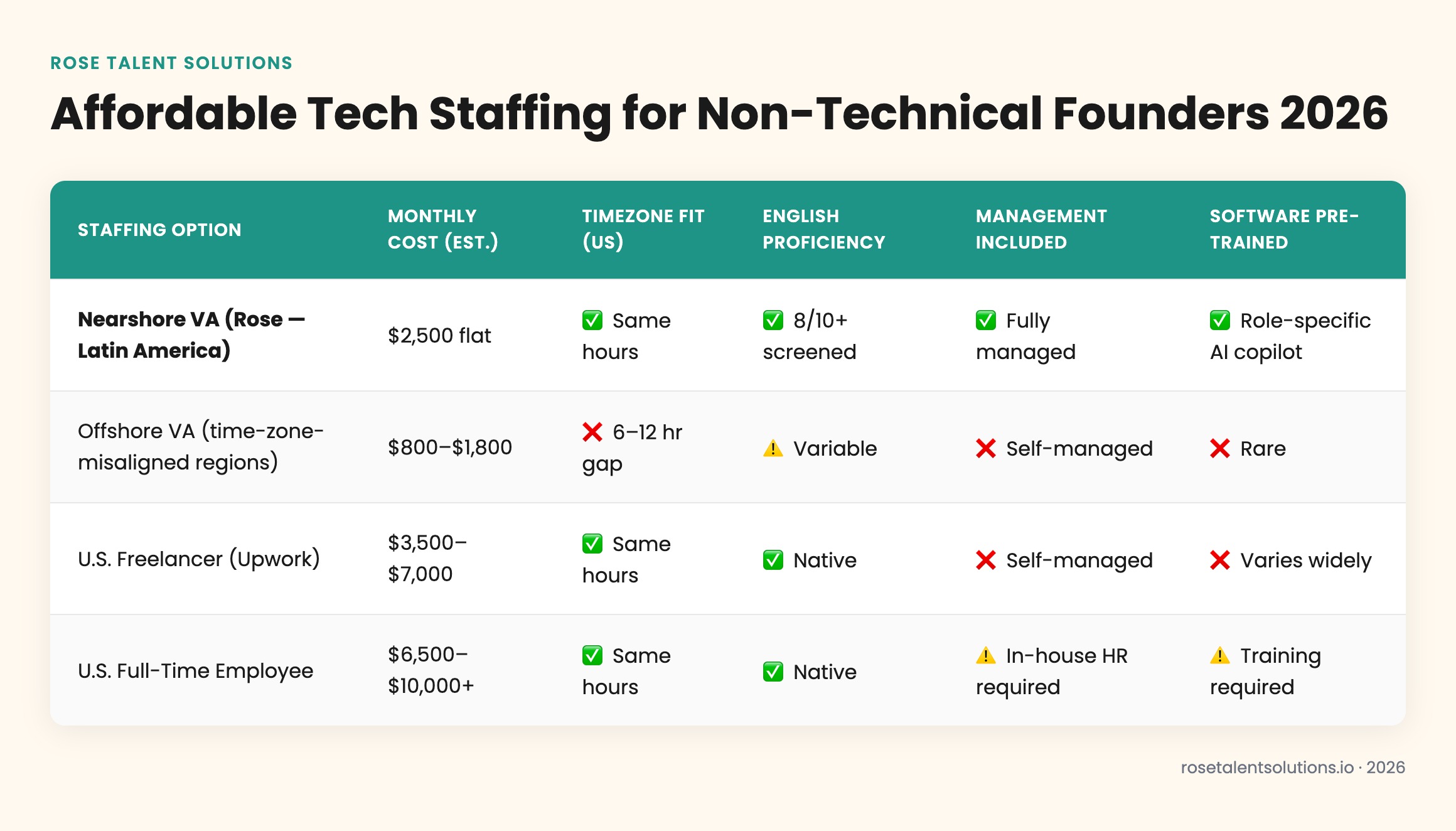
The pattern is clear: nearshore staffing hits a unique sweet spot that no other model reaches. It delivers real-time timezone alignment and screened English fluency — the two things that actually determine whether a remote hire works day-to-day — at a price point that's 60–75% below U.S. market rates. If you want a full data-driven read on how the cost math plays out across models, this breakdown of onshore vs. offshore virtual assistants covers the full picture.
How Rose Talent Solutions Solves the Tech Staffing Problem for Founders in 2026
Rose Talent Solutions is a nearshore virtual staffing agency that places full-time, Latin America-based team members with U.S., Canadian, and UK businesses at $2,500 per month — all-in. That rate covers recruiting, vetting, payroll, HR administration, and ongoing management. There are no hidden fees, no long-term contract, and if the team member isn't the right fit, Rose replaces them at no additional cost.
What makes Rose specifically useful for non-technical founders is the AI copilot layer. Every Rose team member ships with a role-specific AI assistant trained on the software they'll be using in your business — whether that's QuickBooks for bookkeeping support, HubSpot for CRM management, or a project management tool like Asana or Monday.com. You don't need to understand the software deeply yourself to benefit from someone who does. Learn more about how this works on the AI advantage page.
"Founders don't fail because they can't code — they fail because they try to operate software-heavy businesses without anyone on their team who truly owns the tools. The right VA isn't a helper; they're a system operator." — Matt Trifiro, CMO at Vultr and cloud infrastructure advisor (2023)
The roles Rose places most frequently for non-technical founders include operations coordinators, bookkeeping assistants, CRM managers, executive assistants, customer support specialists, and bookkeeping and accounting support staff. These aren't generalist VAs who figure out your tools as they go. They arrive with platform-specific skills, a working knowledge of the most common software stacks in your industry, and the English fluency to represent your business in client-facing communications from day one.
According to Gallup (2023), remote workers who have clearly defined roles and access to the right tools show 23% higher engagement than those without them — a finding that directly supports the case for pre-trained, role-specific staffing over generic hiring.
The hidden cost of offshore or freelance tech staffing isn't the monthly rate — it's the founder hours burned managing, re-training, and re-hiring. A fully managed nearshore placement from Latin America removes that cost entirely, which often saves more than the price difference itself.

What Does the Onboarding Process Actually Look Like in 2026?
One of the first objections non-technical founders raise is: "I don't have time to manage an onboarding process." That's exactly the objection Rose's model is built to eliminate. The entire placement process is handled for you — from role scoping to candidate matching to first-day orientation. Here's how it works in practice.
Role Discovery Call
Rose's team spends 30–45 minutes with you to understand your business, your software stack, and the specific tasks you need covered. You don't need to write a job description — they build it from the conversation.
Candidate Matching
Rose pre-screens Latin America-based candidates against your role requirements, English proficiency standards (8/10+ minimum), software skills, and availability. You review a shortlist of 2–3 vetted candidates — typically within 5–7 business days.
AI Copilot Activation
Your matched team member's role-specific AI copilot is activated for your software stack before day one — so they arrive equipped, not guessing.
First Week Onboarding
Rose manages the structured onboarding process, including tool access setup, workflow documentation, and communication protocols — minimizing the time you spend explaining basics.
Ongoing Management Support
Rose's team stays involved post-placement — handling HR issues, performance check-ins, and any replacement process if the match isn't working out.
If you're comparing this to what it takes to hire on your own, the difference is stark. A typical founder-led hire involves writing a job post, sorting 50–100 applications, running interviews, negotiating, onboarding, and managing HR compliance. According to SHRM, the average time-to-fill for a knowledge-worker role runs 42 days. Rose compresses that to roughly one week, with zero recruiting burden on your end. You can start the matching process here with a single intake form.
Remote work adoption continues to accelerate the demand for this kind of structured, fast staffing model. According to Pew Research Center (2023), 35% of U.S. workers with remote-capable jobs now work from home full-time — a structural shift that has normalized distributed teams and made nearshore remote staffing a first-choice option rather than a fallback for lean startups.
How to Evaluate Affordable Tech Staffing Services: Pros, Cons, and Red Flags in 2026
Not all affordable tech staffing services are created equal, and non-technical founders are especially vulnerable to services that look affordable upfront but create hidden costs through poor matching, self-managed delivery, or time-zone-misaligned teams marketed with nearshore-sounding language. Here's an honest look at the tradeoffs.
What Good Tech Staffing Services Do
- Pre-screen for role-specific software skills, not just general VA experience
- Maintain a published English proficiency standard (e.g., 8/10+ minimum)
- Include payroll, HR, and management — not just placement
- Offer a replacement guarantee (not a refund) if the match isn't right
- Place team members in your exact timezone, not a "partial overlap" window
- Provide role-specific AI or tool training before day one
Red Flags in Cheap Staffing Services
- Hourly billing with no all-in pricing transparency
- No English proficiency screening standard disclosed
- Teams placed outside Latin America marketed with nearshore-sounding language
- Placement-only model — you manage everything after hire
- No replacement policy — just a "satisfaction guarantee" with no teeth
- Overly broad candidate pools with no role-specific vetting
According to McKinsey (2023), companies that invest in structured, skills-based hiring processes see 2.5× better retention compared to those using unstructured sourcing — a finding that applies directly to virtual staffing models. The cheapest option at the point of hire is rarely the cheapest option at 90 days in.
Global remote workforce data reinforces this. According to Statista (2024), Latin America's remote talent market has grown at double-digit rates annually since 2020, driven by a large pool of bilingual, university-educated professionals who increasingly serve U.S. employers. That supply-side expansion is one reason nearshore pricing has remained competitive even as demand rises.
For founders who want to compare specific service providers side-by-side before committing, this roundup of the best affordable virtual assistant services in 2026 covers the leading options with honest tradeoff analysis. And if you're specifically evaluating for a U.S. small business context, this guide to the best VA services for U.S. small businesses narrows the field further.
The bottom line for non-technical founders: the goal isn't to find the lowest monthly rate. The goal is to find the lowest total cost of a working, retained, productive team member — and that calculation almost always points to a fully managed nearshore model with team members based in Latin America. Explore the full scope of roles Rose places, including operations and property management staffing, to get a sense of how deep the role coverage goes.