
Nearshore virtual staff have quietly become one of the most effective levers accounting firm owners can pull in 2026. While most practice management advice focuses on software or billing rates, the real constraint in most firms is people capacity — not enough trained hands to handle bookkeeping, AP, payroll support, and client communication without burning out your licensed staff. The best-run accounting firms are solving this by pairing their in-house CPAs with nearshore virtual team members who work US business hours, speak fluent English, and already know the tools your firm runs on.
This guide covers the accounting firm staff management best practices that are actually working in 2026 — from role design and onboarding to retention and capacity planning. Whether you run a 3-person boutique or a 30-person regional firm, these principles apply.
The talent shortage in public accounting is well-documented. According to the AICPA's CPA Pipeline report (2023), the number of students sitting for the CPA exam has declined for five consecutive years. That means the traditional "hire another staff accountant" solution is both slower and more expensive than it used to be — making flexible staffing models a strategic necessity, not just a cost play.
How to Define Roles Before You Hire Anyone in 2026
The single most common staff management mistake accounting firm owners make is hiring for a vague "accounting support" role without specifying which tasks belong to whom. When responsibilities are blurry, licensed staff spend time on work that doesn't require a CPA license — and that's expensive. A clean role architecture separates your team into three layers:
- Licensed/senior layer: CPAs, senior accountants, and managers who own client relationships, sign off on returns, and handle advisory work.
- Para-professional layer: Staff accountants, bookkeepers, and payroll coordinators who handle recurring transactional work under supervision.
- Support layer: Virtual staff handling data entry, AP processing, reconciliations, inbox management, and client follow-up — work that requires accuracy and reliability, not a license.
Most firms are understaffed at the support layer and overstaffed (or over-billing) at the licensed layer. Fixing that imbalance is where nearshore virtual staff deliver the clearest ROI. If you want a deeper look at how this applies to smaller practices, our guide on bookkeeping and accounting support for small businesses breaks down exactly which tasks are best delegated first.
What is a nearshore virtual staff member? A nearshore virtual staff member is a full-time remote employee based in Latin America who works your business hours, communicates in fluent English, and is recruited, vetted, and managed by a staffing partner on your behalf. Unlike offshore hires in Asia, nearshore team members operate in overlapping or identical time zones to US-based firms — which means real-time collaboration, not asynchronous queues.

How Staffing Model Choice Shapes Firm Performance in 2026
Not all remote staffing models are equal. The table below compares the three main options accounting firms evaluate: onshore US contractors, nearshore virtual staff (Latin America), and offshore virtual staff (Philippines or India).
| Criteria | Onshore (US Contractor) | Nearshore (Latin America) | Offshore (Philippines / India) |
|---|---|---|---|
| Monthly cost (full-time) | $5,000–$9,000+ | $2,500 flat | $1,200–$2,000 |
| Timezone alignment (US hours) | ✅ Full overlap | ✅ Full overlap | ❌ 6–14 hr gap |
| English proficiency | ✅ Native | ✅ 8/10+ screened | ⚠️ Varies widely |
| Software pre-training (QuickBooks, Xero) | ⚠️ Hire-dependent | ✅ AI copilot included | ⚠️ Hire-dependent |
| Recruiting, HR, payroll managed for you | ❌ Usually not | ✅ Fully managed | ⚠️ Platform-dependent |
| Replacement guarantee | ❌ No | ✅ Free replacement if not a fit | ⚠️ Varies |
| Long-term contract required | ⚠️ Often yes | ❌ No long-term contract | ⚠️ Often yes |
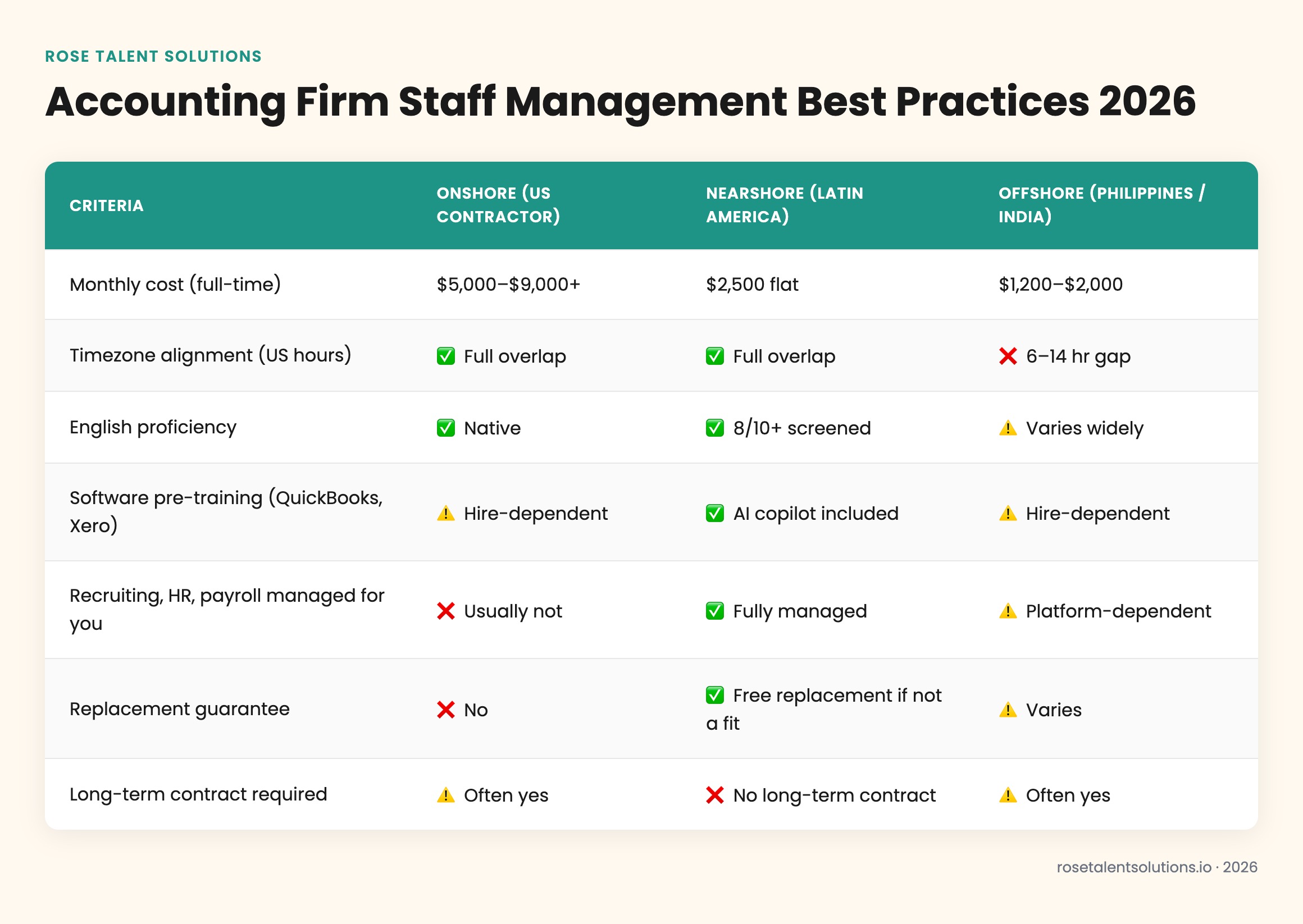
The cost delta between onshore and nearshore is significant, but the more important comparison is nearshore versus offshore. Offshore staffing looks cheaper on paper, but the 6–14 hour timezone gap means your client questions, AP exceptions, and reconciliation requests don't get touched until the next morning. For accounting firms where client responsiveness is a key differentiator, that lag compounds into a real service quality problem.
If your firm uses Xero and you're evaluating virtual support options, our post on working with a Xero virtual bookkeeper covers the specific skills and workflow integrations to look for before you hire.
How to Build an Onboarding Process That Actually Sticks
Most accounting firms have a weak onboarding process for support staff — usually a combination of shadowing and ad hoc instructions. That works tolerably for in-office hires who can ask questions face-to-face. For remote virtual staff, it creates confusion, rework, and premature churn. According to SHRM (2022), organizations with a strong onboarding process improve new hire retention by 82% and productivity by over 70%.
Document the 10 most frequent tasks before day one
List the recurring workflows your virtual staff member will own — AP entry, bank reconciliations, client inbox responses — and create a short SOP for each. Video walkthroughs recorded in Loom take 20 minutes and eliminate weeks of back-and-forth.
Set a 30-day ramp plan with daily check-ins
The first two weeks should include a 15-minute daily sync with a supervisor. Catching misunderstandings early is far cheaper than correcting three weeks of incorrect reconciliations. Taper check-ins to weekly by week four.
Assign a single point of contact, not a committee
Virtual staff who report to multiple people quickly become paralyzed by conflicting instructions. Name one internal owner for each virtual team member for at least the first 90 days.
Activate their AI copilot on day one
Rose team members arrive with a role-specific AI copilot pre-trained on the software they'll use — QuickBooks, Xero, or other platforms. Activating it on day one means your new team member can self-resolve common workflow questions without interrupting your senior staff. Learn more about how this works on the AI advantage page.

How Retention Actually Works in Accounting Firms in 2026
Retention in accounting is notoriously difficult. The U.S. Bureau of Labor Statistics (2024) reports that voluntary turnover in accounting and finance roles runs consistently above the national average, driven by burnout, limited advancement paths, and compensation compression. Firms that treat staff management as a periodic HR task — rather than an ongoing operational discipline — pay the price in recruiting costs and institutional knowledge loss.
"Turnover in public accounting isn't just a people problem — it's a profitability problem. Every time you lose a staff accountant, you're losing three to six months of productivity in recruiting, training, and ramp time." — Barry Melancon, President & CEO at AICPA (2022)
Research backs this up at scale. According to Gallup (2023), the cost of replacing an individual employee ranges from one-half to two times that employee's annual salary — a figure that climbs sharply when institutional knowledge and client relationships are factored in. For a mid-level staff accountant earning $65,000, that's a $32,500–$130,000 replacement cost every time someone walks out the door.
The most effective retention lever for accounting firms isn't compensation alone — it's workload predictability. When licensed staff are constantly pulled into support-level tasks because there aren't enough hands, they burn out faster and leave sooner. Offloading accounts payable processing, document collection, and client follow-up to a dedicated virtual team member protects your senior staff from the grind. If you want to understand how firms are specifically structuring AP support, our overview of the best accounts payable virtual assistant services covers the role structure and task handoff in detail.
The hidden cost of poor staff management isn't the salary of the person who left — it's the 3–6 months of lost productivity, recruiting fees, and client relationship disruption that follows. Proactive capacity management through virtual staff is measurably cheaper than reactive replacement hiring.
Retention also requires clear career visibility. Even virtual staff members perform better and stay longer when they understand what growth looks like in their role. Set quarterly check-ins that include a skills review and a forward-looking conversation about expanded responsibilities. This is especially important for virtual team members who may not have the informal hallway conversations that flag ambitions and frustrations in in-office settings.
For a comprehensive look at how accounting practices are rethinking their entire HR approach — from hiring screens to retention frameworks — our post on accounting practice HR management, hiring, and staff retention goes deeper on the structural changes driving results in 2026.
How to Evaluate Whether Your Staffing Model Is Working in 2026
You can't manage what you don't measure. Accounting firms that run rigorous staff management track a small set of leading indicators — not just revenue per partner. The metrics that matter most:
- Billable utilization rate: What percentage of each team member's hours are billed to clients? Healthy firms target 75–85% for licensed staff. If your CPAs are running at 60%, they're likely absorbing support work that belongs elsewhere.
- Task completion rate per role: Are recurring tasks — reconciliations, AP runs, payroll support — completed on schedule? Slippage here usually signals a capacity problem, not a performance problem.
- Client response time: How long does a client wait for an answer to a routine question? Firms with dedicated virtual coordinators consistently outperform those without on this metric.
- 90-day retention of new hires: If you're losing support staff in the first three months, your onboarding process is the problem — not the hire.
According to a McKinsey analysis of professional services firms (2023), companies that actively track workforce productivity metrics — not just financial KPIs — are 2.4× more likely to outperform peers on revenue growth over a 3-year horizon. That finding applies directly to accounting practices: the firms that treat staff management as a data discipline grow faster than those that manage by intuition.
Workforce engagement is another metric that predicts firm performance before it shows up in revenue. Gallup's State of the American Workplace report (2023) found that highly engaged business units achieve 23% higher profitability than disengaged ones — a correlation that holds across professional services. For accounting firms, engagement is a direct function of workload balance: staff who feel overloaded with non-core tasks disengage faster than any other driver measured.
Signs Your Staffing Model Is Working
- Licensed staff are billing above 75% utilization consistently
- Recurring tasks complete on schedule without partner intervention
- New virtual staff reach full productivity within 30 days
- Client response times are under 4 hours on routine matters
- Voluntary turnover is below 15% annually
Signs You Need to Restructure
- CPAs are doing data entry, AP processing, or inbox triage
- You're missing deadlines during busy season every year
- New hires are leaving before 90 days
- Client complaints center on responsiveness, not expertise
- You're hesitant to take on new clients because you lack bandwidth
If your metrics are pointing toward the "restructure" column, the fastest fix is adding dedicated support-layer capacity before you attempt to fix your senior staffing. Explore what that looks like for accounting firms specifically on Rose's bookkeeping and accounting virtual staff page, or see the full range of roles available at Rose's get started page.
Accounting firm staff management in 2026 is less about finding the perfect hire and more about building a system that makes good hires succeed. Firms that define roles clearly, onboard intentionally, protect their licensed staff's time, and measure what matters will consistently outperform those still treating staffing as a reactive problem. Nearshore virtual staff — at a flat $2,500 per month with no long-term contract and free replacement if it's not a fit — give you a fast, low-risk way to build that capacity right now.