
Why Accounting Practice HR Management Is a 2026 Crisis — Not a Background Task
If you run an accounting practice, you already know the headline: good staff are hard to find and even harder to keep. The smartest practices pulling ahead right now are restructuring how work gets done — pairing onshore CPAs with nearshore talent based in Latin America who work US business hours in real time. That model is fundamentally different from the offshore arrangements many firms tried and abandoned, and it is directly reshaping what accounting practice HR management looks like in 2026.
The accounting profession is facing a structural talent shortfall that no amount of job-board budget will fix. AICPA (2023) reported that the number of accounting graduates sitting for the CPA exam has dropped more than 30% over the last decade, compressing the pipeline at exactly the moment demand is rising. That pressure lands squarely on practice management. Your partners spend more time recruiting than advising clients. Your senior staff burn out covering gaps. Your billing rate stays flat because you cannot scale the delivery team.
People management is no longer an HR admin function — it is a core growth lever. The practices winning at talent management in 2026 are not simply paying more. They are restructuring which humans do which work, and using technology to make every hire more productive from day one.
That number should alarm every practice owner. Nearly half your team is passively or actively looking. The fix is not just a pay bump — it is a systemic rethink of how your practice acquires, structures, and retains talent.
How Accounting Practice HR Differs From Generic Business HR in 2026
What is accounting practice HR management? Accounting practice HR management is the discipline of recruiting, onboarding, developing, and retaining staff inside a professional services firm that provides accounting, tax, audit, or advisory services. It differs from general business HR because the talent pool is credentialed and narrow, client confidentiality requirements shape every staffing decision, and billable utilization directly connects headcount choices to revenue.
Three dynamics make practice staffing uniquely difficult. First, the credential bottleneck: you cannot simply hire a warm body to do tax work. Second, the utilization trap: every unfilled role is revenue you cannot recognize. Third, the client relationship risk: unlike product businesses, your clients are partly buying the relationship with specific staff members. When a senior associate leaves, client churn risk follows.
The practices winning at talent management right now are separating their staffing strategy into two lanes: credentialed onshore roles for complex advisory and client-facing work, and nearshore support roles for bookkeeping, reconciliations, data entry, payroll processing, and AP/AR management. This tiered model is not a compromise — it is how you fund competitive salaries for your senior staff while controlling overhead.
According to the U.S. Bureau of Labor Statistics (2024), the median annual wage for accountants and auditors is $79,880 — and senior-level roles in major markets regularly exceed $120,000 before benefits. Adding a full-time onshore bookkeeper at $55,000–$65,000 to handle volume work your CPAs should not be touching is simply poor capital allocation when a nearshore alternative exists at a fraction of that cost.

What Does High-Performance Staff Retention Look Like in an Accounting Practice?
Retention in an accounting practice has three layers that most firms only address one at a time: compensation, culture, and career trajectory. Getting all three right simultaneously is what separates 8% annual turnover from 25%.
Compensation benchmarking is table stakes. SHRM (2023) found that 64% of employees who left a job cited pay as a primary factor — but 57% of those same respondents said they would have stayed for non-monetary improvements like flexible work, recognition, and development opportunities. Pay matters, but it is not the whole story in accounting practice HR.
The fastest path to retaining your best accounting staff is giving them less of the work they hate. When your senior associates spend 30% of their week on reconciliations and data cleanup, they will leave for a firm that does not. Offloading that volume to a nearshore bookkeeping and accounting VA is a retention strategy, not just a cost play.
Career trajectory is the most neglected lever. Staff under 35 in accounting practices consistently cite "I don't see a path to partner" as their top reason for leaving, according to a survey published by the Journal of Accountancy (2023). Structured promotion timelines, mentorship frameworks, and visible CPE investment signal that the firm is as committed to the employee's future as it is to the client's balance sheet.
Culture, the third layer, is harder to audit but equally measurable. Firms with clear values, low internal politics, and transparent partner communication consistently score higher on employee NPS surveys and see significantly lower voluntary attrition. Gallup's State of the Global Workplace report (2023) found that manager quality alone accounts for 70% of the variance in employee engagement scores — a reminder that your people management training investment pays directly into retention numbers.
Hiring Strategies That Actually Work for Accounting Practices in 2026
Recruitment for accounting practices has shifted dramatically. The old model — post on Indeed, wait, interview, hire — produces results too slowly for a market where good candidates are receiving offers within 72 hours of applying. The practices hiring well in 2026 treat recruitment as a continuous pipeline, not a reactive event.
| Staffing Model | Monthly Cost (Full-Time Equivalent) | Timezone Overlap with US | English Proficiency | Ramp Time | Software Training Included |
|---|---|---|---|---|---|
| Onshore Full-Time Hire | $4,500–$7,500+ (salary + benefits) | Full overlap | Native | 4–8 weeks | No — firm pays for training |
| Offshore VA (Asia-Pacific) | $800–$1,500 | Low (8–12 hr gap) | Variable (typically 5–7/10) | 6–10 weeks | Rarely |
| Nearshore VA via Rose Talent (Latin America) | $2,500 flat, all-in | Full US hours overlap | 8/10+ screened floor | 1–2 weeks | Yes — role-specific AI copilot included |
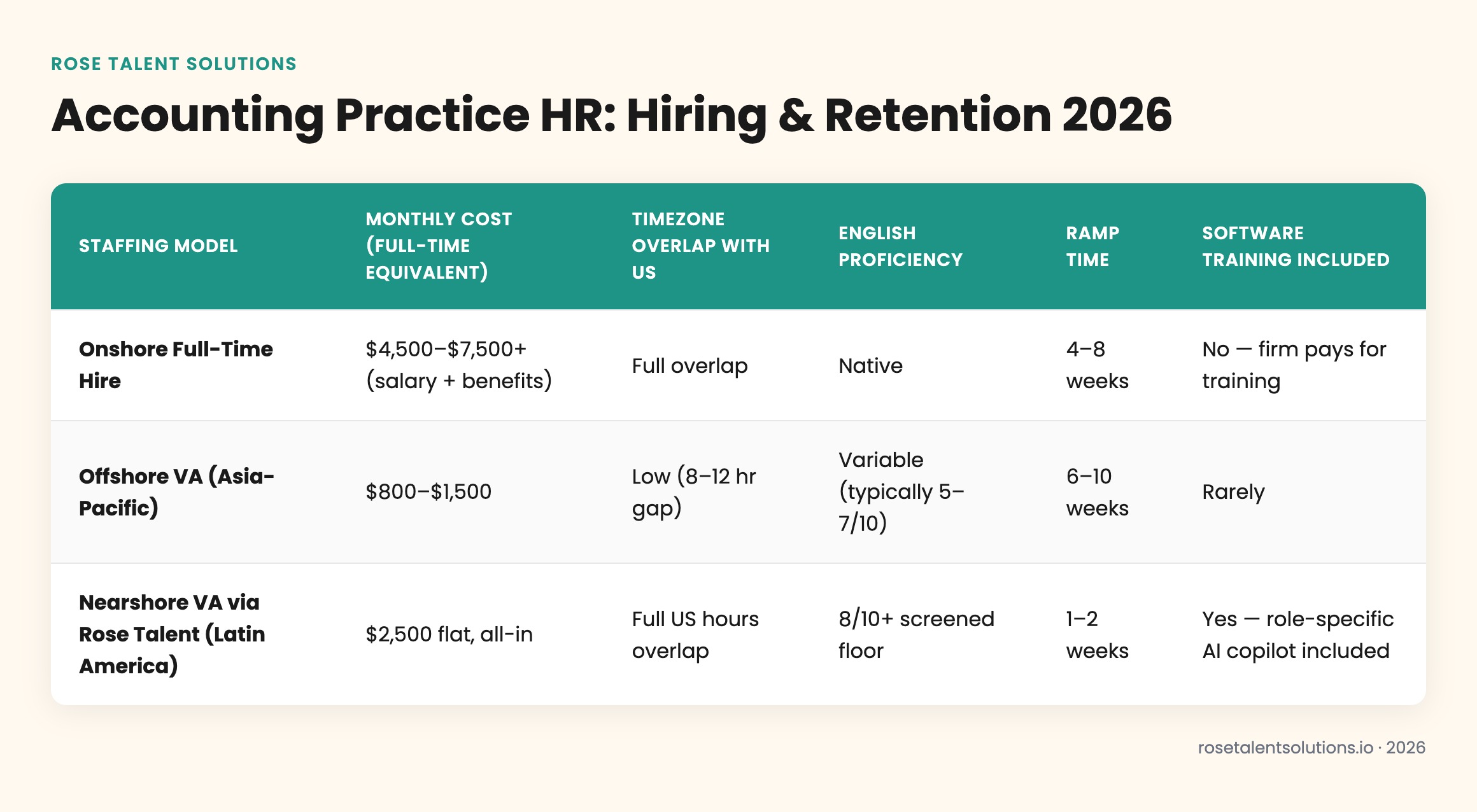
The table above illustrates the core trade-off every practice manager faces. Offshore is cheap but slow to integrate and misaligned on hours. Onshore is fast to integrate but expensive and increasingly hard to find. Nearshore sits in the optimal middle — real-time collaboration, English fluency screened at the door, and an all-in price that includes recruiting, payroll, HR, and ongoing management.
For your onshore hiring pipeline, the practices doing this well maintain a standing talent database of past applicants, actively cultivate relationships with local accounting programs, and use referral bonuses structured to reward staff who bring in long-term hires. Speed matters: SHRM's Talent Acquisition benchmarking data (2023) shows the average time-to-fill for accounting roles is 45 days — firms that cut that to under 20 days close significantly more offers.

How Technology and AI Copilots Change Accounting Practice People Management in 2026
Technology is reshaping what "a hire" actually delivers. The most significant shift in accounting practice staffing is not remote work — it is the emergence of AI-augmented team members who arrive pre-trained on the specific software your practice already uses.
Rose Talent's AI copilot model means every nearshore accounting team member ships with a role-specific AI assistant trained on their software stack — QuickBooks, Xero, Sage, FreshBooks, or whichever platform your practice runs. That dramatically compresses ramp time and reduces the supervision burden on your senior staff. Instead of spending two weeks teaching a new hire how to categorize transactions, your manager reviews output and coaches on judgment calls.
The KPIs that matter for technology-augmented practice staffing are: time-to-productivity (how quickly does the new team member hit target output?), error rate on routine tasks (reconciliations, payroll runs, AP entries), and senior staff time redirected to billable advisory work. According to McKinsey's State of AI report (2024), organizations that deploy AI-augmented workflows in finance functions report a 20–30% reduction in time spent on routine data tasks within the first 90 days.
For accounting and bookkeeping practices specifically, that time savings translates directly into redeployable capacity — either more client engagements at the same headcount, or reduced overtime for staff currently working 55-hour weeks through busy season. Both outcomes address retention. Burnout is one of the top three reasons accounting professionals leave their firms, and workload volume is the primary burnout driver.
Define the role split
Identify which tasks your CPAs and senior associates handle today that a trained accounting VA could own — reconciliations, AP/AR, payroll processing, data entry, client document collection.
Match and onboard your nearshore team member
Rose handles recruiting, vetting (including the 8/10+ English proficiency screen), and placement. Your matched candidate arrives with software-specific AI copilot training already completed.
Run a 30-day integration sprint
Assign your new team member a defined set of recurring tasks. Hold a 15-minute daily check-in for the first two weeks, then transition to async with weekly reviews.
Measure and reallocate senior time
Track hours your senior staff reclaim from volume work and redirect that capacity toward advisory engagements, business development, or CPE. This is how the ROI calculates.
Iterate on fit — with zero replacement cost
If the team member is not the right fit for your practice's culture or workload, Rose replaces them at no additional cost. No penalty, no re-recruiting fee.
Building a Talent Management Culture That Retains Accounting Staff in 2026
Talent management in an accounting practice is not a once-a-year performance review cycle. It is the daily accumulation of small signals that tell your staff whether they are valued, growing, and safe from arbitrary decisions. The practices with the lowest voluntary attrition are not necessarily the highest-paying ones — they are the ones where managers communicate clearly, workloads are sustainable, and promotions follow predictable criteria.
Structured feedback is the single highest-leverage investment most practices are not making. Gallup research (2022) found that employees who receive meaningful recognition at work are 3.7 times more likely to be engaged and significantly less likely to report job hunting. In an accounting practice context, meaningful recognition is specific — "you caught the depreciation error on the Martinez file" — not the generic "great job this quarter" that managers default to.
Development investment matters equally. Paying for CPE is baseline — practices that stand out fund CPA exam prep for promising non-licensed staff, sponsor memberships in professional associations like AICPA, and build internal mentorship programs that pair junior staff with partners on real client work. These investments cost far less than the average cost of replacing an accounting professional, which SHRM's human capital benchmarking (2023) estimates at 50–200% of the departing employee's annual salary.
What High-Retention Accounting Practices Do
- Define clear promotion timelines with measurable criteria
- Offload high-volume work to nearshore accounting support so senior staff focus on advisory
- Hold structured quarterly development conversations, not just annual reviews
- Pay for CPE, exam prep, and professional memberships proactively
- Give staff visibility into firm financials and growth plans
What Drives Accounting Staff to Leave
- Unclear or moving promotion goalposts
- Chronic overwork during busy season with no structural relief
- Managers who hoard information and avoid difficult conversations
- Compensation that lags the market by more than 10% without non-monetary offset
- No investment in technology — staff do not want to work in firms still running everything on Excel
The practices that treat staffing as a strategic function — not a cost center — consistently outperform peers on both revenue per partner and client satisfaction scores. That is not coincidence. It is the compounding effect of lower attrition, higher staff engagement, and the ability to take on more client work without hiring proportionally more people.
If your practice is ready to see what a nearshore accounting team member looks like in day-to-day operations — the tasks they handle, how the handoff works, and what the $2,500 flat rate covers end to end — the Rose bookkeeping and accounting service page breaks it down role by role. No long-term contract. If the placement is not the right fit, Rose replaces the team member at no additional cost.