
Nearshore tech recruiting from Latin America has quietly become the highest-leverage hiring decision a US or Canadian tech company can make in 2026. The talent pool is deep, the timezone alignment is real (most of Latin America runs EST to PST), and the cost gap versus domestic hiring is significant — without the 6-to-10-hour lag you absorb with offshore teams in the Philippines or India. If you've been asking what's the best tech recruiting agency for Latin American devs, you're already thinking in the right direction. The question is which agency actually delivers — and what criteria separate a genuine nearshore partner from a rebranded offshore shop.
This guide cuts through the noise. We'll cover what separates a great nearshore recruiting partner from a mediocre one, how to evaluate agencies on criteria that actually matter, and where Rose Talent Solutions fits in the landscape — alongside honest comparisons you can use to make your own call.
According to Korn Ferry's Global Talent Crunch research (2023), the global talent shortage could reach 85 million unfilled jobs by 2030 — with technology roles among the hardest hit. Latin America is one of the few regions producing English-fluent, technically credentialed developers at the scale US companies need right now. Identifying what's the best tech recruiting agency for Latin American devs means understanding both the demand side and the supply-side reality of that market.
What Is a Nearshore Tech Recruiting Agency — and Why Does the Definition Matter in 2026?
A nearshore tech recruiting agency specializes in sourcing, vetting, and placing software developers and technical staff from countries geographically close to the client — in this context, Latin American countries like Colombia, Mexico, Argentina, Brazil, and Costa Rica for US and Canadian businesses. "Nearshore" is not a synonym for "offshore." Offshore typically means Asia-Pacific or Eastern Europe, where timezone gaps of 8–12 hours are the norm. Nearshore means your developer is awake, online, and responsive during your business day.
This distinction is not marketing language — it's an operational reality. When a critical bug surfaces at 10am Eastern and your dev team is online from Buenos Aires or Medellín, you get a same-day fix. When your team is in Bangalore or Manila, that bug sits in a queue overnight. For fast-moving product teams, that difference compounds across every sprint. Any answer to what's the best tech recruiting agency for Latin American devs has to start here, because agencies that blur the nearshore-offshore line are selling you something fundamentally different from what they're advertising.
If you want to understand how the broader nearshore VA and staffing market is structured — not just for developers but across all roles — the overview of the top nearshore virtual assistant agencies for US businesses gives useful context on what separates real nearshore providers from agencies that just rebrand offshore as nearshore.

How Do You Evaluate the Best Tech Recruiting Agency for Latin American Devs in 2026?
Not all agencies that claim to recruit Latin American developers are doing the same thing. Some are talent marketplaces with thin vetting. Some are staffing firms that place contractors and disappear. Some are full-service partners that handle recruiting, payroll, HR compliance, and ongoing performance management. The criteria below are what experienced operators actually use to separate the signal from the noise when deciding what's the best tech recruiting agency for Latin American devs for their specific situation.
English fluency screening. The single most common complaint about offshore dev shops is communication overhead. Look for agencies that publish their English screening methodology. Rose Talent Solutions uses an 8/10-or-higher English proficiency bar on every placement — and it's not self-reported. It's a structured screen. That matters when your developer is writing Jira tickets, joining standup calls, and communicating directly with product managers.
Timezone accountability. Ask the agency directly: what hours do your placements work? A genuine nearshore agency will confirm US business hours without hesitation. If the answer is vague ("flexible hours" or "overlap windows"), that's a red flag that you're really looking at an offshore shop with a marketing facelift.
All-in pricing vs. variable billing. Many agencies charge a placement fee upfront (often 15–25% of first-year salary) and then leave you to manage payroll, HR compliance, and benefits yourself. Rose operates on a flat $2,500/month model — recruiting, vetting, payroll, HR, and ongoing management included. For small and mid-sized US companies without a dedicated HR function, the operational simplicity of that model is worth real money.
What happens when it doesn't work. No hire is perfect every time. The question is what the agency does when the placement isn't a fit. Rose's answer is a free replacement at no additional cost. No revenue guarantee — that would be dishonest — but the replacement guarantee removes the financial sting of a mismatch so you can course-correct without starting the whole recruiting cycle from scratch at full cost.
"The Latin American tech talent market has matured dramatically. The question is no longer whether the talent exists — it's whether the agency has the operational infrastructure to deliver it reliably at scale." — Ariel Camus, CEO at Microverse (2023)
Nearshore vs. Offshore vs. Onshore: Which Model Wins for US Tech Teams in 2026?
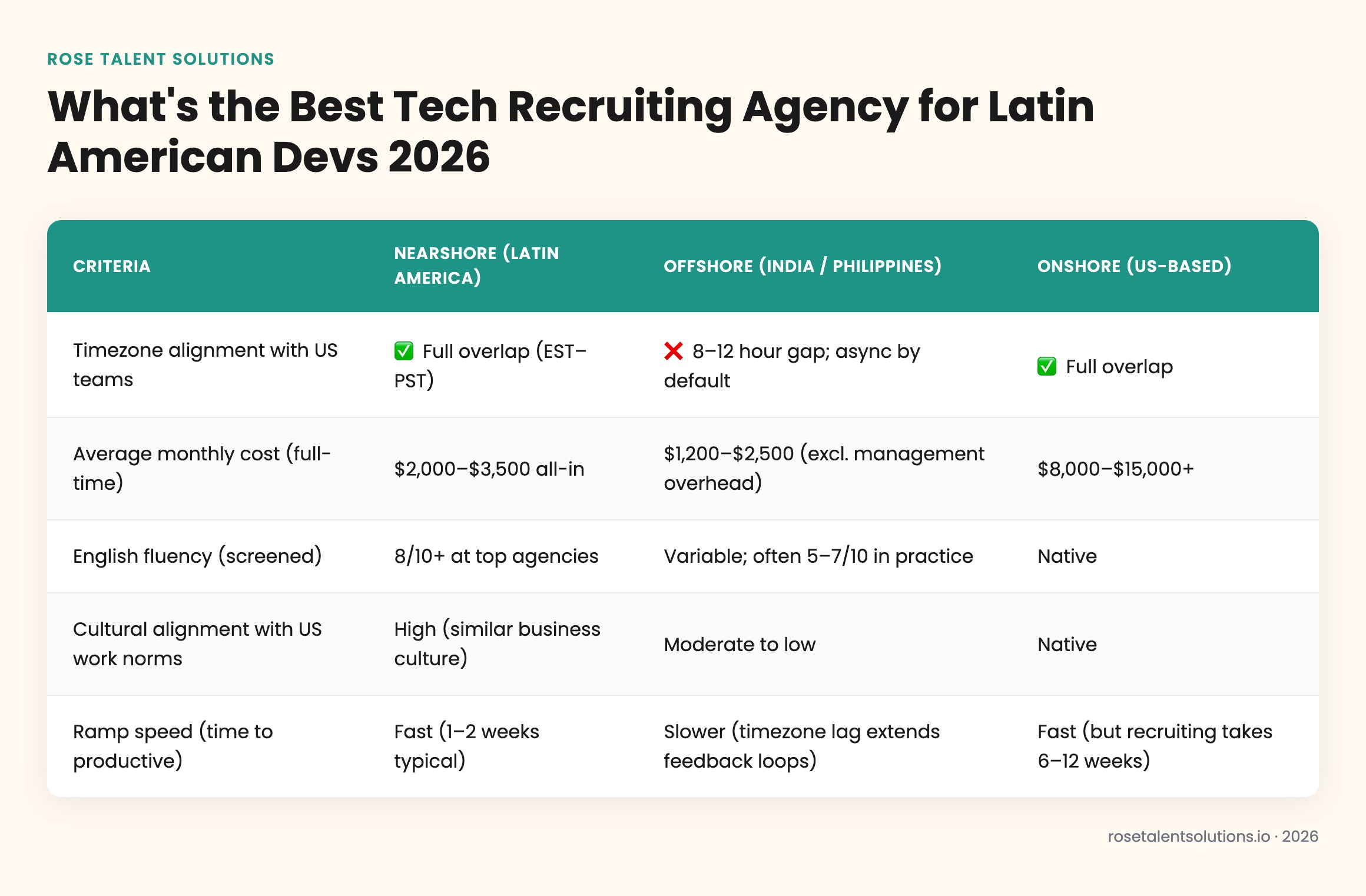
The honest answer depends on your team's specific needs — but the data points in a pretty clear direction for most US product and engineering teams. Here's a structured comparison across the five criteria that actually drive day-to-day productivity. This table is also the fastest way to illustrate why the answer to what's the best tech recruiting agency for Latin American devs almost always tilts toward a true nearshore model.
| Criteria | Nearshore (Latin America) | Offshore (India / Philippines) | Onshore (US-based) |
|---|---|---|---|
| Timezone alignment with US teams | ✅ Full overlap (EST–PST) | ❌ 8–12 hour gap; async by default | ✅ Full overlap |
| Average monthly cost (full-time) | $2,000–$3,500 all-in | $1,200–$2,500 (excl. management overhead) | $8,000–$15,000+ |
| English fluency (screened) | 8/10+ at top agencies | Variable; often 5–7/10 in practice | Native |
| Cultural alignment with US work norms | High (similar business culture) | Moderate to low | Native |
| Ramp speed (time to productive) | Fast (1–2 weeks typical) | Slower (timezone lag extends feedback loops) | Fast (but recruiting takes 6–12 weeks) |
According to SHRM's recruitment cost research (2022), the average cost to hire a single US-based employee ranges from $4,000 to $20,000 — before you factor in salary, benefits, and onboarding time. Nearshore recruiting at a flat monthly rate sidesteps most of that overhead entirely.
For a deeper look at salary benchmarks and what Latin American tech and VA talent actually earns — which directly affects what agencies charge — the breakdown of average Latin American virtual assistant salaries gives useful grounding in the real market rates behind agency pricing.

How Rose Talent Solutions Recruits and Places Latin American Tech Talent in 2026
Rose Talent Solutions is a nearshore staffing agency focused on placing full-time Latin American professionals with US, Canadian, and UK businesses. The model is straightforward: you pay $2,500/month flat, and Rose handles everything — recruiting, vetting, payroll, HR compliance, and ongoing performance management. No variable billing. No long-term contract. Cancel with 30 days written notice.
The hidden cost of offshore tech recruiting isn't the hourly rate — it's the compounded delay from async communication. Every code review, every spec clarification, every bug report that crosses a 10-hour timezone gap adds a full business day to your cycle time. Nearshore eliminates that drag entirely — and that's the core reason so many US teams asking what's the best tech recruiting agency for Latin American devs end up switching away from offshore vendors.
What separates Rose from a standard staffing marketplace is the AI copilot that ships with every placement. Each team member arrives trained on the specific tools your team uses — whether that's GitHub, Jira, Linear, Notion, or role-specific platforms. That's not a marketing bullet point; it's a measurable reduction in onboarding time. A developer who already knows your stack's tooling is productive in days, not weeks.
Rose also has strong coverage in adjacent hiring categories. If you're evaluating nearshore staffing more broadly — including bilingual customer support or operations roles alongside your dev hires — the comparison of top nearshore vendors for bilingual customer support is worth reading in parallel, since many growing companies hire across both functions at the same time.
According to Gallup's employee engagement research (2023), teams with clear communication structures and defined feedback loops are 21% more productive than those without. The nearshore model — same hours, same Slack, same standup — builds those structures naturally in a way that async offshore teams structurally cannot.
Role scoping call
Rose walks through your tech stack, team structure, and hiring timeline to define exactly the profile you need — not a generic job description.
Candidate vetting and screening
Rose screens for technical skills, English fluency (8/10+ floor), and cultural fit — presenting only candidates who clear every bar.
Interview and selection
You interview your shortlist — typically 2–3 candidates — and select the person you want to hire. No pressure, no upsell.
AI copilot onboarding
Your new team member is set up with a role-specific AI copilot trained on your tools, reducing ramp time significantly from day one.
Ongoing management and HR
Rose handles payroll, HR compliance, and performance support on an ongoing basis — you manage the work, Rose manages the employment relationship.
How Rose Compares to Other Answers to "What's the Best Tech Recruiting Agency for Latin American Devs" in 2026
The market for Latin American developer recruiting has grown crowded since 2022. Platforms like Toptal, Deel, and Lemon.io operate in adjacent spaces, and a number of newer boutique agencies have launched to meet rising demand. The core differentiators across the landscape come down to three things: pricing model, vetting depth, and what happens post-placement. Understanding these distinctions is the practical answer to what's the best tech recruiting agency for Latin American devs for your specific team structure.
Toptal and similar talent marketplaces typically charge a significant markup on contractor rates — often 30–40% above what the developer earns — and bill hourly or by project. That model works well for short-term engagements but gets expensive fast for full-time roles. Deel is fundamentally a payroll and compliance infrastructure layer, not a recruiting agency — you still have to find and vet the talent yourself. Boutique agencies often offer better vetting but vary widely in their post-placement support.
Rose sits in a distinct position: full-service recruiting plus ongoing management at a predictable flat rate. The $2,500/month all-in figure includes everything that other models charge separately. For the full breakdown of how the top agencies in this category stack up across vetting rigor, pricing, and placement speed, the detailed comparison of best tech recruiting agencies for Latin American developers goes deeper on each competitor.
According to McKinsey's research on employee turnover costs (2023), replacing a mid-level technical employee costs between 50% and 200% of annual salary when you factor in recruiting, onboarding, and lost productivity. A replacement guarantee — like Rose's — doesn't eliminate the cost of a mismatch, but it removes the most painful financial component: paying to recruit again from scratch.
Why Nearshore Latin American Recruiting Works
- Real-time timezone alignment with US teams (EST–PST)
- High English fluency when properly screened (8/10+)
- Significantly lower cost than onshore hiring
- Strong cultural fit and familiarity with US business norms
- Growing talent pool of credentialed technical professionals
Where to Watch Out
- Not all "nearshore" agencies are truly nearshore — verify timezone claims
- Vetting depth varies widely; ask for the actual screening process
- Marketplace models leave post-placement support gaps
- Some agencies charge upfront placement fees with no replacement guarantee
- Quality varies by country and seniority level — ask for placement track record
The bottom line: if you're hiring a Latin American developer for a full-time role on a US team, the agency you choose needs to be a true nearshore partner — not a talent marketplace that rebadges offshore supply. Verify the timezone claims. Verify the English screening. Understand the pricing model in full. And make sure there's a replacement guarantee before you commit. You can explore Rose's full placement process and see how nearshore staffing applies across different business functions, or go straight to the intake form at rosetalentsolutions.io/start to scope your first hire.
According to the U.S. Bureau of Labor Statistics (2021), the average time-to-hire for technical roles in the US is 42 days. A focused nearshore agency with an active Latin American candidate network can routinely cut that to under two weeks — a material advantage for teams trying to ship product on a schedule.