
Nearshore tech recruiting from Latin America has quietly become the most cost-effective growth lever for US, Canadian, and UK software teams in 2026. The region produces more than 500,000 engineering graduates per year, according to the Inter-American Development Bank (2023), and that pipeline is finally mature enough to support serious enterprise hiring — not just MVP contractors. If you are evaluating agencies right now, this guide cuts through the noise and tells you exactly what separates the best from the rest.
What Is a Nearshore Tech Recruiting Agency — and Why Does It Matter in 2026?
A nearshore tech recruiting agency sources, vets, and places developers from countries geographically and culturally close to your headquarters — primarily Latin America for North American businesses. Unlike offshore models that place talent in regions with large time zone gaps, nearshore talent works in overlapping US business hours: UTC-3 to UTC-6. That means a developer in Medellín or Mexico City is on Slack when your 9 a.m. standup starts, not logging in at midnight their time.
The distinction matters operationally. Timezone overlap is the single biggest predictor of remote developer productivity, according to research published by Harvard Business Review (2021) on distributed team collaboration. When your engineering lead needs to unblock a PR at 2 p.m. EST, a nearshore developer in Latin America is already at their desk — no overnight lag, no batch-and-wait async cycle.
If you are exploring the broader staffing landscape before narrowing to tech, the overview of top staffing agencies for Latin America developers covers the full spectrum from administrative to engineering roles in one place.

How the Best Agencies in 2026 Vet Latin American Developer Talent
Not all agencies that claim to recruit in Latin America actually vet for the same quality bar. The best firms run structured technical screens, English proficiency assessments, and culture-fit interviews before a candidate ever reaches your inbox. The weakest ones push warm bodies and let your onboarding process do the filtering — costing you weeks of lost engineering cycles.
Here is what a rigorous vetting process looks like at top-tier agencies in 2026:
Application & Resume Screen
Automated filters remove candidates below minimum experience thresholds. The agency checks for verifiable employment history and GitHub or portfolio evidence of shipped code.
English Proficiency Assessment
Candidates complete a live or recorded spoken English test. Rose's published floor is 8/10 or higher — roughly equivalent to B2-C1 on the CEFR scale — so your team is never translating Slack messages.
Technical Skills Interview
A senior engineer or technical recruiter at the agency conducts a live coding or systems design interview matched to the specific role you need filled.
Client-Side Final Interview
You meet two to three shortlisted candidates and choose. The agency handles offer logistics, onboarding paperwork, and payroll so you never touch compliance.
Ongoing HR & Management Support
The best agencies do not disappear after placement. They handle ongoing HR, performance check-ins, and — if needed — a no-additional-cost replacement if the team member is not a fit.
The importance of a strong vetting framework is backed by workforce data: employees who go through a structured hiring process are 70% more likely to perform well in the first year, according to SHRM (2022). For remote engineering roles where onboarding time is expensive, that number translates directly to your bottom line.
Nearshore vs. Offshore vs. Onshore: Which Model Wins for 2026 Tech Hiring?
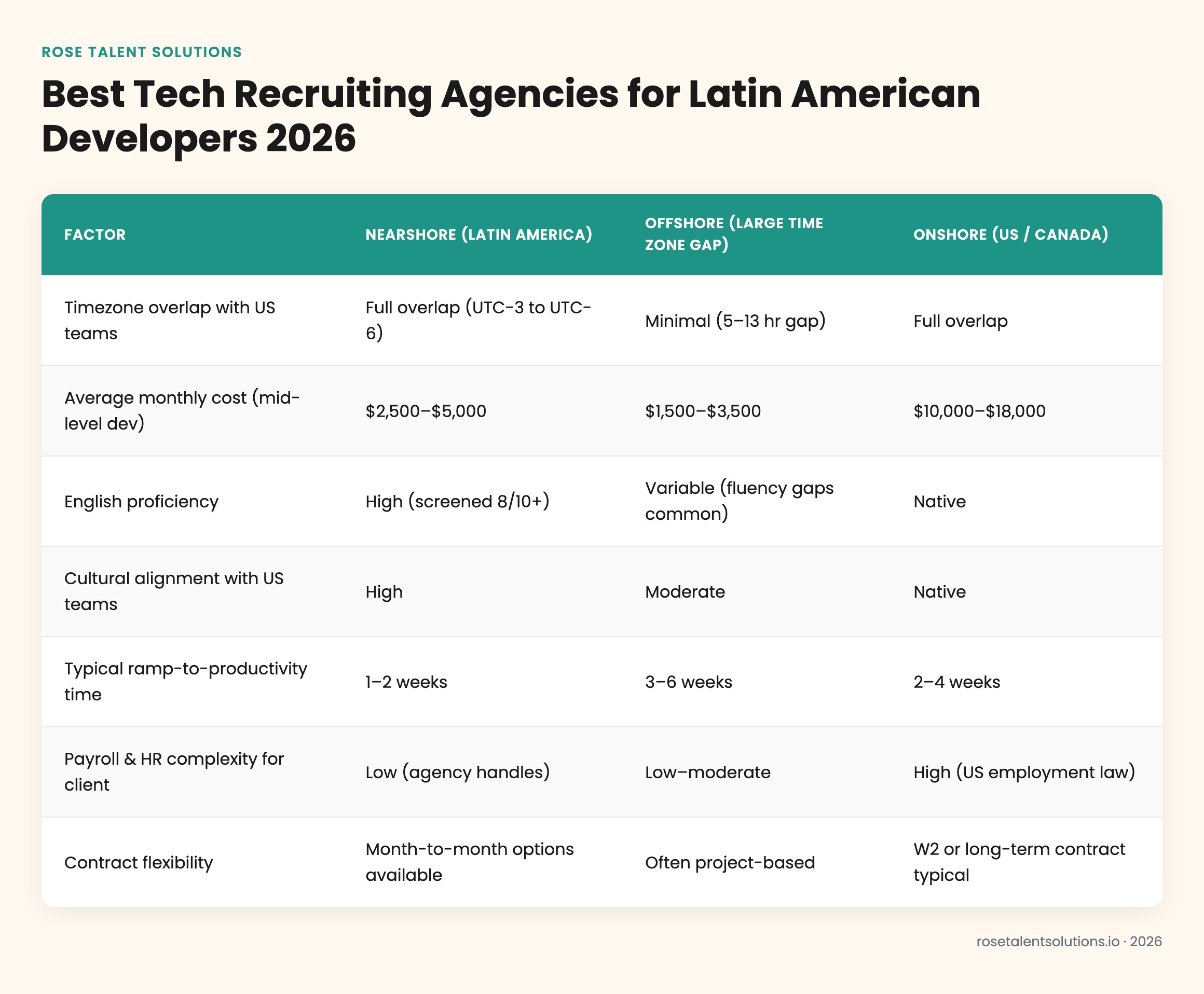
The choice between nearshore, offshore, and onshore recruiting is not just a cost decision — it is an operational one. The table below compares the three models across the dimensions that most affect engineering team performance.
| Factor | Nearshore (Latin America) | Offshore (large time zone gap) | Onshore (US / Canada) |
|---|---|---|---|
| Timezone overlap with US teams | Full overlap (UTC-3 to UTC-6) | Minimal (5–13 hr gap) | Full overlap |
| Average monthly cost (mid-level dev) | $2,500–$5,000 | $1,500–$3,500 | $10,000–$18,000 |
| English proficiency | High (screened 8/10+) | Variable (fluency gaps common) | Native |
| Cultural alignment with US teams | High | Moderate | Native |
| Typical ramp-to-productivity time | 1–2 weeks | 3–6 weeks | 2–4 weeks |
| Payroll & HR complexity for client | Low (agency handles) | Low–moderate | High (US employment law) |
| Contract flexibility | Month-to-month options available | Often project-based | W2 or long-term contract typical |
How Rose Talent Solutions Compares to Other Leading Agencies in 2026
When US businesses search for the best nearshore agencies for US businesses, a handful of names come up consistently: Toptal, DistantJob, Lemon.io, and Rose Talent Solutions. Each has a different model, and the right choice depends on whether you need a pure-play engineer or a fully-managed team member who also handles operational work.
Toptal is the premium option for elite freelance engineers — the top 3% claim is their brand. Rates reflect that: expect $80–$150/hour for senior developers. They are excellent for short, high-complexity projects. They are not designed for full-time, embedded team members at a predictable monthly cost.
DistantJob specializes in full-time remote tech hires sourced from Latin America and other regions. Their model is closer to a traditional headhunter — they charge a placement fee (typically 10–15% of annual salary) rather than a monthly management rate. That means upfront cost and a DIY ongoing management experience.
Lemon.io is a developer marketplace focused on vetted freelancers. Good for project-based needs. Less suited to businesses that want a dedicated full-timer who is culturally part of the team.
Rose Talent Solutions takes a managed staffing approach: $2,500/month flat, full-time 40-hour-per-week dedication, with recruiting, vetting, payroll, HR, and ongoing management all included. There is no long-term contract — month-to-month terms with 30 days written notice. If the team member is not the right fit, Rose replaces them at no additional cost. For companies that want predictable spend and zero HR overhead, that all-in model is hard to beat.
Rose also ships every team member with a role-specific AI copilot trained on the software stack relevant to the position — whether that is a developer familiar with your project management tools or a support specialist pre-loaded with your ticketing system. You can read more about how that works on the Rose AI Advantage page.
The hidden cost of sourcing developers from regions with large time zone gaps is not the hourly rate — it is the 6–13 hour lag that turns a 10-minute code review into a 24-hour cycle. Nearshore agencies in Latin America eliminate that drag entirely, and the productivity recovery typically offsets any price premium within the first 60 days.
What Should You Look for When Choosing a Tech Recruiting Agency for LATAM Talent in 2026?
Not every agency that markets "Latin American developers" actually has deep regional infrastructure. Here are the five non-negotiable criteria to evaluate before you sign anything.
- Owned talent pipeline vs. job board aggregator: Agencies with their own sourcing networks — referrals, university partnerships, internal databases — consistently outperform those that simply repost on LinkedIn or Computrabajo. Ask directly: "Where do your candidates come from?"
- Technical vetting rigor: Can they show you the actual assessment they use? Generic personality tests do not predict engineering output. Live coding screens and architecture discussions do.
- English proficiency floor: Get the specific score or benchmark, not vague assurances. "Professional working proficiency" means nothing without a number attached.
- Post-placement support: Who handles HR issues, time-off, performance problems? If the answer is "you do," budget for a part-time HR coordinator.
- Replacement policy: Bad hires happen even with good vetting. The best agencies stand behind placements with a free replacement guarantee rather than leaving you to restart the search at full cost.
For businesses looking specifically at senior-level placements, the breakdown of the top recruiting companies for senior Latin American developers goes deeper on how to evaluate agency pedigree for principal and staff engineer searches.

It is also worth understanding total cost of ownership. The Gallup State of the American Workforce report (2023) estimates that replacing an employee costs 50–200% of their annual salary. For a mid-level US developer earning $130,000/year, a bad hire and restart costs $65,000–$260,000. A replacement guarantee from your recruiting agency is not a marketing gimmick — it is quantifiable risk protection.
Why Nearshore LATAM Works
- Full US business hours overlap — no async lag
- Significantly lower cost than US equivalents without the distant-offshore quality tradeoff
- Strong English proficiency driven by regional education investment
- Cultural alignment reduces onboarding friction
- Growing talent pool: 500K+ engineering graduates per year
Limitations to Plan Around
- Premium over the cheapest far-offshore rates — but timezone savings usually offset this
- Top agencies have placement lead times of 7–14 days — not instant
- Not every LATAM country has equal depth in specialized stacks (e.g., embedded systems, niche ML frameworks)
- Time zone still varies ±3 hours depending on country — confirm overlap for your standup time
How to Get Started with a Nearshore Tech Recruiting Agency in 2026
Once you have shortlisted agencies based on the criteria above, the actual engagement process should be straightforward. With Rose Talent Solutions, the path from first contact to placed developer looks like this: you describe the role and stack on the Rose intake form, the team builds a shortlist from their vetted Latin American talent network, you interview finalists, and your team member starts — typically within seven days. Payroll, compliance, and HR are handled on Rose's end for the flat $2,500/month rate.
If you also need operational or administrative tech support — think a developer-adjacent project coordinator who lives in your Jira and Notion all day — the Rose property management staffing page shows how the same model applies to operational roles, and the same hiring flow applies across functions.
"Remote work has permanently shifted the talent market. Companies that limit their engineering hiring to a 50-mile radius are competing for the same expensive pool. Latin America gives you a 10x larger talent market at 30–60% lower cost — and the quality bar has never been higher." — Matt Drozdz, Head of Engineering at Deel, as quoted in Forbes (2023)
The agencies that consistently earn the highest marks in 2026 — across employer review platforms, developer community forums like Hacker News, and analyst coverage — share a common profile: they own their talent pipeline, they enforce a real English floor, they handle post-placement HR, and they stand behind their placements with a replacement guarantee rather than leaving you holding the bag. For a deeper side-by-side of agency models specifically focused on the recruiting mechanics, the guide to the best recruiting firms for hiring Latin American developers breaks down the fee structures and vetting approaches of the most active players in the market.
Latin America is not an emerging market for tech talent anymore — it is an established one. The agencies that understood that early built the infrastructure to match. Now it is your turn to use it.