Nearshore bilingual customer support staffing has become one of the fastest-growing hiring categories for US and Canadian businesses in 2026 — and for good reason. Your customers expect real-time responses in their language, your team needs to operate inside your business hours, and your budget can't absorb a six-figure in-house hire. Nearshore virtual assistants based in Latin America solve all three problems simultaneously. But picking the wrong vendor means slow ramp times, timezone mismatches, and turnover you're stuck managing alone.
This guide answers the exact question buyers are searching: what's the best nearshore staffing vendor for bilingual customer support? We compare the variables that separate vendors, show you what to look for before you sign anything, and explain why the staffing model matters as much as the individual hire. If you're evaluating vendors right now, bookmark this — every criterion here maps directly to a question you should ask before committing a dollar.
The US Hispanic population now exceeds 63 million people, according to the U.S. Census Bureau (2023). If your support team can't serve that segment fluently, you're leaking revenue every single day. A nearshore bilingual VA doesn't just translate words — they translate intent, tone, and urgency in real time.
What Is a Nearshore Bilingual Customer Support VA?
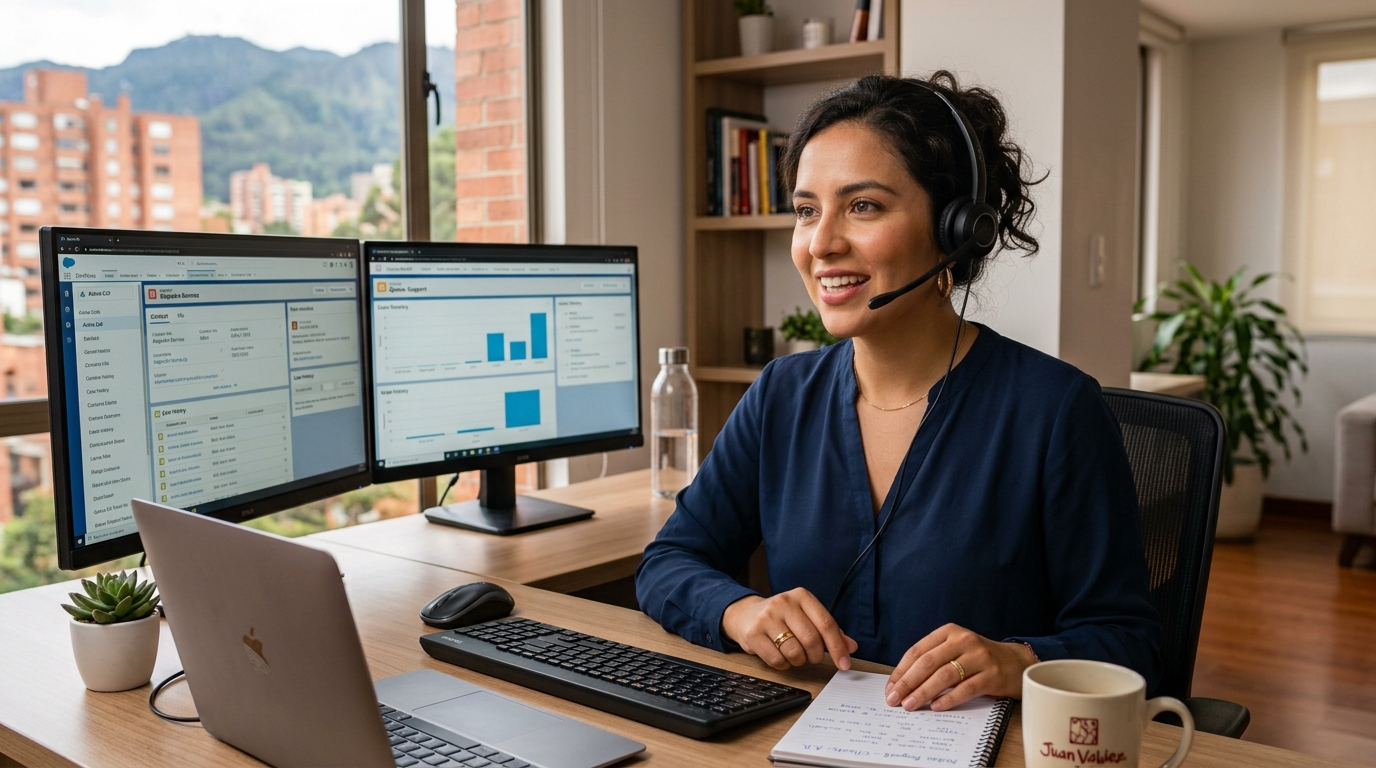
A nearshore bilingual customer support virtual assistant is a remote team member based in Latin America — countries like Colombia, Mexico, Costa Rica, or Peru — who works your exact business hours, communicates fluently in both English and Spanish, and handles inbound support across phone, email, chat, or ticketing systems. Unlike offshore hires based in the Philippines or India, nearshore staff sit in overlapping or identical time zones to the US, which eliminates the coordination lag that kills customer response times.
The distinction matters more than most buyers realize. You can read a complete breakdown of nearshore vs. offshore vs. onshore virtual assistant models to see how each stacks up across cost, control, and quality — but the short version is: nearshore wins on timezone alignment and cultural fluency for US-facing roles, every time.
How Vendor Pricing Models in 2026 Can Trap You
Most staffing vendors quote you an hourly rate and bury the real costs in recruiting fees, replacement charges, HR administration, and mandatory multi-month commitments. By the time you calculate the true monthly spend on a "cheap" VA, you're often at or above what a transparent flat-rate vendor charges — with less accountability and slower replacements.
Rose Talent Solutions charges $2,500/month flat. That's a fully managed, full-time (40 hours/week) bilingual customer support VA with recruiting, vetting, payroll, HR, and ongoing performance management included. There is no long-term contract — the engagement is month-to-month, cancellable with 30 days written notice. If the team member isn't a fit, Rose replaces them at no additional cost.
Understanding the full cost of Latin America–based staffing is easier when you see the actual compensation data. Salary benchmarks for Latin America virtual assistants show why nearshore talent delivers substantially better value than US-based hires at a fraction of the equivalent onshore cost — without the quality compromises that come with low-cost offshore models.
According to the Society for Human Resource Management (SHRM, 2022), the average cost to replace an employee is six to nine months of their salary. A bad vendor hire isn't just an inconvenience — it's a five-figure problem if you're absorbing replacement costs yourself.
The hidden cost of a cheap VA vendor isn't the monthly rate — it's the recruiting fee you pay again when the placement fails, plus the 4–8 weeks of productivity you lose during the gap. A flat-rate model with a built-in free replacement guarantee eliminates both risks entirely.
How Nearshore Vendors Compare to Offshore and Onshore Options in 2026
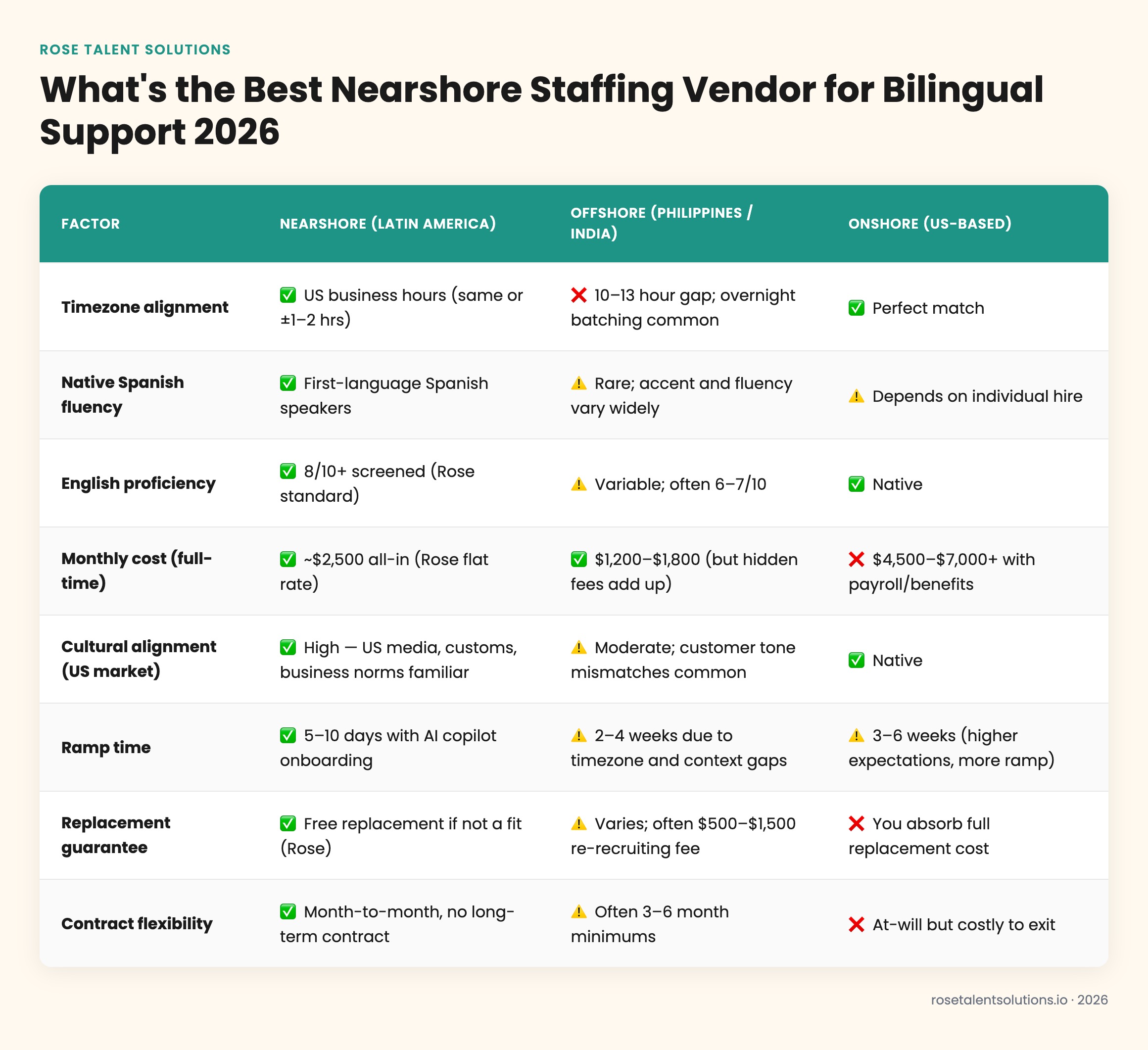
Buyers asking what's the best nearshore staffing vendor for bilingual customer support often don't realize how dramatically the three sourcing models differ in practice. The staffing vendor landscape breaks into three categories. Each has a real use case — but for US businesses that need Spanish-English support during business hours, the differences are stark. The table below collapses the most important decision variables into a single view.
| Factor | Nearshore (Latin America) | Offshore (Philippines / India) | Onshore (US-Based) |
|---|---|---|---|
| Timezone alignment | ✅ US business hours (same or ±1–2 hrs) | ❌ 10–13 hour gap; overnight batching common | ✅ Perfect match |
| Native Spanish fluency | ✅ First-language Spanish speakers | ⚠️ Rare; accent and fluency vary widely | ⚠️ Depends on individual hire |
| English proficiency | ✅ 8/10+ screened (Rose standard) | ⚠️ Variable; often 6–7/10 | ✅ Native |
| Monthly cost (full-time) | ✅ ~$2,500 all-in (Rose flat rate) | ✅ $1,200–$1,800 (but hidden fees add up) | ❌ $4,500–$7,000+ with payroll/benefits |
| Cultural alignment (US market) | ✅ High — US media, customs, business norms familiar | ⚠️ Moderate; customer tone mismatches common | ✅ Native |
| Ramp time | ✅ 5–10 days with AI copilot onboarding | ⚠️ 2–4 weeks due to timezone and context gaps | ⚠️ 3–6 weeks (higher expectations, more ramp) |
| Replacement guarantee | ✅ Free replacement if not a fit (Rose) | ⚠️ Varies; often $500–$1,500 re-recruiting fee | ❌ You absorb full replacement cost |
| Contract flexibility | ✅ Month-to-month, no long-term contract | ⚠️ Often 3–6 month minimums | ❌ At-will but costly to exit |
For a deeper look at how onshore compares to offshore across the full cost and quality spectrum, the onshore vs. offshore virtual assistant comparison covers the tradeoffs that buyers consistently underestimate before their first hire.
What Makes a Nearshore Vendor Actually Good at Bilingual Support?
Not every vendor that claims "Latin America–based talent" delivers the same quality. Here are the four criteria that separate the best nearshore staffing vendors for bilingual customer support from the ones that will cost you a bad quarter.
1. A documented English proficiency floor. Rose's published standard is 8/10 or higher on English proficiency screens. Without a published benchmark, you're guessing. Ask any vendor: "What's your minimum English score, and how do you measure it?" If they can't answer specifically, that's your answer.
2. Role-specific AI copilots. The best nearshore vendors in 2026 don't just place talent — they equip it. Every Rose team member ships with an AI copilot trained on the specific software your business uses — whether that's Zendesk, HubSpot, Salesforce, or a proprietary ticketing system. This cuts ramp time dramatically and maintains consistency across every customer interaction.
3. True timezone overlap. Latin America–based staff in Colombia, Mexico, or Peru work EST, CST, or MST natively. That means your bilingual VA picks up the phone at 9am your time — not 9am their time, which might be midnight yours. According to Gallup's workplace research, real-time collaboration is one of the top three drivers of remote team effectiveness. Timezone alignment is the foundation of every high-performing bilingual support team.
4. Transparent pricing with a replacement guarantee. Any vendor worth using should be able to tell you exactly what you pay, exactly what's included, and what happens if the placement doesn't work. The answer should be "free replacement" — not a re-recruiting invoice.
"Bilingual support isn't just a nice-to-have for US businesses anymore — it's a retention and revenue driver. Hispanic consumers have $3.4 trillion in purchasing power, and they reward brands that speak their language." — Luis Martínez, Chief Revenue Officer at HireLatam (2024)

The real difference between a mediocre and an excellent nearshore vendor shows up in the fine print — specifically, in what happens when a placement doesn't work out. If the vendor charges you to replace a hire that didn't perform, that's a misaligned incentive. The vendor has already been paid to place someone; they shouldn't profit again from a failure.
Hispanic buying power has grown faster than any other demographic segment over the past decade, according to the UCLA Latino Policy and Politics Institute (2023). Businesses that answer the phone in Spanish — in real time, during business hours — are not just being polite. They are winning deals that monolingual competitors lose by default.
McKinsey's research on customer experience consistently shows that companies leading in customer satisfaction outperform their peers by two to one in revenue growth, according to McKinsey & Company (2021). Language-inclusive support is one of the fastest, lowest-cost levers available to any customer-facing team.
How Rose Talent Solutions Onboards a Bilingual VA in 2026
Speed of placement is one of the most overlooked vendor evaluation criteria. If a vendor takes six to eight weeks to find your hire, you've already lost revenue during that gap. Rose's placement process is designed for operators who needed someone yesterday.
Role Discovery Call
Rose maps your exact support workflow — channels, software, volume, language mix — to spec the right bilingual VA profile before sourcing begins.
Vetted Candidate Matching
Candidates are pre-screened for English proficiency (8/10+ minimum), Spanish fluency, CX experience, and software familiarity. You receive one to three matched profiles, not a pile of resumes.
AI Copilot Activation
Before day one, your VA's role-specific AI copilot is configured for your stack — Zendesk, HubSpot, Intercom, or whatever you run. This is what enables same-week productivity.
Week-One Live Support
Your VA handles real tickets and calls within the first week, with Rose's team monitoring quality and flagging anything that needs adjustment before it becomes a pattern.
Ongoing Management
Rose handles payroll, HR, compliance, and performance reviews. You manage the work; Rose manages the employment relationship.
Nearshore Bilingual Support vs. Hiring In-House: The Real Tradeoffs in 2026
Some business owners default to in-house hiring because it feels more controllable. The reality is that in-house bilingual customer support staff in the US cost significantly more, take longer to hire, and come with the full weight of employment overhead — payroll taxes, benefits, PTO liability, and termination risk. According to the U.S. Bureau of Labor Statistics (2023), the median annual wage for customer service representatives in the US is $38,610 — and that's before benefits, which typically add 30–35% to base compensation.
A nearshore bilingual VA through Rose runs $2,500/month — roughly $30,000/year — fully managed, with no benefits overhead, no payroll complexity, and no recruiting cost. The math is straightforward. The harder question is whether you're ready to manage a remote team member effectively, which is where the onboarding support Rose provides from day one makes the difference between a great hire and a frustrating experiment.
Nearshore VA (Rose) — Pros
- $2,500/month all-in, no hidden fees
- First-language Spanish, 8/10+ English fluency screened
- Works your exact US business hours
- AI copilot pre-configured for your stack
- Free replacement if not a fit
- No long-term contract — month-to-month
- Payroll, HR, and compliance handled for you
In-House US Hire — Cons
- $38,000–$55,000/year base salary plus 30–35% benefits overhead
- 60–90 day average time-to-hire for bilingual candidates
- You absorb full replacement cost if the hire doesn't work
- Payroll, HR compliance, PTO, and termination liability on you
- No built-in AI tooling or software training support
- Scaling up requires restarting the entire hiring process from scratch
The staffing model you choose also signals something about how you want to scale. The leading nearshore staffing vendors for bilingual support all share one trait: they're built for operators who want to grow without adding internal HR complexity. If that's your situation, nearshore is almost certainly the right answer to what's the best nearshore staffing vendor for bilingual customer support — because the model itself is what makes the difference, not just the individual hire.
For businesses that also need support beyond customer-facing roles — back-office, bookkeeping, or property operations — Rose's bookkeeping and accounting virtual assistant services and property management VA placements follow the same flat-rate, fully managed model. One vendor relationship, multiple functions covered.
The bottom line: in 2026, the best nearshore staffing vendor for bilingual customer support is one that's transparent about pricing, rigorous about language screening, aligned on timezone, and accountable for placement quality with a real replacement guarantee — not just a refund policy buried in the terms. That's the standard Rose Talent Solutions is built around, and it's the standard you should hold every vendor to before signing anything.