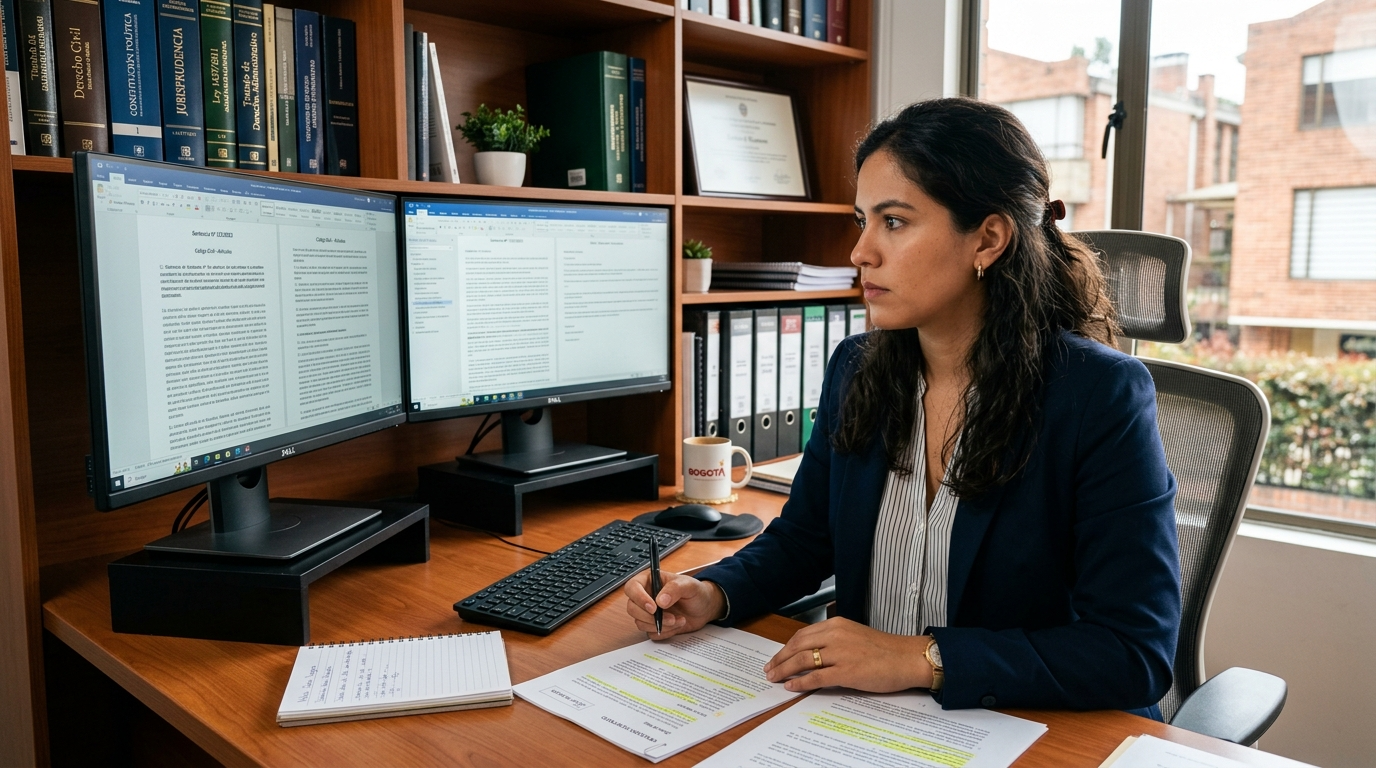
Nearshore virtual paralegals are quietly reshaping how lean law firms and solo practitioners handle the relentless volume of legal work that never stops piling up. If you're a US-based attorney drowning in case prep, client intake, and deadline tracking, you've probably asked whether a remote paralegal could actually hold the load — or whether the quality trade-off is too steep. This guide answers both questions with specifics, not sales fluff.
What Is a Virtual Paralegal? A Plain-English 2026 Definition
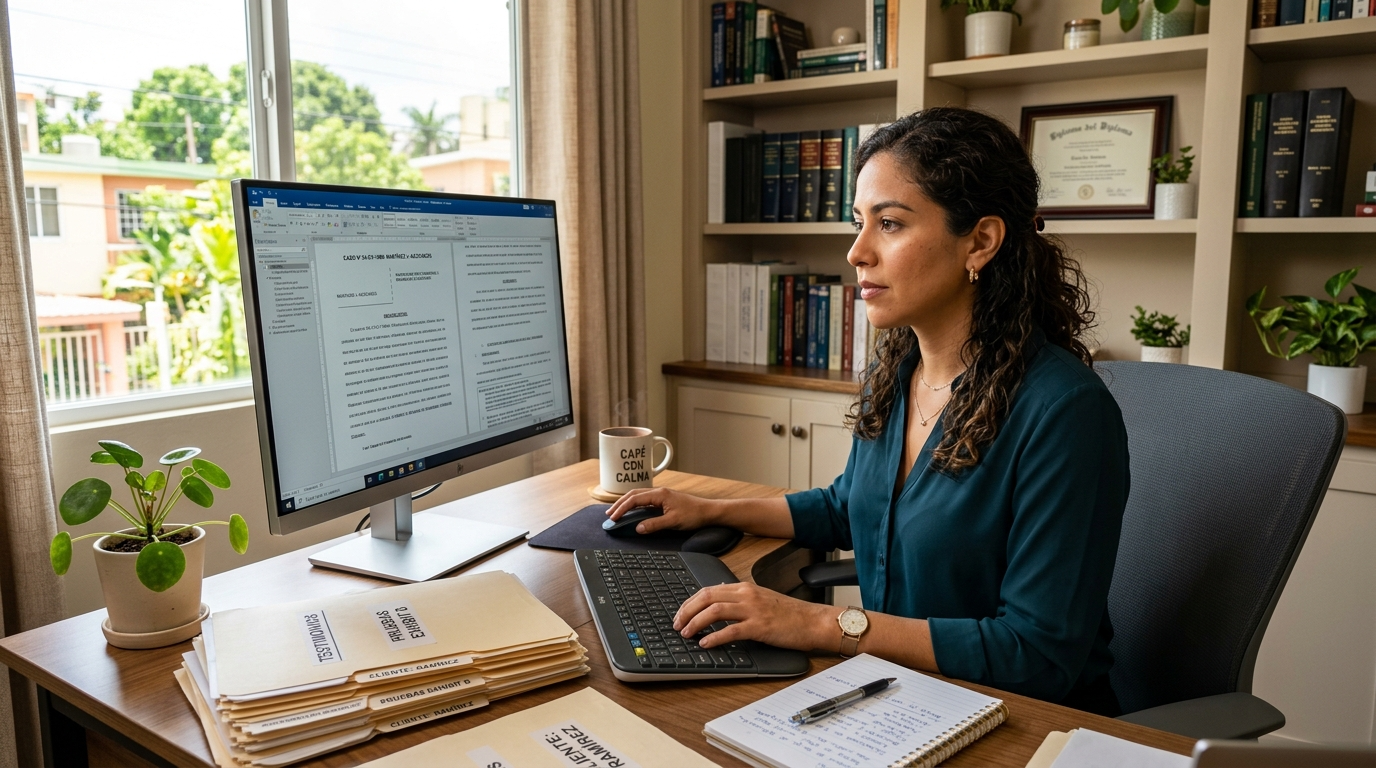
A virtual paralegal is a trained legal professional who performs substantive paralegal tasks entirely remotely, using secure digital tools to collaborate with attorneys and legal teams in real time. The role is not administrative in the clerical sense — virtual paralegals draft pleadings, summarize depositions, conduct Westlaw or Casetext research, manage discovery timelines, and coordinate with courts and opposing counsel on your behalf.
The distinction from a virtual legal assistant matters. A virtual legal secretary vs paralegal comparison shows that secretaries handle scheduling, correspondence, and file organization, while paralegals handle substantive legal work that directly supports case strategy. You need to know which role you're hiring before you post a job description — conflating them is the most expensive mistake small firms make.
According to the U.S. Bureau of Labor Statistics (2024), paralegal and legal assistant employment is projected to grow 12% through 2032 — faster than the average for all occupations — driven largely by law firms seeking cost-effective alternatives to full attorney billing hours. Virtual delivery is the primary channel absorbing that growth.
What Does a Virtual Paralegal Actually Do in 2026?
The task list has expanded significantly as legal tech matured. Today's virtual paralegal isn't just typing up forms — they're operating inside your practice management software, pulling court dockets, flagging deadline conflicts, and drafting first-pass motions that your supervising attorney reviews and signs. Here's what a typical full-time virtual paralegal handles across a week:
- Legal research: Case law lookups, statutory analysis, regulatory summaries using Westlaw, LexisNexis, or Casetext
- Document drafting: Complaints, answers, motions, demand letters, settlement agreements, and contract summaries
- Case file management: Organizing discovery documents, maintaining case timelines, and managing e-filing through PACER or state court portals
- Client intake coordination: Gathering client information, preparing engagement letters, and following up on missing documentation
- Deposition and transcript support: Summarizing depositions, flagging key testimony, and indexing exhibits — tasks that pair naturally with legal transcription virtual assistant workflows
- Deadline and docket management: Monitoring court calendars, setting internal reminders, and keeping attorneys from missing filing windows
The supervising attorney is still responsible for all legal advice and strategy — that doesn't change in a virtual model. What changes is who handles the 60-70% of legal work that doesn't require a law license. According to Thomson Reuters' State of the Legal Market report (2024), law firms that leverage paralegals for non-attorney-level work recover significantly more billable hours per lawyer — hours that had previously been written off or absorbed into overhead.
Nearshore vs. Offshore vs. Onshore: How Does the 2026 Model Stack Up?
Not all virtual paralegals are equal. Where your team member is located determines response time, communication fluency, and cultural fit with your clients — three things that matter enormously in legal work where a misunderstood instruction can mean a missed filing deadline.
| Factor | Onshore (US-Based) | Offshore (Philippines/India) | Nearshore (Latin America) |
|---|---|---|---|
| Monthly Cost (Full-Time) | $5,000–$8,000+ | $800–$1,500 | $2,500 flat (all-in) |
| Time Zone Overlap with US | Full | 12–13 hour gap (overnight batch) | Same or 1–2 hours off US Eastern |
| English Proficiency | Native | Variable (often accent-heavy) | 8/10+ screened (Rose standard) |
| Legal Software Familiarity | High | Low–moderate | High (AI copilot pre-trained) |
| Ramp Time | 2–4 weeks | 4–8 weeks | 1–2 weeks |
| Real-Time Collaboration | Yes | No (async only) | Yes |
| Turnover Risk | High (US market mobility) | High (global competition) | Low–moderate |
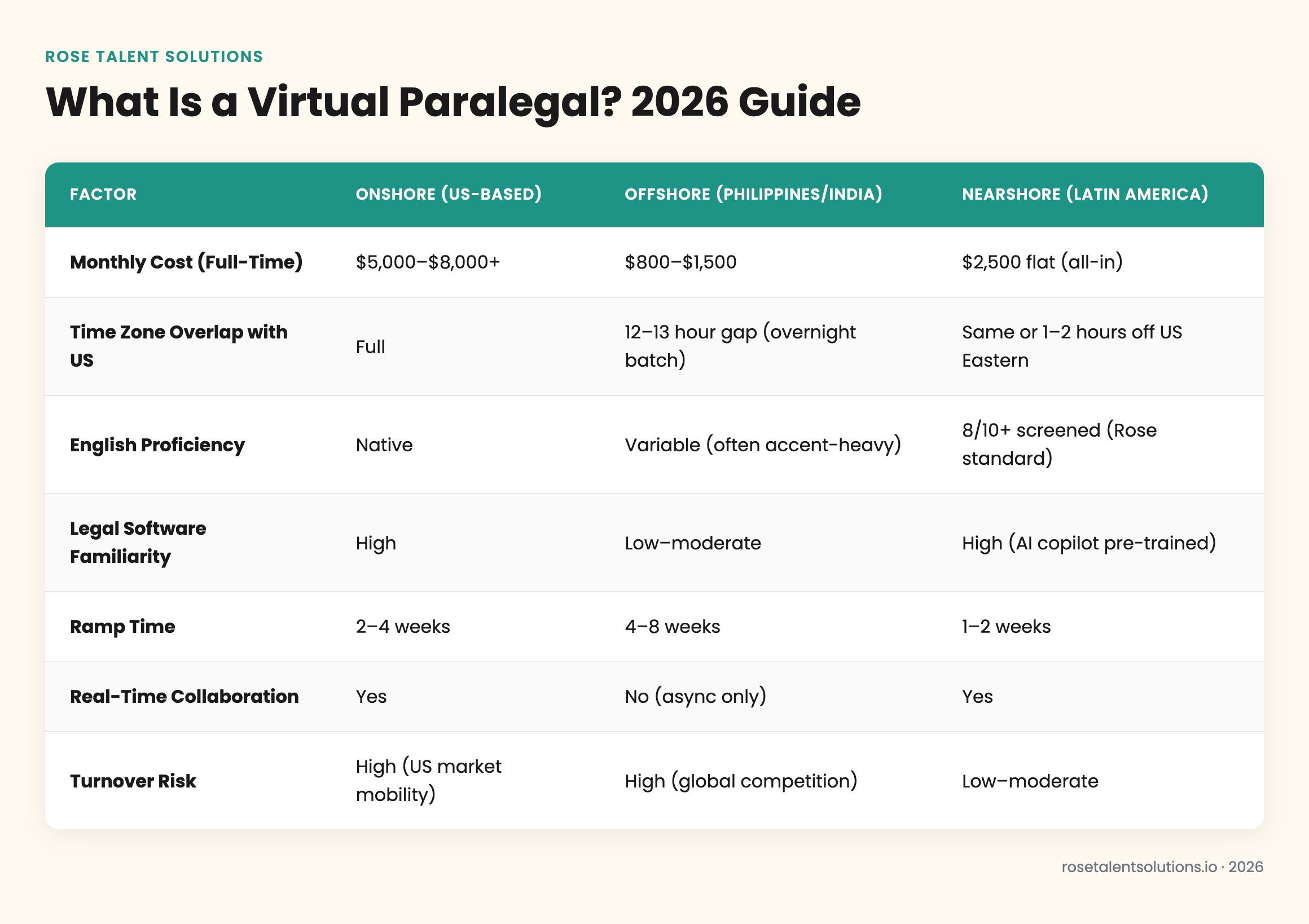
The offshore model looks cheap on paper until you calculate the communication drag. When your virtual paralegal is 12 time zones away, every back-and-forth question about a motion becomes a 48-hour delay. In litigation, that's unacceptable. Nearshore legal staff work your hours — 9 to 5 Eastern, Central, or Pacific — which means they can respond to a judge's order the same morning it lands, not the next day.
"Clients increasingly expect same-day responses, and that pressure flows directly to your support staff. A paralegal who isn't available during your court day isn't really a paralegal — they're a delayed email." — Ivy Grey, Legal Tech Advisor and Director of Strategy at Words & Modes (2024)
How AI Makes Nearshore Virtual Paralegals Faster in 2026
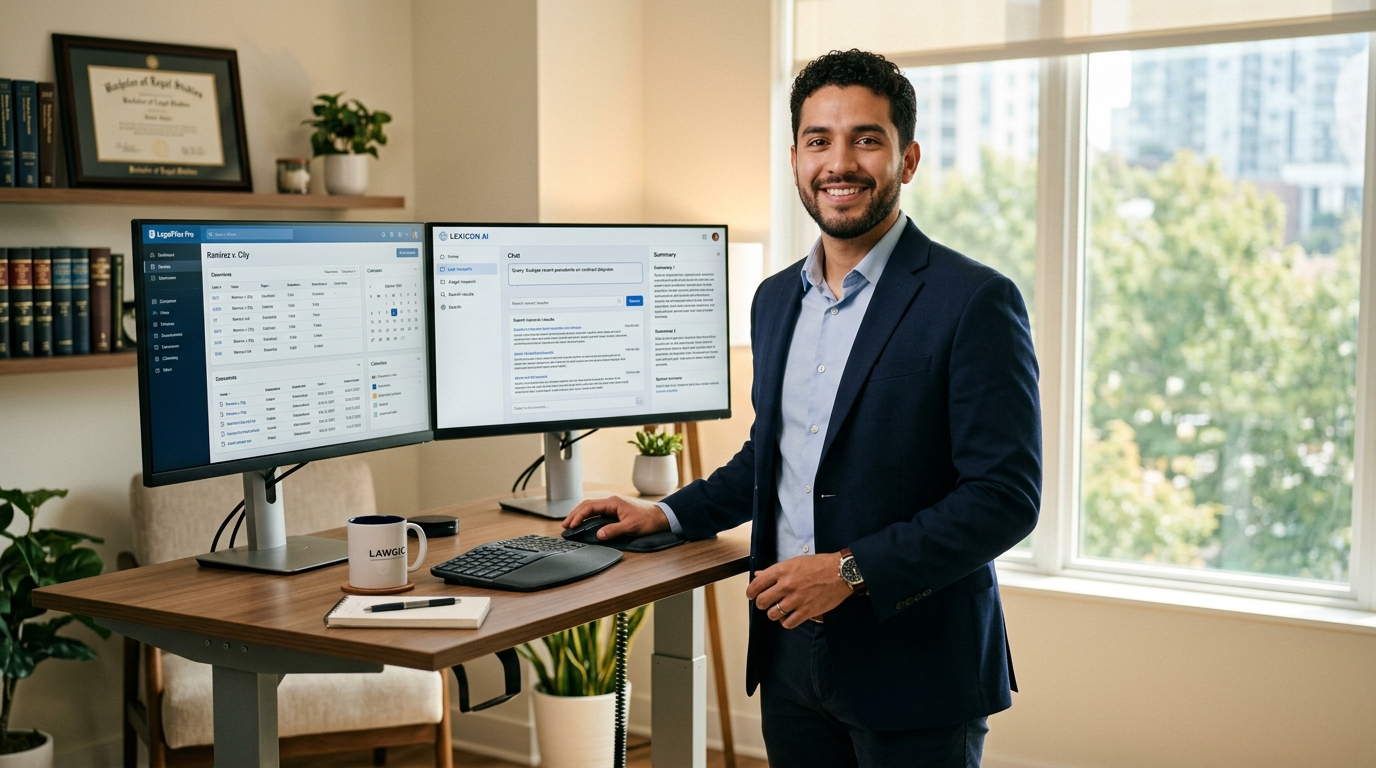
Every Rose virtual paralegal ships with a role-specific AI copilot pre-trained on the tools they'll actually use. For legal roles, that means familiarity with Clio, MyCase, PracticePanther, Westlaw workflows, and document automation tools like HotDocs or Lawyaw — before they touch your files on day one.
This is not the same as handing someone a ChatGPT subscription and hoping for the best. The AI copilot is trained on specific software interfaces, your firm's document templates, and common legal task sequences. The result is a paralegal who completes a standard demand letter draft in 40 minutes instead of two hours, and who surfaces the right case law citation without you spelling out the search string.
AI-assisted nearshore paralegals don't replace legal judgment — they eliminate the repetitive mechanical work (formatting, cite-checking, file organization) that shouldn't be consuming attorney time in the first place. The attorney still supervises every substantive output.
According to McKinsey's report on the economic potential of generative AI (2023), legal work ranks among the top professions where AI augmentation — not replacement — drives the largest productivity gains. Paralegals who use AI tools complete document drafting tasks up to 50% faster than those who don't, without sacrificing accuracy.
If your firm also handles high-volume client communication, you may want to look at how law firm virtual receptionist services can layer on top of your virtual paralegal setup — handling inbound calls and client intake while your paralegal focuses on substantive case work. The two roles are complementary, not redundant.
How Much Does a Virtual Paralegal Cost in 2026?
An in-house paralegal in a mid-sized US city costs $55,000–$75,000 annually in salary alone — before you add payroll taxes, benefits, malpractice insurance riders, office space, software licenses, and the 4–6 weeks of paid leave that comes with a full-time employee. The all-in cost of a US-based paralegal routinely lands between $80,000 and $100,000 per year when you count everything.
A Rose nearshore virtual paralegal runs $2,500 per month flat — $30,000 per year, all-in. That includes recruiting, vetting, payroll, HR, and ongoing management. No hidden fees for software, no recruiting surcharge when you need a replacement, no long-term contract locking you in. If the team member isn't the right fit for your firm's workflow, we replace them at no additional cost.
The math is straightforward: you get a full-time, 40-hour-per-week paralegal who works your business hours, communicates in fluent English, and arrives pre-trained on your legal tech stack — for roughly 30–35 cents on the dollar compared to a US-based hire. The savings fund a second case clerk, a marketing budget, or simply stay in the firm.
For law firms that also manage trust accounting or client billing, a nearshore bookkeeping and accounting virtual assistant can work alongside your paralegal — keeping IOLTA accounts reconciled and invoices current without adding a second full-time salary to your overhead.
How to Hire a Virtual Paralegal Through Rose in 2026
The process is designed to get you from "I need help" to "she's working on my files" in under two weeks. Here's how it flows:
Discovery Call
You spend 30 minutes with a Rose placement specialist mapping your practice area, case volume, software stack, and the specific tasks eating your week. This call shapes the candidate profile — not a generic paralegal search.
Candidate Matching
Rose pre-screens candidates against your criteria, running English proficiency screens (8/10+ minimum), legal knowledge assessments, and software-specific skill checks. You see only the top 1–3 matches.
Interview & Selection
You interview your shortlisted candidates directly. Most firms pick on the first or second interview. You're choosing the person, not approving a staffing agency's choice for you.
Onboarding & AI Copilot Setup
Your new paralegal gets access to your systems, and their role-specific AI copilot is configured for your document types and software. Expect meaningful output within the first week.
Ongoing Management
Rose handles HR, payroll, and performance oversight. If anything isn't working, you have a dedicated account manager — not a ticket queue — to resolve it fast.
If you want a broader picture of how virtual legal support staffing works before committing to a specific role, the Rose guide on how to hire a virtual legal assistant for your law firm walks through the full evaluation framework — role definition, vetting criteria, and first-week onboarding structure.
Is a Virtual Paralegal Right for Your Firm in 2026?
The model works best for specific firm profiles. It's an excellent fit if you're a solo practitioner or small firm (2–10 attorneys) with consistent case volume but no budget for a second in-house hire. It also works well for growing firms that need paralegal capacity in a specific practice area — family law, immigration, real estate, personal injury — without committing to a full-time domestic salary before revenue justifies it.
Strong Fit For
- Solo and small firm attorneys with 20+ active cases
- Firms expanding into a new practice area needing specialized support
- High-volume document-intensive practices (immigration, real estate, PI)
- Attorneys spending 3+ hours per day on non-billable prep work
- Firms that already use cloud-based practice management software
Poor Fit For
- Firms with no existing case management system or cloud infrastructure
- Practices requiring in-person court attendance or physical file handling daily
- Attorneys who prefer to do all legal research themselves as a matter of style
- Firms with strict on-premise IT security requirements that block remote access
According to the American Bar Association's Legal Technology Survey Report (2023), more than 58% of solo and small firm lawyers now use cloud-based practice management tools — meaning the infrastructure for remote paralegal collaboration already exists in the majority of your peer firms. The technical barrier to going virtual is lower in 2026 than it has ever been.
Ready to scope your first virtual paralegal placement? Visit the Rose get started page to book a discovery call and get a matched candidate profile within five business days.