
What Is a Virtual Bookkeeper — and Why Does "Nearshore" Matter in 2026?
Nearshore virtual bookkeepers are remote accounting professionals based in Latin America who manage your financial records, reconcile bank accounts, process invoices, and deliver monthly reports — all while working your US business hours. Unlike a freelancer you find on a job board, a fully managed nearshore bookkeeper comes vetted, software-trained, and supported by an HR layer that handles payroll, compliance, and replacements on your behalf.
The definition matters because "virtual bookkeeper" has become a catch-all term. It can mean a part-time freelancer in the Philippines reconciling transactions overnight, a US-based CPA firm's offshore data-entry clerk, or a dedicated full-time professional in Colombia who opens QuickBooks at 9 a.m. Eastern and closes tickets by 5 p.m. Those three are not the same product. This guide focuses on what the best version looks like — and how to know when you're buying it.
According to the U.S. Bureau of Labor Statistics (2024), the median annual wage for bookkeeping, accounting, and auditing clerks in the United States is $47,440 — roughly $3,953/month before benefits, payroll taxes, or office overhead. A nearshore virtual bookkeeper at a flat $2,500/month all-in is structurally less expensive, and that math doesn't include recruiting costs or turnover risk.
How a Virtual Bookkeeper's Day Actually Works in 2026
A common misconception is that "virtual" means asynchronous — that your bookkeeper is batching work at 2 a.m. your time and emailing you PDFs. A well-placed nearshore bookkeeper works nothing like that. They log on at your start time, attend your team's morning standup, respond to Slack messages in real time, and close out their shift when you do. The only difference from an in-office hire is the commute they're not taking.
On a typical day, a virtual bookkeeper handling small-business or property-management accounts will:
- Reconcile bank and credit card feeds in QuickBooks, Xero, or Wave
- Code and categorize transactions flagged by automated bank rules
- Process vendor invoices and queue payments for owner approval
- Follow up on outstanding receivables and update aging reports
- Prepare weekly or monthly P&L summaries for owner review
- Communicate directly with vendors, tenants, or contractors as needed
If your business runs on QuickBooks, the work looks remarkably similar whether your bookkeeper is in Austin or Bogotá — because the software is identical. If you want a deeper look at how dedicated QuickBooks support is structured at the VA level, the Rose guide on QuickBooks virtual bookkeeper services compared breaks down the key service models side by side.

Nearshore vs. Offshore vs. Onshore: How Do the Options Compare in 2026?
The virtual bookkeeper market splits into three geographies, and they deliver meaningfully different results. "Offshore" typically means the Philippines or India — 9-to-14-hour timezone gaps, communication delays, and cultural nuances that slow response loops. "Onshore" means a US-based contractor or employee — highest cost, most familiar, but often unaffordable at scale. "Nearshore" means Latin America — same or adjacent US time zones, strong English fluency, and a fraction of onshore cost.
"The timezone overlap issue is underrated. When your bookkeeper is 12 hours away, a single question-and-answer cycle about a miscoded transaction takes two business days. When they're in the same hours as you, it takes two minutes." — Matt Malouf, Business Coach and Author, The Stop Doing List (2023)
| Factor | Onshore (US) | Offshore (Philippines/India) | Nearshore (Latin America) |
|---|---|---|---|
| Monthly cost (full-time) | $4,000–$6,500+ | $800–$1,500 | $2,500 flat (all-in) |
| Time zone overlap with US | Full overlap | 2–4 hrs (night shift required) | Full overlap (same hours) |
| English fluency (avg. screen) | Native | 6–7/10 | 8/10+ (Rose's minimum bar) |
| QuickBooks / Xero readiness | Varies widely | Basic to intermediate | Role-specific AI copilot included |
| Recruiting + HR overhead on you | High | High (unless through agency) | None (fully managed) |
| Replacement if not a fit | Rehire from scratch | Rehire from scratch | Free replacement at no extra cost |
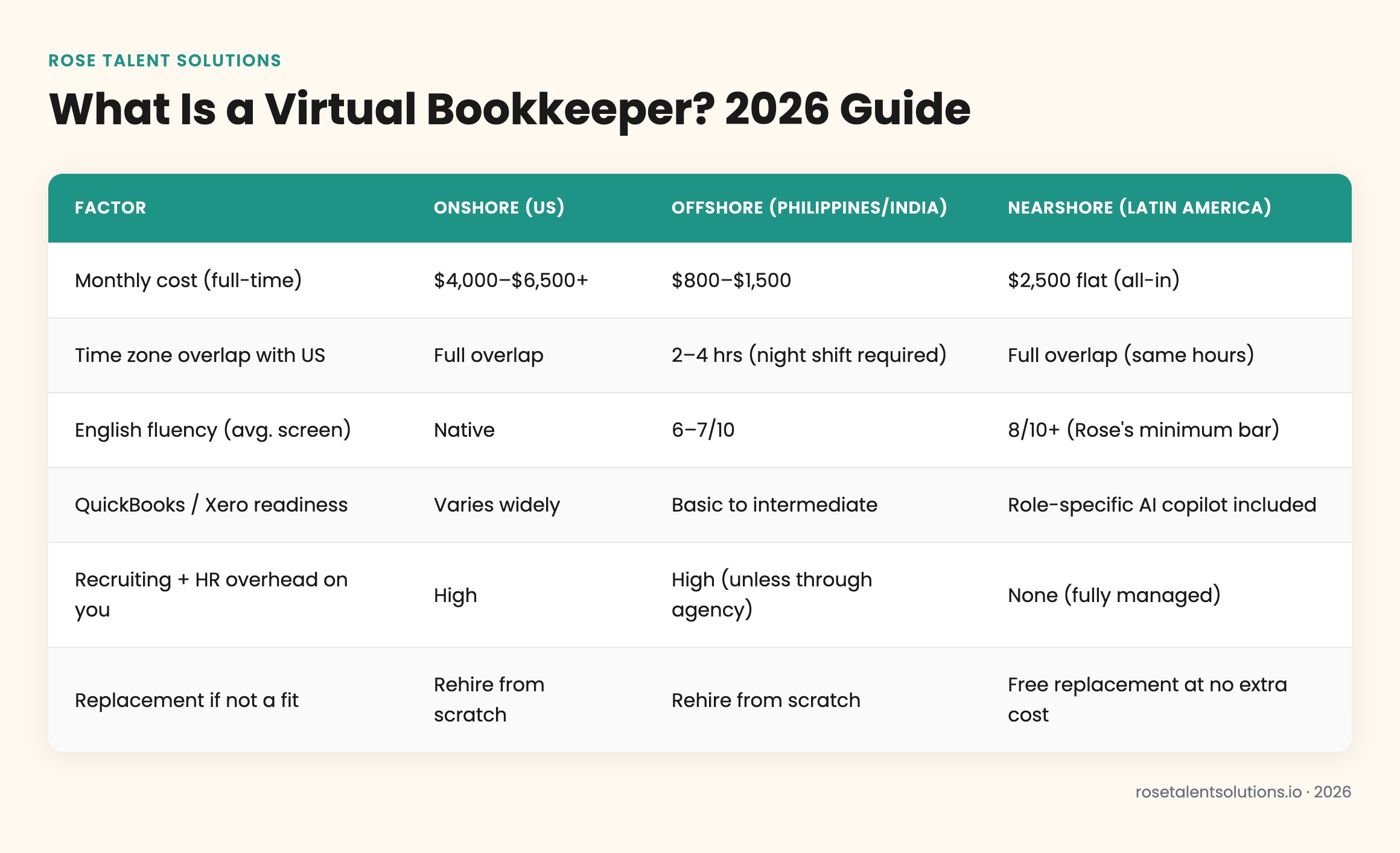
The comparison above makes the cost-vs-risk trade-off concrete. Offshore is cheapest on paper, but the hidden cost is time — every question batches overnight, every revision cycle takes 48 hours, and every miscommunication multiplies. Nearshore sits in the middle on price while matching onshore on availability and communication quality.
What Software Does a Virtual Bookkeeper Use — and Does Training Matter?
Software fluency separates a good virtual bookkeeper from an expensive data-entry clerk. In 2026, the core stack for small business and property management bookkeeping includes QuickBooks Online, Xero, Wave, FreshBooks, and — for property managers specifically — AppFolio and Buildium's built-in accounting modules. The bookkeeper who knows which report to pull before you ask for it is worth three times the bookkeeper who needs instructions every time.
According to Intuit (2024), QuickBooks Online has over 7 million subscribers globally — making it the dominant platform for small-business bookkeeping by a wide margin. Xero is the primary alternative in the UK, Australia, and among US firms with multi-entity structures. If you're running property management, the Rose guide on using Xero with a virtual bookkeeper walks through the exact setup that works best for rental portfolios.
Rose's AI advantage layer means every bookkeeper placed comes with a role-specific AI copilot trained on their software stack — whether that's QuickBooks, Xero, AppFolio, or Buildium. That's not a generic chatbot; it's a tool calibrated to the exact workflows, report structures, and reconciliation routines of their assigned role. You can learn more about how this works on the Rose AI advantage page.
According to SHRM (2022), the average cost-per-hire across all US industries is $4,683. For accounting roles with software-specific requirements, that number climbs considerably — which is one reason fully managed placement models have grown in adoption among small business owners who can't afford a mis-hire.
A virtual bookkeeper without hands-on software training will spend their first 30–60 days learning your stack at your expense. A nearshore bookkeeper placed through a managed agency arrives already fluent in your platform — and backed by an AI copilot that accelerates their first-week output significantly.

How Much Does a Virtual Bookkeeper Cost in 2026?
Pricing models for virtual bookkeeping fall into three buckets: hourly freelance, per-task subscription services, and fully managed full-time placement. Each has a different total cost of ownership when you account for management time, software access, HR overhead, and turnover risk.
Hourly freelancers on platforms like Upwork range from $15 to $55/hour depending on experience and location — but you own the recruiting, onboarding, quality control, and replacement process entirely. Per-task subscription services (like Bench or Pilot) charge $299–$999/month for catch-up bookkeeping but aren't a substitute for a full-time dedicated hire who knows your business intimately. Fully managed full-time placement through Rose is $2,500/month flat — and that price includes recruiting, vetting, payroll, HR, and ongoing management. There is no additional cost if we need to replace your team member.
According to the U.S. Census Bureau's Small Business Statistics (2023), there are approximately 33 million small businesses in the United States — the vast majority of which carry bookkeeping in-house or on a part-time basis until payroll, tax exposure, or investor requirements force a change. By the time most owners upgrade their bookkeeping function, they've already absorbed months of reconciliation backlog and the stress that comes with it.
For property managers specifically, the bookkeeping function extends into owner disbursements, trust accounting, late fee tracking, and CAM reconciliations — functions that require platform-specific knowledge. The Rose bookkeeping and accounting virtual assistant service is built specifically for that use case. And if accounts payable is a bottleneck in your operation, the Rose overview of the best accounts payable virtual assistant services is worth reading before you finalize your hiring decision.
Why Nearshore Virtual Bookkeeping Works
- Full US business-hours availability — no overnight batching
- Flat $2,500/month all-in — no surprise invoices
- Software-trained from day one (QuickBooks, Xero, AppFolio, Buildium)
- No long-term contract — month-to-month with 30 days written notice
- Free replacement if the team member isn't a fit
- 8/10+ English fluency — communicates clearly with your team and vendors
What to Watch Out For
- Not a licensed CPA — tax strategy and filings still need a US accountant
- Requires clear onboarding documentation for fastest ramp
- Not suitable for businesses that need physical presence at the office
How to Get Started With a Virtual Bookkeeper in 2026
The hiring process for a nearshore virtual bookkeeper through a managed agency is materially faster than a traditional hire. You're not posting a job, screening 40 applications, or negotiating salary. The agency has already done that. Your job is to describe the role, review a shortlist, and get to work.
Define the Role
Identify which platforms you use (QuickBooks, Xero, AppFolio), how many entities need bookkeeping, and whether you need AP/AR support in addition to reconciliation. The clearer your scope, the faster the match.
Receive a Vetted Shortlist
Rose screens candidates on accounting fundamentals, software fluency, and English proficiency (8/10+ minimum). You review profiles and select who you want to meet — typically within days, not weeks.
Onboard and Activate
Your bookkeeper joins your communication channels, gets access to your accounting software, and begins working your business hours from day one. Rose handles all HR, payroll, and compliance on the back end.
Scale or Adjust as Needed
Month-to-month terms mean you're never locked in. If your business grows and you need a second bookkeeper, or if your needs shift, you adjust without penalty — just 30 days written notice to change or cancel.
If you're ready to move, the fastest path is the Rose intake form — it takes about five minutes and gives the matching team what they need to send you a shortlist. For property managers evaluating the full scope of what a virtual team member can handle, the Rose property management virtual assistant page covers the broader role beyond bookkeeping.
One question that comes up frequently: can a virtual bookkeeper use QuickBooks Live in addition to your own books? It's a legitimate question for businesses that want redundant reconciliation. The Rose explainer on whether a virtual bookkeeper can use QuickBooks Live addresses that directly, including the workflow implications.
According to Gallup (2023), remote workers report higher engagement and productivity scores than their in-office counterparts when given clear goals and adequate communication tools — exactly the conditions a well-onboarded nearshore bookkeeper operates under. The data supports what operators are already experiencing: the location of the work matters far less than the quality of the person doing it.