
What Is a Virtual Paralegal — and Why 2026 Is the Year to Hire One?
Nearshore virtual paralegals are reshaping how solo attorneys and small law firms operate in 2026. A virtual paralegal is a trained legal professional who works remotely — handling everything from case research and document drafting to court filing coordination and client intake — without occupying a desk in your office or drawing a full-time US salary. When that professional is based in Latin America and works your exact business hours, you get real-time collaboration without the six-to-eight-hour lag that plagues offshore outsourcing models.
The demand is real. According to the U.S. Bureau of Labor Statistics (2024), the median annual salary for a paralegal in the United States is $60,370 — and that figure doesn't include benefits, payroll taxes, office space, or software licenses. For a firm billing 20 to 30 hours per week to clients, that fully-loaded cost can easily exceed $85,000 per year for a single in-house hire.
A virtual paralegal flips that equation. You get full-time, dedicated legal support at a predictable flat rate, and you only pay for productive output — not office politics, PTO accruals, or a spare monitor. For firms that are exploring whether to hire a virtual legal assistant for their law firm, a virtual paralegal is often the natural next step — someone who goes beyond administrative support into substantive legal work.
What Does a Virtual Paralegal Actually Do in 2026?
The scope of a virtual paralegal's role has expanded meaningfully in the last two years, largely because AI-powered legal tools have removed the bottleneck of repetitive drafting tasks. Today's virtual paralegal is less a document typist and more a case workflow manager. Here's what a strong nearshore virtual paralegal handles day-to-day:
- Legal research — Westlaw, LexisNexis, Casetext searches; case law summaries; statute interpretation memos
- Document drafting — motions, briefs, demand letters, pleadings, discovery requests, contract templates
- Client intake management — screening calls, conflict checks, intake forms, CRM updates in Clio or MyCase
- Docket and deadline management — court calendar tracking, filing deadline alerts, e-filing coordination
- Deposition and trial prep support — exhibit organization, binder preparation, witness summary sheets
- Billing and time entry support — logging billable hours, invoice preparation, collections follow-up
Each Rose virtual paralegal ships with a role-specific AI copilot trained on the legal software your firm already uses — whether that's Clio, MyCase, PracticePanther, or Smokeball. That means your new team member isn't learning your tools from scratch on your dime. Visit our AI advantage page to see exactly which tools are pre-trained for legal roles.

How Nearshore Virtual Paralegals Compare to Offshore and In-House in 2026
Not all remote paralegals are equal. The staffing market in 2026 offers three broad categories: in-house US-based paralegals, offshore virtual paralegals (Philippines, India), and nearshore virtual paralegals (Latin America). Each has a different cost profile, timezone alignment, and practical fit for a US or Canadian law firm.
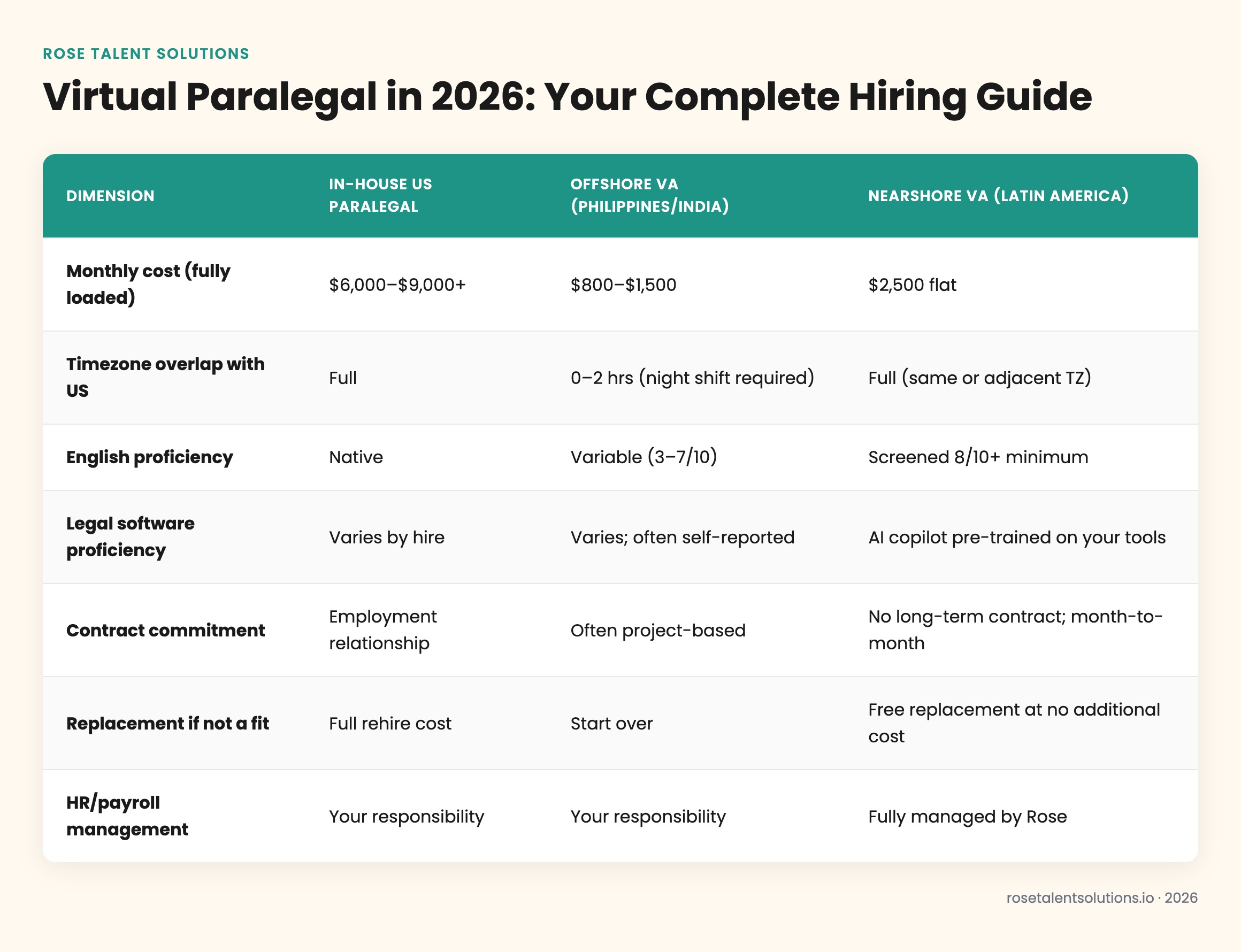
The table below breaks down the real differences across the dimensions that matter most to attorneys making a hiring decision today. If you've ever wrestled with the question of whether you need a virtual legal secretary vs. a paralegal, this comparison should also help clarify the scope of investment at each level.
| Dimension | In-House US Paralegal | Offshore VA (Philippines/India) | Nearshore VA (Latin America) |
|---|---|---|---|
| Monthly cost (fully loaded) | $6,000–$9,000+ | $800–$1,500 | $2,500 flat |
| Timezone overlap with US | Full | 0–2 hrs (night shift required) | Full (same or adjacent TZ) |
| English proficiency | Native | Variable (3–7/10) | Screened 8/10+ minimum |
| Legal software proficiency | Varies by hire | Varies; often self-reported | AI copilot pre-trained on your tools |
| Contract commitment | Employment relationship | Often project-based | No long-term contract; month-to-month |
| Replacement if not a fit | Full rehire cost | Start over | Free replacement at no additional cost |
| HR/payroll management | Your responsibility | Your responsibility | Fully managed by Rose |
How Does Timezone Alignment Change Real Law Firm Productivity in 2026?
Ask any attorney who has tried offshore paralegal support from a Philippines-based VA: the timezone gap is the silent productivity killer. When your VA is 12 hours ahead, every question you send at 3pm doesn't get answered until 3am — which means the answer lands in your inbox at 7am the next morning. For a court filing with a 5pm deadline, that loop is catastrophic.
Nearshore legal professionals in Latin America — Colombia, Mexico, Brazil, Argentina — operate in time zones ranging from EST to CST. Real-time collaboration means your virtual paralegal can jump on a Zoom call to discuss a motion at 10am your time, flag a missed deadline before lunch, and complete a last-minute deposition exhibit before close of business. That's not a minor operational detail. It's the difference between a VA who functions like a team member and one who functions like a slow-moving email inbox.
"Timezone alignment is the single most underrated factor in remote legal staffing. A paralegal who works your hours can prevent a missed deadline — one working overnight cannot." — Lori Gonzalez, Legal Operations Director at Consero Global (2023)
According to SHRM (2024), replacing a mid-level employee costs an average of 50–60% of their annual salary. For a paralegal earning $60,000, that's $30,000–$36,000 in replacement costs alone — not counting the productivity gap while the role sits open. A model that includes a free replacement guarantee at no additional cost is not a perk. It's a meaningful financial protection.
The American Bar Association has also flagged the growing adoption of remote legal support as a formal trend, noting that distributed legal teams are now considered a standard operating model rather than an exception, according to the ABA Legal Technology Survey Report (2023). Firms that build nearshore legal teams today are aligned with where the profession is already heading.
The hidden cost of offshore legal VAs isn't the hourly rate — it's the 10–12 hour timezone gap that turns every urgent legal task into a next-day problem. For a firm managing court deadlines, that lag is a malpractice risk, not just an inconvenience.
What Qualifications Should a Virtual Paralegal Have in 2026?
Hiring a virtual paralegal without a qualification checklist is how firms end up with a glorified typist billing at paralegal rates. In 2026, here's the baseline you should require:
- Paralegal certificate or law degree — from an accredited institution; many Latin American candidates hold full law degrees (Licenciatura en Derecho), which is a meaningful signal of analytical capability
- English proficiency 8/10 or higher — both written and verbal; Rose screens every candidate to this bar before placement
- Legal software fluency — Clio, MyCase, PracticePanther, Westlaw, or the specific tools your firm uses
- Familiarity with US legal procedure — federal court rules, state filing requirements, citation formats (Bluebook)
- Confidentiality and data security protocols — HIPAA awareness for medical malpractice or personal injury practices, ABA model rules on client confidentiality
The legal outsourcing market is growing for a reason. According to Statista (2024), the global legal process outsourcing market is projected to reach $35.9 billion by 2027 — growing at a compound annual rate of 31.8%. That growth is being driven by law firms that have realized qualified remote talent is widely available at a fraction of the in-house cost.
It's also worth considering adjacent support roles that can free your virtual paralegal for higher-value work. For example, pairing your virtual paralegal with a dedicated legal transcription virtual assistant means your paralegal focuses on analysis and drafting while transcription tasks are handled in parallel — a productivity multiplier that most solo firms haven't discovered yet.

How Does Rose's Hiring Process for Virtual Paralegals Work in 2026?
Getting a vetted, trained virtual paralegal placed in your firm shouldn't take months. Rose Talent Solutions runs a structured intake-to-placement process that most firms complete in under two weeks. Here's how it works:
Discovery Call
You describe your practice area, caseload volume, software stack, and the specific tasks you need handled. This takes 30 minutes and drives the entire match.
Candidate Matching
Rose identifies 2–3 pre-vetted Latin America-based candidates with verified legal backgrounds, English scores, and software proficiency relevant to your firm. You review profiles within 5–7 business days.
Interview & Selection
You interview your top choice (or two). Rose facilitates and provides the structured interview framework. You make the call — Rose doesn't place anyone without your explicit approval.
AI Copilot Onboarding
Your new virtual paralegal receives a role-specific AI copilot calibrated to your software and workflows before their first day, cutting ramp time dramatically.
Ongoing HR & Management
Rose handles payroll, HR compliance, performance check-ins, and any replacement coordination. You manage the work — Rose manages the person. Month-to-month, no long-term contract.
Rose's flat $2,500/month rate covers recruiting, vetting, payroll, HR, and ongoing management. There's no hidden markup when your paralegal bills more hours, and no penalty for scaling. If the placement isn't a fit, Rose replaces the team member at no additional cost — no restart fees, no re-recruiting charges. You can get started today at rosetalentsolutions.io/start.
Should You Hire a Virtual Paralegal or a Full Virtual Legal Team in 2026?
Many law firms start with one virtual paralegal and quickly discover the model works well enough to expand. A paralegal handles the substantive legal work, but a thriving practice also needs front-of-house support — someone to answer calls, qualify leads, and schedule consultations before they reach your paralegal's queue. That's where a law firm virtual receptionist becomes the natural complement to your virtual paralegal.
According to McKinsey & Company (2023), legal functions rank among the top five professional categories where generative AI and human-AI hybrid roles deliver the highest productivity lift. Firms that pair trained human professionals with AI copilots — rather than replacing one with the other — consistently outperform firms that do neither. That's the model Rose builds for every placement.
Gallup research on remote work trends reinforces the business case. According to Gallup (2023), fully remote professional workers report 15% higher engagement scores than their fully on-site counterparts, and distributed team structures have become a retention advantage — not a liability. For law firms trying to retain top legal support talent without paying downtown lease premiums, the nearshore remote model offers a compounding advantage over time.
Nearshore Virtual Paralegal — Best For
- Solo attorneys and small firms (1–10 attorneys) with consistent caseloads
- Practices that need real-time collaboration during US court hours
- Firms tired of the overhead and turnover cost of in-house staff
- Attorneys who want legal-grade work without a full-time employee commitment
May Not Be the Right Fit If
- Your practice requires in-person courthouse appearances or physical document handling daily
- You need someone credentialed to appear before specific tribunals in person
- Your firm has no existing case management software — expect 2–4 weeks to set up infrastructure first
- You prefer not to delegate substantive legal work and need only administrative help (a virtual legal assistant may be the better entry point)
Firms that figure out the nearshore model now will have a structural cost and speed advantage over competitors still paying downtown office rents for every support role. Explore how Rose structures legal and property management staffing to see the full scope of what a nearshore team can cover for service-based businesses.