
Nearshore virtual litigation support is quietly reshaping how US law firms handle the grinding administrative and paralegal work that eats up attorney time. Instead of paying a $70,000-a-year in-house litigation paralegal to chase down medical records, organize discovery binders, or draft deposition summaries, forward-thinking practices are delegating that work to dedicated, English-fluent professionals based in Latin America—available during US business hours, fully integrated into the firm's software stack, and billed at a flat monthly rate.
This guide covers everything you need to know about virtual litigation support in 2026: what it is, what tasks it covers, how nearshore compares to offshore, what to look for in a provider, and how to get started without disrupting ongoing cases.
What Are Virtual Litigation Support Services?
Virtual litigation support services are remote staffing or outsourced professional services that assist attorneys with the non-billable and paralegal-level tasks involved in preparing, managing, and closing litigation matters. These services cover the full case lifecycle—from initial intake and discovery coordination through trial preparation and post-judgment administration. The professionals delivering these services work entirely remotely, integrated into the law firm's case management and communication systems.
A virtual litigation support specialist is distinct from a general virtual assistant. They are trained in legal-specific software (Clio, MyCase, Filevine, CaseText), understand court rules and filing deadlines, and can execute tasks like drafting demand letters, preparing exhibit lists, summarizing depositions, and coordinating with expert witnesses—without attorney hand-holding on every step.
According to the Clio Legal Trends Report (2024), attorneys spend less than 3 hours per day on billable work—the rest goes to administrative tasks that could be delegated. Virtual litigation support directly recaptures that time.
What Tasks Do Virtual Litigation Support Specialists Handle in 2026?
The scope of virtual litigation support has expanded significantly as case management software has matured. Here is what a well-trained nearshore litigation support specialist handles day-to-day:
- Discovery management — organizing, Bates-stamping, and tracking document productions; maintaining discovery request and response logs
- Deposition prep — scheduling court reporters, issuing notices, preparing exhibits, summarizing transcripts
- Medical records retrieval — sending authorizations, following up with providers, organizing records chronologically
- Case timeline and deadline tracking — maintaining litigation calendars, flagging statute of limitations dates, docketing court orders
- Demand letter and pleading drafting — first-draft preparation under attorney supervision
- E-filing coordination — preparing and submitting filings through PACER, state e-file portals, and local court systems (see our deeper breakdown of virtual court filing assistant services for court-specific workflows)
- Expert witness coordination — communicating schedules, sending files, tracking reports
- Trial preparation logistics — exhibit binders, witness lists, trial notebooks, technology setup coordination
- Legal transcription — converting recorded client calls, hearings, or dictation into usable text (related: our guide to legal transcription virtual assistants)
How Nearshore Litigation Support Outperforms Offshore in 2026
The offshore outsourcing model dominated legal back-office work for a decade. But the timezone math never worked well for litigation, where deadlines are same-day and attorney questions need real-time answers. A 10–13 hour gap means a discovery request that lands at 4pm Tuesday doesn't get touched until Wednesday morning. In active litigation, that lag compounds into missed windows.
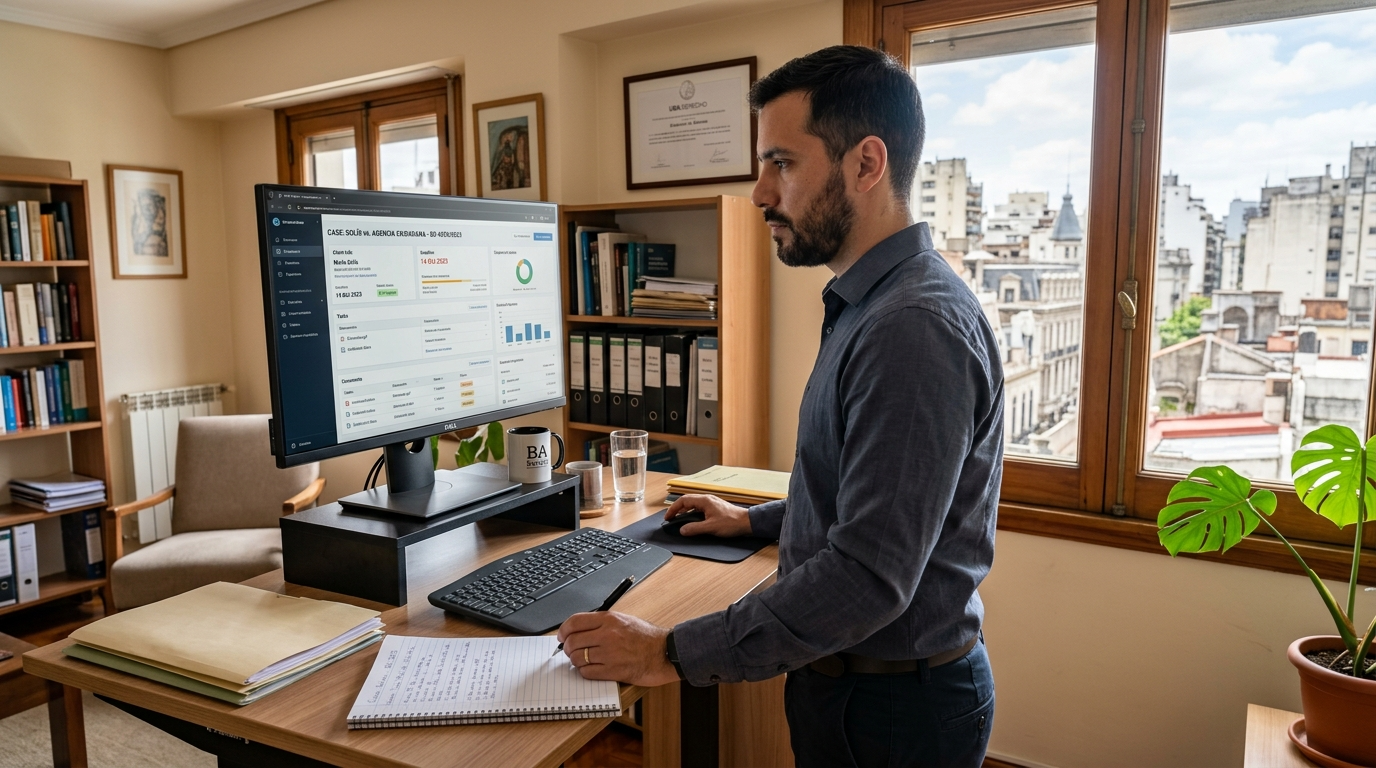
Nearshore litigation support, with team members based in Latin America—countries like Colombia, Mexico, Argentina, and Peru—eliminates that problem entirely. Your specialist logs on at 8am EST, attends your Monday team call, responds to Slack messages in real time, and files documents before the courthouse closes. Time zone alignment is not a soft benefit—it is a hard operational requirement for litigation work.
"The legal industry is increasingly recognizing that the timezone and cultural alignment of Latin American talent makes nearshore a structurally superior model for US firms that need real-time collaboration and same-day task completion." — Ron Friedmann, Legal Technology and Operations Consultant, Fireman & Company (2023)
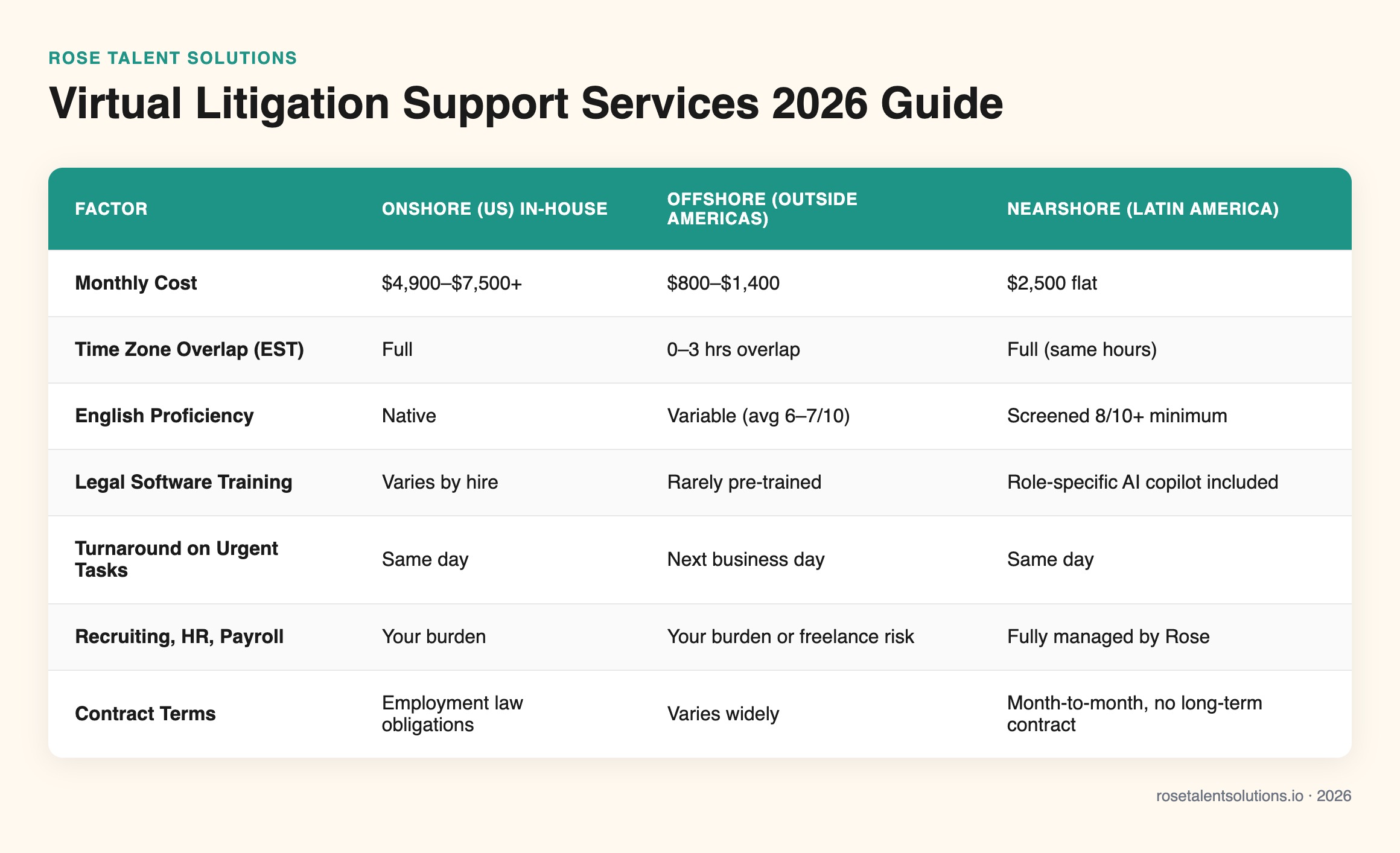
The Bureau of Labor Statistics reports that paralegals and legal assistants earn a median annual wage of $59,200 in the US (BLS, 2023)—more than $4,900 per month before benefits, recruiting, and overhead. A flat-rate nearshore specialist at $2,500/month all-in represents roughly 50% savings while keeping the work inside US business hours.
| Factor | Onshore (US) In-House | Offshore (Outside Americas) | Nearshore (Latin America) |
|---|---|---|---|
| Monthly Cost | $4,900–$7,500+ | $800–$1,400 | $2,500 flat |
| Time Zone Overlap (EST) | Full | 0–3 hrs overlap | Full (same hours) |
| English Proficiency | Native | Variable (avg 6–7/10) | Screened 8/10+ minimum |
| Legal Software Training | Varies by hire | Rarely pre-trained | Role-specific AI copilot included |
| Turnaround on Urgent Tasks | Same day | Next business day | Same day |
| Recruiting, HR, Payroll | Your burden | Your burden or freelance risk | Fully managed by Rose |
| Contract Terms | Employment law obligations | Varies widely | Month-to-month, no long-term contract |
How the AI Copilot Advantage Works for Litigation Support
Every Rose team member ships with a role-specific AI copilot trained on the software and workflows relevant to their position. For a litigation support specialist, that means pre-trained familiarity with Clio matter management, Filevine pipelines, PACER e-filing protocols, and document review conventions—before they log into your systems on day one.
This is not a chatbot bolted onto their workflow. The AI copilot handles first-draft generation for demand letters, auto-population of deposition notice templates, deadline calculations from scheduling orders, and document cross-referencing during discovery. The specialist reviews, edits, and submits. Attorneys get clean, accurate work product. The AI does the heavy lifting on repetitive structure.
The hidden cost of traditional in-house hiring for litigation support isn't the salary—it's the 6–8 weeks of onboarding, the benefits overhead, and the institutional knowledge that walks out the door when that person leaves. A nearshore specialist based in Latin America, equipped with an AI copilot, reaches full productivity in days—not months—and the institutional knowledge lives in the software, not the individual.
According to McKinsey's State of AI Report (2024), firms that integrate AI-assisted workflows into professional services roles see a 20–30% reduction in task completion time within the first 90 days. For litigation support—where time literally translates to billable dollars—that compression matters enormously.
If your firm also needs coverage at the front door, our guide on law firm virtual receptionist services explains how a nearshore receptionist integrates with your litigation support workflow to create a fully staffed front-to-back virtual legal team.

How to Hire a Virtual Litigation Support Specialist in 2026: The Rose Process
Most law firms assume hiring a remote litigation specialist means posting on Upwork, interviewing a dozen strangers, and hoping for the best. The Rose model is fully managed—you describe the role, and the placement, vetting, onboarding, payroll, and ongoing HR are handled for you. Every candidate is sourced exclusively from Latin America, so you get same-timezone coverage from day one.
Role Discovery Call
You spend 30 minutes with a Rose placement specialist describing your case load, software stack, and the specific litigation tasks you need delegated. No generic intake forms—this is a targeted conversation.
Candidate Matching
Rose identifies two to three pre-vetted Latin America-based candidates with litigation-specific backgrounds, screens them on English proficiency (8/10+ minimum), and presents you with a ranked shortlist within days.
Interview and Selection
You interview your top candidate. If no one clicks, Rose keeps searching at no additional cost. You don't pay until you've selected someone you're confident in.
Onboarding and AI Copilot Activation
Your specialist is onboarded to your systems within the first week, with their role-specific AI copilot configured for your case management software. Most specialists are handling live tasks by day three.
Ongoing Management
Rose handles payroll, HR compliance, and ongoing performance management. If the specialist isn't a fit, Rose replaces them at no additional cost—the replacement guarantee is built into the flat monthly rate.
The entire model runs month-to-month. There is no long-term contract. You can scale up, change roles, or cancel with 30 days written notice. For firms that have never outsourced before, this removes the biggest adoption barrier: the fear of being locked in.
For firms already considering a broader legal staffing build-out—adding a virtual assistant for intake, research, or client communication alongside litigation support—our full guide on how to hire a virtual legal assistant for your law firm covers the role design and delegation framework in detail.
Is Virtual Litigation Support Right for Your Firm in 2026?
Virtual litigation support is the right move if your attorneys are regularly working past 6pm on tasks that don't require a law degree. Chasing medical records, formatting exhibit binders, calendaring deadlines, drafting deposition notices—none of that needs a JD. It needs an organized, trained, reliable professional who shows up every day and knows your systems.
Strong Fit For
- PI, family law, employment, and civil litigation firms with high case volume
- Firms where attorneys handle their own admin due to staffing shortages
- Practices looking to grow without adding full-time W-2 headcount
- Firms already using Clio, Filevine, MyCase, or similar platforms
- Attorneys billing under 4 hours/day due to administrative load
Less Ideal If
- Your practice area requires in-person courthouse runs daily
- Your bar association has strict rules around non-attorney work product (verify state ethics rules)
- You have no case management software—a VA without a system cannot create structure from chaos
The Society for Human Resource Management (SHRM, 2023) reports that the average cost to replace a single employee runs 50–200% of annual salary. For a $60,000 litigation paralegal, that is $30,000–$120,000 in turnover cost alone. The month-to-month, fully managed nearshore model eliminates that risk entirely—and the free replacement guarantee means you're not absorbing a bad placement.
If you want to explore adding bookkeeping support alongside legal admin—common at smaller firms where the office manager wears multiple hats—see Rose's bookkeeping and accounting staffing page for how that role pairs with a legal VA. And when you're ready to move forward, the fastest path is the Rose start page, where you can book your role discovery call and get a shortlist in under a week.
According to Gallup's 2023 State of the Global Workplace Report, employee disengagement costs US businesses $1.9 trillion in lost productivity annually. Remote professionals in Latin America who are carefully matched to roles they're trained for—and who choose the remote arrangement—consistently show higher engagement scores than in-office hires doing work below their capability level.