
What Are Virtual Bookkeeper Services — and Why 2026 Is the Tipping Point?
Nearshore virtual bookkeeper services have crossed from "nice to have" into a genuine operational necessity for US small and mid-sized businesses. A virtual bookkeeper is a remote financial professional who manages your day-to-day books — reconciling accounts, categorizing transactions, processing payroll, tracking accounts payable and receivable, and producing monthly financial statements — without sitting in your office. What separates a great virtual bookkeeper from a mediocre one in 2026 is three things: real-time availability during your business hours, native-level fluency in the accounting software your business actually uses, and English communication that doesn't create friction.
According to the U.S. Bureau of Labor Statistics (2024), the median annual wage for bookkeeping, accounting, and auditing clerks in the United States is $47,440 — that's roughly $3,950 per month before you add payroll taxes, benefits, office space, and software licenses. Virtual bookkeeper services eliminate most of that overhead while keeping the financial expertise inside your business.
The tipping point in 2026 is AI. Modern virtual bookkeepers aren't just data-entry clerks — they're operators who use AI copilots trained on QuickBooks, Xero, FreshBooks, and industry-specific platforms to flag anomalies, auto-categorize transactions, and surface cash-flow insights your old bookkeeper would have missed entirely. Rose Talent Solutions builds a role-specific AI copilot into every placement at no extra charge, which means your bookkeeper hits the ground running from week one.
How Nearshore Beats Offshore for Virtual Bookkeeper Services in 2026
There is a common misconception that "virtual bookkeeper" just means cheap labor sourced from Asia. That model has real costs hidden inside the low hourly rate. A bookkeeper based in the Philippines or India operates on a 10-to-13-hour time zone gap with the US East Coast. That means every question you send at 2pm arrives during their night, and every answer comes back the next morning. For something as time-sensitive as payroll, vendor payments, or month-end close, overnight lag is not acceptable.
Nearshore bookkeepers — based in Latin American countries like Colombia, Mexico, Costa Rica, and Argentina — work your exact business hours. When you message at 2pm, they respond at 2pm. That real-time availability alone eliminates the single biggest complaint US business owners have about offshore bookkeeping teams.
"The time zone issue with offshore bookkeeping isn't just annoying — it compounds. Every delayed response pushes your close date back, inflates your DSO, and gives you less time to make decisions on current data." — Mike Michalowicz, Author of Profit First and small business financial systems advocate (2023)
English fluency is the second hidden cost of offshore bookkeeping. Rose screens every candidate to an 8/10 or higher English proficiency standard. That's not "functional English" — that's fluent written and verbal communication that lets your bookkeeper get on a Zoom call with your accountant, your bank, or your vendors without you acting as translator.

Rose's bookkeeping and accounting virtual staff are recruited, vetted, and managed entirely by Rose — so you never post a job, conduct an interview, or run payroll for a contractor. The flat $2,500/month covers all of it.
Onshore vs. Nearshore vs. Offshore: How Do Virtual Bookkeeper Services Compare?
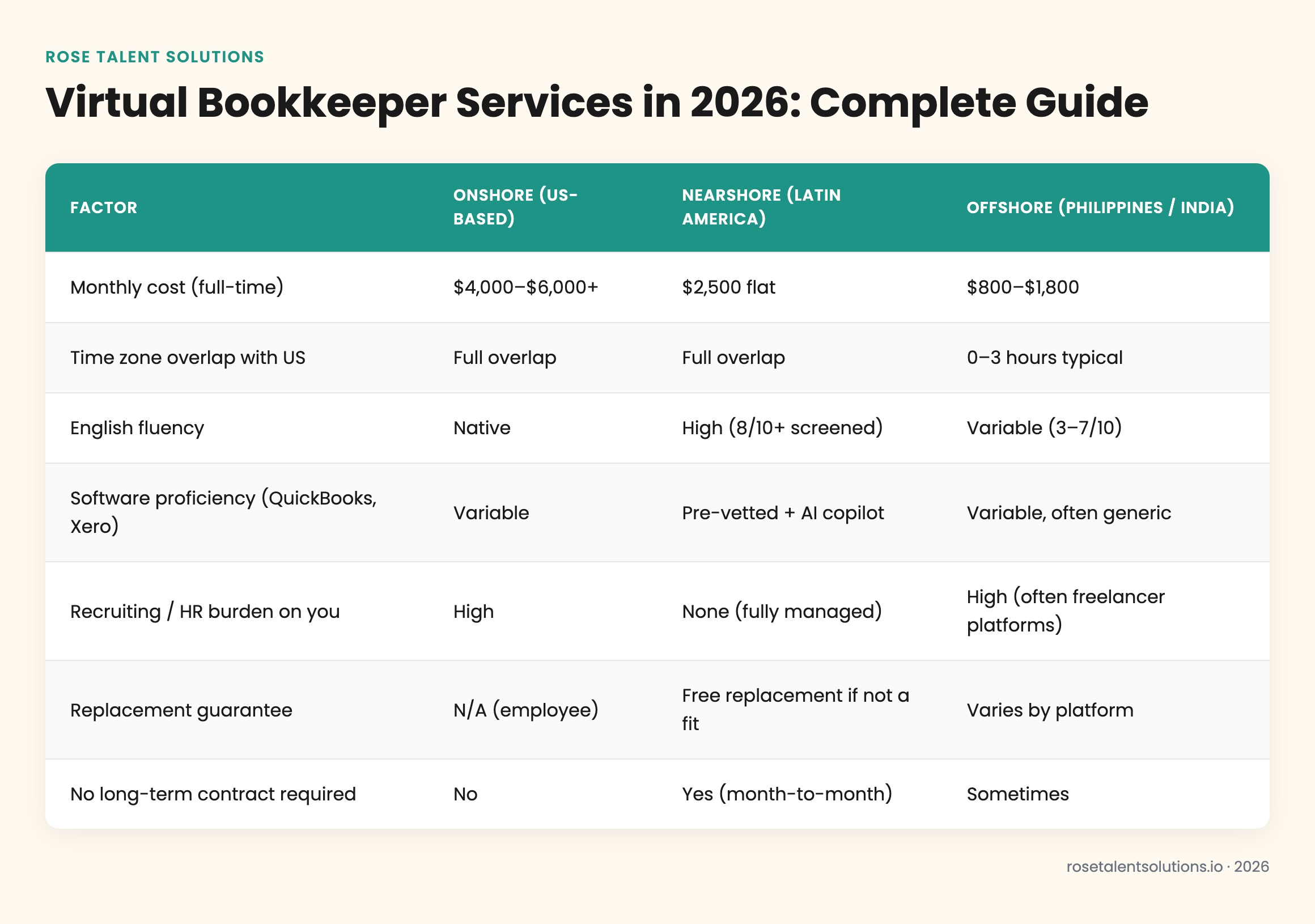
Before you commit to any virtual bookkeeper service, it helps to see the real trade-offs across the three main models side by side. The table below covers the dimensions that actually matter when you're running a US business with real deadlines and real compliance requirements.
| Factor | Onshore (US-based) | Nearshore (Latin America) | Offshore (Philippines / India) |
|---|---|---|---|
| Monthly cost (full-time) | $4,000–$6,000+ | $2,500 flat | $800–$1,800 |
| Time zone overlap with US | Full overlap | Full overlap | 0–3 hours typical |
| English fluency | Native | High (8/10+ screened) | Variable (3–7/10) |
| Software proficiency (QuickBooks, Xero) | Variable | Pre-vetted + AI copilot | Variable, often generic |
| Recruiting / HR burden on you | High | None (fully managed) | High (often freelancer platforms) |
| Replacement guarantee | N/A (employee) | Free replacement if not a fit | Varies by platform |
| No long-term contract required | No | Yes (month-to-month) | Sometimes |
If your business uses QuickBooks, you'll want to review how different platforms and VA services stack up specifically on that software in our detailed QuickBooks virtual bookkeeper comparison. Similarly, if your team runs on Xero, the differences in VA capability are significant enough to warrant a dedicated look — our Xero virtual bookkeeper services comparison breaks that down specifically.
What Tasks Does a Virtual Bookkeeper Actually Handle in 2026?
One of the most common questions business owners ask is: "What exactly will my virtual bookkeeper do every day?" The honest answer is: more than most people expect, especially with an AI copilot built into the role.
A well-matched virtual bookkeeper doesn't just enter data — they become the financial nervous system of your business, flagging overdue invoices, catching duplicate charges, and ensuring your month-end close happens on schedule every single month without you chasing anyone.
According to a QuickBooks / Intuit (2023) survey, 60% of small business owners say they are not confident in their bookkeeping knowledge — and 40% say they spend more than 80 hours per year on bookkeeping tasks they're not qualified to perform. That's two full work weeks lost to tasks a trained bookkeeper handles in the background daily.
Here's what a full-time virtual bookkeeper manages on a typical day:
- Bank and credit card reconciliation
- Accounts payable — coding and scheduling vendor payments
- Accounts receivable — invoicing clients and following up on overdue balances
- Payroll processing (in coordination with your payroll provider)
- Month-end and year-end close preparation
- Financial statement preparation (P&L, balance sheet, cash flow)
- Sales tax tracking and filing support
- Expense categorization and receipt management
- 1099 preparation support at year-end
For businesses with high transaction volume — e-commerce, property management, construction, agencies — accounts payable alone can consume 15-20 hours per week. If you haven't looked at what dedicated virtual accounts payable services can remove from your plate, that's worth a separate read.

According to SHRM (2022), a bad hire can cost an employer up to 50–60% of the employee's annual salary in replacement and productivity costs. That's the risk reversal Rose's free replacement guarantee is designed to eliminate — if your bookkeeper isn't a fit, Rose replaces them at no additional cost.
How Rose's Virtual Bookkeeper Placement Process Works in 2026
Most virtual staffing services ask you to post a job description and sort through applicants yourself. Rose inverts that model entirely. You describe what you need; Rose does the rest.
Discovery Call
You spend 30 minutes with a Rose placement specialist describing your business, your software stack, and the specific bookkeeping tasks you need covered. No generic intake form — a real conversation.
Candidate Matching
Rose sources from its vetted Latin America talent network, filtering for your exact software (QuickBooks, Xero, FreshBooks, etc.), industry experience, and English proficiency score of 8/10 or higher.
AI Copilot Setup
Before your bookkeeper starts, Rose configures a role-specific AI copilot trained on your software and workflows — so they're productive from day one, not week four.
Onboarding & Handoff
Your bookkeeper joins your tools, gets introduced to your accountant or CPA if applicable, and takes ownership of the books. Rose manages HR, payroll, and ongoing performance — you manage the work output.
Ongoing Management
Rose stays in the background handling payroll, compliance, and any personnel issues. If anything isn't working, you contact Rose — not a freelancer marketplace.
The entire process from discovery call to first day is typically seven business days. Pricing is $2,500 per month flat — no long-term contract, month-to-month, with a free replacement if the team member isn't the right fit. Get started with Rose to begin the matching process.
Is a Nearshore Virtual Bookkeeper Right for Your Business?
Virtual bookkeeper services are not a one-size-fits-all solution. They work best for businesses that have predictable, recurring bookkeeping volume — not businesses that need a CPA-level tax strategist available 80 hours a week during filing season. Here's an honest look at who benefits most.
Best Fit
- Small to mid-sized US businesses with $500K–$10M+ annual revenue
- Property managers with 30+ units using AppFolio, Buildium, or similar
- E-commerce brands with high transaction volume
- Professional services firms (agencies, law firms, consultancies)
- Businesses currently doing books in-house with no dedicated staff
Not the Best Fit
- Businesses that need a licensed CPA for tax strategy and filings (a bookkeeper handles the books; your CPA handles taxes)
- Startups with fewer than 50 transactions per month (may be over-resourced)
- Businesses with no defined software stack or chaotic financial systems with no cleanup roadmap
According to a McKinsey Global Institute (2023) analysis, 23% of work activities in finance and accounting can be automated with currently available technology — which is precisely why a bookkeeper with an AI copilot outperforms one without, dollar for dollar. Rose's AI advantage program is built around that reality.
If your business runs on Xero and you're evaluating whether a dedicated virtual bookkeeper is the right step beyond your current setup, our guide on hiring a Xero virtual bookkeeper covers the nuances in detail — including when a generalist bookkeeper falls short on Xero-specific features like tracking categories and multi-currency.
For a broader look at how Rose's property management virtual staff handle financial operations inside platforms like AppFolio and Buildium, that page covers the full scope of what's possible when bookkeeping is embedded directly into your property management workflow.
According to Gallup's State of the Global Workplace (2023), engaged employees are 23% more productive than disengaged ones — and Rose's ongoing management model is specifically designed to keep your virtual bookkeeper engaged, supported, and accountable without that burden falling on you.