
Nearshore virtual assistant services have become the fastest-growing staffing category for scaling US businesses in 2026 — and the math behind that growth is hard to argue with. When you can hire a full-time, English-fluent operations professional based in Latin America, working your time zone, for a flat $2,500 a month all-in, the question stops being whether to use a VA and starts being why you waited. This guide breaks down exactly how virtual assistant services work for growing companies, what to look for in a provider, and how to avoid the traps most operators fall into the first time they hire remotely.
What Are Virtual Assistant Services for Growing Companies?
A virtual assistant service for a growing company is a staffing model where a dedicated remote professional handles specific business functions — administration, customer communication, bookkeeping, scheduling, data entry, or operations support — so your in-house team can stay focused on revenue-generating work. Unlike freelance platforms where you manage a rotating cast of contractors, a managed VA service handles recruiting, vetting, payroll, HR, and ongoing oversight on your behalf.
What is a nearshore VA? A nearshore virtual assistant is a remote professional based in a geographically close region — in the US context, that means Latin America. Nearshore VAs work in overlapping or identical time zones to US business hours, hold strong English proficiency (Rose Talent Solutions screens for 8/10 or above), and bring the real-time availability that offshore models — based in Asia or Eastern Europe — structurally cannot match. For a deeper breakdown, see this complete nearshore vs offshore vs onshore virtual assistant comparison.
Growing companies typically turn to VA services when they hit one of three walls: their founders are doing $15/hour admin tasks, their first employees are stretched across roles they were never hired for, or they need to scale customer touchpoints without adding full-time US salaries. Virtual assistant services solve all three — if you pick the right model.
According to SHRM's State of the Workplace research (2024), organizations that restructured support roles toward remote staffing reported significantly faster hiring timelines and lower total labor cost per output unit than those maintaining fully onsite teams.
How Nearshore VAs Outperform Offshore in 2026 — The Real Comparison
The offshore VA pitch sounds compelling on paper: very low hourly rates, large talent pools, English-speaking options. But growing companies that have tested both models consistently report the same friction points with offshore hires — communication delays caused by time zone gaps, cultural miscommunication on tone and urgency, and a high rate of re-work when tasks require judgment calls during your business day.

The timezone issue alone compounds silently. If your VA is 10–12 hours ahead, every question that needs a judgment call — a tenant complaint, a client email requiring a nuanced reply, a vendor invoice that looks off — waits overnight. For growing companies where speed of execution is a competitive advantage, that lag compounds across hundreds of interactions per month. You can read a full breakdown of this dynamic in our post on onshore vs offshore virtual assistant tradeoffs.
The hidden cost of offshore VAs isn't the hourly rate — it's the 6–12 hour timezone gap that turns every time-sensitive task into a next-day item. For growing companies that live and die by response speed, this structural delay erodes the hourly-rate savings faster than most operators realize.
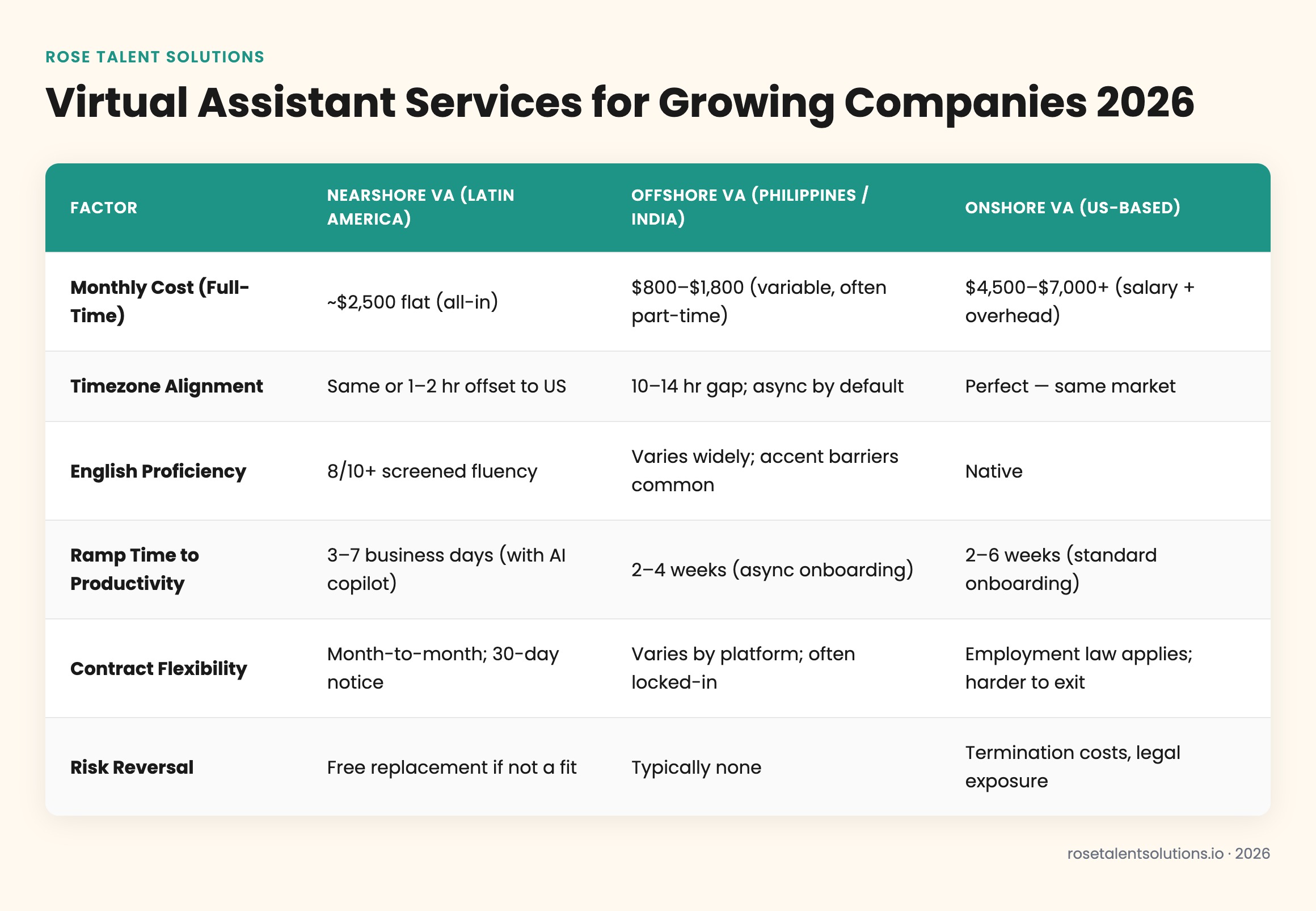
Here is how the three models stack up across the dimensions that matter most to scaling businesses:
| Factor | Nearshore VA (Latin America) | Offshore VA (Philippines / India) | Onshore VA (US-based) |
|---|---|---|---|
| Monthly Cost (Full-Time) | ~$2,500 flat (all-in) | $800–$1,800 (variable, often part-time) | $4,500–$7,000+ (salary + overhead) |
| Timezone Alignment | Same or 1–2 hr offset to US | 10–14 hr gap; async by default | Perfect — same market |
| English Proficiency | 8/10+ screened fluency | Varies widely; accent barriers common | Native |
| Ramp Time to Productivity | 3–7 business days (with AI copilot) | 2–4 weeks (async onboarding) | 2–6 weeks (standard onboarding) |
| Contract Flexibility | Month-to-month; 30-day notice | Varies by platform; often locked-in | Employment law applies; harder to exit |
| Risk Reversal | Free replacement if not a fit | Typically none | Termination costs, legal exposure |
How Growing Companies Use Virtual Assistants in 2026 — The Most Common Roles
The most scalable VA use cases for growing companies fall into three categories: operations support, customer communication, and financial admin. Each of these represents a high-volume, repeatable workload that consumes founder or manager time without generating revenue — which is exactly the work that a well-matched VA eliminates from your plate.
Operations support includes scheduling, vendor coordination, project tracking, data entry, CRM updates, and inbox management. These tasks are time-consuming, require consistency, and are well-suited to a dedicated professional who owns a system rather than a founder who context-switches between them. If your business uses tools like HubSpot, Asana, or Monday.com, a VA trained on those platforms can take over workflow management almost immediately.
Customer communication is where nearshore VAs create the most visible ROI fastest. Real-time responsiveness — answering inbound inquiries, following up on leads, handling service requests — requires someone working your hours. Companies that have tested this report that response times drop from hours to minutes, which directly impacts conversion rates on inbound leads. According to Salesforce's State of the Connected Customer report (2023), 80% of customers say the experience a company provides is as important as its product — and speed of response is the single most-cited component of that experience.
Financial admin — bookkeeping, accounts payable, invoice reconciliation, expense categorization — is another high-leverage function for growing companies. The QuickBooks Small Business Financial Management survey (2023) found that 40% of small business owners spend more than 80 hours per year on tax preparation alone, and most cite bookkeeping as the internal task they most want to delegate. Rose's bookkeeping and accounting virtual assistant service pairs each placement with a QuickBooks-trained AI copilot, so your VA hits the ground running in your existing stack.

How the AI Copilot Advantage Changes the 2026 VA Equation
The biggest shift in virtual assistant services in 2026 isn't the pricing model — it's the AI layer. Every Rose Talent Solutions team member ships with a role-specific AI copilot trained on the software they'll actually use: QuickBooks, HubSpot, AppFolio, Buildium, and others. This isn't a generic chatbot bolted onto the side — it's a trained assistant that knows your VA's software environment and helps them handle tasks faster, more accurately, and with fewer errors on day one.
The practical result: ramp time compresses dramatically. A traditionally onboarded VA might take two to four weeks to reach full productivity in an unfamiliar software stack. A VA with an AI copilot trained on that specific platform reaches useful output within the first week. That difference matters enormously for a growing company that needs results quickly, not a month-long onboarding runway.
"AI-augmented workers aren't just faster — they make fewer errors on high-volume repetitive tasks, which is exactly where unaugmented remote workers tend to slip after the first few weeks." — Dr. Erik Brynjolfsson, Professor at Stanford Institute for Human-Centered AI (2024)
According to McKinsey's research on the economic potential of generative AI (2023), knowledge workers augmented with AI tools complete tasks 25–40% faster on average than unaugmented peers — with quality scores that match or exceed manual-only output. For a growing company paying a flat monthly rate, faster and more accurate output from day one is a compounding advantage that compounds every month your VA is on your team.
The AI copilot also matters for risk management. When your VA has an intelligent assistant cross-checking data entry, flagging invoice anomalies, or surfacing the right response template for a customer inquiry, the error rate drops — and so does your oversight burden. You can find a full breakdown of how this model is changing nearshore staffing at Rose's AI advantage page.
How to Hire a Virtual Assistant for a Growing Company — Step by Step
The process of hiring through a managed VA service like Rose is designed to eliminate the friction that kills most first-time remote hiring attempts. You don't post a job, review 200 applications, conduct interviews, handle payroll setup, or manage HR compliance. Here's what a structured process looks like:
Define the Role
You tell us what tasks you need done, what software you use, and what "great" looks like for the position. The more specific you are here, the better the match — a 15-minute intake call is usually enough.
Recruiting and Vetting
Rose sources candidates from its Latin America talent network, screens for English proficiency (8/10+ hard floor), software skills, and role-specific judgment. Only candidates who clear all screens reach your desk.
You Approve the Match
You review the shortlisted candidate profile and confirm the match. You are not obligated to accept a candidate who doesn't feel right — placement continues until you have someone you're confident in.
Onboarding with AI Copilot
Your VA is onboarded with a role-specific AI copilot trained on your software stack. Most placements are operational within the first week.
Ongoing Management Included
Rose handles payroll, HR, compliance, and performance oversight. If the team member isn't a fit, we replace them at no additional cost — with no disruption to your workflow.
This model is why growing companies increasingly prefer managed VA agencies over freelance platforms. On a platform like Upwork or Fiverr, you carry the management burden. With a managed service, you get a full-time professional without the full-time employer responsibilities. For a deeper look at how Latin America–based agencies structure this, see our overview of virtual assistant companies in Latin America and what separates strong providers from weak ones.
The pricing structure is also worth understanding clearly. At $2,500/month flat, you're getting full-time hours (40 per week), all recruiting and placement costs included, payroll and HR handled, ongoing management, and the AI copilot layer. There are no hidden per-hour charges, no platform fees on top, and no long-term contract — terms are month-to-month with 30 days written notice to cancel. That structure is designed specifically for growing companies that need to move fast without locking in long-term commitments before they've validated the role.
What Growing Companies Get Wrong About Virtual Assistant Services
The most common mistake growing companies make with virtual assistant services is treating the VA like a task queue rather than a role. A VA who receives a random daily list of one-off requests from three different people will underperform — not because of skill, but because of structure. The operators who extract the most value from VA services define a clear scope, assign ownership of specific systems, and treat the VA as a functional team member rather than a shared resource.
The second mistake is choosing a provider based on the lowest hourly rate without accounting for the total cost of management overhead. If you spend four hours a week managing your VA, troubleshooting communication issues, and redoing work that came back wrong, the "cheap" option isn't cheap. The all-in pricing model — where the provider handles HR, payroll, performance, and replacement — removes that overhead entirely. According to Bureau of Labor Statistics JOLTS data (2024), the average cost of replacing an employee in a support role runs 50–75% of annual salary when you include recruiting time, training, and lost productivity. A free replacement guarantee eliminates that risk entirely.
The third — and most fixable — mistake is waiting too long to hire. Most founders who have used virtual assistant services report that the single thing they'd change is starting earlier. The work doesn't get less complex as you grow; it gets more complex. Delegating early gives your VA time to build systems, context, and institutional knowledge before you're underwater.
Why Nearshore VA Services Work for Growing Companies
- Same-timezone availability means real-time decisions, not next-day ones
- Flat monthly pricing removes cost uncertainty at budget-planning time
- Managed service eliminates HR, payroll, and compliance overhead
- AI copilot layer compresses ramp time to days, not weeks
- No long-term contract — exit with 30 days written notice if needed
Where VA Services Fall Short (and How to Mitigate)
- Requires clear role definition upfront — vague scopes produce weak output
- Not a fit for roles requiring physical presence or licensed professional credentials
- First week has a learning curve — plan for a structured onboarding period
- Best value realized when VA owns a system, not a random task list
If you're ready to move from reading about virtual assistant services to actually building out your support layer, the fastest path is to start the matching process at Rose — intake takes 15 minutes and most companies have a candidate profile in front of them within 48 hours. You can also explore how Rose structures property management virtual assistant placements if real estate operations are part of your business. And if you want to understand the broader Latin America staffing landscape before committing to a provider, our guide to working with a Latin America staffing agency covers what to look for, what to avoid, and how the best providers structure their delivery.
The companies that scale fastest in 2026 aren't the ones with the most in-house headcount — they're the ones who figured out which work requires a local senior hire and which work is better owned by a dedicated, well-matched, full-time nearshore professional who shows up at 9am your time, ready to work.