
Nearshore virtual assistant packages have quietly become one of the most cost-effective hiring decisions available to US, Canadian, and UK businesses in 2026. But the market is noisy — dozens of providers sell "packages" that mean wildly different things, from a 10-hour monthly prepaid bundle to a fully managed full-time placement. Knowing what's actually inside a package before you sign is the difference between a productivity win and a hidden-cost nightmare.
This guide breaks down every major package structure on the market, what each includes (and quietly excludes), and how to match the right model to your business. By the end, you'll know exactly what to ask any provider — and exactly what a fair price looks like in 2026.
What Is a Virtual Assistant Package — and What Should It Actually Include in 2026?
A virtual assistant package is a pre-structured service offering that bundles some combination of VA hours, recruiting, vetting, software access, management, and HR support into a single purchase. The word "package" is used so loosely across the industry that two products both called "VA packages" can differ by $2,000/month in real total cost once you account for what's missing from the cheaper one.
A complete package — the kind worth paying for — covers at minimum: candidate sourcing and screening, skills testing, a client-facing interview process, payroll administration, and a point of contact for ongoing performance management. Anything less than that is really just a staffing referral with a nicer name. When you're evaluating providers, the fastest filter is to ask: "After placement, who handles HR, payroll, and performance issues?" If the answer is "you do," the package is incomplete.
According to SHRM's Employee Benefits Survey (2024), employers spend an average of $4,700 per hire in administrative and compliance overhead alone — costs that a fully managed VA package should absorb entirely on your behalf.

How the Four Main VA Package Structures Compare in 2026
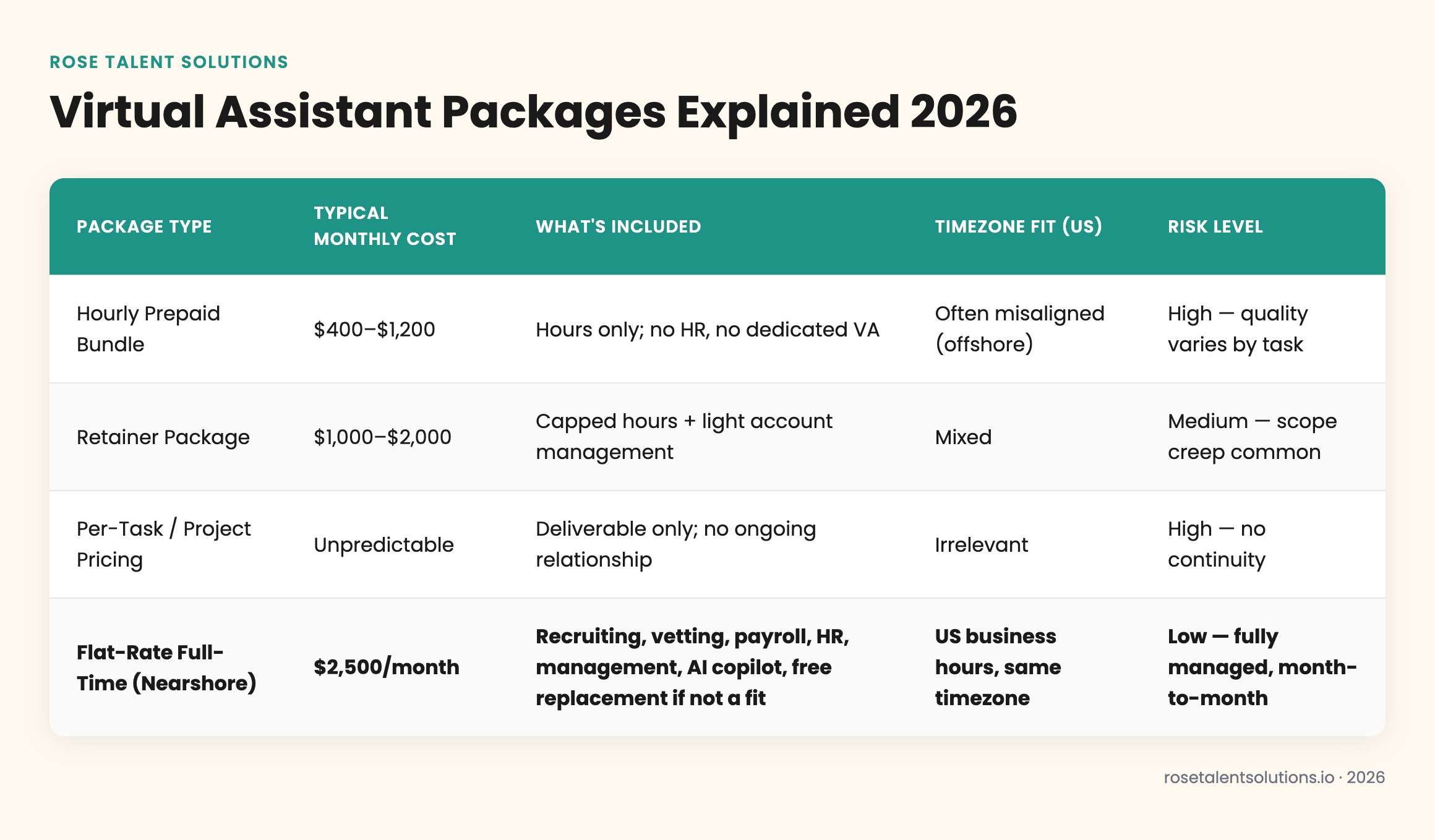
Not every package is built the same. The four dominant models — hourly prepaid bundles, retainer packages, per-task pricing, and flat-rate full-time placements — each serve different business profiles. Hourly bundles work well for founders who need fewer than 20 hours a month of admin support. Retainer packages offer slightly more predictability but typically cap hours and exclude HR overhead. Per-task pricing sounds cheap until you realize every scope change triggers a re-quote.
Flat-rate full-time placements are the model that scales. For a business that needs a dedicated team member — not a rotating pool of anonymous contractors — the flat monthly rate covering 40 hours per week is almost always the lowest effective cost per productive hour. If you're weighing all three models in depth, the complete nearshore vs. offshore vs. onshore VA comparison on Rose's blog walks through the total cost of each model with real numbers.
| Package Type | Typical Monthly Cost | What's Included | Timezone Fit (US) | Risk Level |
|---|---|---|---|---|
| Hourly Prepaid Bundle | $400–$1,200 | Hours only; no HR, no dedicated VA | Often misaligned (offshore) | High — quality varies by task |
| Retainer Package | $1,000–$2,000 | Capped hours + light account management | Mixed | Medium — scope creep common |
| Per-Task / Project Pricing | Unpredictable | Deliverable only; no ongoing relationship | Irrelevant | High — no continuity |
| Flat-Rate Full-Time (Nearshore) | $2,500/month | Recruiting, vetting, payroll, HR, management, AI copilot, free replacement if not a fit | US business hours, same timezone | Low — fully managed, month-to-month |
How Nearshore VA Packages Outperform Offshore Bundles on Real Productivity
The timezone argument is underrated. When a tenant calls at 10am EST with a maintenance emergency and your VA is 10–12 hours ahead in Southeast Asia, the response cycle doesn't close until the next business day. That single delay — repeated dozens of times a month across leasing inquiries, vendor calls, and owner reports — compounds into measurable revenue loss. Real-time collaboration is only possible when your VA works your hours, not theirs.
Nearshore VAs based in Latin America work US business hours natively. They're in EST, CST, or MST time zones, depending on country. English proficiency at Rose is screened to a minimum 8/10 on a standardized test — not self-reported. This distinction matters because, according to Gallup's State of the Global Workplace (2024), communication quality is the single strongest predictor of remote team engagement and output — above pay, tools, or task clarity.
Beyond timezone, software fluency is the other differentiator. Every Rose team member ships with a role-specific AI copilot trained on the software they'll actually use — AppFolio, Buildium, QuickBooks, and others. That means your property management VA isn't learning AppFolio at your expense during week one. They arrive knowing the workflows. For context on how Latin American staffing agencies source and vet this caliber of candidate, see Rose's breakdown of how Latin America staffing agencies operate end-to-end.
"Latin America has quietly built one of the strongest pools of bilingual, technically fluent remote talent in the world — and US businesses that tap it now are going to have a structural cost and speed advantage over those that wait." — Economist Intelligence Unit, The Future of Work in the Americas (2023)
A nearshore VA package isn't just cheaper on paper — it's faster in practice. Same-timezone availability means your team member can attend your morning standup, respond to Slack in real time, and close client tickets the same day they open. Offshore packages simply can't replicate this, regardless of price.
What Does a $2,500/Month VA Package Get You — Line by Line?
Price transparency is rare in this industry, so here's exactly what Rose Talent Solutions' flat-rate package covers for $2,500/month. This isn't a teaser rate that scales up — it's the full number, all-in, with no long-term contract required.

Sourcing & Screening
Rose sources candidates from its Latin America talent network, screens for English proficiency (8/10+ floor), technical skills, and role-specific software experience. You never post a job listing.
Client Interview & Match
You interview your top shortlisted candidates directly. Rose facilitates the process and handles offer logistics once you select your team member — typically within 7 days of kickoff.
Onboarding & AI Copilot Setup
Your VA arrives with a role-specific AI copilot already configured for your software stack. Rose manages the onboarding checklist so your team member is productive in days, not weeks.
Ongoing HR & Payroll
Rose handles payroll, compliance, and all HR administration throughout the engagement. You manage the work; Rose manages the employment relationship.
Performance Support & Replacement Guarantee
If the team member isn't a fit, Rose replaces them at no additional cost. Month-to-month terms mean you can cancel with 30 days' written notice — no long-term contract.
For businesses that need financial operations support alongside administrative help, Rose also offers dedicated bookkeeping and accounting VAs under the same flat-rate structure — one price, full-time, fully managed.
According to the U.S. Bureau of Labor Statistics (2024), the median annual salary for a full-time US-based bookkeeping clerk is $47,440 — roughly $3,953/month in salary alone, before benefits, payroll taxes, or overhead. The math on a $2,500/month all-in nearshore package is straightforward.
How to Evaluate Any VA Package Before You Buy in 2026
Five questions to ask every provider before committing to any virtual assistant package in 2026:
- Who handles payroll and HR after placement? If the answer isn't the provider, you're not buying a managed package.
- What's the replacement policy? Any provider confident in their vetting will offer a no-additional-cost replacement guarantee. If they won't put it in writing, walk away.
- What timezone does the VA work? Always confirm working hours match your business hours — not approximations, not "flexible."
- What software is the VA trained on before day one? Pre-training on your stack (AppFolio, QuickBooks, Buildium, etc.) is a multiplier on ramp speed. Generic VA packages don't offer it.
- What are the contract terms? Month-to-month with 30 days' written notice is the standard for a provider confident in their service. Multi-year lock-ins are a red flag.
If you want a broader framework for evaluating provider types — not just packages — the onshore vs. offshore virtual assistant breakdown covers how geography, pricing, and quality intersect across the full market. And if you're specifically looking at the Latin American VA market, Rose's guide to virtual assistant companies in Latin America explains how to benchmark providers in that region.
Flat-Rate Nearshore Package — Pros
- Fully predictable monthly cost — no surprise invoices
- Dedicated full-time team member who knows your business
- Same-timezone availability for real-time collaboration
- HR, payroll, and compliance handled by the provider
- Role-specific AI copilot included
- Free replacement if not a fit
Hourly / Bundle Packages — Cons
- Hours run out at the worst times; overages cost extra
- No single dedicated VA — quality varies task to task
- Timezone gaps delay every real-time workflow
- You manage compliance, payroll, and HR yourself
- No software pre-training; ramp time is on your dime
- No replacement guarantee if the work is poor
The AI advantage built into Rose's packages deserves its own moment. Every team member's AI copilot is trained on the specific software they'll use in your role — not a generic chatbot bolted on for marketing. You can explore the full scope of that capability on Rose's AI advantage page. According to McKinsey's report on the economic potential of generative AI (2023), workers using AI tools embedded in their daily software complete repeatable tasks 30–50% faster than those without — a multiplier that compounds every month your team member is on the job.
Ready to see what a nearshore VA package looks like for your specific role? The fastest next step is to start your placement request — Rose's team will match you with screened candidates within days, not weeks.
According to Statista's Virtual Assistant Market Size report (2024), the global virtual assistant services market is projected to exceed $44 billion by 2027 — a growth rate that reflects exactly how many businesses are moving administrative and operational work off their internal payroll and into managed VA packages. The question in 2026 isn't whether to use a VA. It's whether the package you choose is actually built to deliver.