
Nearshore remote staffing is the fastest-growing hiring model for small and mid-size businesses in North America — and Latin America is the engine driving it. When you work with a remote staffing agency LATAM, you get a full-time team member who operates on your schedule, communicates in fluent English, and costs less than half what a comparable US hire would run. This guide breaks down exactly how the model works in 2026, what it costs, and how to pick the right agency so you don't waste three months on a bad hire.
What Is a Nearshore Remote Staffing Agency — and Why Does LATAM Win in 2026?
A nearshore remote staffing agency recruits, vets, places, and manages virtual staff in a neighboring or near-time-zone region on your behalf. For US businesses, that means Latin America: Colombia, Mexico, Argentina, Costa Rica, and similar markets where English fluency is high, infrastructure is modern, and the talent pool has grown dramatically over the last five years.
"Nearshore" is not a synonym for "cheap offshore." It is a structurally different model. Offshore vendors in the Philippines or India typically operate on a 10-to-14-hour time-zone gap, which means your team member is processing requests while you sleep. A LATAM-based hire works 9-to-5 EST or PST, joins your Slack huddles in real time, and jumps on a Zoom with a client the same afternoon you ask. That difference in availability is not a soft benefit — it fundamentally changes how fast work gets done. If you want a deeper breakdown of the structural differences, our complete nearshore vs offshore vs onshore comparison walks through each model side by side.
According to SHRM's 2024 Workforce Trends Report, 72% of HR leaders cite time-zone alignment as the top operational factor when evaluating remote staffing vendors — ahead of cost and language skills.
Latin America also offers something the Philippines and India markets historically have not: cultural proximity to the United States. Shared business norms, familiarity with US holidays and customer expectations, and consumption of English-language media from an early age produce VAs who communicate the way your clients expect — not in formally correct but stilted English. For a closer look at what this talent market actually costs, see our breakdown of Latin America virtual assistant pricing in 2026.
How 2026 Nearshore vs. Offshore VA Costs and Quality Actually Stack Up
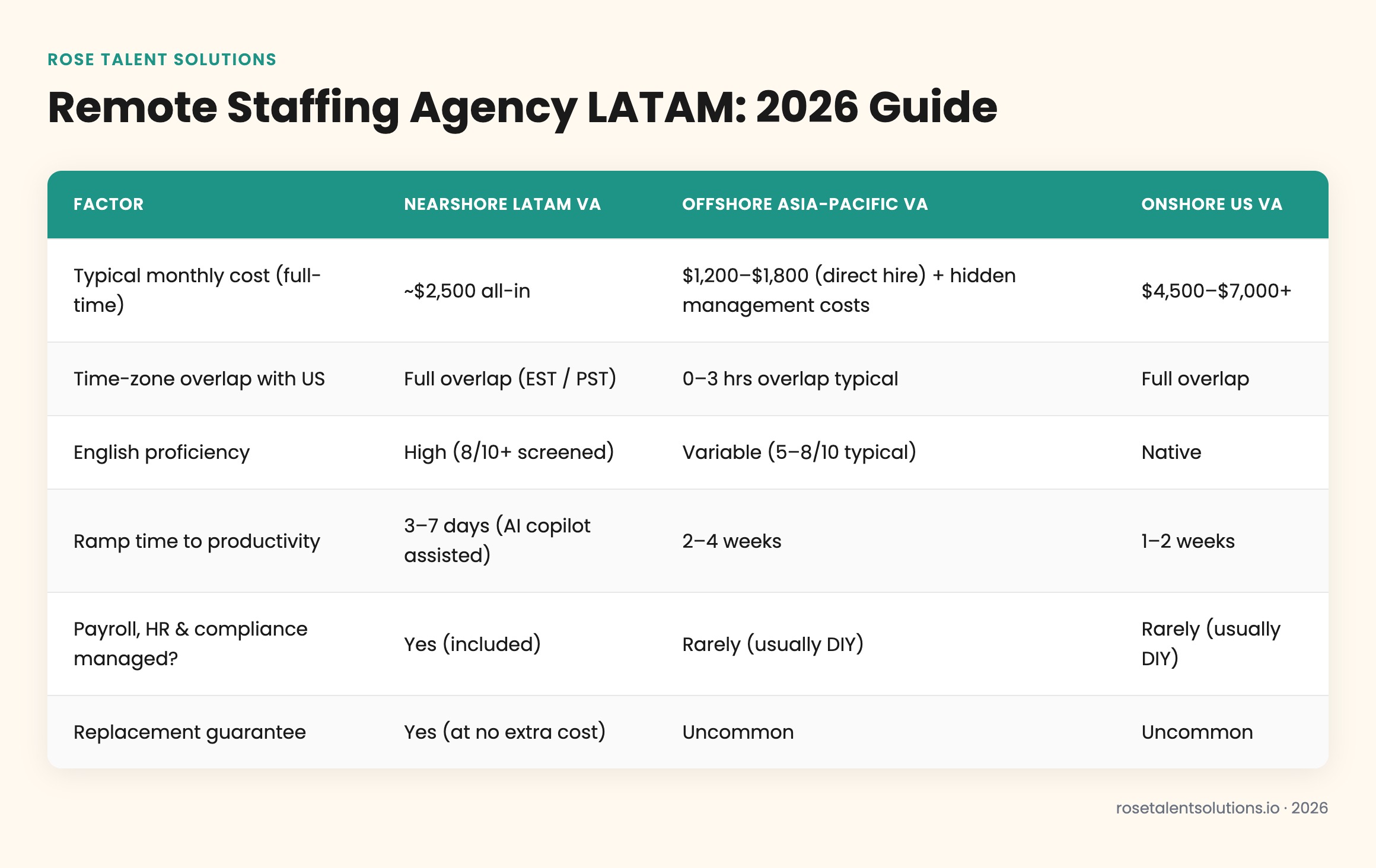
The table below is the clearest way to see why the nearshore LATAM model has displaced offshore for US businesses that care about speed and communication quality — not just the lowest possible line item.
| Factor | Nearshore LATAM VA | Offshore Asia-Pacific VA | Onshore US VA |
|---|---|---|---|
| Typical monthly cost (full-time) | ~$2,500 all-in | $1,200–$1,800 (direct hire) + hidden management costs | $4,500–$7,000+ |
| Time-zone overlap with US | Full overlap (EST / PST) | 0–3 hrs overlap typical | Full overlap |
| English proficiency | High (8/10+ screened) | Variable (5–8/10 typical) | Native |
| Ramp time to productivity | 3–7 days (AI copilot assisted) | 2–4 weeks | 1–2 weeks |
| Payroll, HR & compliance managed? | Yes (included) | Rarely (usually DIY) | Rarely (usually DIY) |
| Replacement guarantee | Yes (at no extra cost) | Uncommon | Uncommon |

What Does a Remote Staffing Agency LATAM Actually Include in 2026?
Not all LATAM staffing agencies are built the same, and the gap between a full-service agency and a glorified job board can cost you months. A full-service remote staffing agency should handle recruiting, multi-stage vetting (including English proficiency scoring, skills testing, and background checks), placement, payroll, HR compliance in the team member's home country, and ongoing performance management. When all of those are bundled, your internal HR team has effectively zero administrative burden from the hire.
At Rose Talent Solutions, the $2,500/month flat rate covers every one of those layers. There is no separate recruiting fee, no HR add-on, and no surprise invoice when payroll currency fluctuates. The month-to-month terms mean you are not locked into a 12-month commitment — just 30 days written notice to cancel if something changes in your business. That is what "no long-term contract" means in practice.
One feature that separates modern LATAM staffing agencies from the previous generation: AI copilots. Every team member placed through Rose ships with a role-specific AI assistant trained on the software they will actually use — AppFolio, Buildium, QuickBooks, and others. According to McKinsey's 2023 generative AI productivity analysis, knowledge workers augmented by AI tools complete repetitive task categories 40–60% faster than unaugmented peers. That is not an abstraction for your business — it means your VA finishes the lease abstraction queue before noon instead of end of day. Learn more about how this works on Rose's AI advantage page.
"The productivity gap between AI-augmented and non-augmented knowledge workers will be one of the defining business stories of the late 2020s — companies that embed AI at the point of hire will compound that advantage every quarter." — Lareina Yee, Senior Partner at McKinsey & Company (2023)
The cheapest LATAM VA placement is not the one with the lowest monthly rate — it is the one where recruiting, HR, payroll, compliance, and management are bundled so your team spends zero hours on vendor administration. Hidden coordination costs on unbundled arrangements routinely add $800–$1,200/month in internal labor before the VA does a single billable task.
How to Evaluate a LATAM Remote Staffing Agency: 2026 Checklist
The LATAM staffing market has matured rapidly. There are now dozens of agencies claiming to place "top 1% talent" with "rigorous vetting." Here is what to actually verify before you sign anything.
English proficiency scoring: Ask for the specific test used and the minimum score threshold. Rose's published floor is 8/10 on its proprietary proficiency screen. Vague claims like "business-level English" are meaningless without a number. Time-zone guarantee: Confirm the team member will work your core business hours — not a shifted schedule that only overlaps for three hours. Replacement policy: The only honest risk reversal in this industry is a free replacement if the team member is not a fit. If you are not satisfied with your placement, the agency should swap them at no additional cost — not credit your account or start a lengthy review process. Payroll and compliance: Verify the agency handles in-country payroll legally. Misclassification risk is real in Colombia, Mexico, and Argentina — a good agency eliminates it entirely for you.
If you are comparing multiple vendors, our guide on what separates a quality Latin America staffing agency from a middleman gives you a vendor-agnostic framework for the evaluation.

According to the U.S. Bureau of Labor Statistics' 2023 remote work productivity analysis, remote workers in roles with structured onboarding reach full productivity 34% faster than those without it. That gap narrows further when the staffing agency provides role-specific tool training before day one — which is precisely the edge an AI-copilot-equipped placement delivers.
It is also worth benchmarking compensation context against published data. The Inter-American Development Bank's labor market research consistently shows that skilled bilingual professionals in Colombia, Mexico, and Argentina command salaries equivalent to 25–35% of their US counterparts for the same role type — which explains how a full-service agency can deliver a vetted, managed, full-time placement for $2,500/month while the equivalent US hire costs $5,000–$8,000 in total employment cost.
How the Rose Talent Placement Process Works — Step by Step
Intake & Role Scoping
You spend 20–30 minutes with a Rose team member defining the role, the software stack, the working hours, and any must-have experience. No lengthy SOW — just a focused conversation that feeds the matching engine.
Candidate Matching & Vetting
Rose pulls from its pre-vetted LATAM talent pool — candidates who have already cleared English proficiency screens, skills assessments, and background checks. You receive a shortlist within days, not weeks.
Interview & Selection
You interview your top match (or top two). Rose coordinates scheduling, prepares the candidate on your business context, and handles any follow-up questions. You make the call — no pressure.
AI Copilot Onboarding
Before day one, your new team member is set up with a role-specific AI assistant trained on the tools you use. By day three, they are typically operating independently on standard task queues.
Ongoing Management & HR
Rose handles payroll, HR compliance, performance check-ins, and any replacement if the fit is not right — all included in the flat monthly rate. You manage the work; Rose manages the employment relationship.
Who Should — and Should Not — Use a LATAM Remote Staffing Agency in 2026?
The nearshore LATAM model works best for businesses that have recurring, defined roles they need filled full-time. Property managers who need a dedicated property management VA to handle maintenance coordination, lease renewals, and tenant communication are a natural fit. So are growing SMBs that need a full-time bookkeeping or accounting support person who can run QuickBooks reconciliations and AP/AR workflows every day without being on a US payroll.
The model is not ideal for project-based or highly sporadic needs — if you need 10 hours of research help this month and nothing next month, a freelance marketplace is a better fit. LATAM remote staffing shines when you have consistent daily workflows that justify a dedicated full-time resource.
According to Gallup's 2023 State of the Global Workplace Report, employees in Latin America report some of the highest levels of daily engagement among all remote worker cohorts globally — a meaningful indicator of output consistency for businesses considering the region as a staffing source. And according to Pew Research Center's 2023 remote work study, businesses that formalize their remote staffing arrangements with a managed agency report significantly lower turnover and ramp costs than those managing remote hires independently — a pattern that holds across both domestic and international placements.
LATAM Nearshore — Best For
- Full-time, recurring roles (40 hrs/week)
- Businesses that need real-time US-hours communication
- Operators who want HR, payroll, and compliance handled for them
- Teams using specific software (AppFolio, QuickBooks, Buildium) where AI training adds speed
- Month-to-month flexibility without long-term contract lock-in
Might Not Be the Right Fit If…
- You need sporadic project-based help (use a freelance platform instead)
- You require a US-licensed professional (CPA, attorney, licensed realtor)
- Your internal processes are too undefined to onboard anyone — remote or local
For businesses sitting on the fence between nearshore and other models, our detailed post on onshore vs offshore virtual assistant tradeoffs gives you a framework for making the call based on your specific workflow — not generic advice.
The LATAM remote staffing market in 2026 is more competitive than ever, which means pricing has stabilized and quality has risen. The agencies that have survived are the ones with real infrastructure — not just a WhatsApp group and a PayPal account. When you vet properly, the ROI is not marginal: you get a dedicated full-time professional for less than the cost of a part-time US contractor, and you keep your operations running on your time zone without the overhead of a domestic hire.