
Nearshore bookkeeping has quietly become one of the smartest financial moves a US small business can make in 2026. A remote bookkeeper based in Latin America—not Southeast Asia, not South Asia—works your hours, speaks fluent English, and costs a fraction of what a domestic hire runs, without the communication delays that make traditional offshore outsourcing so frustrating. If you've been burning hours on bank reconciliations, expense categorization, or month-end close, this guide breaks down exactly what to expect, what to pay, and how to hire right.
What Is a Remote Bookkeeper in Latin America?
A remote bookkeeper in Latin America is a full-time financial professional based in countries like Colombia, Mexico, Argentina, or Costa Rica who supports US businesses virtually. These team members are trained on US accounting standards, work within US business hours due to minimal time zone differences (typically 0–3 hours), and communicate in fluent English—making them functionally equivalent to a domestic hire for most bookkeeping tasks.
This is not the same as traditional offshore outsourcing. Nearshore refers specifically to neighboring or close-time-zone regions, which eliminates the 8–12 hour lag that makes offshore teams difficult to manage in real time. Latin American bookkeepers routinely hold certifications in QuickBooks, Xero, and other platforms used by US businesses, and many have formal accounting degrees from accredited universities.
According to the U.S. Bureau of Labor Statistics (2024), the median annual wage for bookkeeping, accounting, and auditing clerks in the US is $47,440—and that's before payroll taxes, benefits, PTO, and recruiting costs push the true total well past $60,000. A nearshore bookkeeper in Latin America delivers comparable output at a dramatically lower total cost of ownership. If you want a deeper look at the full hiring process, our step-by-step guide to hiring a remote bookkeeper in Latin America walks through every stage from sourcing to onboarding.
How 2026 Cost Comparisons Stack Up: Nearshore vs. Offshore vs. Onshore
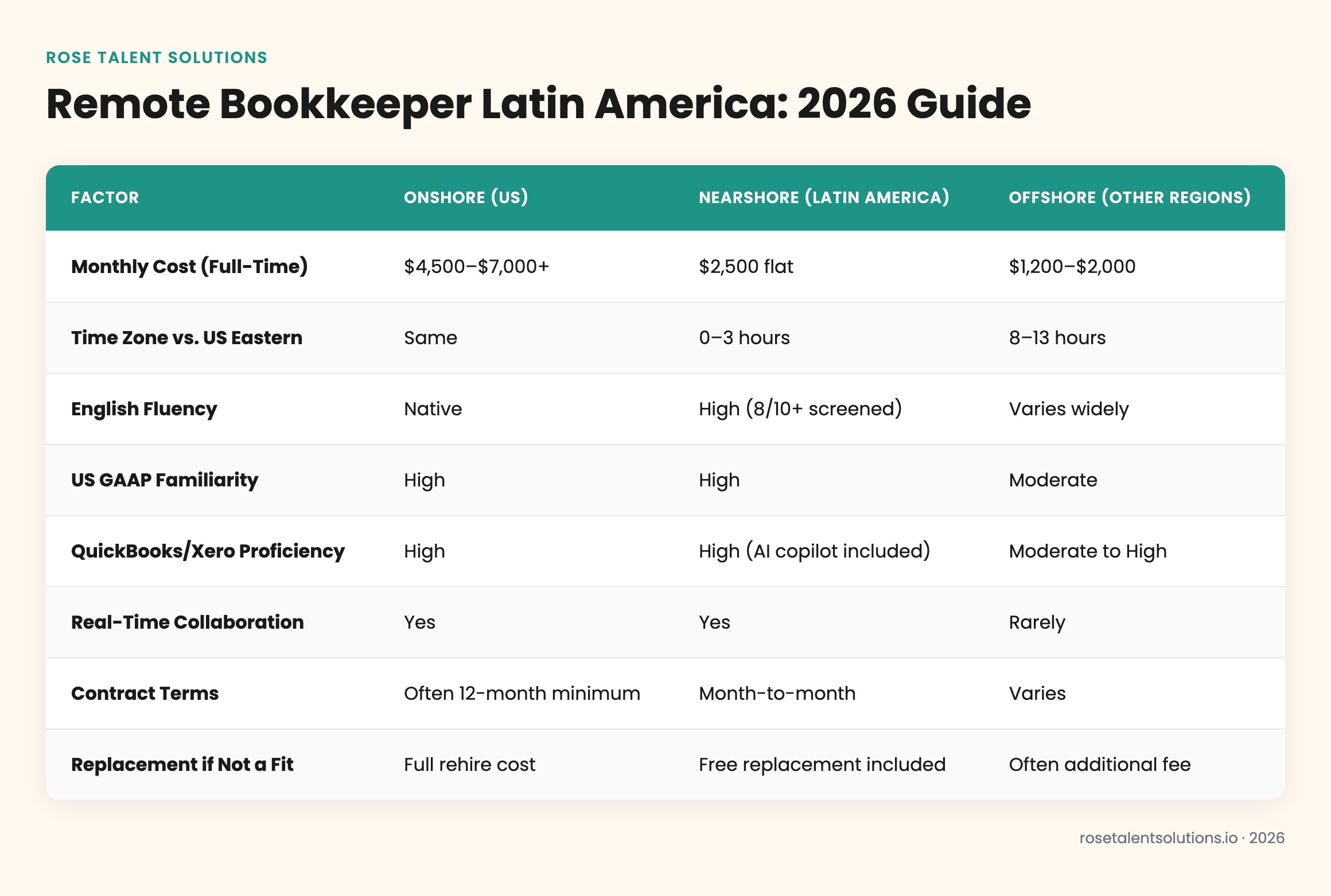
Price is usually the first question—but it shouldn't be the only one. The real calculation includes time zone compatibility, English fluency, software familiarity, and the hidden management overhead that comes with async-only teams. Here's how the three main options compare head-to-head.
| Factor | Onshore (US) | Nearshore (Latin America) | Offshore (Other Regions) |
|---|---|---|---|
| Monthly Cost (Full-Time) | $4,500–$7,000+ | $2,500 flat | $1,200–$2,000 |
| Time Zone vs. US Eastern | Same | 0–3 hours | 8–13 hours |
| English Fluency | Native | High (8/10+ screened) | Varies widely |
| US GAAP Familiarity | High | High | Moderate |
| QuickBooks/Xero Proficiency | High | High (AI copilot included) | Moderate to High |
| Real-Time Collaboration | Yes | Yes | Rarely |
| Contract Terms | Often 12-month minimum | Month-to-month | Varies |
| Replacement if Not a Fit | Full rehire cost | Free replacement included | Often additional fee |

How Latin American Bookkeepers Handle QuickBooks, Xero, and Modern Accounting Tools in 2026
Software fluency is non-negotiable when you're hiring remotely. The good news: Latin America has a deep and growing pool of bookkeeping professionals certified in the platforms US businesses actually use. QuickBooks and Xero both run active ProAdvisor and partner certification programs in Latin America, and demand for these credentials has grown sharply as more US companies embrace remote finance teams.
At Rose Talent Solutions, every bookkeeper placed through our bookkeeping and accounting staffing service ships with a role-specific AI copilot trained on their core software stack. That means a QuickBooks bookkeeper arrives on day one already familiar with your chart of accounts workflow, your reconciliation cadence, and common error patterns in your platform—not learning those basics on your dime. If you're specifically running Xero, our guide to hiring a Xero virtual bookkeeper covers platform-specific screening criteria in detail.
"Accounting talent in Latin America has matured significantly. We're seeing professionals with Big Four training, US CPA exam candidates, and deep familiarity with cloud accounting tools—at salary expectations that reflect local cost of living, not New York rates." — Raul Mendez, Director of Finance Talent, Nearshore Americas (2024)
According to SHRM's Talent Acquisition Benchmarking Report (2023), the average cost-per-hire for a US accounting role exceeds $4,700—and that's before the first paycheck clears. Nearshore hiring through a managed staffing provider collapses that cost dramatically, while still giving you a vetted professional who knows your tools and shows up on time for your morning standup.
The depth of Latin America's accounting talent pool is not an accident. Universities in Colombia, Mexico, and Argentina have long-established accounting and finance programs aligned with international standards. The Inter-American Development Bank has tracked significant investment in STEM and finance education across the region over the past decade, producing a generation of graduates who entered the workforce as remote work became the norm—meaning they're culturally and technically prepared for exactly this kind of role.
The hidden cost of offshore bookkeeping isn't the monthly rate—it's the 8–13 hour time zone gap that turns every urgent question into a next-day problem. Nearshore Latin America eliminates that gap entirely: your bookkeeper is online when your bank statement drops, your vendor calls, or your CPA needs a report by noon.
What Tasks Can a Remote Bookkeeper in Latin America Handle in 2026?
A well-placed nearshore bookkeeper can take on the full scope of day-to-day financial operations for a small or mid-sized US business. This isn't a data-entry role—it's a functional finance team member who owns processes end to end. The full breakdown of company accounting functions suited to Latin American remote staff covers more specialized roles, but the core bookkeeping scope typically includes the tasks below.
- Daily bank and credit card reconciliation
- Accounts payable and receivable management
- Expense categorization and receipt matching
- Payroll data entry and processing support
- Month-end close preparation and journal entries
- Financial statement preparation (P&L, balance sheet, cash flow)
- Vendor communication and bill payment scheduling
- QuickBooks, Xero, or FreshBooks maintenance and cleanup
- 1099 preparation support and year-end reporting
According to Fit Small Business (2024), small businesses that outsource bookkeeping save an average of 10+ hours per week that owners were previously spending on financial admin. That time compounds: owners redirect it to sales, operations, or simply not working weekends. When those hours are reclaimed consistently, the return on a $2,500/month engagement becomes straightforward math—even before you account for the reduction in errors that come from having a dedicated specialist instead of a generalist wearing twelve hats.
Beyond routine tasks, a nearshore bookkeeper working full-time develops genuine context about your business. They notice when a vendor's invoices spike unexpectedly, flag a receivable that's aging past terms, or flag a payroll discrepancy before it becomes a compliance issue. That institutional knowledge is what separates a dedicated full-time hire from a rotating team at a bookkeeping outsourcing firm—and it's one of the strongest arguments for the model Rose uses rather than a shared-services approach.

How the Rose Talent Solutions Hiring Process Works in 2026
Most business owners worry that hiring a remote bookkeeper will be complicated, slow, or require them to become a recruiting expert overnight. Rose's model is designed to remove every step of that burden. Here's what the process actually looks like from intake call to productive first week.
Intake & Role Scoping
You tell us your software stack, weekly transaction volume, and must-have skills. We document the role and begin active matching within 24 hours.
Vetting & English Screening
Candidates clear Rose's multi-step screen: accounting skills test, software proficiency check, and English fluency interview (minimum 8/10 required to advance). No candidate reaches your inbox without passing every gate.
Client Interview & Selection
You interview your top 1–3 matches and choose. No pressure to pick anyone you're not confident in—we keep sourcing until you are.
AI Copilot Onboarding
Your new bookkeeper's role-specific AI copilot is configured for your software. They arrive on day one knowing your platform, not learning it. Learn more about how this works at our AI advantage page.
Ongoing Management & HR
Rose handles payroll, HR, compliance, and ongoing performance management. You manage the work; we manage the employment relationship—including replacing the team member at no additional cost if they ever aren't the right fit.
The flat rate is $2,500/month, all-in. That covers recruiting, vetting, payroll, HR administration, and ongoing management support. Terms are month-to-month with 30 days written notice—no long-term contract required. If the team member isn't the right fit for any reason, Rose replaces them at no additional cost. That's the only risk reversal we offer, and it's the one that actually matters: you don't absorb the cost of a wrong hire.
According to Gallup (2023), the cost of replacing an employee ranges from one-half to two times their annual salary. For a bookkeeping role, that's a $25,000–$95,000 exposure every time a hire doesn't work out through traditional channels. Rose's replacement guarantee eliminates that exposure entirely—making the managed staffing model not just convenient but structurally lower-risk than hiring on your own.
Is Hiring a Remote Bookkeeper in Latin America Right for Your Business in 2026?
Nearshore bookkeeping is not a universal fit for every business at every stage. Here's an honest breakdown of who benefits most—and where friction can appear. Use this as a quick self-assessment before you book an intake call.
Best-fit situations
- US-based SMBs spending 10+ hours/week on financial admin
- Companies using QuickBooks, Xero, FreshBooks, or similar cloud tools
- Businesses that need real-time financial visibility during US hours
- Owners who want a dedicated person, not a rotating outsourced team
- Teams scaling fast and needing finance support without a full-time US hire
- Property managers handling AP, owner distributions, and reconciliation volume
Potential friction points
- Businesses with highly complex, niche US tax situations (a CPA is still needed for tax strategy)
- Owners who require in-person collaboration exclusively and cannot adapt to async tools
- Companies using legacy desktop software with no remote access or cloud sync capability
For most US small businesses—especially those in real estate, e-commerce, services, or professional services—a nearshore bookkeeper covers the full operational bookkeeping load. For tax planning and CPA-level advisory, you'd still want a licensed US CPA; your remote bookkeeper handles the clean, organized books that make your CPA's work faster and cheaper. If you're in property management specifically, our property management staffing page details how nearshore team members handle the specific workflows of AppFolio, Buildium, and Yardi environments.
According to McKinsey Global Institute (2023), over 70% of finance and accounting tasks currently performed in-office are fully compatible with remote delivery—and that number is only growing as cloud adoption accelerates. The infrastructure question for nearshore bookkeeping is effectively solved. The only remaining question is whether the talent matches your standards—and that's precisely what a managed staffing model is built to address.
If you're ready to move from research to action, the fastest next step is to review the specifics of what a full-time engagement covers and start your hiring process here. Or, if you want more context on exactly what to screen for before committing, our detailed guide to hiring a bookkeeper in Latin America covers the full due-diligence checklist—software vetting criteria, English assessment frameworks, and red flags to watch for in unmanaged freelance hires.