
Nearshore bookkeeping support has become one of the fastest-growing cost-control levers for US small businesses in 2026 — and understanding QuickBooks Online Accountant pricing is the first step to knowing where that support fits. Whether you are a business owner trying to decode your accounting software bill or an accountant building a scalable tech stack, the real cost picture is almost always more complicated than the QuickBooks pricing page suggests. This guide breaks down every tier, every add-on, and every hidden line item so you can make a fully informed decision.
What Is QuickBooks Online Accountant — and How Does Its Pricing Work in 2026?
QuickBooks Online Accountant (QBOA) is the free practice-management hub that Intuit provides to accounting professionals. It lets bookkeepers and CPAs access multiple client QuickBooks Online (QBO) files from a single login, run cross-client reports, and manage team workflows — all at no direct cost to the accountant. The cost sits with the client, who pays for their own QBO subscription.
QBOA itself does not have a monthly fee. What you are actually pricing when you research "QuickBooks Online Accountant pricing" is the underlying QBO plan your clients — or your own firm — must carry. Intuit's 2026 list prices for those plans are shown in the table below. Accountants who purchase QBO on behalf of clients through the ProAdvisor wholesale channel receive a 30% discount on client subscriptions, which is the primary financial incentive to use QBOA as your practice hub.
According to Intuit's official QuickBooks pricing page (2026), the four core QBO tiers are Simple Start, Essentials, Plus, and Advanced. Each tier unlocks additional users, reporting depth, and automation features. Accountants should match the tier to the client's actual operational complexity — not to the lowest number on the page.
2026 QuickBooks Online Plan Tiers: What Each One Actually Costs
| QBO Plan | 2026 List Price / Month | ProAdvisor Wholesale Price / Month | Included Users | Key Features |
|---|---|---|---|---|
| Simple Start | $35 | ~$24.50 | 1 | Income & expense tracking, invoicing, basic reports, 1099 filing |
| Essentials | $65 | ~$45.50 | 3 | Everything in Simple Start + bill management, time tracking, 3 users |
| Plus | $99 | ~$69.30 | 5 | Everything in Essentials + project profitability, inventory, budgeting |
| Advanced | $235 | ~$164.50 | 25 | Everything in Plus + custom roles, batch invoicing, dedicated account team, analytics |
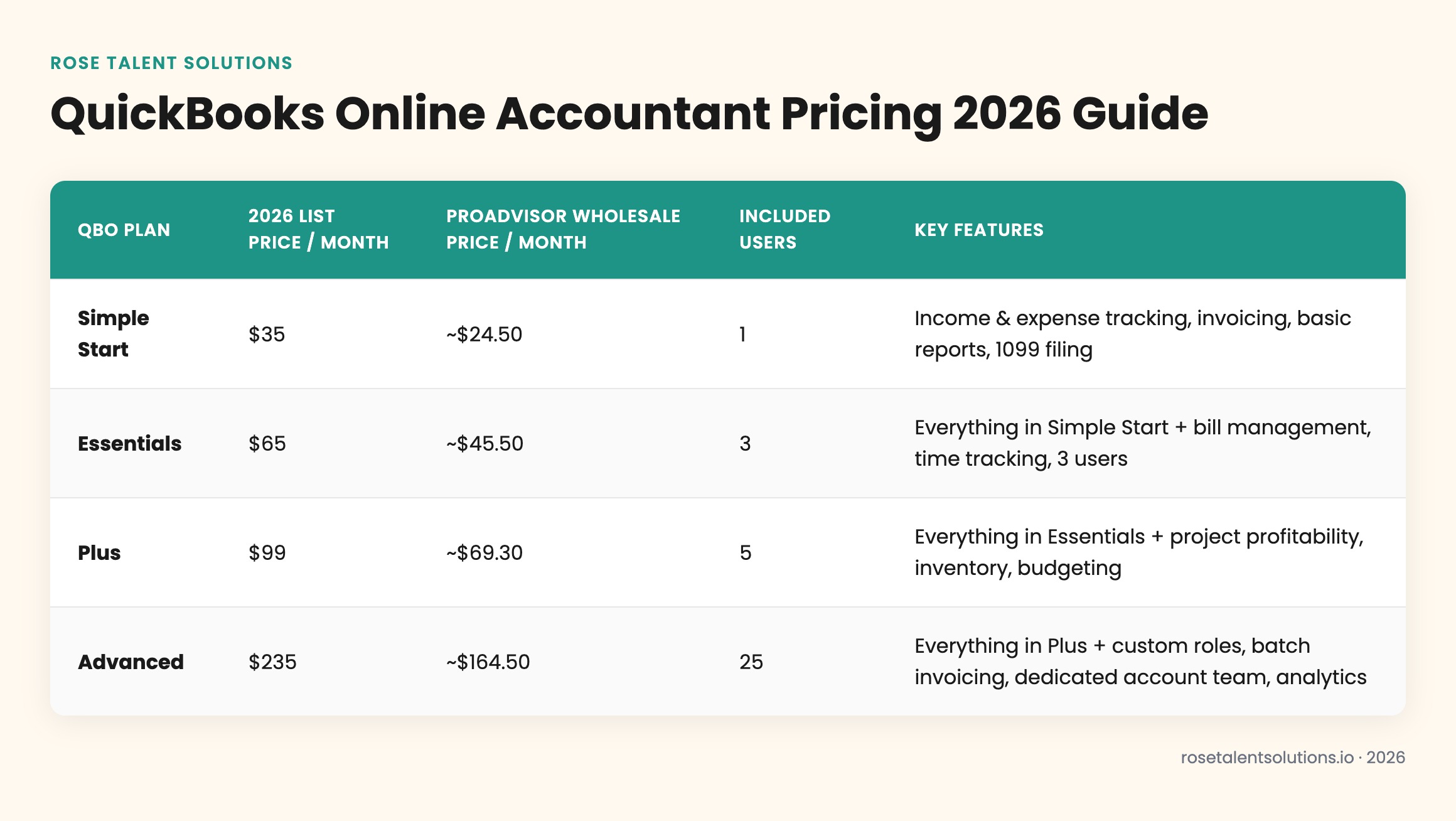
List prices above reflect Intuit's standard retail pricing. Promotional introductory rates (typically 50% off for the first three months) are frequently offered but expire, so budget-plan decisions should be based on the full list price. If you want to understand how these QBO subscription costs intersect with what a dedicated bookkeeper charges on top of the software, our QuickBooks bookkeeping pricing breakdown maps the full picture.
How Add-Ons and Hidden Fees Inflate Your Real 2026 QuickBooks Cost
The base QBO subscription is almost never the final number. Intuit offers a growing menu of paid add-ons that most growing businesses eventually need. Payroll is the most common: QuickBooks Payroll Core starts at $45/month plus $6 per employee, while Payroll Premium runs $80/month plus $8 per employee, according to Intuit's payroll pricing page (2026). For a ten-person team, payroll alone adds $105–$160 per month on top of your QBO plan.
Other common add-ons that can meaningfully raise monthly spend include:
- QuickBooks Time (time tracking): $20/month base + $8 per user
- QuickBooks Payments (merchant processing): 2.4%–3.5% per transaction depending on method
- Live Bookkeeping (Intuit's managed service): $200–$400/month depending on monthly expenses
- Additional QBO users beyond plan limit: not available on Simple Start or Essentials — forces an upgrade
The combined total for a 15-person business running QBO Plus, Payroll Premium, and QuickBooks Time easily exceeds $600 per month before any professional bookkeeping labor. That context matters when you are evaluating whether Intuit's own QuickBooks Live Bookkeeping cost is competitive against hiring dedicated human support.
QuickBooks Live vs. a Nearshore Bookkeeping VA: How the 2026 Numbers Compare
Once you know what the software costs, the next question is who runs it. Intuit's own QuickBooks Live Bookkeeping service pairs you with a bookkeeper for $200–$400 per month — but that service is scoped narrowly to categorization and reconciliation. It does not cover accounts payable, accounts receivable, payroll processing, financial reporting, or CFO-level advisory. The moment your needs grow beyond basic catch-up, you are pushed toward a full-service accountant billing $75–$150 per hour, according to U.S. Bureau of Labor Statistics Occupational Employment data (2024).
"Small businesses that outsource their bookkeeping functions spend on average 10 hours less per week on financial administration than those that keep it in-house." — Angie Mohr, CPA, Author of Financial Management 101 and small business finance columnist (2023)
A nearshore virtual bookkeeper hired through a staffing model like Rose's bookkeeping and accounting practice handles the full scope — AP, AR, reconciliation, reporting, payroll coordination — for a flat $2,500 per month. That is a fully dedicated, full-time team member working 40 hours per week on US business hours, with recruiting, vetting, HR, and payroll all included. Compare that to the cost of a local full-time bookkeeper: the median US salary for a bookkeeper is $47,440 per year (roughly $3,953/month in salary alone), according to the Bureau of Labor Statistics Occupational Outlook Handbook (2024) — before benefits, payroll taxes, and equipment.

QuickBooks Live covers only basic categorization and reconciliation. A nearshore bookkeeping VA at $2,500/month handles the full accounting function — AP, AR, payroll coordination, reporting, and software management — for less than the salary cost of a US junior bookkeeper, with no benefits overhead.
What Does "Nearshore" Mean — and Why It Matters for QuickBooks Work?
A nearshore virtual assistant is a professional based in Latin America who works remotely for a US, Canadian, or UK employer. Unlike offshore outsourcing sourced from regions with 6–12 hour time-zone gaps, nearshore means your bookkeeper operates in EST, CST, MST, or PST — so they are live in QuickBooks when your vendors call, your bank flags a transaction, or you need a report before a 3pm meeting. Rose requires all team members to score 8/10 or higher on English proficiency screens, which eliminates the communication friction that plagues many remote bookkeeping arrangements.
Every Rose bookkeeping VA also ships with a role-specific AI copilot trained on QuickBooks Online, so they are not learning the software from scratch on your dime. The AI copilot handles pattern recognition on transaction categorization, flags reconciliation discrepancies, and drafts financial summaries — accelerating output without replacing the human judgment your books require. According to McKinsey's State of AI report (2024), organizations that combine human oversight with AI assistance in financial functions report 20–30% faster cycle times on routine accounting tasks.
The talent pool in Latin America has deepened considerably. According to the Inter-American Development Bank's Future of Work research (2023), Latin America produced over 175,000 new accounting and finance graduates annually as of 2022 — a pipeline that supports strong English-fluent candidate quality at significantly lower total labor cost than comparable US hires. That supply-demand dynamic is a core reason nearshore bookkeeping scales in a way that domestic hiring simply cannot match for most small businesses.
If you are weighing alternatives to QuickBooks entirely, our guide to hiring a Xero virtual bookkeeper covers how the same nearshore model works for Xero-based workflows — useful if your clients or industry lean toward Xero.
How to Get Started with a Nearshore QuickBooks VA in 2026
The process of engaging a Rose nearshore bookkeeper is faster than most business owners expect. Here is the typical sequence from inquiry to first day in your QuickBooks file:
Discovery Call (Day 1)
Rose reviews your QBO plan tier, transaction volume, current pain points, and any add-ons in use (payroll, payments, time tracking) to scope the role accurately.
Candidate Matching (Days 2–5)
Rose's recruiting team identifies two to three pre-vetted Latin America-based candidates with verified QuickBooks experience and English proficiency scores of 8/10 or higher.
Interview & Selection (Days 5–6)
You interview shortlisted candidates and select your preferred team member. No surprise fees — the $2,500/month flat rate is all-in from day one.
Onboarding & Access (Day 7)
Your VA receives QBOA access, gets oriented on your chart of accounts, and begins reconciliation or AP/AR workflow by end of first week.
Ongoing Management
Rose handles payroll, HR, and performance oversight. If the placement is ever not a fit, Rose replaces the team member at no additional cost.
The entire engagement runs month-to-month with no long-term contract. You give 30 days' written notice to cancel. For a deeper look at what the cost structure looks like across different QuickBooks service models, the QuickBooks virtual bookkeeper cost guide for 2026 benchmarks all the major options side by side.
Nearshore vs. Offshore vs. In-House: The 2026 Cost Reality
Business owners researching QuickBooks accountant pricing are almost always making a staffing decision alongside a software decision. The table below puts the three most common paths side by side so you can see total cost of ownership — not just the hourly rate or subscription fee.
| Option | Typical Monthly Cost | Hours/Week | Time Zone Overlap (US) | QuickBooks Proficiency | Includes HR/Payroll Mgmt? |
|---|---|---|---|---|---|
| US In-House Bookkeeper | $3,953–$5,500 (salary + taxes) | 40 | Full | Varies — you train | No (you manage) |
| Offshore VA (significant time-zone gap) | $800–$1,500 | 40 | Poor (6–12 hr gap) | Variable, often generic | Rarely |
| QuickBooks Live (Intuit) | $200–$400 | Limited scope only | US-based | QBO-specific | No |
| Rose Nearshore VA (Latin America) | $2,500 flat | 40 dedicated | Full (Latin America) | QBO-trained + AI copilot | Yes — all-in |
Nearshore VA Advantages
- Real-time US business hours — no overnight batching
- Full-scope bookkeeping: AP, AR, payroll, reporting
- Flat $2,500/month — no benefits, no payroll tax overhead for you
- AI copilot accelerates QBO workflows from day one
- Free replacement if not a fit — zero placement risk
Potential Tradeoffs to Consider
- Not physically in your office (fully remote model)
- Requires granting QBO/QBOA file access and brief onboarding
- Not suitable if your state requires a licensed CPA to sign off on filings (the VA handles the books; you or your CPA reviews and signs)
According to SHRM's Human Capital Benchmarking report (2023), the average cost to hire a single full-time employee in the US is $4,700 in recruiting costs alone — before the first paycheck is written. The Rose model eliminates that recruiting cost entirely and wraps it into the flat monthly rate. That single data point changes the math for most small businesses evaluating their first dedicated bookkeeper hire.
Gallup research further reinforces the value of remote staffing done well: according to Gallup's Employee Engagement and Growth report (2023), highly engaged remote employees show 23% higher profitability contribution than disengaged in-office peers — a reminder that engagement and oversight structure matter more than physical proximity when it comes to bookkeeping quality.
Ready to stop estimating and start scaling? Visit the Rose get-started page to tell us about your QuickBooks setup and get matched within the week.