
How Much Does a QuickBooks Accountant Actually Cost in 2026?
Nearshore accounting support has become the fastest-growing answer to a question every business owner eventually asks: why is qualified QuickBooks help so expensive? The honest answer is that "QuickBooks accountant cost" isn't a single number — it's a spectrum that runs from $25/hour for a part-time bookkeeper to well over $100/hour for a CPA doing month-end close work. Where you land on that spectrum depends on what you actually need, how you hire, and whether you're willing to look beyond the traditional in-house model.
This guide breaks down every major hiring path, what each one truly costs when you factor in overhead, and where the real leverage is for businesses that want QuickBooks expertise without the enterprise payroll.
That figure — $61,480/year for bookkeeping and accounting clerks, according to the U.S. Bureau of Labor Statistics (2024) — covers base salary only. Add employer payroll taxes (7.65%), health benefits, PTO, software seats, and recruiting fees, and the fully loaded cost of a mid-level in-house QuickBooks accountant lands between $75,000 and $95,000 per year for most US employers. That's the number most hiring managers never see on a job offer — but it's the number that hits the P&L every month.
Understanding the full cost picture is especially important if you're also weighing adjacent roles. The true cost of a QuickBooks bookkeeper breaks down differently from accountant-level work — worth reading before you decide which role you actually need and what level of financial oversight your business genuinely requires.
What Are the 2026 Rates for Every QuickBooks Accountant Hire Type?
Before you can compare options intelligently, you need a clear picture of what each hiring path actually costs — not just the sticker price, but the real number after taxes, benefits, and time investment. Here's the full landscape across the four most common routes businesses take.
Freelance QuickBooks accountants on platforms like Upwork or Toptal typically charge $50–$150/hour depending on credential level and specialization. At 20 hours/month of bookkeeping work, that's $1,000–$3,000/month — with zero guarantee of consistent availability, no coverage during illness or vacation, and no HR backstop when the relationship goes sideways. You're also responsible for 1099 management, scope creep, and re-sourcing if they disappear mid-quarter.
In-house hires solve the availability problem but trade it for a much larger fixed cost. At a $65,000 base salary, an in-house QuickBooks accountant costs roughly $6,500–$8,000/month when employer taxes, benefits, and office overhead are included. According to SHRM (Society for Human Resource Management, 2024), the average cost to fill an open role runs $4,683 in direct recruiting expenses — before that person processes a single invoice.

QuickBooks Live Bookkeeping — Intuit's own managed product — sits at a different point in the market entirely. QuickBooks Live connects you with a certified bookkeeper for catch-up work and ongoing reconciliation, but it's a subscription to a rotating pool of bookkeepers, not a dedicated staff member who knows your chart of accounts or your vendors by name. For a full picture of what that product delivers versus a staffed solution, see this detailed breakdown of QuickBooks Live bookkeeping cost and what it covers.
How Do QuickBooks Accountant Costs Compare Across Hiring Models in 2026?
The table below is the clearest way to see what you're actually buying at each price point — and what you're giving up. Use this as a decision framework, not just a price list.
| Hire Type | Monthly Cost (Est.) | Hours/Week | Timezone | Benefits & HR Included | Replacement if Not a Fit |
|---|---|---|---|---|---|
| Freelance (US-based) | $1,000–$4,000 | Variable | US | No | No — you restart the search |
| In-House Employee (US) | $6,250–$7,900 | 40 | US | Yes (adds 25–35% to base) | No — hiring cycle repeats |
| QuickBooks Live Bookkeeping | $500–$700 | Limited scope | US | N/A (product, not staff) | N/A |
| Offshore VA (non-Latin America) | $800–$1,500 | 40 | 8–12 hr gap | Varies | Rarely guaranteed |
| Nearshore VA (Latin America) | $2,500 flat | 40 | US hours | Yes — fully managed | Yes — free replacement |
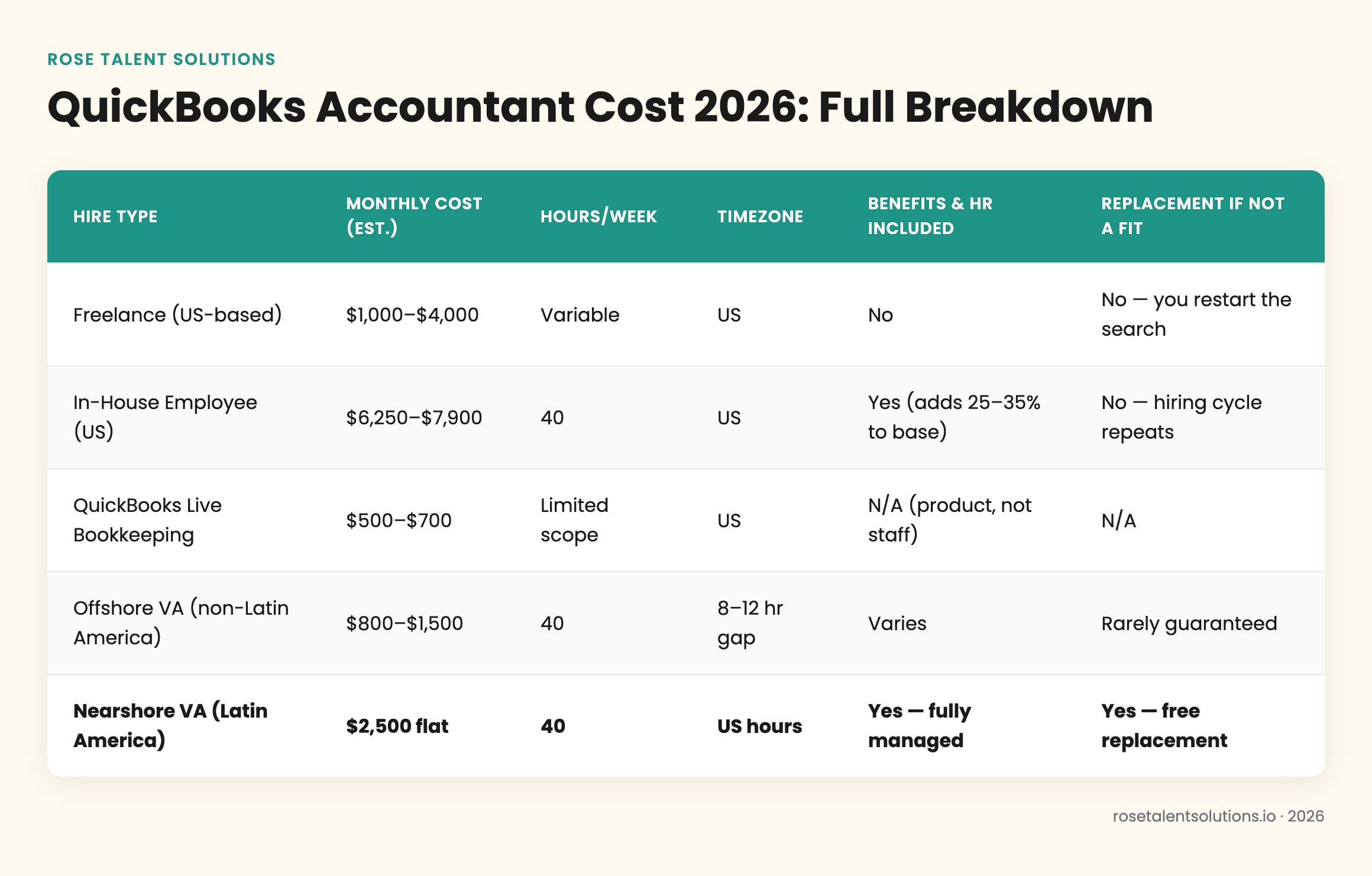
The offshore row in that table deserves a specific note. Offshore staffing solutions based outside Latin America often carry an 8–12 hour timezone gap. That gap turns every QuickBooks question into an overnight ticket, every reconciliation error into a next-morning fix, and every vendor call into a relay race. The price looks attractive until you calculate the operational drag it introduces across your accounting cycle.
What Does "Fully Loaded" QuickBooks Accountant Cost Actually Mean in 2026?
Most business owners underestimate in-house accounting costs because they anchor on base salary. The real number includes payroll taxes, benefits, software licenses, office overhead, and the hidden cost of turnover. The BLS Job Openings and Labor Turnover Survey (2024) consistently shows financial and business services sectors with annual voluntary turnover rates of 20–25%. Statistically, your in-house QuickBooks accountant has roughly a 1-in-5 chance of leaving in any given year — triggering another recruiting cycle, another 60-to-90 day onboarding ramp, and another gap in your books.
When you add payroll taxes (7.65%), health insurance (~$7,000–$8,000/year employer contribution), PTO (10–15 days), and recruiting costs, a $60,000 base salary QuickBooks accountant actually costs $78,000–$92,000 all-in. That's the number to compare against — not the salary line alone.
Retirement benefits add another layer. According to the BLS National Compensation Survey (2024), employers in private industry contribute an average of 4.5% of total compensation toward retirement and savings plans. For a $65,000 salary, that's nearly $3,000/year in additional cost that rarely appears in a hiring manager's mental math.
The cost escalation problem is especially sharp for small businesses managing multiple accounting functions simultaneously. If your accountant also handles Xero or you're evaluating platforms, the economics of a Xero virtual bookkeeper versus a QuickBooks-trained counterpart follow a similar pattern — platform expertise matters, but the hire model you choose has a bigger long-term impact on total cost and coverage continuity.
"Small businesses consistently overpay for accounting because they conflate bookkeeping tasks with accountant-level work. Separating the two — and staffing each appropriately — is where most of the savings live." — Gene Marks, Small Business Columnist & Founder of The Marks Group (2024)

How Does Nearshore QuickBooks Staffing Cut Costs Without Cutting Quality in 2026?
Nearshore staffing means hiring skilled professionals from Latin American countries — such as Mexico, Colombia, or Argentina — who work your US, Canadian, or UK business hours in real time. The Latin American talent pool for accounting and finance roles is substantial: World Bank tertiary education enrollment data (2023) shows Latin America has significantly expanded its university-educated workforce over the past two decades, with accounting and business administration among the most common degree fields in the region. That depth of supply, combined with significantly lower cost-of-living benchmarks than the US, is what makes the $2,500/month price point sustainable without sacrificing credential quality.
Unlike offshore models based outside the Americas (which typically carry an 8–12 hour timezone gap), nearshore team members are on the same daily schedule as your team. That difference is not minor — it means your QuickBooks accountant is in QuickBooks while you are, not processing last night's entries when you arrive in the morning.
According to the NFIB Small Business Economic Trends survey (2024), finding qualified staff remains the top operational pain point for small business owners — surpassing even cash flow anxiety. Nearshore staffing directly addresses that constraint by giving US businesses access to a deeper talent pool without paying US fully-loaded compensation rates.
Rose Talent Solutions places full-time QuickBooks-trained accountants at $2,500/month flat — that's 40 hours/week, all-in. Recruiting, vetting, payroll, HR, and ongoing management are included in that number. Every team member placed through Rose comes equipped with a role-specific AI copilot trained on their core software, including QuickBooks — which compresses onboarding time significantly. If a placement isn't a fit, Rose replaces them at no additional cost. Rose's published English proficiency floor is 8/10+ on screening assessments — a bar that filters out the communication friction that makes distant-timezone accounting hires frustrating in practice.
For businesses that need comprehensive accounting support — not just transaction entry but full-cycle bookkeeping — it's worth understanding what QuickBooks full-service bookkeeping costs at different tiers, so you can right-size the engagement before committing to a staffing model.
How the Rose Nearshore Accounting Hiring Process Works
Role Scoping Call
Rose walks you through the specific QuickBooks tasks, software versions, and workflow integrations you need covered — AP/AR, payroll, reconciliation, reporting, or all of the above.
Candidate Vetting & Matching
Rose screens for QuickBooks proficiency, English fluency (8/10+ floor), and timezone availability. You review 1–2 matched candidates, not a pile of resumes.
Placement & AI Copilot Onboarding
Your team member starts within days, equipped with a role-specific AI copilot trained on QuickBooks workflows — compressing the ramp from weeks to days.
Ongoing Management Included
Rose handles payroll, HR, and performance management. You manage the work. If it's not working, Rose replaces the team member at no additional cost.
The engagement is month-to-month with no long-term contract — 30 days written notice to cancel. You can explore the full bookkeeping and accounting staffing options or go straight to the intake form to get matched.
Nearshore vs. Offshore QuickBooks Accountant: What the Data Shows in 2026
Nearshore (Latin America) — Pros
- Works your exact US business hours — no timezone lag
- English fluency screened to 8/10+ floor
- Cultural alignment with US business communication norms
- Real-time QuickBooks collaboration and same-day turnaround
- Flat $2,500/month covers full-time, fully managed
- Free replacement if the team member isn't a fit
Distant Offshore — Cons
- 8–12 hour timezone gap creates asynchronous bottlenecks
- Overnight batch processing delays same-day financial visibility
- Communication friction increases review cycles
- Oversight burden falls entirely on the employer
- No standard replacement guarantee
- Month-end close errors discovered in the morning sit unresolved until the next business day
The timezone gap is not a soft inconvenience — it's a hard operational cost. If your QuickBooks accountant is processing invoices overnight and you discover an error at 10am, you are waiting until the following day for a fix. That delay compounds across month-end close cycles, cash flow decisions, and vendor payment windows. Nearshore staffing eliminates that lag entirely because your accountant is online, in QuickBooks, and responsive during the same hours you are.
A 2023 Gallup study found that employees who work in real-time collaboration with their managers report significantly higher engagement and productivity scores than those operating in asynchronous-only environments, according to Gallup's State of the Global Workplace report (2023). That principle applies directly to remote accounting hires: a nearshore accountant who attends your morning standup, responds to Slack messages in real time, and joins your monthly financial review call is fundamentally a different operational asset than an offshore counterpart processing batches overnight.
If you are evaluating virtual staff for property management accounting specifically — where AppFolio or Buildium intersects with QuickBooks reconciliation — the nearshore timezone advantage is even more pronounced, since tenant and vendor payment cycles don't pause for batch windows on the other side of the globe.
The right question isn't just "what does a QuickBooks accountant cost?" — it's "what does a gap in my books cost me?" When you frame it that way, the $2,500/month flat rate for a full-time, nearshore, AI-equipped QuickBooks accountant stops looking like an expense and starts looking like insurance with a very favorable premium.