
Nearshore sales development reps — based in Latin America, working US business hours — have quietly become the highest-leverage hire in the SaaS playbook for 2026. While US-based SDRs cost north of $75,000 a year in base salary alone, before benefits, tools, and manager overhead, nearshore SDR talent in Colombia, Mexico, Argentina, and Costa Rica delivers the same pipeline-building work in fluent English at a fraction of the cost. If you've been searching for an outsourced SDR team for SaaS companies, this post breaks down exactly how the model works, what it really costs, and how to avoid the pitfalls that sink most first-time buyers.
Sales development is the engine of SaaS growth. SDRs cold-call, cold-email, run LinkedIn sequences, qualify inbound leads, and hand off booked demos to your account executives. According to the U.S. Bureau of Labor Statistics (2024), the median annual wage for sales representatives in technical industries already exceeds $65,000 — and that's before commissions, recruiting fees, or the six to twelve weeks it typically takes a new SDR to hit quota. Outsourcing that function to a dedicated nearshore team collapses the cost curve and cuts ramp time simultaneously.
What Is an Outsourced SDR Team, and How Does It Work in 2026?
An outsourced SDR team is a group of dedicated sales development representatives employed and managed by a third-party staffing or services firm, working exclusively on your pipeline. Unlike freelancers or shared call-center agents splitting time across five clients, a dedicated outsourced SDR functions exactly like an in-house hire — they use your CRM, follow your sequences, attend your standups — but the recruiting, vetting, payroll, HR compliance, and ongoing performance management are handled by the vendor, not you.
The nearshore model specifically places those reps in Latin America: countries like Colombia, Mexico, Argentina, and Costa Rica. That geographic proximity means the team works the same time zone as your US or Canadian sales floor, can hop on Slack in real time, and speaks English at a level that passes the same fluency bar your domestic hires would. Rose Talent Solutions screens every SDR candidate to an 8/10 or higher on English proficiency before a client ever sees a profile. Rose operates exclusively in Latin America — every team member is based in the region, full stop.
If you want a deeper walkthrough of the vendor selection process, the Rose post on how to hire outsourced SDR services for SaaS covers the exact criteria — contract structure, ramp expectations, and red flags to watch for — in plain language.

How Nearshore Latin America SDR Teams Outperform Offshore Alternatives in 2026
The most common mistake SaaS founders make when outsourcing sales development is conflating nearshore with offshore. They are not the same model, and the difference shows up directly in your pipeline numbers. Vendors routing work through regions with a 10-to-14-hour time offset create structural delays that no amount of process can fix — a prospect replies to a cold email at 10am EST and doesn't hear back until the next business day because the rep's shift already ended hours earlier.
Nearshore Latin America sits 0 to 3 hours off US Eastern time. Your outsourced SDR team is on Slack when you open Slack. They can attend 9am standups live. They can handle a hot inbound lead the moment it lands. According to McKinsey's B2B Sales Benchmark Report (2023), B2B buyers who receive a response within five minutes of a demo request are 100 times more likely to convert than those who wait thirty minutes or more. Timezone alignment isn't a soft benefit — it's a pipeline metric.
The hidden cost of misaligned SDR teams isn't the hourly rate — it's the 10-to-14-hour timezone gap that means every hot inbound lead sits cold overnight while your competitor's nearshore Latin America rep already booked the demo.
Language quality matters equally. English fluency at an 8/10 or higher — the bar Rose enforces across its Latin America talent pool — means your SDR can handle objection-heavy cold calls, write personalized outbound copy, and represent your brand on a discovery call without the friction that erodes conversion rates. According to Gallup's State of the Global Workplace (2024), employee effectiveness drops sharply when communication clarity between team members falls below a defined threshold — a finding that applies directly to remote sales teams operating across language gaps.
For a head-to-head financial breakdown, Rose's analysis of outsourced vs. in-house SDR hiring ROI runs the full numbers — including hidden costs most SaaS CFOs miss when they model the "cheaper to hire in-house" scenario.
How Much Does an Outsourced SDR Team Cost for SaaS Companies?
Pricing in the outsourced SDR market ranges wildly, and the range itself tells you something about what you're actually buying. Here is what the market looks like in 2026:
| SDR Model | Monthly Cost (per rep) | Timezone Fit (US) | English Fluency | Ramp Time |
|---|---|---|---|---|
| Onshore US in-house SDR | $6,500–$9,000+ (salary + benefits + overhead) | Perfect | Native | 8–12 weeks |
| Nearshore SDR (Latin America) | ~$2,500 flat (all-in) | 0–3 hr offset | 8/10+ fluent | 1–3 weeks |
| Low-cost offshore SDR (distant time zones) | $800–$1,800 | 10–14 hr offset | Variable (4–7/10) | 3–6 weeks |
| SDR Agency (shared / fractional) | $3,000–$8,000 (shared reps, no exclusivity) | Varies | Varies | Varies widely |
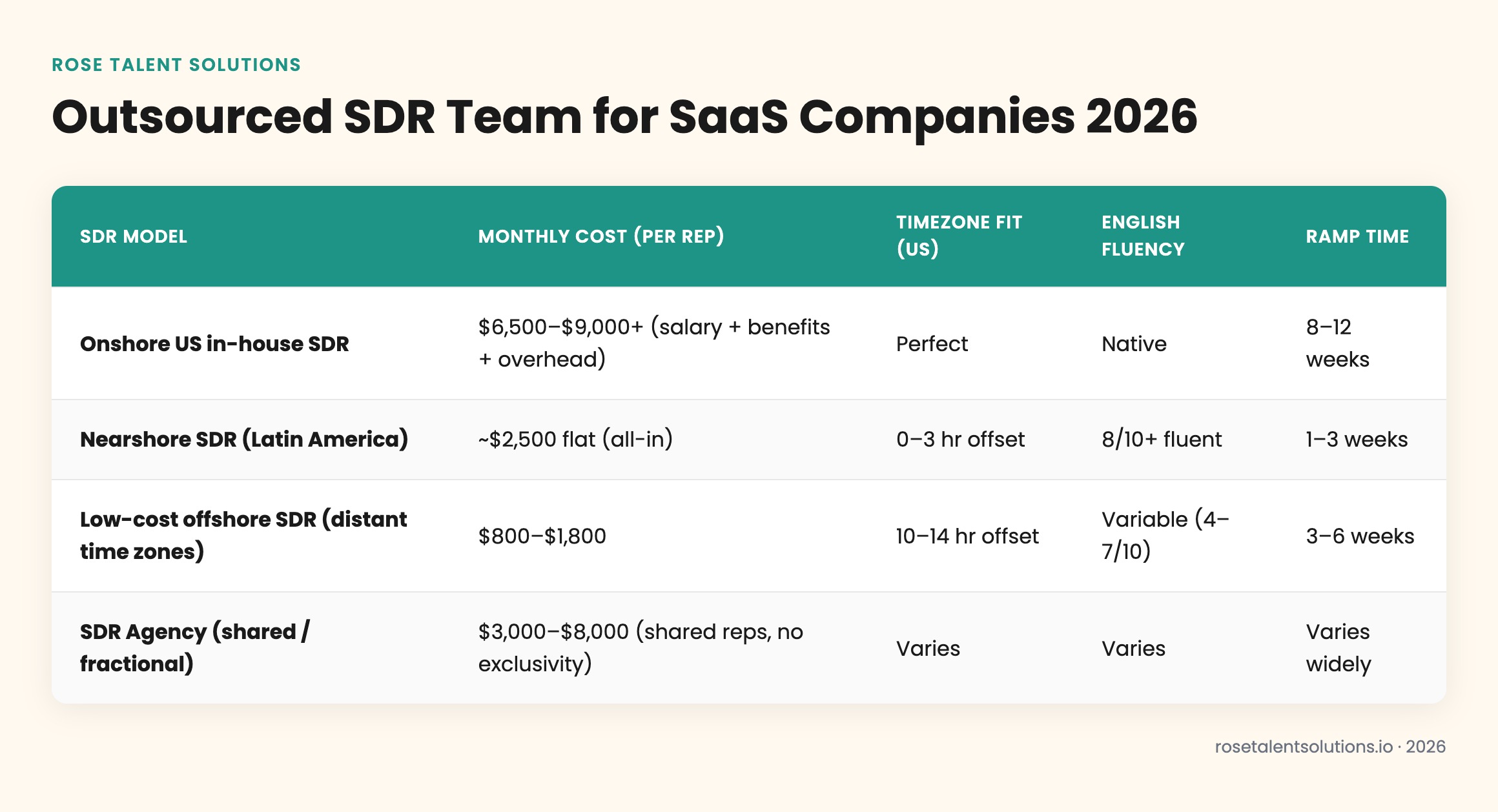
The $2,500 flat rate at Rose Talent Solutions covers recruiting, vetting, onboarding, payroll, HR compliance, and ongoing performance management — everything. There is no long-term contract. You can cancel with 30 days written notice. And if the team member isn't the right fit for your product or process, Rose replaces them at no additional cost. That replacement guarantee is the risk reversal — not a discounted month, not a refund, a qualified Latin America-based replacement who's ready to run your playbook.
"The best SDR teams I've seen in SaaS aren't necessarily the most expensive ones — they're the ones with the tightest feedback loop between rep activity and pipeline data. When your outsourced team is in your timezone, on your tools, in your Slack, that loop closes in hours instead of days." — Kyle Coleman, CMO at Copy.ai (2024)
What Does an Outsourced SDR Team Actually Do for a SaaS Company in 2026?
A well-scoped outsourced SDR team handles the full top-of-funnel workflow. Here is what that looks like in practice for a typical B2B SaaS company running an outbound-plus-inbound motion. According to Deloitte's Global Outsourcing Survey (2023), 65% of companies that outsource sales functions cite access to skilled talent and speed-to-productivity as the top two drivers — not cost alone.
Prospect list building
The SDR identifies target accounts from your ICP, pulls verified contact data from tools like Apollo or ZoomInfo, and segments lists by persona and vertical.
Outbound sequencing
They run personalized email and LinkedIn sequences using your messaging framework — typically 6-to-8 touch sequences over 14 to 21 days — and A/B test subject lines and CTAs.
Cold calling
The SDR works a call block each morning — your US morning, because they're in the same time zone — hitting decision-makers when they're actually at their desks.
Inbound qualification
Every inbound demo request, form fill, or trial signup gets a same-day qualification call to confirm fit, gather discovery data, and lock a calendar slot with your AE.
CRM hygiene and reporting
The SDR logs all activity in your CRM (HubSpot, Salesforce, Pipedrive — whatever you run), updates contact records, and pulls a weekly pipeline report so your leadership team always has clean data.
Every Rose SDR ships with a role-specific AI copilot trained on the tools and workflows your team actually uses. That means faster personalization at scale, smarter sequence optimization, and CRM data that doesn't require a manager to clean up every Friday. For SaaS companies running HubSpot or Salesforce, the AI layer compresses the time between "rep joins your Slack" and "rep is booking qualified demos" dramatically.

How to Choose Between an Outsourced SDR Team and Outsourced Appointment Setters
SaaS buyers often conflate two distinct roles: SDRs and appointment setters. The distinction matters because you pay for different outputs and manage the two functions very differently.
An SDR owns the full top-of-funnel: prospecting, list building, sequencing, calling, objection handling, and handing off a qualified opportunity. They understand your product well enough to have a 10-minute discovery conversation and determine whether the prospect deserves an AE's time. SDRs are typically compensated on booked meetings that hit a defined qualification threshold — not just raw demo volume.
An appointment setter is a narrower role: they work a pre-built list, follow a defined script, and book calendar slots. They're not expected to qualify deeply or adapt to complex objections. Cost is lower, ceiling is lower. If your product sells itself on a demo and your list quality is already high, appointment setters can work. If your AEs are wasting time on demos with unqualified prospects, you need SDRs.
A useful way to think about it: SDRs protect your AEs' time; appointment setters fill your AEs' calendar. According to Pew Research (2023), the shift toward distributed and remote sales teams has accelerated demand for clearly scoped roles — a blurred SDR-vs-setter boundary is consistently cited as a top cause of pipeline funnel inefficiency in remote sales organizations.
Rose's post on outsourced appointment setters for SaaS companies breaks down exactly when to use each model, including the pipeline metrics that tell you which problem you're actually solving.
Is an Outsourced SDR Team Right for Your SaaS Company in 2026?
The model works best for SaaS companies at specific growth stages. If you're pre-product-market fit and still figuring out your ICP, an outsourced SDR team will amplify confusion, not pipeline. If you're post-PMF with a repeatable demo process and an AE who can close, adding nearshore Latin America SDR capacity is one of the highest-ROI levers available.
According to SHRM's cost-per-hire benchmarks (2024), the average cost to recruit and onboard a single US sales hire runs $4,700 in direct recruiting costs alone — before the 8-to-12 weeks of ramp time where that hire is producing below quota. An outsourced nearshore SDR at $2,500/month skips the recruiting cost, compresses ramp to days rather than months, and comes with a no-long-term-contract structure that lets you scale up or down as pipeline demand shifts.
When Outsourced SDR Works
- You have a repeatable demo process and a closing AE
- Your ICP is defined and your messaging is tested
- You need pipeline volume without adding headcount overhead
- You want US-hours coverage without US-salary costs
- You need to scale fast — weeks, not quarters
When to Wait
- You haven't validated product-market fit yet
- Your AE close rate is below 15% (SDRs will fill a broken funnel)
- You have no CRM or defined sequence playbook
- Your messaging changes week to week
- You can't dedicate 2–3 hours in month one to onboarding the rep
If you're ready to move, the fastest path is to review how Rose structures the engagement — dedicated Latin America-based reps, flat pricing, month-to-month terms, and a free replacement if the match isn't right. You can explore the full model on the Rose get-started page or read more about the full outsourced SDR services model for SaaS companies before you book a call.
The SaaS pipeline problem in 2026 isn't a budget problem — it's a capacity and speed problem. Nearshore SDR teams in Latin America solve both simultaneously. At $2,500/month with no long-term contract, the question isn't whether you can afford to try it. The question is how many demos you're leaving on the table every month while you wait.