
Why US Businesses Are Choosing Nearshore VAs in 2026
Nearshore virtual assistants — staff based in Latin America who work your exact US business hours — have become the dominant outsourcing model for US and Canadian businesses that need real-time support without the friction of a wide time zone gap. If you've searched "outsource virtual assistant in USA," you've probably already looked at Upwork freelancers, low-cost overseas agencies, and local part-time hires. In 2026, none of those options consistently deliver the combination of cost, availability, and English fluency that nearshore staffing does.
The math is straightforward. The average fully-loaded cost of a US-based administrative employee — salary, benefits, payroll taxes, recruiting — runs well over $55,000 per year, according to the U.S. Bureau of Labor Statistics (2024). A nearshore VA through Rose Talent Solutions runs $2,500/month flat — roughly $30,000 annually — with recruiting, vetting, payroll, HR, and ongoing management already included. That's not a freelancer rate with hidden overhead on top. It's all-in.
If you're running a property management firm, a bookkeeping practice, an e-commerce brand, or a professional services business, you're almost certainly doing tasks every day that a well-trained VA could handle — leasing inquiries, invoice processing, calendar management, tenant communications, data entry. The question isn't whether to outsource. It's where you outsource, and what structure keeps it from becoming a management headache.
What Is a Nearshore Virtual Assistant? (2026 Definition)
A nearshore virtual assistant is a remote staff member based in a geographically proximate country — in the context of US businesses, that means Latin America: Colombia, Mexico, Argentina, Costa Rica, and similar markets. Nearshore VAs operate in the same or adjacent time zones as their US employers, typically UTC-5 to UTC-3. They hold scheduled hours, attend live meetings, and respond to Slack messages and calls in real time — not the next morning.
This model is structurally different from staffing arrangements that rely on talent pools in Asia or Eastern Europe, where double-digit time zone gaps require night shifts or async-only workflows. Rose's published English proficiency floor is 8/10 or higher on standardized language screens, which filters out the communication friction that frequently affects arrangements spanning very large time zone differences. For a deeper breakdown of how these models differ structurally, this complete nearshore vs offshore vs onshore VA comparison walks through every variable in detail.

Understanding what separates nearshore from other outsourcing models is the first step. The second is knowing whether the VA you're hiring is actually managed — or just placed and forgotten. That distinction matters enormously for businesses that don't have HR infrastructure to babysit a remote worker.
How Nearshore VAs Compare to Other Options in 2026
Most businesses shopping for virtual assistant support in 2026 are weighing three models: hiring domestically (onshore), using a low-cost overseas agency, or going nearshore through a Latin America-based staffing firm. Each has a real cost profile and a real operational footprint. Here's how they stack up.
| Factor | Onshore (US-based) | Distant Offshore | Nearshore (Latin America) |
|---|---|---|---|
| Monthly cost (full-time) | $4,000–$7,000+ | $800–$1,500 | $2,500 flat |
| Time zone overlap with US | Full | 0–4 hrs (night shift required) | Full (same business hours) |
| English fluency | Native | Variable (accent, gaps common) | High (8/10+ screened) |
| Recruiting + HR included | No (DIY or agency fee) | Sometimes (varies by agency) | Yes (Rose handles end-to-end) |
| Ramp time | 2–4 weeks | 3–6 weeks (timezone delays) | ~1 week (same-hours sync) |
| Contract requirement | Varies | Often 3–6 month minimums | No long-term contract (30-day notice) |
| AI copilot included | No | Rarely | Yes (role-specific, software-trained) |
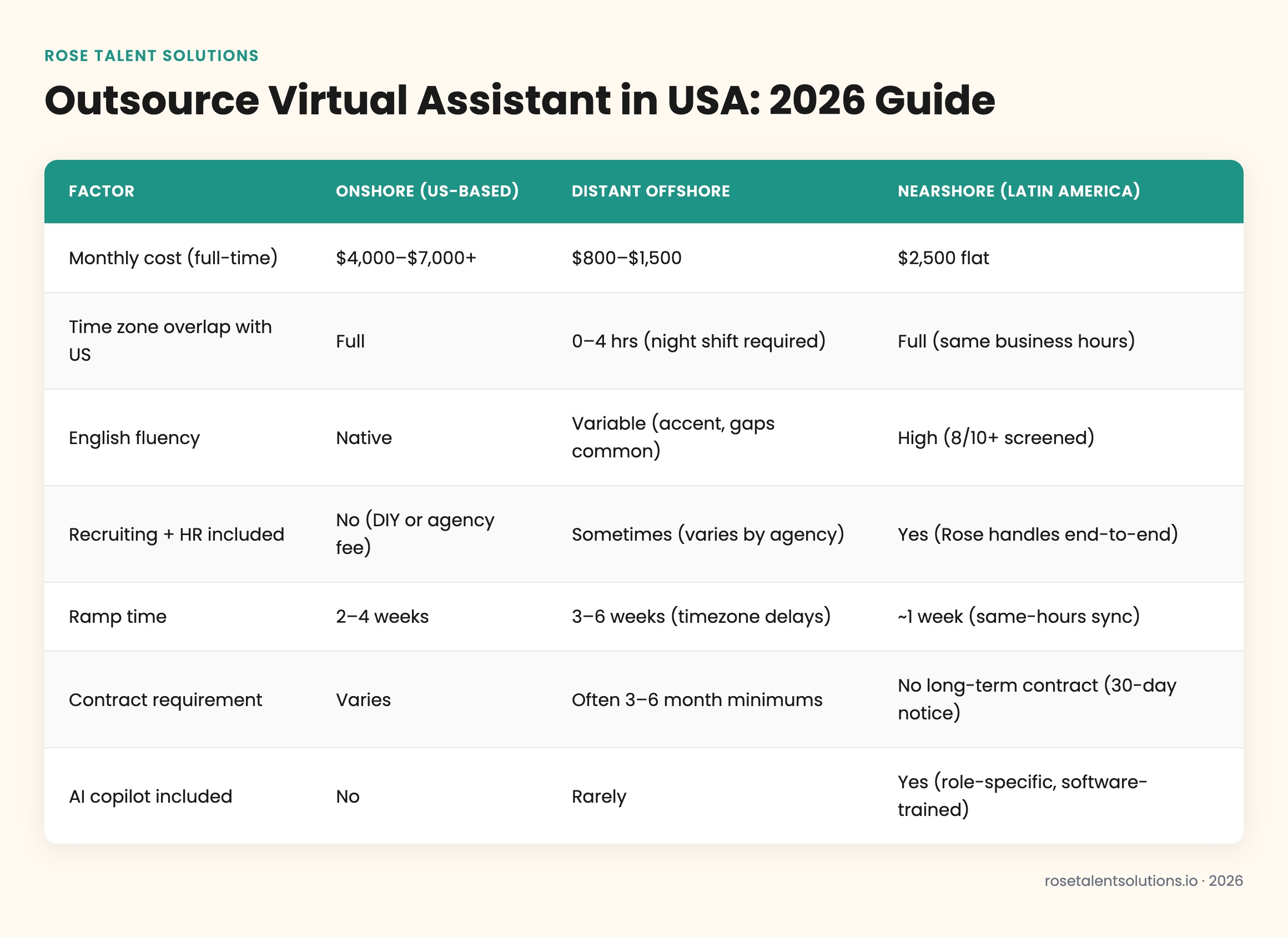
The distant offshore price point looks attractive until you factor in the hidden costs: rework from miscommunication, async delays that turn a 10-minute fix into a 24-hour back-and-forth, and the management overhead of coordinating across a very wide time gap. For a sharper look at how onshore and overseas models differ operationally, this onshore vs offshore VA breakdown covers the real trade-offs most agencies won't tell you.
"The time zone alignment piece is underrated. When your VA is 10 hours ahead, you're essentially running a relay race — you hand off a baton at 5pm and hope it comes back correctly at 3am. That's not collaboration, that's delayed correspondence." — Matt Weirich, Co-founder & CEO at Renters Warehouse (2023)
What Does It Actually Cost to Outsource a Virtual Assistant in 2026?
Let's be direct. When you outsource a virtual assistant in the USA context — meaning you're a US business hiring remote support — you have a wide price range to navigate. Freelancers on platforms like Upwork or Fiverr can run $10–$25/hour, which sounds cheap until you realize you're the recruiter, the HR department, the QA manager, and the payroll processor. A dedicated 40-hour-per-week freelancer at $15/hour is $2,400/month before platform fees — and you've done all the management work yourself.
Managed nearshore staffing at $2,500/month flat includes everything: candidate sourcing, multi-stage vetting, reference checks, English proficiency screening, payroll, compliance, HR support, and ongoing performance management. You get a full-time dedicated team member without building the infrastructure to support one. There's no long-term contract — just 30 days written notice to cancel.
The $2,500/month figure from Rose isn't just a "VA rate" — it's a fully managed employment model. When you account for what you'd spend on recruiting (average $4,200 per hire, per SHRM benchmarking data), benefits, payroll tax, and management time, the flat-rate model often costs less than hiring a part-time domestic admin.
Curious what Latin American virtual assistants actually earn in their local markets? This breakdown of Latin America VA salary averages by country shows why the nearshore model works economically for both sides — the VA earns a competitive wage in their market, and the US business pays well below domestic rates.
According to Statista's outsourcing industry data (2024), the global outsourcing market exceeded $700 billion in annual spend — with the fastest-growing segment being managed remote staffing for SMBs, driven precisely by the cost and flexibility advantages that flat-rate nearshore models offer.

How Rose's AI Advantage Makes Nearshore VAs Faster in 2026
Most VA agencies place a person and walk away. Rose does something different: every team member is paired with a role-specific AI copilot trained on the software they'll actually use — AppFolio, Buildium, QuickBooks, HubSpot, and more. This isn't a generic chatbot wrapper. It's a tool trained on the workflows specific to the VA's role, so they arrive knowing how to navigate the system, not just the job description.
The practical effect: faster ramp time, fewer errors in the first 30 days, and less hand-holding from your team. Software-trained VAs consistently reach full productivity faster than untrained hires — because they're not searching how to run a late fee report in AppFolio while your tenants are waiting.
This matters especially for property management and bookkeeping roles, where platform fluency is the difference between a VA who adds capacity on day one and one who creates a training burden for the first month. Explore how Rose staffs property management virtual assistants with AppFolio and Buildium-trained support, or see the bookkeeping and accounting VA roles built around QuickBooks and Xero workflows.
According to McKinsey's 2025 workplace AI report, employees who work alongside AI tools complete tasks an average of 30–40% faster than those without AI support — a compounding advantage when your VA handles 50+ routine tasks per week.
How to Outsource a Virtual Assistant in the USA: The Rose Process
Getting started with a managed nearshore VA doesn't require a long procurement process. Here's how Rose moves from intake to active team member — typically within one week.
Discovery Call
Rose scopes your role — tasks, software stack, hours, communication style. This takes 30 minutes and produces a candidate brief your VA is hired against, not a generic job post.
Candidate Matching
Rose's recruiting team surfaces 2–3 pre-vetted candidates from its Latin America talent network — already screened for English fluency (8/10+ floor), background-checked, and matched to your software stack.
Your Interview + Selection
You interview the shortlisted candidates and choose your hire. No pressure to pick someone who isn't the right fit — Rose handles replacement at no additional cost if a placed team member doesn't work out.
Onboarding + AI Copilot Setup
Your VA's role-specific AI copilot is configured before day one. Rose handles payroll setup, HR paperwork, and the first-week check-in cadence so you're not managing the logistics.
Ongoing Management Support
Rose stays in the loop — monthly check-ins, performance visibility, and HR escalation support. You manage the work; Rose manages the employment relationship.
Ready to scope your first role? Start your VA search here — the intake process takes under 10 minutes and a Rose team member follows up within one business day.
Nearshore VA Pros and Cons: What to Know Before You Hire in 2026
No staffing model is perfect for every business. Here's an honest look at what nearshore VA staffing delivers — and where it has limits — so you can make an informed decision before committing.
Pros
- Full US business hours — real-time Slack, calls, and live collaboration
- Flat $2,500/month all-in — no recruiting fees, no payroll overhead, no HR surprises
- 8/10+ English fluency screen eliminates most communication friction
- Role-specific AI copilot accelerates ramp time and reduces errors
- No long-term contract — 30 days written notice to cancel
- Free replacement if the team member isn't a fit
- Rose handles HR, payroll, compliance — you focus on the work
Cons
- Not the cheapest option if you only need 5–10 hours per week (flat rate optimized for full-time)
- Requires you to have basic workflow documentation — a VA can't build your processes from scratch
- Some businesses prefer direct freelancer relationships without an agency layer
- Flat monthly rate is a larger upfront commitment than hourly billing for micro-tasks
For a business running 20+ hours per week of administrative work — which describes most property managers, bookkeepers, and professional services operators — the nearshore managed model consistently outperforms both the freelancer path and distant overseas agency alternatives. If you're still comparing models, this guide to choosing a nearshore staffing agency covers what to look for in a partner before you sign anything.
According to Gallup's State of the Global Workplace report (2024), teams with high day-to-day communication quality — defined as real-time, low-latency interactions — report 21% higher productivity scores than those relying primarily on async communication. Time zone alignment isn't a soft benefit — it's a measurable productivity driver.