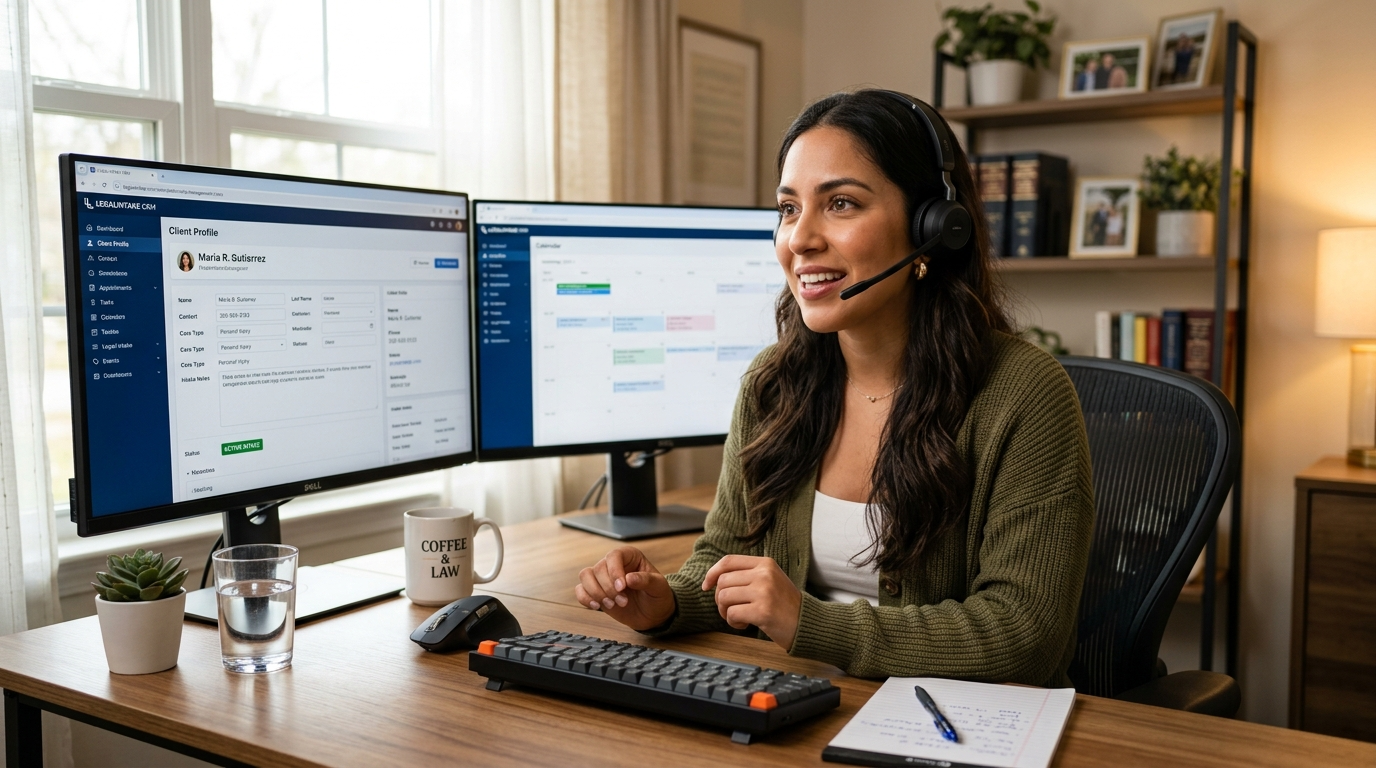
Nearshore virtual assistants have quietly become the most cost-effective way for law firms to handle legal intake without dropping a single lead. If your front desk goes to voicemail after 5 pm, or your paralegals are still manually entering prospect data into Clio or Lawmatics, you are losing paying clients every week — and the math on that loss is brutal.
This guide breaks down exactly how to outsource legal intake in 2026: what tasks to hand off, which staffing model outperforms the rest, and how to get a dedicated intake VA live inside seven days. Every cost figure, statistic, and comparison below is sourced and verifiable.
What Does It Mean to Outsource Legal Intake?
Legal intake is the process of capturing a potential client's information, qualifying them against your firm's case criteria, scheduling a consultation, and entering the data into your practice management software. It sounds simple, but it typically requires someone to be available by phone, email, and web chat simultaneously — during business hours and often beyond.
To outsource legal intake means to delegate those tasks to a remote staff member or service rather than an in-house receptionist or paralegal. Done right, it means a trained, English-fluent virtual assistant is answering your calls, running your intake scripts, and syncing every lead into your CRM — all while you are in court or focused on billable work.
That 42% figure, from the Clio Legal Trends Report (2023), is the single most important reason to outsource legal intake. Every missed call is a converted case for a competitor. A dedicated intake VA eliminates the gap.
How Much Revenue Is Missed Intake Costing Your Firm in 2026?
Most attorneys underestimate missed-call cost because they think in billable hours, not in lost lifetime client value. Run the numbers: if your average case is worth $4,000 and you miss 10 viable leads per month due to no live answer or slow follow-up, that is $40,000 in monthly revenue that evaporated before you ever knew it existed.
Response speed compounds the problem. Calling a web lead within five minutes makes you 100 times more likely to reach them than calling 30 minutes later, according to Harvard Business Review (2011). That window shrinks further every year as consumer expectations accelerate. An in-house receptionist juggling phones, the front desk, and filing cannot meet that bar. A dedicated intake VA whose sole job is answering and qualifying can.
According to the U.S. Bureau of Labor Statistics (2024), the median annual wage for a legal secretary or administrative assistant in the United States exceeds $56,000 — before benefits, payroll taxes, and office overhead. A full-time nearshore intake VA through Rose Talent Solutions costs $2,500/month flat, or $30,000/year, with recruiting, vetting, payroll, HR, and ongoing management included. The arithmetic is not close.

Nearshore vs. Offshore vs. Onshore: Which Model Wins for Legal Intake in 2026?
Not all remote intake options are equal. The staffing model you choose determines call quality, response time, and how well the VA integrates with your US-based team. Here is how the three main options compare across the metrics that matter most for legal intake.
| Factor | Onshore (US) Staff | Offshore VA (Philippines / India) | Nearshore VA (Latin America) |
|---|---|---|---|
| Typical Monthly Cost | $4,500–$7,000+ | $800–$1,500 | $2,500 flat |
| Time Zone Alignment | Perfect — same US hours | Poor — 10–14 hr gap; overnight batch responses | Excellent — works US business hours in real time |
| English Proficiency | Native | Variable — accent and comprehension issues common | Fluent — 8/10+ proficiency floor on Rose's screens |
| Intake Software Training | Varies; you train from scratch | Varies; often generic admin only | Role-specific AI copilot pre-loaded (Clio, Lawmatics, etc.) |
| Lead Response Speed | Real time (if staffed) | Delayed — next business day common | Real time during US hours |
| Turnover Risk | High in admin roles | High — global competition for talent | Low — stable with managed HR support |
| Contract Flexibility | Employment law constraints | Variable by agency | Month-to-month, no long-term contract |
If you are evaluating virtual support more broadly for your firm, the decision between a virtual legal secretary versus a paralegal is worth reading before you finalize your job description — the scope of intake work often determines which role is the right fit.
What Tasks Can You Outsource in Legal Intake?
A trained nearshore intake VA can own the entire intake pipeline from first contact to booked consultation. Firms that outsource only one piece — say, just answering calls — leave significant time savings on the table. The biggest ROI comes from handing off the full sequence.
- Live call answering — answering inbound calls in your firm's name, running your intake script, and qualifying callers against your case-type criteria
- Web form and chat lead follow-up — responding to new web submissions within minutes, not hours
- CRM data entry — logging all prospect information accurately into Clio, Lawmatics, Filevine, or your chosen platform
- Consultation scheduling — booking and confirming appointments directly on attorney calendars
- Conflict checks — running initial conflict screenings using your firm's system before the consult
- Intake packet collection — sending and following up on digital intake forms, ID documents, and retainer agreements
- Lead nurturing — sending follow-up emails or texts to prospects who did not immediately book
Many firms also pair their intake VA with a broader legal support role. If your needs extend to document preparation or transcription, a virtual assistant trained in legal transcription can handle both functions from one hire, keeping your costs flat while expanding coverage.
Outsourcing only inbound calls while leaving web and chat follow-up to in-house staff creates a split-attention problem — leads submitted at 2 pm on a Friday still sit unanswered Monday morning. Full-pipeline outsourcing closes that gap entirely.
How Rose Talent Solutions Staffs a Legal Intake VA in 2026
The most common objection attorneys raise is time: "I don't have time to find, train, and manage a VA." Rose handles every step of that process. Here is exactly how the placement works.
Discovery Call
Rose's team maps your intake workflow — call volume, software stack, case types, and hours of coverage needed — to build a precise candidate profile before sourcing begins.
Vetting and Matching
Candidates are screened for English proficiency (8/10+ floor), legal intake experience, and software familiarity. Rose presents a matched finalist — you do not sift through 40 resumes.
AI Copilot Onboarding
Every Rose team member ships with a role-specific AI copilot pre-trained on your intake software — Clio, Lawmatics, MyCase, or similar — so they are productive from day one, not week four.
Go Live
Your VA starts taking calls and entering leads within seven days of your kickoff. Rose manages payroll, HR, and ongoing performance — you manage the work output, nothing else.
Free Replacement If Needed
If the team member is not the right fit, Rose replaces them at no additional cost — no re-recruiting fee, no disruption to your intake pipeline.
The AI copilot advantage is what separates this model from a generic staffing placement. Intake VAs who are pre-trained on your exact software do not spend three weeks learning where the fields are — they are entering leads accurately and running conflict checks from the first day of calls.

How Nearshore Legal Intake VAs Handle After-Hours Coverage in 2026
One of the most common intake gaps is the 5 pm to 9 am window. Personal injury, criminal defense, and family law prospects do not schedule their crises around business hours. Extended-hours coverage is where a dedicated VA — set up with call forwarding and a clear escalation protocol — pays for itself fastest.
According to Pew Research Center (2021), over 85% of US adults now use a smartphone as their primary communication device, meaning prospective clients expect a live or near-live response at any hour. A VA working an extended East Coast shift (7 am–4 pm local Latin America time, covering 8 am–5 pm ET) delivers that coverage at a fraction of the cost of an answering service that merely takes a message.
For firms that also need a human voice answering the main line — not just a CRM operator — pairing intake VA coverage with a virtual front desk makes the most sense. The full picture of what law firm virtual receptionist services include is worth reviewing if your callers expect a live answer at the main number, not just a callback.
"Law firms that respond to online inquiries within an hour are seven times more likely to have a meaningful conversation with a key decision maker than those that wait even 60 minutes longer." — Jack Newton, CEO at Clio (Clio Legal Trends Report, 2023)
That seven-times multiplier applies directly to intake. A nearshore VA answering at 8:01 am beats an in-house receptionist who logs on at 9:00 am — every single day.
Is Outsourcing Legal Intake Right for Every Firm?
Outsourcing legal intake delivers the clearest ROI for firms with a steady inbound lead volume — typically 20 or more new inquiries per month — where the attorney or paralegal handling intake is visibly pulled away from billable work. Solo practitioners with very low call volume may not need a full-time dedicated VA immediately, though even smaller firms often find the conversion improvement justifies the cost.
Strong Fit For
- Personal injury, criminal defense, immigration, and family law firms (high inbound volume)
- Firms where attorneys or paralegals currently handle intake calls personally
- Practices with multiple intake channels — phone, web form, chat, and referral
- Firms that have lost leads due to slow follow-up or voicemail
- Growing practices that need intake to scale without adding headcount costs
Less Ideal For
- Boutique practices with fewer than 10 inbound inquiries per month
- Firms with highly specialized intake requiring licensed staff involvement from call one
- Practices where all intake is driven by referrals with zero cold inbound volume
If you are still assessing which type of virtual support your firm actually needs before committing to an intake-specific hire, a broader overview of how to hire a virtual legal assistant for a law firm covers the full range of roles — from intake and scheduling through research and document support — so you can scope the role correctly from day one.
According to SHRM's 2022 Employee Benefits Survey, the average cost to replace an employee is six to nine months of their salary. For a $56,000 legal admin, that is $28,000–$42,000 in replacement cost every time someone leaves. A managed nearshore engagement with a free replacement guarantee eliminates that exposure entirely.
Ready to see what full-pipeline intake outsourcing looks like for your specific firm? Start the conversation with Rose — placement takes seven days and there is no long-term contract required.