
Nearshore medical coding specialists are quietly replacing both in-house billing departments and offshore coding farms — and in 2026, the economics are impossible to argue with. When a practice or health system decides to outsource ICD-10 coding services, the core question is no longer whether to outsource, but where to source the talent. Latin America has emerged as the highest-value answer: same-timezone availability, 8/10+ English fluency, and an all-in price point that undercuts a single W-2 coder's salary by more than half.
ICD-10 (International Classification of Diseases, 10th Revision) is the standardized diagnostic coding system mandated by the Centers for Medicare & Medicaid Services for all HIPAA-covered entities in the United States. Every claim submitted to a payer — Medicare, Medicaid, or commercial insurance — must carry accurate ICD-10-CM diagnosis codes and ICD-10-PCS procedure codes. Errors translate directly into claim denials, delayed reimbursements, and in serious cases, compliance exposure. Getting coding right is not optional; it is the financial heartbeat of any medical practice or hospital system.
Claim denial rates remain stubbornly high across the industry. Coding inaccuracies account for roughly 30% of all initial claim denials, according to Change Healthcare's Denials Index (2024). That is not a rounding error — it is a direct hit to revenue cycle performance that nearshore coding specialists are specifically trained to prevent. If your practice is still relying on a single overworked in-house biller or an opaque offshore vendor with a 12-hour time gap, 2026 is the year to fix that.
How ICD-10 Coding Errors Drain Revenue in 2026
Every unresolved denial costs a practice an average of $25 to $118 to rework, according to MGMA's Revenue Cycle Benchmarking data (2024). Multiply that by hundreds of denials per month in a mid-size clinic and you have a six-figure annual drag that shows up nowhere on your P&L — until you audit it. The hidden cost is not just the rework labor. It is the 60-to-90-day cash flow gap between original submission and eventual payment on a denied-and-resubmitted claim.
ICD-10-CM alone contains over 72,000 diagnosis codes as of the FY2025 update, with annual additions released each October by the Centers for Medicare & Medicaid Services. Keeping a small in-house team current on annual code updates, payer-specific LCD (Local Coverage Determination) policies, and specialty-specific coding guidelines requires continuous education investment — typically $1,500 to $3,000 per coder per year in CEU costs alone. Outsourcing transfers that training burden entirely to your coding partner.

The math on in-house hiring is equally unfavorable. The Bureau of Labor Statistics (2024) puts the median annual wage for medical records and health information specialists at $47,180 — and that is before benefits, payroll taxes, PTO, and the recruiter fee to find one. A certified coding specialist (CCS or CPC credential) commands $55,000 to $70,000 in most US metro markets. At Rose Talent Solutions' flat rate of $2,500/month ($30,000/year), you are accessing a full-time, fully managed nearshore coder for roughly half the fully loaded cost of a domestic hire.
Nearshore vs. Offshore vs. In-House ICD-10 Coding: 2026 Comparison
Not all outsourcing is equal. The word "outsourcing" covers everything from a Philippines-based coding farm billing by the line to a Latin American specialist working your exact business hours on your EHR. The differences in outcome are substantial. When evaluating where to compare nearshore, offshore, and onshore staffing models, coding-specific variables like payer communication, provider query turnaround, and real-time denial appeal response deserve extra weight.
| Dimension | In-House (US) | Offshore (India / Philippines) | Nearshore (Latin America) |
|---|---|---|---|
| Annual fully loaded cost | $65,000–$85,000 | $12,000–$20,000 | $30,000 (flat) |
| Timezone overlap with US | Full | 0–3 hours | Full (US business hours) |
| English fluency | Native | Variable (3–7/10) | 8/10+ screened |
| Avg. denial response turnaround | Same day | 24–48 hours (overnight batch) | Same day |
| Annual code update training | Your cost ($1,500–$3,000/coder) | Vendor's cost (quality varies) | Included in management layer |
| HIPAA compliance oversight | Internal HR | Contractual (hard to audit) | Managed by Rose HR layer |
| Replacement if not a fit | Full rehire cost | Varies | Free replacement, no extra cost |
| Contract length | At-will employment | Often 12-month minimum | Month-to-month, 30-day notice |
The offshore cost advantage looks compelling on a spreadsheet until you factor in the 6-to-12-hour time gap. A payer denial that arrives at 10am Eastern cannot be appealed until the next business day if your coding team is in Manila or Bangalore. That delay compounds across hundreds of claims per month. For a deeper look at how the two models compare on communication latency alone, the onshore vs. offshore virtual assistant breakdown on the Rose blog quantifies the hidden cost in real terms.
What Tasks Can You Outsource to a Nearshore ICD-10 Coder in 2026?
A nearshore ICD-10 coding specialist is not a data entry clerk. The role spans the full revenue cycle from chart review through denial resolution. Understanding the scope prevents underutilization — one of the most common mistakes practices make after outsourcing for the first time.
Most practices that outsource ICD-10 coding only think about code assignment. The bigger ROI comes from having the same specialist also managing denial appeals, payer correspondence, and monthly coding audits — tasks that typically pile up unworked in in-house departments.
Core tasks a nearshore medical coding VA handles daily: ICD-10-CM and CPT code assignment from physician notes and operative reports; charge entry and claim submission through your practice management system (AdvancedMD, Kareo, Athenahealth, DrChrono); denial management and appeal letter drafting; payer-specific edit scrubbing; provider query drafting for documentation clarification; and monthly coding accuracy audits against AAPC or AHIMA coding guidelines. For practices that also need revenue cycle support beyond coding, Rose's bookkeeping and accounting virtual staff can handle accounts receivable reconciliation alongside your coding team.
"Accurate clinical documentation and precise ICD-10 code assignment are inseparable — when coders and clinicians communicate in real time, first-pass claim acceptance rates climb measurably." — Sue Bowman, Senior Director of Coding Policy and Compliance at AHIMA (2023)
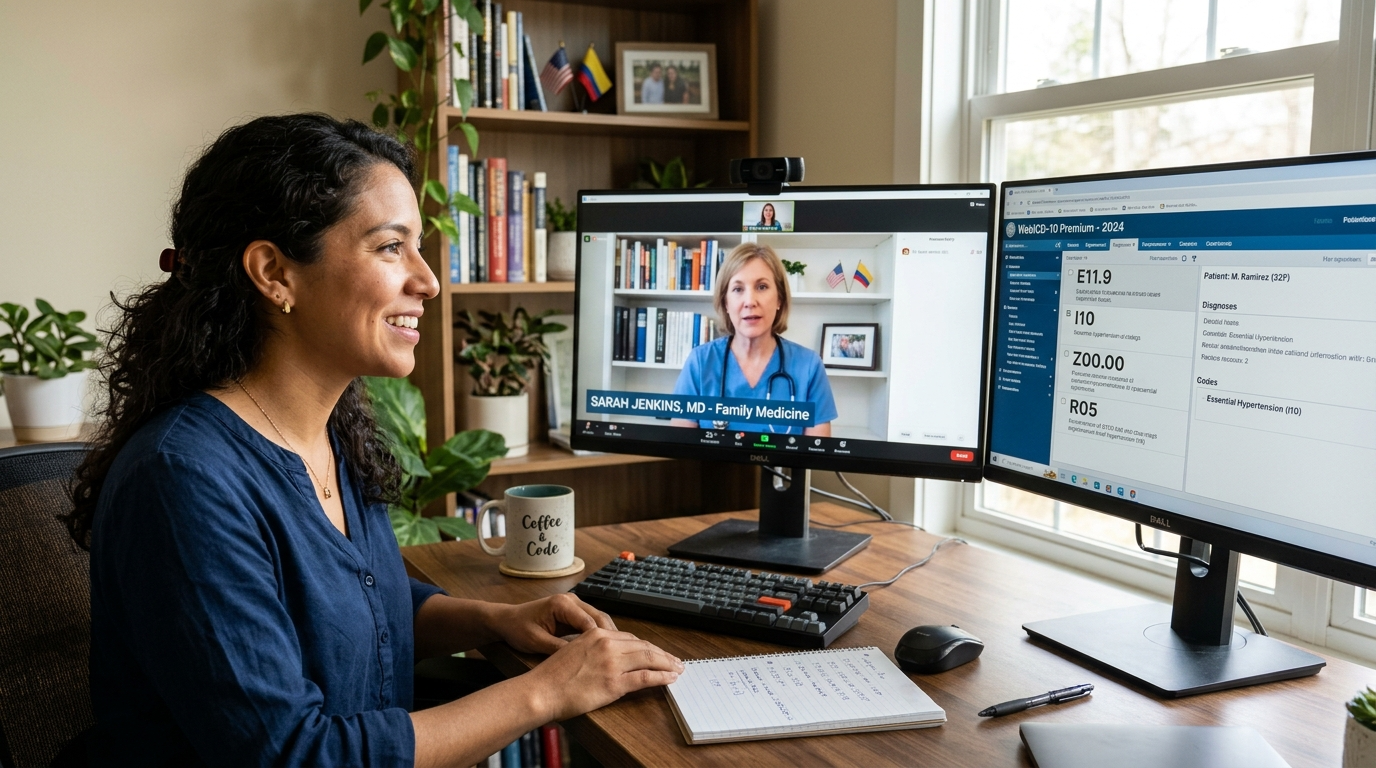
The AI advantage layer amplifies every one of these tasks. Every Rose team member ships with a role-specific AI copilot — trained on the specific software your practice uses. If your team runs Kareo, your coder's AI copilot is calibrated to Kareo's claim scrubbing logic. If you use Athenahealth, same principle applies. This is not generic ChatGPT access; it is a workflow-embedded tool that cuts code lookup time and flags documentation gaps before submission. Learn more about how the AI copilot advantage works for every role Rose places.
How the Rose Nearshore Coding Placement Process Works in 2026
Speed to placement matters in medical coding because denials compound daily. Rose's structured placement process gets a vetted, coding-qualified nearshore specialist in front of your EHR within roughly one week of kickoff — without the 60-to-90-day agency search cycle typical of domestic staffing firms. The Latin America staffing model Rose operates is built specifically to eliminate that lag.
Intake & Role Scoping
Rose's team maps your specialty, EHR platform, payer mix, and coding volume in a 30-minute intake call. This shapes the candidate profile before sourcing begins — no generic job posts.
Candidate Vetting & Coding Screen
Candidates clear Rose's English proficiency screen (8/10+ required), a live ICD-10 coding assessment, and a background check. You only meet finalists who pass all three gates.
Interview & Selection
You interview your top 1-2 candidates and make the call. Rose handles offer, onboarding paperwork, and payroll setup — zero HR lift on your side.
AI Copilot Activation
Your coder's role-specific AI copilot is configured to your EHR and payer list before day one. First-week ramp time drops significantly compared to a cold-start hire.
Ongoing Management
Rose handles HR, payroll, performance check-ins, and compliance oversight monthly. If the placement is not the right fit, Rose replaces the team member at no additional cost.
The all-in pricing model — $2,500/month, no long-term contract — means no surprise invoices for recruiting fees, no benefits administration, and no payroll tax calculations. Everything is covered. And because the engagement is month-to-month with 30 days written notice to exit, you are never locked into a vendor relationship that stops performing. For a full breakdown of what Latin America-based specialist talent costs compared to domestic alternatives, the Latin America virtual assistant cost guide breaks down the numbers by role and seniority level.
Is Outsourcing ICD-10 Coding Right for Your Practice in 2026?
Outsourcing works best when coding volume is consistent enough to keep a full-time specialist productively utilized — roughly 200+ claims per month is the common threshold. Below that, a part-time or shared-coder arrangement may be more appropriate. Above it, a dedicated nearshore coder consistently outperforms both in-house and offshore alternatives on cost-per-clean-claim.
Outsource ICD-10 Coding: Pros
- Eliminate $55,000–$85,000 in fully loaded annual salary costs
- Same-timezone response on denials and provider queries
- Annual code update training handled by your staffing partner
- Free replacement if the specialist is not the right fit
- AI copilot cuts code lookup and claim scrubbing time
- Month-to-month terms — exit with 30 days written notice
Outsource ICD-10 Coding: Cons
- Requires a solid onboarding brief and EHR access setup upfront
- Not ideal for practices under ~200 claims/month (part-time may fit better)
- HIPAA BAA and data security protocols must be established at kickoff
- Initial 1–2 week ramp period before full coding velocity is reached
Practices that have already outsourced administrative functions — scheduling, prior auth, patient communication — often find that adding a nearshore ICD-10 coding specialist through the same operational model is a natural next step. Rose's virtual staffing solutions page outlines the full range of roles available, from revenue cycle to executive support. The fundamental principle is identical: replace a high-overhead domestic hire with a fully managed, timezone-aligned nearshore specialist who costs a fraction of the in-house alternative — and get a free replacement guarantee if the fit is off.
If your denial rate is above 5%, your coding backlog is growing, or your in-house biller is stretched across coding and collections and patient billing simultaneously, that is the signal. The cost of inaction — compounding denials, slow reimbursement cycles, and an overloaded biller making avoidable errors — almost always exceeds the $2,500/month investment within the first 60 days. Start the conversation and Rose can scope the right coding specialist for your specialty and EHR within 24 hours.